Monthly Archives: June 2017
An Interview with Lucy Roslyn

Hello, so where ya from & where ya at, geographically speaking?
Hello! I was born and raised in Coventry but have lived and worked in London for the past *coughs into sleeve* years.
When did you first feel the pull of the dramatic arts?
I had hoped I would work in theatre and film when I was small – I have always felt passionate about them although it took me a while to get the courage to go on stage. I also thought it would be a good way to make friends, which it is. The dramatic arts are full of opportunity – they are worth looking after.
What for you makes a good piece of theatre?
I feel the best theatre starts a conversation. It will ask so many questions and answer only a few, and the solution is not always so straightforward. Something dark and character driven. I remember seeing Misterman at the National a few years back, the psychology of the character and Cillian Murphy’s commitment to the role – it was striking.

What can you tell us about the BoonDog Theatre company?
BoonDog came together as an umbrella for a series we are creating all set within the same Circus – it’s like the Marvel Universe but in 1930’s Dustbowl America. We are very much looking forward to bringing new collaborators into the fold as we make more work.
What do you like to do when you’re not being theatrical?
I am also a freelance illustrator on the side, so I enjoy being a hermit who stays in hunched over my desk. It’s a nice balance against theatre which is very sociable and collaborative. It takes a team to bring a project together.
You will be bringing Goody to Edinburgh this August, can you tell us about the play?
It is a darkly funny look into the relationship between one man and his ape – two characters unable to communicate on an equal level. Backstage at the circus we meet Goody, a performing chimpanzee, and her one companion: her trainer Frances. How does this relationship work? An ape is dangerous and volatile. Even with an animal you have known for years, things can flip in a moment.
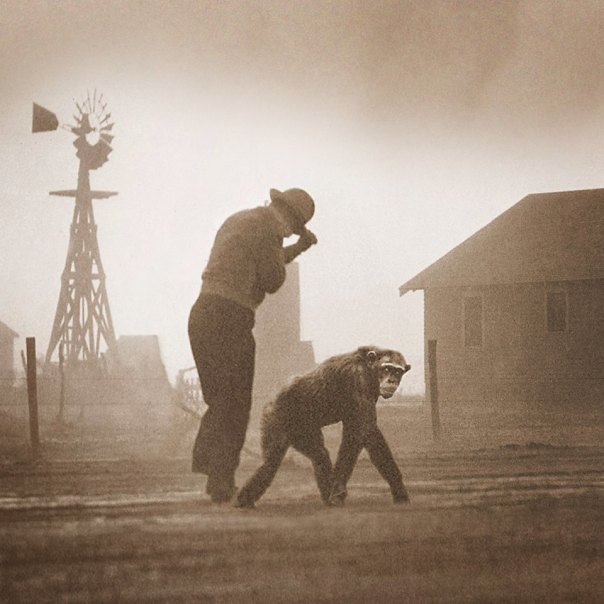
Creating Goody led you to visit ape sanctuaries and zoos to understand the relationship between humans and apes. How did this experience effect you personally?
Learning about performing apes and apes used for human demand has been as incredible as it has been heartbreaking. In many ways it has taught me more about people than apes, as it is people who dropped them into an incomprehensible situation from which there is no way out. I have been struck by the cruelty of some stories. Apes are impressive creatures, smart and emotional – seeing some of these apes in person is astonishing and we have had the good fortune to meet people who love and respect them, who make their lives fun and happier. However it is very bitter sweet to understand why they have ended up here at all, that they will never be wild and free again and, in some cases, that they have had to learn how to be a chimpanzee. Learn from scratch what you are, how to fit in, find yourself misunderstood – I feel many people could relate to these feelings.
How do audiences respond when it was performed?
The performance we have done so far won us the Greenwich Partnership Award, which we were blown away to receive. We were not sure what people would make of Goody, so this was a huge boost of confidence. We are looking forward to talking with our audiences in Edinburgh. We hope they will enjoy it.
In one sentence can you describe the experience of performing in Edinburgh in August
It’s like getting on a fairground Waltzer, but then staying on it for a month.
What will you be doing after the Fringe?
We’re looking forward to taking this show on to the next level and launching the next in the series. We had a reading of the next show, See The Elephant, at the start of the year, so we’ll be gearing up for that alongside Goody. One aim this year was to go all out, all guns blazing.
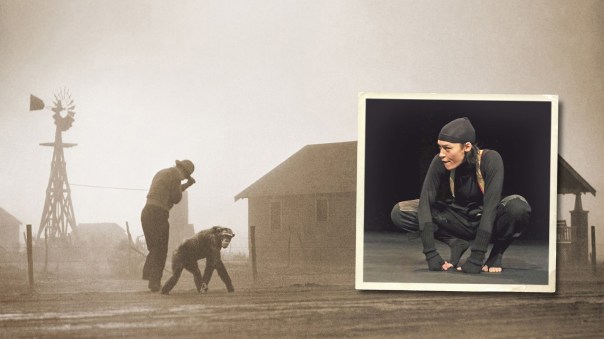
Goody will be playing at the Pleasance Courtyard (venue 33) : Aug 2-14, 16-28 (15.15)
An Interview with Laura Turner
This weekend, Chapterhouse are bringing their adaption of Pride & Prejudice to Thirlestane Castle, near Lauder.
————————
 Hello Laura, so where you from & where you at, geographically speaking?
I’m originally from Lincolnshire and the East Midlands and moved back several years ago to Lincoln, where Chapterhouse is also based.
When did you first realise you could write for the stage
I loved theatre and performing from a young age but it wasn’t until I went to university to study English Literature that I really got into writing. I realised I was particularly drawn to writing for the stage and specifically my career actually began with crafting adaptations of classic novels for the stage. With my literature background, it seemed a natural way for me to channel my more creative energies, whilst still working with the classic stories I loved so much.
You are a member of the Chapterhouse team, can you tell us about the company?
Chapterhouse was formed in 1999 and since then has gone on to become one of the UK’s largest touring open-air theatre companies. Every year we visit country houses, gardens and castles across the UK and Ireland with over 150 performances every summer. We also tour theatres during the winter and have recently begun taking productions to China as well. Chapterhouse specialises in presenting traditional but accessible productions of Shakespeare and classic novel adaptations.
When & how did you first join the team?
I first worked with Chapterhouse whilst at university, undertaking work experience with the company and from then on my involvement grew. I am now Associate Playwright with the company alongside my work for the stage and screen elsewhere and it’s lovely to still be so involved with the company that started my journey into writing and the theatre.
As a writer You have a penchant for adapting classic novels for the stage – what is it about this aspect of playwrighting that makes you tick?
It’s a huge privilege to work with classic novels – stories we have all grown up with and characters we know and love so well. For me, I learned how to write by studying the example set by authors such as Austen, Bronte and Dickens – how to shape a story, create unforgettable characters and keep your audience hooked. It’s really important to me when adapting a novel to both honour the author’s original intention, as well as bringing something of my own to the play itself, to make it a unique new adaptation that hopefully says something about who we are today as well as telling the story.
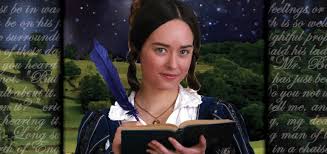
How did the process go with the ‘sacred’ text that is Austen’s P&P?
There’s definitely a lot of pressure working with stories that everyone knows and people feel so passionately about. I feel a responsibility to the author themselves, to reflect their work as they might have intended, and also to the audience who will be looking forward to seeing their favourite bits come to life! As with any adaptation, you inevitably have to leave things out but I hope that in doing so I still capture the overall feel and heart of the story. It’s never easy to make these decisions but the external factors of time constraints and the amount of actors I have to play with forces my hand, but I never make these cuts or changes without real consideration of whether it feels right. Hopefully it enhances the storytelling by making the production streamlined. I’d hate for an audience to get bored!
What does Laura Turner like to do when she’s not being all literary?
Being a writer, it’s definitely a calling rather than a vocation, so escaping the literary world isn’t really something I’m familiar with! It’s my passion so I spend a lot of my time with stories, whether that’s writing, brewing new ideas, reading, going to the cinema and watching plays. But I am trying to cultivate some time away from the laptop – especially with summer on the way I’ll be spending lots of time outdoors and walking…probably whilst thinking of some new play ideas!
Will you be coming to Scotland with Chapterhouse?
With several new writing projections on the horizon, I won’t be able to travel with the company as they go about the country, but I always look forward to visiting the teams and having the opportunity of seeing some of the beautiful venues and countryside we are so privileged to visit.
What does the rest of 2017 hold in store for Laura Turner?
My new play The Buried Moon recently premiered in London and transfers to the Petersfield Shakespeare Festival this July so I have that on the horizon as well as developing my first feature film script. I’ll be looking ahead to the rest of the year soon too when I’ll be developing a new strand of plays inspired by female characters from history and literature
Jane Eyre
Theatre Royal, Glasgow
5th May – 10th May
Script:  Stagecraft:
  Performance:
This tour of Jane Eyre for National theatre productions comes around with an entourage to match the titans. Starting in 2014 at the Bristol Old Vic it is a take on the story that delivers perhaps its most original meaning from Bronte that Sally Cookson, Director, was inspired by in the Orson Wells film noir version. The difference between the two is striking from the point of view of Jane Eyre. Wells distorted the idea behind the story making it instead a tinsel ride for Holly wood. Sally tells us that she thought of the tail as a life story rather than a love story which I think was correct from Bronte’s own point of view.
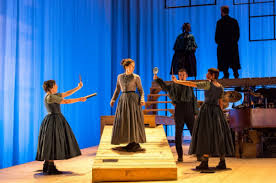
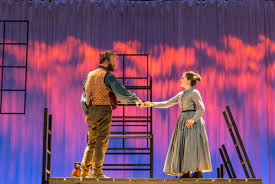
The epic quality to this play was set in plain sight in that we saw on the stage of perfect proportions a construction made of wooden levels and black metal ladders. This brought a curious feeling from the beginning. There were all sorts of theatrical nuances that played as pivotal a role as the music and costume, bringing with it a sense of theorising provoking thought. The production offered far more than collaboration instead looking to a group sense that played in the battle that shone with the light of Jane Eyre. The great leap from novel to play was made greater as the stage went beyond into the hearts of the characters.
Charlotte Bronte’s characters, who the group filtered for the stage, brought her droughts of admirable scenes particularly between Jane, played by Nadia Clifford, and Mr Rochester, played by Tim Delap, who converse about Jane and her position in his house. Jane’s story is the development of the play, which is as passionate as the book itself, her life as regarded by her and her early dealings with cruelty, and tragedy and each rung she would climb through with a strength that equality and justice deeply imbued in her as the story unfolded.
There was more than pushing of boundaries going on in this play, there was a creative urgency in almost every minute that Sally saw in the story and would passionately bring into her dedication to the cause of woman’s liberty at the end of the nineteenth century, here in a most harrowing way. Jane herself offers interludes of plain description during the evening, she talks with her colleagues in real time but is also followed by voices who debate what she is to do in her mind that was at times fragile, at times belligerent but always fair.
The representation part in this play was so intelligent, rich and fresh. In a complicated transaction from book to play on the surface planned immaculately and underneath allowed to grow as she did in pain, thought and above all action. There were bizarre moments that cut across the stage in the music and choreography, the stage brought to life in nineteenth century garb, they held a close scope to costumes so as to fit other ideas, as characters ran up and down the stage, shadows and silluetes as the stage darkened.
We could only imagine how Janes world would feel with her and the plays introductions she as orphaned as a baby, as an offering to her life. The ideas brought about in this play seem almost countless; visions arise as does life supported by the music band on stage and the various singing, melodies plucked from a pool of senses, and indifferent to Jane her own singing conscious that wore a red dress.
Visually this impact happened again and again, and deepened and was pulled back by loud appealing responses from Rochester who was perhaps Janes love that grew more passionate but again in her despair she was lost even after accomplishing so much.
Reviewer : Daniel Donnelly

An Interview with Stewart Schiller

Attune Theatre are just about to take Alan Bisset’s ‘The Ching Room’ on a mini-tour. The Mumble managed to catch a wee shpiel with Attune’s artistic director, Stewart Schiller
—————————————————
Hello Stewart, so where ya from & where ya at, geographically speak?
I’m from Glasgow and still stay here.
Which paths did you take that led to becoming a theatrical artistic director?
I worked with Fablevision in Govan for a year. I learned about a lot of training in Theatremaking and Fundraising. I saw lots of ‘issue-based’ theatre and became passionate about it. I think that passion is what fuelled my desire to become an Artistic Director and form Attune.
Can you tell us about winning the IdeasTap with the BBC Writersroom?
Yeah, that was a really great experience. After winning I got to meet the head of the Writersroom and take part in a workshop explaining the BBC Commissioning Priorities. I got to meet a lot of other writers, at a similar level, from all over the UK, which was a lot of fun. I think the main lesson I took home was how the Specific can be Universal. For instance, look at Doctor Who it has very distinct ‘Britishness’ but is a huge worldwide success.
What does Stewart Schiller like to do when he’s not being theatrical?
I love Wrestling (purely the fake kind), Rugby, and Gaming in particular.
You are just about to bring ‘The Ching Room’ to Glasgow – can you tell us about the play?
The Ching Room’s one of these plays that just jumps off the page. I try to read as many plays as I can and, after awhile, they can start to blend together. The Ching Room though is really arresting. It describes seedy acts with beautiful language, whilst also being really funny. That’s a rare combination that gets me really excited.

Alan Bisset
How do you find Alan Bisset’s writing?
It might sound daft, but I find there’s a sincerity to it. In that, you feel like each play is a window to where his head was at at that specific time. So if you look a series of them, you can see his evolution as a writer and the Scottish Independence Referendum effected this psyche.
Not every play from the PPP system makes it back to the stage, But this one did. Why do you think that is?
Because it’s been printed. Unless I’ve missed something (possible). I don’t think a lot of a Play, a Pie, and a Pint scripts are printed so that greatly reduces the chances of a Director or a Producer finding the play. The play obviously stands out on it’s writing alone, but I feel that pragmatic issue has a huge influence.
Finally, what does the rest of 2017 hold in store for Stewart Schiller?
Well, on the 23rd of June I’ll be directing another piece for this year’s Tron 100 Festival. Other than that, it depends how successful we are with the Pay What You Decide model we’re using for this show. If it proves to be successful, we can go straight into Production on another show. If it doesn’t, we will need rethink things.
THE CHING ROOM WILL BE PLAYING @
Dram 10th June 2:30 pm & 7:30pm
Broadcast 12th June 8:00pm
Canal Station 13th June 8:00pm
An Interview with Liz Richardson

Hello, so where ya from & where ya at, geographically speaking?
I’m originally from Cumbria but now live in the Peak District, having moved from London a couple of years ago.
When did you first feel the pull of the dramatic arts?
There wasn’t an awful lot of access to the Arts on offer when growing up on the West Coast of Cumbria, so when my school teacher told my parents “I think she could be more than a clown in just the classroom” I joined the local Am Dram group and before you know it, I’m 17 and driving down to London with my Dad to audition at East 15 Acting School…the rest is history.
What for you makes a good piece of theatre?
A lack of elitism. An all-inclusive piece of art which can also be inspirational – I love to feel moved when I leave the theatre, both in an emotional sense but also from having been educated or taken on an unexpected journey. But then I also love to laugh – providing moments of relief where the audience can laugh out loud is a gift.
What do you like to do when you’re not being theatrical?
I love to be walking and running in the fells, mostly with my young daughter and dog. As much as I loved my 15 years in London and all it has to offer, the pull of the mountains (like where I grew up) brought me to the change of lifestyle and also allowed me to start a family.
What can you tell us about your role running the ‘Mothers Who Make’ group at Home?
Mothers Who Make is a wonderful outlet for mums who have, at some point, taken time out to have children but still want to be around those who, like them, are creators in the Arts. The sessions (which originate from London-based Matilda Leyser of Improbable Theatre) bring together such a huge range of talented mothers who, not only continue to grow their skills and build their careers within the industry but also grow and nurture our next generation. I co-facilitate these sessions with another actress/theatre maker and each month we are blown away by the incredible women we meet, their stories and their work. It can be an incredibly lonely time being self-employed and raising children and you can often feel like you’ve lost the essence of ‘you’ on the way, but Mothers Who Make allows you to share these experiences and often encourages you to keep ‘making’ and keep talking in order to achieve all that you want to. Being a parent is the most important job in the world and this is something that I think is still not recognised enough for there needing to be more support, especially in the arts.
You will be bringing Gutted to Edinburgh this August, can you tell us about the play?
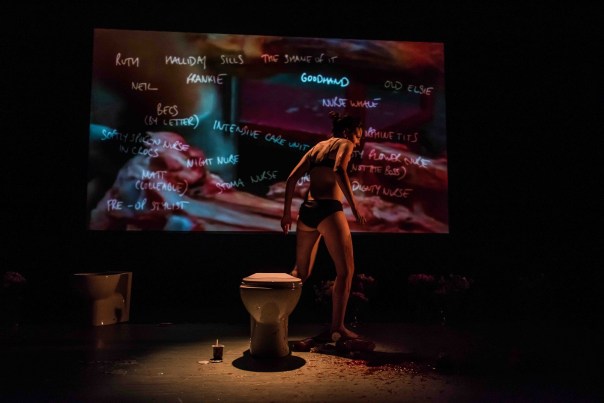
Gutted is a one-woman show about my life since being diagnosed in my early 20s with Ulcerative Colitis (an Inflammatory Bowel Disease). It takes the audience on a journey from partying hard, boyfriends and denial to building relationships with hospital patients and medical staff and my surrounding family. There are moments of tears and moments of laughter, free cake and beer and I leave my dignity at the door!
Do you find comedy develops well from adversity?
Yes absolutely- quite often this is when comedy is at its best. If you allow an audience to laugh at your expense, if you tell them how it was or is but allow them to see that it’s ok or can be, then you will have a much more receptive audience. Setting it up so you give permission to the audience to laugh rather than stifle the joy in the scenario, I think, warms them up to a lovely room temperature level…and then you can come crashing down on them with some terrible scene of tragedy where they’re left weeping.
In one sentence can you describe the experience of performing in Edinburgh in August.
It’s like eating chocolate digestives- at first you’re looking forward to it, then after the first indulging moments you start to regret starting but then you think a little more won’t harm you, and then you think what the hell am I doing and before you know it you’ve finished the lot and swear you won’t put yourself through that again, despite the highs. The next day you go to the shops and then do it all over again.
What will you be doing after the Fringe?
Eating. I can never eat before a show, I feel sick and anxious with nerves, and then quite often I forget to eat after a show as I’m usually propping up the bar. Sleeping too, although I’m hoping I can do a bit of that whilst I am off child minding duty. In-between eating and sleeping I’ll also be continuing work on my next piece of theatre making which I am starting to develop at the moment.

 Mumble Theatre