Monthly Archives: March 2019
Ring Road
Oran Mor, Glasgow
March 11-16 2019
Script:  Stagecraft:
  Performance:
Cast within the natural limitations of the parameters of a PPP production, some plays often feel void of a certain something – characterization, drama, story even – but not Ring Road. This is a remarkable strike of the match, creating a somewhat quite brilliant flame as it deals with modern issues, & handles them with a sort of fluffy grittiness. Ring Road, by the way, is definitely not one for the school holidays!
“At first I thought you were a snooty cow…” Mark
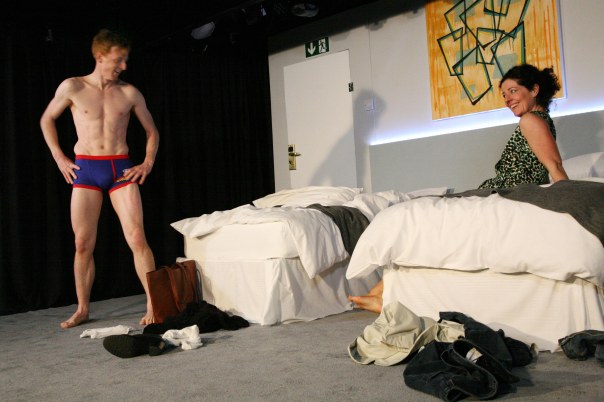
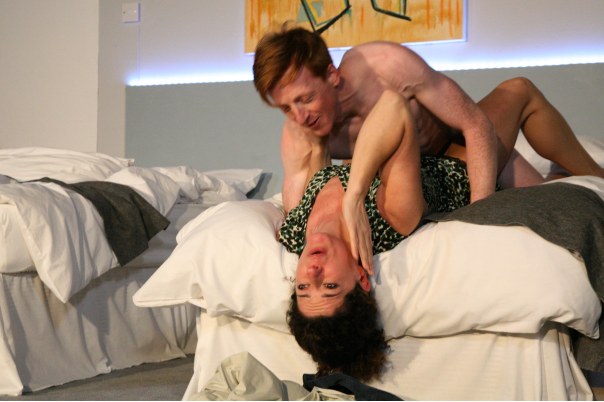
The set is a hotel room – twin beds -, a consummate stage in which unfolds the key bedsheet of the play, a dangerous slice of extra-marital nookie to be conducted between in-laws. Enter Anita Vettesse, starring as Lisa in her own pencrafted play. Her brother-in-law, Mark, is brought to life with bouncing aplomb by Gavin Wright; while her husband, Paul, turns up only in timely & plot-stirring phone-call soliloquies.

Despite their sordid swaggerings, Lisa & Mark are actually quite like-able characters, with their personal inter-plays & polish’d possessions of an excellent script really helping to raise this play up to be widely praised. There are several levels to the story, all of which are relevant. I especially enjoy’d Mark’s reminiscences of when there might or might not have been some kind of chemistry/sexual tension in the earlier encounters of their lives. That Lisa always shirks an answer shows the depth & talent of Anita Vitesse’s craft.
“We’re attracted to each other, & you’re the double of Paul.” Lisa
All in all a wonderful offering from the Oran Mor, which as I said at the start carries on its shoulders just exactly what PPP is all about – top notch drama from a small cast, mixed with classy & contemporary writing!
Damian Beeson Bullen

Orca
Weston Studio
The Old Vic, Bristol
March 4-16, 2019
Script:  Stagecraft:
  Performance:
This was the first time I’ve stepped into the Old Vic after living in London for the last twelve years, and I instantly noticed the massive change in the whole theatre, and how lovely the atmosphere had become since the major renovation. I had chosen to see Matt Grinter’s Orca – part of the exciting & innovative ‘New Plays in Rep’ season – about the unspoken, the mystical and the magical tales of a small, island fishing village.
The first scene focused on Maggie (Heidi Parsons) and her playful, curious and intelligent, yet rather gullible younger sister, Fan (Rosie Taylor-Kitson). While Fan longs to be chosen to go out in the fishing boats to scare off the Orcas, Maggie becomes the protective & stern older sister who is hellbent in protecting Fan at any costs, even if it means that the family is hated within the village.
Joshua (Finbar Hayman) plays Maggie and Fan’s father, a coward who is willing to avoid the truth, and is failing to protect his daughters in order to adhere to the prevailing ritualistic mysticism of their the village. This is a place with many secrets and an almost cult-like atmosphere; denial is the norm, laced with the eeriness of ignorance.
At this point I found the story paradoxically suggestive & conspicuous, offering a familiar correlation within today’s society and how our ‘taboo’ subjects are generally addressed. This became more prevalent when Gretchen (Holly Carpenter) made her first appearance, and consequently The Father (Sam Henderson), from whose arrivals the story began to unfold in more detail.
At the dramatic core of Orca is the highlighting of small-mindedness and a community’s willingness to bury the truth at all costs, against which push displays of courage and integrity amidst the darkness of people choosing to look the other way. In the end it was a good watch, the theme was compelling, but there was a certain something missing in terms of enticing dialogue.
Ava Banks

The Witch of Edmonton
Royal Conservatoire of Scotland
Glasgow
March 6th–9th, 2019
Script: Stagecraft:  Performance:
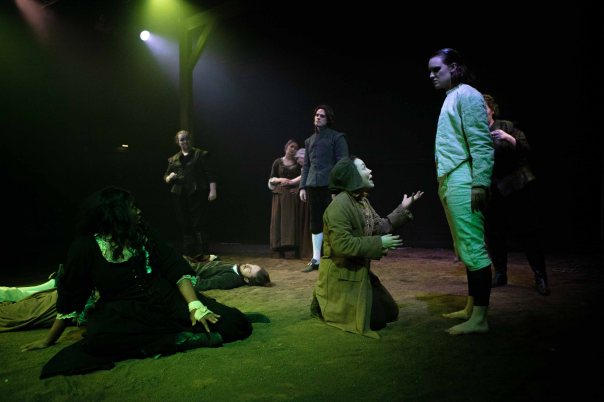
The atmosphere in the Royal Conservatoire’s Chandler Studio Theatre was dark and murky as we took our seats, set up in a double row on three sides of the stage. The set itself added further intrigue as out of the smoky darkness arose two great hinged planks of wood suspended from the ceiling. There was just time for one more cough in the audience before we settled down to enjoy, at close range, the performance of The Witch of Edmonton, written in 1621 by William Rowley, Thomas Dekker and John Ford and based, it seems, on real life events that had happened earlier that year. This adaptation is by Mark Silverschatz.
We witness a town meeting in which all sorts of townsfolk take part – a real crowd scene, with the characters, both rich and poor, comfortably attired and seeming to be happy with their lot in life. Cheerful uproar ensues as plans for the further development of Edmonton are approved. But this blissful state does not last for long: with each subsequent town meeting and encounter the subjects become more and more disruptive and disingenuous as it becomes clear that everyone is really only thinking of themselves and nothing else, even to the extent of cold blooded murder.
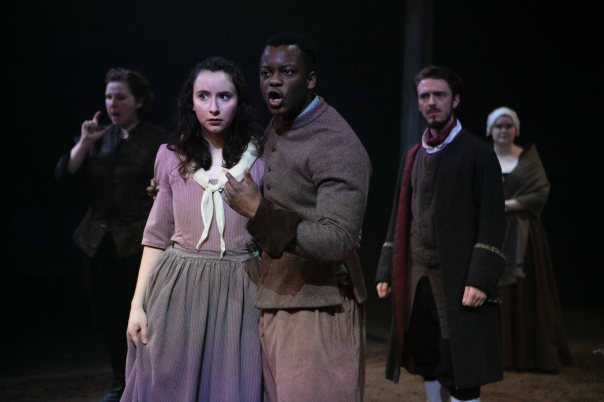
We start to see the true nature of the town when the haggard figure of a woman, Mother Sawyer, crawls on to the scene, totally distraught after being accused of witchcraft by the townsfolk. A terrible judgement that would reap terrible outcomes for all involved. Especially when a new character, a black dog called Tom leaps on stage, crouching behind the accused woman and offering her the revenge she so badly desires after her unfair treatment by the town. In order to reap this revenge, she makes a bargain with the devil, for that is the true identity of the dog.
Then follows a complicated intertwining web of subplots involving various characters; starting with love, bigamy and treachery, and progressing to murder and the way the devious mind can work to avoid being captured. At every turn, the devil dog Tom is always there, lurking and manipulating everything, unknown to the protagonists who cannot see very far beyond themselves; a source for great frustration and a genius opportunity for crowd participation.
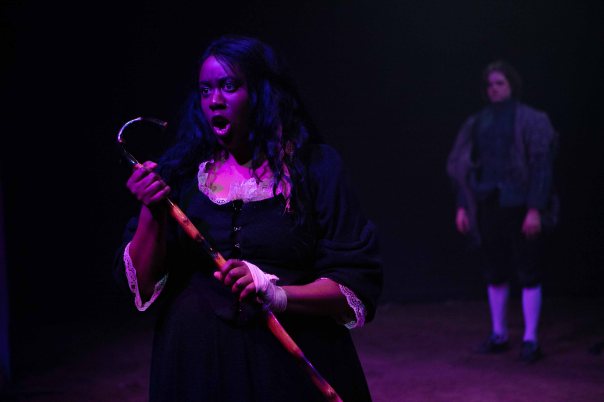
The play casts a spotlight upon human weakness, whether prompted by the devil or not. It does not shy away from grim and graphic confessions of sensuality, rape and cruelty. Love tries to hold out with a wistful dialogue between earth and heaven, but it is as if the world beneath them is shaking like a vision of hell. We are drawn into the tragedy, held together by fragments of speech between the many and the few. At one point, in mourning, they huddle cross legged in the freezing cold, only to be woken again by further grief.
The devil must be paid and leaves only tragedy in her wake; the ‘witch’ who seems no better off than when she started and a population that seems only good for servitude and slavery. The play grabs you by the proverbials and doesn’t let go until it is finished with you, a feeling enhanced by your proximity to the action. Strong stuff!
Daniel Donnolly

An Interview with Rickylee Russell-Waipuka

Riding the Te Rehia surf of 80’s nostalgia into Auckland comes the brilliant Rickylee Russell-Waipuka…
Hello Rickylee, so where are you from & where are you at, geographically speaking?
Kia Ora, ko Ngati Kahungunu me Ngati Raukawa ōku iwi. I’m from the Wairarapa, but I’ve lived in the North Shore of Auckland for the majority of my life.

When did you first realise you were, well, theatrical?
I don’t think I realised I was ‘theatrical’ until I was in College. But as early as 3 years old, I would get my family and friends to sit down and watch me perform in the lounge, at parks, at kohanga and school, anywhere I could make a stage! It mellowed out when I got a bit older because it wasn’t as accepted or cool to do that. However that’s when I 100% realised it was an actual thing, to be a performer and I was pretty good at it, naturally.
What for you makes a good piece of theatre?
Personally, pieces that make me laugh and/or something that I can connect to on a personal level with a powerful message. If a show doesn’t make feel something I won’t remember it.
You’ve been on TV quite a bit in recent years – Waka Warriors & This Is Piki spring to mind. How did you find the experiences?
Waka Warriors was honestly a life changing experience for me. I was completely pulled into a whole other world that I didn’t even know existed! The highly valuable knowledge and skills I learnt doing Waka Warriors I hold very close to my heart. I’m so honoured and feel privileged to have met everyone on that show, many I consider whānau (family) now. This Is Piki came about through the connections I had made during Waka Warriors. Again the cast from that show I consider my brothers and sisters now too. This Is Piki was so much fun making. The last minute changes to the scripts (in terms of languages) kept us on our toes, that’s for sure! We always made it work though, that’s how pro we all were hahaha! We were all very disappointed when we didn’t get a second season we would been back in a heart beat.
Can you tell us about I Am Paradise?
I Am Paradise follows a struggling, young, Māori mother of two with one on the way and her journey having to raise two kids on her own, pregnant, while her partner is incarcerated. This is the first main role that I have landed, it was also very different from the characters I have played in the past. Playing this character made me dig a lot deeper as this character had a lot more weight to her it and her story. I also wanted to represent her well for all of the women who do live the life of a Paradise.
You’ve just been on a massive tour of Canada – what were you doing there & how do you find the Canadians, & how did they find you?
I was on tour with a musician, performing at music festivals all over Canada. Some minor back up vocals but mainly dance, Māori movements fused with contemporary dance. As well as running haka workshops for women. I mainly spent time with First Nations people, LOVED them! I have a friend that I made over there visiting New Zealand right now actually.
You’ve got three famous people from history coming round for dinner. Who would they be & what would you cook; starters, mains & dessert?
Beyoncé, Jessica Alba & Bob Marley – Curry puffs, Stir fry(because I know I’m good at it) and banoffee pie because it’s a favourite.

You are part of a play that will be performed at this year’s Auckland Arts Festival. Can you tell us about it?
Astroman is set in the 80s, the play follows a Māori whanau (family) settling into a new town. The main character is a kid genius who gets bored easily because he’s not challenged enough and gets into trouble, everyone in his life only ever notices how naughty he is. He finally meets a Mr Miyagi type figure at local arcade who helps to set him on the right path.
How are you finding playing the role of Natalie?
Natalie’s relationship with her mother is actually very similar to my own relationship with my mum. Especially with being the eldest and taking responsibility of the younger siblings. So that has been very helpful when beginning to find Natalie. She also has a similar relationship with her brothers that the younger me had with my younger brother. So naturally I have drawn on a few of my own experiences to help shape Natalie. Natalie is quite hard work, she can be very light and playful but also holds a lot of depth to her at the same time.
You’ve got 20 seconds to sell the show to somebody in the street, what would you say?
For some of you, come and relive one of the best eras of all time and for others come check out what your parents/grandparents got up to in…. the 80s! Break dancing, bopping, Donkey Kong, Pac Man, Defender, awesome music and lots of LOLs, what more could you want! Come be a part of it.
What will you be doing for the rest of 2019?
Doing what I can to make this world a nicer place to be alive in and whatever else that makes me happy.
Astroman

Q Theatre
March 16-April 6
www.atc.co.nz
Hamlet
West Yorkshire Playhouse, Leeds
Mar 5-30, 2019
Script: Stagecraft: Performance:
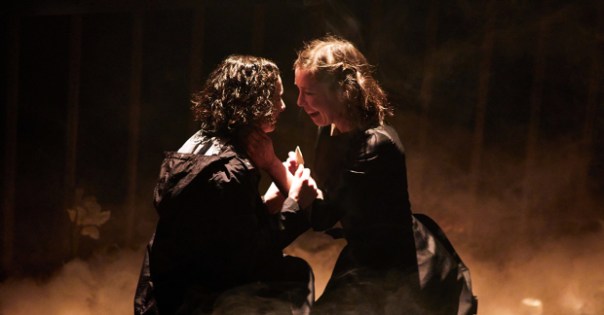
“Frailty, thy name is woman,” says Hamlet to his mother, Gertrude, in an early scene in Shakespeare’s most iconic work. The misogyny is clear, one facet of Hamlet’s borderline oedipal relationship with his mother and also evident in his treatment of Ophelia. In director Amy Leach’s interpretation, however, Hamlet is a woman. In this production, Leach manages to shine a completely new light not only upon this particular line of dialogue, rearranging its gender politics into new shapes, teasing out themes of sexuality, but most importantly, she thoroughly reinvigorates this play in a way that arguably improves the narrative and makes it fresh and relevant today. Now, it’s not entirely unheard of for Hamlet to be played by a woman, but for the character to re-gendered as a Princess of Denmark is where this production boldly strays away from convention. And the convention shredding doesn’t stop there.
It starts with a wordless prologue that takes place before Act 1, Scene 1. Tessa Parr’s Hamlet is engaging in a playful sword fight with a similarly re-gendered Horatio. Parr is energetic and flirtatious, licking her lips at her opponent – we’re in entirely new territory here and this is a suitably audacious statement of intent. We are then taken silently through King Hamlet’s funeral and the subsequent coronation of Claudius and his marriage to Gertrude. Along the way, Hamlet manages to engage in passionate embrace with Ophelia. Never mind that we’re watching a female Hamlet, this Hamlet is unapologetically gay. This is in no way merely shoe horned into the narrative to serve an agenda, this Hamlet feels as though this is the way the play should have been all along. What an opening sequence – it effortlessly sets the tone and themes to be developed upon later, all without the need to utter a single word. In a way, it’s almost a disappointment when the cast set upon the main text of the play and begin to speak. Almost.
At this point, it is worth stopping for a moment to admire the production design on display. The stage is a two tier affair, minimal but with enough detail to perfectly encapsulate Elsinore Castle. The lower tier is bedecked with wreaths and candles to represent a graveyard and provide a hint of the tragedies to come. On the top tier, stark metal poles mounted with floodlights provide a harsh modern light, occasionally sinking into darkness to be replaced by strips of neon light that are at times abstract and at other become crucifixes. The cast use the stage to its full potential, with energetic militaristic displays and tightly choreographed sword fights. They are all dressed in modern costume, from tracksuits, to army camouflage, to pyjamas… At one point, Ophelia sports a set of headphones as she listens to music in her bedroom. Smoke billows out from the stage at key moments to soften the stark edges of the set, to transform it from its modern landscape and plunge it into a more timeless and ghostly atmosphere. Full marks to Hayley Grindle (set design) and Joshua Carr (lighting), the work on display elevates the production to a high level.
Further adding to the atmosphere is Alexandra Faye Braithwaite’s hauntological soundtrack – filled with eerie drones, crackles of static, flashes of synthesiser melodies and glitchy echoes of gunfire. The soundtrack starts as the audience begins to take their seats and never lets up, a wonderful mix of old and new that is in perfect step with this iteration of Hamlet.
In all honesty, the quality of the acting isn’t entirely commensurate with the thematic ambition and production design, but there is still a great deal to celebrate. At the top of the list is Susan Twist’s standout performance as Lady Polonius – she delivers a light and comedic take on the character, an overbearing matriarchal figure, who drips with disdain at her daughter Ophelia’s dalliances with a woman (the horror!) and a seemingly unhinged one at that. I’ve never seen this character so vital. Ophelia’s exchanges with her mother bear all the hallmarks of a difficult coming out to an even more difficult parent and the scene bursts with energy as it absorbs new meaning.
Robert Pickavance’s performance as the gravedigger delivers another highpoint, bringing much needed comic relief as the tragedies begin to hit thick and fast. There’s a lightness of touch at work in these comic performances – the strong emphasis on humour prevents the otherwise heavy plot from becoming unbearable. It’s also worth noting that the production leans away from a reliance on the classic soliloquies, which are often delivered in muted tones. Instead, the real focus is placed on the more throwaway conversational dialogue, which is a delight to listen to as it revels in bringing to the fore the northern accents and phrasings of the cast and allows the smaller – but equally important – character moments to shine.
Tessa Parr’s Hamlet is a very fragmented affair, and this is potentially a deliberate decision. She switches from maudlin contemplation to a manic confidence and then into a very theatrical despair. At moments this performance can come across as uneven. However, at its high points, this is a stunning, energetic and very natural performance, one that sells every single decision and narrative alteration made throughout.
The plot itself is stripped back in several ways – Rosencrantz appears on his own without his friend Guildenstern, the character of Fortinbras is merely referred to as story context but is never seen, and the play that Hamlet commissions to prove his uncle’s guilt happens entirely in the imaginations of the main characters as they sit in a row and stare out at the audiences. These cuts and abbreviations provide a refreshing economy and efficiency to the plot, whilst the playful gender switching adds an additional depth.
There was nothing but a palpable sense of warmth in the auditorium for these reimagined characters. This is a version of Hamlet that both managed to pass the Bechdel test for possibly the first time in its performance history, and in its twisting of the line, “Frailty, thy name is woman,” provides a real dramatic irony as Hamlet is no longer chastising womanhood for their perceived flaws, but is instead unwittingly chastising herself for her own tragic flaws. It’s hard to imagine that this version isn’t the one intended originally by Shakespeare, all the parts fits so perfectly together.
Steve Bromley
Essay: The Dramatic Iliad of Thales

An essay showing the theatrical origins of Homer’s Iliad, through the pen of Thales, under the direction of Lycurgus of Sparta…
I am currently sat at a table amidst the sunswingingly sensuous delights of Star Beach on the northern shores of Crete. My family & I arrived late last night, hiring a car & eventually tracking down our residence for the next three nights, Petra Village, a mini-resort with pool, bar & a trillion crickets piping a cacophony. It is apt to be here on the Megalonisi, the ‘big island’ of the Greeks, to provide an account of the mesmerizing energy of Homer’s mind-music, that poetical weaver of disparate strands of ancient subject matter into the world’s two most earliest & most majestic epics. That an individual author composed these poems, however, is simply not the case. This ‘Homeric Question’ has tested academic minds for many an age, with Frederick Nietzsche declaring ‘the primary form of this widespread and honeycombed mountain known as the Homeric question can be most clearly observed by looking down at it from a far-off height.’ The ‘far-off’ height mentioned by Neitzsche is the tall mountain upon which the chispologist builds a weather-station & shouts into the gusting breezes that Homer was a quasi-mythological deity, to whom only the highest examples of streaming elysium would be associated – less an individual genius & more the poetic soul of an entire people.
But for now, & for ease of dictate, we shall call Homer by his antique identity, as the singular author of the Iliad & Odyssey. His subject was the Trojan War & its aftermath, an event of deep history whose war-drums still beat resoundingly today. The Iliad centers on a small series of events that took place toward the end of the ten-year war, while the Odyssey sings of the return from Troy of the Grecian hero Odysseus. The poems are, in a word, magnificent, full of comprehension & understanding for the ways of men, while possessing some of the greatest phraseology ever to be uttered by a human tongue. The most astonishing thing about the epics is their sheer antiquity, through which mists of deep time the creation of the poems, & indeed their creator, have been readily obscured.
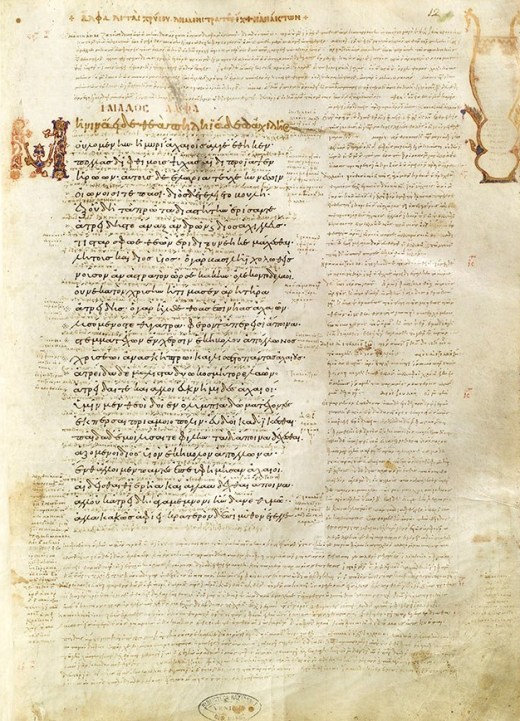
Folio 12r of Venetus A.
It was as early as the Classical period that the first doubts appertaining to the origins of the epics were raised. The oldest complete copy of the Iliad – the 10th century BC manuscript – has marginal notes, first published by De Villoison in 1788, which preserve substantial remnants of ancient scholarship on the poems from the intense erudition of Didymus, Aristonicis, Herodian, Nicanor & Antoninian. A century later, a similar note-smitten codex was created which ended up in the library at of the Townleys of Townley Hall, in my hometown of Burnley. Of these scholia, we encounter the thoughts of two obscure figures known as Xenon & Hellanicus, two antique scholars who first speculated that the Iliad & Odyssey had been composed by separate authors. This actually makes sound sense, for where the Iliad contains four times as many similes as the Odyssey, the language of the Odyssey is less archaic than that of the Iliad, to which surmise we may add that words for many common items are different in each poem. Aristotle further highlights the differences between the epics when he muses, ‘the composition of the Iliad is simple & full of pathos, that of the Odyssey complex, as there are recognitions throughout & full of character.’
So far so different, & as the Aegean sea blows a refreshingly wild wind into my beachside boudoir, we may acknowledge that long before the days of word-files & photocopying, the preservation of Homer’s poetry, spread over many centuries, suggests a great number of scribes have handled the text. Along the way, each would add something of their own making, maybe respelling a word, or perhaps re-writing whole passages in order to please a changing audience. As the poems evolved, two vast chains of transcreation would slowly fossilize themselves into the epics we whimsically attribute to a single Homer. One cannot understand why this happened, for the dating of the ‘original’ Homer was offered quite differently by a great many ancient scholars. The early Christian churchman, Tatian, in his Address to the Greeks, identifies this scattered strata of Homeric composition;
Now the poetry of Homer, his parentage, and the time in which he flourished have been investigated by the most ancient writers,— Of these, Crates says that he flourished before the return of the Heraclidæ, and within 80 years after the Trojan war; Eratosthenes says that it was after the 100th year from the taking of Ilium; Aristarchus, that it was about the time of the Ionian migration, which was 140 years after that event; but, according to Philochorus, after the Ionian migration, in the archonship of Archippus at Athens, 180 years after the Trojan war; Apollodorus says it was 100 years after the Ionian migration, which would be 240 years after the Trojan war. Some say that he lived 90 years before the Olympiads, which would be 317 years after the taking of Troy. Others carry it down to a later date, and say that Homer was a contemporary of Archilochus; but Archilochus flourished about the 23d Olympiad, in the time of Gyges the Lydian, 500 years after Troy.
It is through these ‘Homers’ that the story of the Trojan War & its aftermath would pass, until the Iliad as we know it began to take shape in the 9th century BC – as I believe – under the auspices of the Spartan King, Lycurgus. Not a poet himself, the task was given to a certain verse-maker called Thales, whom he met on Crete, an island which I am yet to explore but have made my first landing as if I was one of the German gliders crash-landing in advance of the German Fallschirmjäger in 1941. It is through the vita of Lycurgus, as given by Plutarch, that we gain a heady hint of just how powerful a poet-thinker was Thales. We join the vita with Lycurgus on some kind of state visit to Crete;
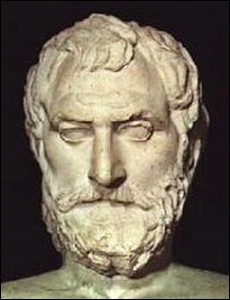
Thales
One of the men regarded there as wise statesmen was Thales, whom Lycurgus persuaded, out of favour and friendship, to go on a mission to Sparta. Now Thales passed as a lyric poet, and screened himself behind this art, but in reality he did the work of one of the mightiest lawgivers. For his odes were so many exhortations to obedience and harmony, and their measured rhythms were permeated with ordered tranquillity, so that those who listened to them were insensibly softened in their dispositions, insomuch that they renounced the mutual hatreds which were so rife at that time, and dwelt together in a common pursuit of what was high and noble.
This description of Thales tells us he was the perfect poet, a teacher who used the soft & easy words of the lyric, but resonant with meaning in order to teach the people of Crete just how to be, how to live a good life. I have only been here a few hours, but so far all the Cretans we have met have been decent & open; from the young couple on a moped who led us to the beach road in the dark last night, to our cool & friendly waiter here at Star Beach, the appropriately named ‘Adonis.’ ‘Don’t worry be happy’ is the mantra & if these easy vibes emanated from the ancient wisdom of Thales, then to be in his actual company would have been a tremendous sensation for Lycurgas, & it is no wonder, I suppose, that he was invited to join the royal Spartan party. Agreeing to terms, perhaps, Thales left his gorgeous rock at the edge of Europa & joined Lycurgas on a visit Asia Minor, where Plutarch tells us the Spartan king;
Made his first acquaintance with the poems of Homer, which were preserved among the posterity of Creophylus; and when he saw that the political and disciplinary lessons contained in them were worthy of no less serious attention than the incentives to pleasure and license which they supplied, he eagerly copied and compiled them in order to take them home with him. For these epics already had a certain faint reputation among the Greeks, and a few were in possession of certain portions of them, as the poems were carried here and there by chance; but Lycurgus was the very first to make them really known.

Lycurgas
At this point in time we have a certain Spartan king in possession of the two foundation stones of what would become the Iliad, these being those fragments of the early Homeric materials, & a poet who could do something with them, to turn them into something cohesive & infinitely beautiful. Such a moment provided the perfect conditions for what can only be called a regurgitation of Homer, a moment remembered by Demeterius of Magnesia, who placed the author of the Iliad in the same ‘very ancient times’ of Lycurgus. With all the pieces in position, all that was need was a catalyst to spark off the creative furnace that would produce the Iliad, & it came in the form of the first Olympic Truce. We begin with Plutarch, who writes of Lycurgas; ‘Some say that he flourished at the same time with Iphitus, and in concert with him established the Olympic truce. Among these is Aristotle the philosopher, and he alleges as proof the discus at Olympia on which an inscription preserves the name of Lycurgus.’ The truce forged by Lycurgas, Iphitus of Elis & Cleosthenes of Pisa was designed to bring peace to the Peloponnese; all three sides were bogged down in endless rounds of bloodshed, and it was decided that they would try to soothe their differences by staging a peaceful games at Olympia. A tribute to the unity of the Greek nation was needed, & a tribute to the pan-Grecian unity as it fought the Trojan War was a perfect theme, & subject worthy of Thales’ pensmanship. The following passage by the 5th Century BC Athenian historian, Thucydides, backs up the sentiment;
The weakness of the olden times is further proved to me chiefly by this circumstance, that before the Trojan war, Hellas, as it appears, engaged in no enterprise in common.
The squabbling Greeks of the Olympic Truce would need to be reminded of a time when they stood shoulder-to-shoulder in solidarity. If anything could convince them to settle their differences, the Homeric poems of Troy recreated by a noble-minded Thales would definitely do the job. That Thales handled the Iliad is unconsciously supported by Pausanius, who describes the Greece of Lycurgus’ time as being grievously worn by internal strife and plague, while the Iliad actually begins with a plague. Indeed, Pausanius tells us that Thales, ‘stayed the plague at Sparta,’ during which time, I conject, he was likely to have been composing the Iliad. The dates also fit, for where Herodotus tells us, ‘Hesiod and Homer I suppose were four hundred years before my time and not more,’ i.e. 850 BC, the Olympics of Lycurgus can be approximately dated to the same period. The Greeks counted their Olympiads from 776 BC, but the Olympic Games of Lycurgas were said to be much earlier. Sources vary as to when these actually took place; both Polybius (quoting Aristodemus of Elis) & Eratosthenes tell us that the 776BC victors were recorded 27 Olympiads from that of Iphitops & Lycurgas, whereas Callimachus differs by saying 13 Olympiads had passed. If we average that out & say 20 Olympiads, a timespan of 80 years, we gain a date of 856 BC for the Lycurgean Olympics.

Delving further into the ordinance of what I shall now call the Thalian Iliad, it’s form appears to have been based upon the ritualistic & quite theatrical mystery plays of Greece & Egypt, played out over several days like the Ring Cycle of Wagner. Plutarch even places Lycurgas in Egypt at one point, where he would have encountered an Egyptian Drama full of soliloquies by narrator-style priests, actor dialogue & dramaturgical expressions of stage-craft still used in our modern theatre. Egyptian drama of the Lycurgan period was sophisticated; consisting of a prologue, three acts subdivided into scenes & a concluding epilogue. Two have come down to us whole, the ‘Ramesseum Coronation’ & the ‘Myth of Horus at Edfu.’ In the latter, both mortals & immortals play out the action, a motif also present in the Iliad.
Over the centuries, academics have subconsciously suspected that the Iliad was in its origins a dramatic performance. The Roman writer Quintilian praises the second book of the Iliad in particular for the greatness of its speeches, while the 17th century English poet, Alexander Pope, stated, ‘for a farther preservation of this air of simplicity, a particular care should be taken to express with all plainness those moral sentences & proverbial speeches which are so numerous in this poet. They have something venerable, & as I may so oracular, in that unadorned gravity & shortness with which they are delivered.’ In recent years we have Jenny Strauss Clay’s description of the Iliad’s ‘extraordinarily high percentage of direct speech – much more than any other epic;’ Bernard Fenik’s, ‘direct discourse comprises 67 percent of the Iliad;’ & Laura M Slatkin’s, ‘extraordinary refinement & complexity of oral performance,’ from which erudite opinions we should acknowledge that the Iliad was in fact played out through a series of scenes in which actors & actresses were given lengthy speeches. Interspersed are the battle scenes, which may have been played out in the manner of the Egyptian dramas, reminiscent of gladiators in a Roman arena – beautifully choreographised physical theatre but without the actual bloodshed.
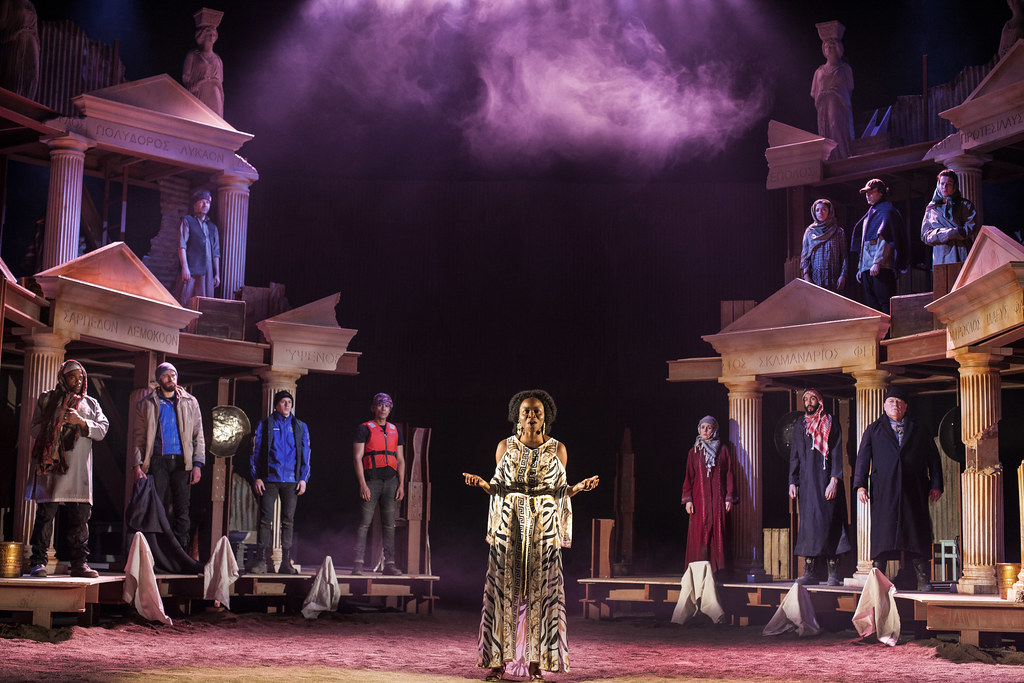
Roll on a few millennia & the Iliad material is coming full circle, so to speak. Three years ago, for example, I reviewed a stage version of the material for Mumble Theatre. Unfortunately, the original theatrical purpose of the Iliad was slowly eroded by time, when the mega-money spectacular of Lycurgas would gradually give way to performances by individual singers called Rhapsodes, such as the the Homeridae, the ‘Children of Homer.’ Perhaps it was their memories which preserved the Thalian Iliad, which were later transcribed by the librarians of Alexandria, or perhaps one of the scripts survived enough centuries to be copied down on fresh papyrus, but either way all evidence points to a mid-ninth century BC origin for the Iliad, when one poet & one benefactor shine out through the darkness of their times – Lycurgus the Spartan King, & Thales, the Cretan poet. Meanwhile, some chilli olives & soft Cretan red wine await me at the Petra Village.
Damian Beeson Bullen
Coming Clean: Barbara

Oran Mor, Glasgow
Mar 4-9, 2019
Script: Stagecraft: Performance:
‘Coming clean; Barbara’ is a solo piece written by the award winning writer Alma Cullen, this being the fifth in a series written for Oran Mor. Wendy Seager as Barbara takes us on an intense emotional journey, conjuring up a whole series of conversations as her story unfolds. The set, neat and professional with a desk and a hat stand combines with her smart blue jacket to give us an idea of her smart lifestyle and acquaintances. In sharp contrast to the emotional turmoil that is about to be revealed.

The show opens with Barbara opening her heart to the audience, her voice full of emotion and despair. The momentum never flags as she recalls one dialogue after another, piecing together the catastrophe that has happened in her life. The lights would dim as she comes to the end of one section, only to immediately light up the solitary figure again as she recalls something else. Even the moments of silence afford no respite, just a moment for reflection before we are yet again reeled in. When she converses with her husband Andy, a senior policeman, and her son Gavin, she reflects on love, kisses, fondness, despair, reality. Things were good before they went very awry. She becomes sadder and sadder, focusing all her energy on events that seem to have become too much for anyone to bear. Events that, as a wife and mother she can only watch from the side-lines as life becomes surrounded by the law and the consequences of breaking it.

Her lawyer, Mr Maxwell is almost her salvation, at times breaking through her grief, but ultimately failing because it seems limitless. The priest Eric is no comfort and drives her to go over and over the case by herself. We follow her conversation with Andy as she manages to talk to him in a clear voice and takes us in the imagination to the courthouse where he is convicted of a sexual offense and sentenced to 3 years in jail and a permanent sex offender licence. She falls apart; her voice growing high and urgent as she becomes more and more upset and breaks down before us, weeping on her knees. Barbara tries to hug Andy’s memory close, to remember the scent of him. But in the end her anger and despair only grow as she comes out with all the revelations of what happened and acknowledges the personal sacrifice she has been asked to make. Coming clean indeed. This is a wonderfully sweet, concerning, in-depth piece of writing and acting. Yet another reason to turn up at the Oran Mor on a Monday and sign on for an hour on the roller coaster of entertainment.
Daniel Donnolly
 Mumble Theatre