Author Archives: yodamo
Interview: Nathalie Morris

Auckland Theatre Company are in the process of unveiling a fantastic young actress
Hello Nathalie, first things first, where are you from & where are you at, geographically speaking?
Hello! I’m from Canberra, Australia, and I’ve just moved to Auckland this year.
When did you first realise you were, well, theatrical?
I’ve wanted to perform since I was 11 and I saw a stage production of High School Musical. The ensemble looked like they were having so much fun as a team, and I wanted to have that too. When I started taking theatre classes and tackling scripts, I got way more interested in characters and the forces that drive them to act in the ways they do. I love putting myself in other people’s circumstances and using them to express
myself in ways that I wouldn’t get to in my own life.
Last year you graduated from the Toi Whakaari: New Zealand Drama School, how was your time there?
It was so cool. Toi Whakaari is a place where you are constantly experimenting. There’s no end goal to the training. You are just continuously exposed to new techniques and styles of performance and given lots of opportunities to test them out. You are pushed to take more risk, have more pleasure, and go further into the unknown, but you are never pushed to be a certain kind of actor. The school celebrates creativity and has a great subversive sense of humour. It’s also incredibly challenging to put your struggle in front of other students and teachers for three years, but I’m grateful that those challenges took place within those walls.
Can you tell us about,’ I Never Thought I’d Have to Explain it All?’ & its tenure in Wellington?
I Never Thought I’d Have to Explain it All is a show I made about a high profile disappearance case in Australia – one that I was briefly involved with as a kid. As I researched deeper into the case, I got really affected by how it was reported on and spread through the entertainment industry. So the show buries the story of the case in many of these entertainment mediums, like talk show, film, documentary, stand-up comedy, podcast etc. As we give the audience more truths about the case, we also involve them more in the thrill of these forms. It’s very funny and wicked and compelling. I started writing the show with Andrew Eddey in our final year of drama school, and we presented the first draft at Toi Whakaari’s annual Festival of Work in Development. It started out as a solo show, but it grew to include more performers, designers, and managers by the time we presented a second draft at The NZ Fringe Festival in March this year. We learned an incredible amount about the work throughout this second season, so hopefully we will mount another development of the show in Auckland or Australia in the next couple of years.
What’s the last thing you do before you step out on stage / the curtain goes up?
Sometimes I do a ‘dick-ass dance’, which is a very important technique I learned at drama school. Basically you just dance your heart out, off the beat and leading from your hips. Other times I just stand toward the audience and feel love and gratitude right before going on. If I’m about to enter with someone else, I’ll try to make a joke with them or whisper something titillating in their ear.
What does your perfect Sunday afternoon look like?
Reading a great play out loud with friends, or watching a great film with a big cup of coffee, or body surfing at the beach with my dad.
You are playing the young Queen Elizabeth in Peter Morgan’s ‘The Audience,’ how did you get the role?
I auditioned for the role in December. I was in Australia at the time, but my grandma said “oh, you’ve got to go get seen” so I flew over for the day. And then there was a recall audition in January.
Can you tell us a little something about the play?
It’s a theorised glimpse into the private audiences that Queen Elizabeth II has had with the British Prime Ministers each week throughout her reign. It’s also a beautiful and comical portrait of the woman, and a compelling insight into how those PMs stayed sane in power.

Nathalie as HRH
How are you finding Her Highness’s accent?
It’s very fun. It’s one of my favourite parts about this project. When she was young her voice was very distinct. There are all sorts of words that I catch her saying in broadcasts and interviews that don’t quite follow any rules, and I like the challenge of trying to capture them all.
How is Director Colin McColl handling both yourself individually & then the cast as a whole?
Colin has worked with many of the actors in the cast for many years, and I’ve witnessed a very strong and easeful working relationship, with lots of mutual respect and responsibility. The actors don’t wait to be told what to do by Colin, nor are they lead through any specific process. They do their research and jump straight onto the floor with lots of offers and confidence. This is my first professional theatre show since graduating drama school, so it’s really great to witness that.
What emotive responses do you expect from the audience?
I think The Audience will be very funny and moving, especially for people who have grown up listening to Queen Elizabeth II’s broadcasts and following the politics of all of the British Prime Ministers who appear in the show.
You’ve got 20 seconds to sell the play to somebody in the streets, what would you say?
Come watch a wonderful actress, Theresa Healey, navigate the role of Queen Elizabeth II – over 60 years of her life! – with dexterity, humour, and sensitivity. And an ensemble of daredevil character actors take on all of the wacky traits of the British PMs. A majestic set and a pandora’s box of wigs and costumes – it’s going to be fun!
What will you be doing for the rest of 2019?
I’m heading back to Canberra when The Audience closes to start rehearsals for The Street Theatre’s production of A Doll’s House Part 2 by Lucas Hnath. The play is set 15 years after the end of Ibsen’s classic, and I’ll be playing Emmy, Nora’s grown-up daughter.
THE AUDIENCE
ASB Waterfront
May 8-23

The Mistress Contract
Tron Theatre, Glasgow
May 1 – 11, 2019
Script:  Stagecraft:
  Performance:
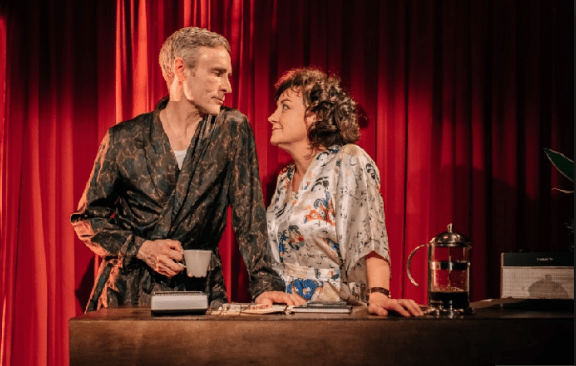
I felt solemn as I entered the tiny venue at the Tron Theatre Glasgow, expecting a serious play. The set was absolutely gorgeous – bigger than the seating area and plastered with props and dividers. It was a very plush living room with luxurious couch and a second level a red drape covering the half of it. All depicting the home of a wealthy man. As the lights brightened, yet more was revealed where the stage seemed to double in size.
The night’s play, inspired by the memoir ‘The Mistress Contract’ by ‘She and He’, was written by Abi Morgan and premiered at the Royal Court Theatre London in 2014, the same year it was written. Now enjoying its Scottish premier, the current production is directed by Glaswegian playwright and director Eve Nicole. Taking the role of HE is the uniquitous Cal MacAninch fresh from TV shows and theatre work around the country and SHE is played by actress Lorraine McIntosh, of Deacon Blue fame.
The Mistress Contract gets straight down to business with the two characters in conversation about their different perspectives on their sexual encounters with each other. Encounters which we learn arise from the contract that they signed thirty years before which lays out the deal in which she would favour him with sexual services in exchange for a home and a decent share of his formidable riches. But, she recalls, there was a period in what she refers to as their thirty year experiment where he couldn’t afford his side of the bargain, but she nonetheless allows him to owe it to her.

She produces a Dictaphone and recalls that when they signed the mutual contract in 1981, there was an idea that they would record this experiment to perhaps make it into some kind of a book. Today she is someone who is passionate about her books, her life, her house and garden. As they talked, music played and they undressed and sat together on the couch, still debating sexuality, gender equality, whether there was a difference between their perspective sexualities. Finding, 30 years on, that the difference was often profound.
They fought, they kissed, they relaxed they loved. As you watched, you felt that the crux of their relationship was a self-revealing, tangible and passionate love. The fact that it had endured for three decades seems to prove that the contract was a powerful one and signed by both in honesty and good faith. Never to marry, and only to love each other became exclusive as the years passed; they despair, they make up, they perform in love together. They were serious and enlightened, with kids and life to contend with but ultimately they come together as a real life couple who triumphed, and remained faithful to the contract they both signed thirty years ago, which is more than you can say for many marriages!
Daniel Donnolly

The Origins of Ivor Punch
A Play, a Pie and a Pint
Oran Mor, Glasgow
April 29 – May 4, 2019
Script:  Stagecraft: Performance:
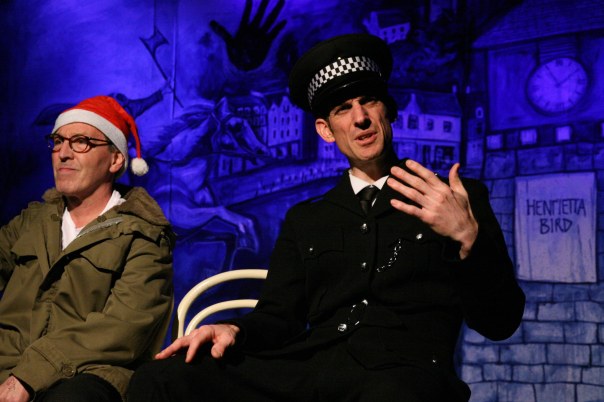
A blue-toned set depicting the Isle of Mull – or some similar remote island – greeted us as we took our seats. In the middle stood the grim looking Henrietta Bird clock tower. As the stage darkened we could just make out the movement of the three actors, all playing double roles; Andrew Tait, as Sergeant Ivor Punch and his ancestor Duncan, a postman, Tom McGovern as Ivor’s friend Randy and -no less – the great Charles Darwin; and Eva Traynor playing the famous Victorian explorer Isabella Bird and her sister Henrietta. This play, written by Colin MacIntyre, is quite a complicated piece, based on the author’s own prize-winning book, ‘The letters of Ivan Punch’, and touches upon ideas of identity and mythology, history and love – a tall order in the space of a mere hour!
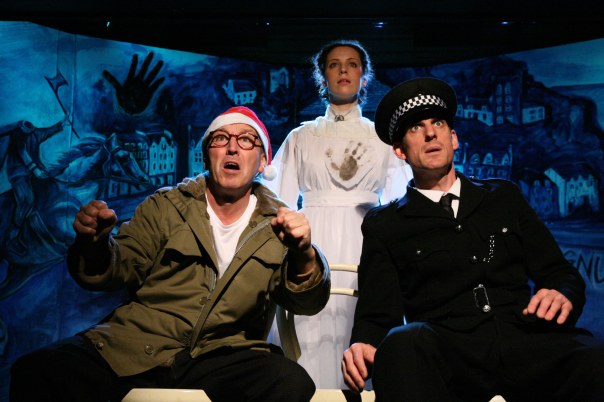
The action began with Randy and Ivor Punch sitting together in a car singing a song about angels. The purpose of their journey was humorously to steal a Christmas tree with Ivor ironically dressed in his full Police uniform on his way to commit a crime. But an angel, in the form of a woman in a white dress, Eva Traynor’s Isabella, who stated she was somehow there to help him. He was intrigued when she called him Duncan, a character Ivan was unaware of.
The words ‘God is love’ appeared graffitied on the side of a cliff and were introduced to the plot in a dramatic scene at the clifftop, a proverbial cliff hanger. Then bright lights shone dramatically upon the scene to invite us into another aspect of the story. This time, Andrew Tait appeared as Duncan, postman and jack of all trades, a man of few words, beyond a few well-worn stories. Henrietta falls for him, but you wondered if it was him or something he knew of that she wanted?
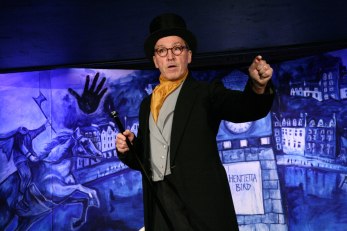
Through interactions between the various modern and historical characters, the story delved more and more into exploring the identity of Ivor and the factors which made up who he was. We had costume changes and found Charles Darwin, resplendent in top hat, waistcoat and pocket watch. Lofty ideas were analysed and Ivor revealed that he had put Darwin’s book ‘The Origins of…’ to the test with the ‘Bible’ and found that naturally the Bible was chosen every time. In the midst of all these weighty discourses, light relief was provided by Randy, with his down to earth, not to say rude, language.
The passion between Duncan and Henrietta was also explored, particularly in the dialogues between the two sisters. Ivan and Randy came to realise the identity of the name on the clock tower and in the final scene we found Henrietta offering support to Ivan as she professed her faith in his capability for love in all of life.
The way this story was built up, using a great many facets that all somehow mysteriously melded and joined together was much like the complex original book by Darwin himself. The play bounced along sometimes lightly, sometimes heavily, for the hour and after proposing many questions, somehow in the end had them all answered.
Daniel Donnolly

Turn of the Screw

Perth Concert Hall
Tues 16 – Sat 20 Apr
Script: Stagecraft: Performance:
A young inexperienced governess with a fertile imagination fuelled by gothic horror potboilers; two precocious children, altogether too knowing, in her care; a rambling, isolated country house witness to a history of cruelty; preternatural occurrences and eerie noises in the night. Henry James’ 1898 horror novella is the archetypal haunting story. Or, at least that’s one reading. It could equally be the account of the young governess’s incipient ‘female hysteria’. The novella maintains the ambiguous nature of the events at the house and James leaves the reader to make up their own mind over the causes of the horror. It’s a satisfying read.
Mercury Theatre Colchester and Wolverhampton Grand Theatre’s production of Turn of the Screw, adapted by Tim Luscombe, whilst replete with enough terror, puts the cause of all the haunting malarky on the governess, played by Janet Dibley with maniacal poise. Confirmation bias from the homely but astonishingly dim-witted housekeeper Mrs Grose (Maggie McCarthy) propels the governess ever onwards in her attempt to save the children, Miles and Flora, from what she thinks is supernatural attack from the spectral visitations of the previous governess Miss Jessel and the diabolical ghost of Peter Quint, the former upstairs-man, who had, and seemingly still maintains, a corrupting influence on young Miles.

Luscombe’s treatment turns the action into a taught psychodrama, that pulls out many of the threads in James’ story, such as the suppressed sexuality of the tale, hinted at in the relationship between the governess and young Miles, and the nature of Quint’s corrupting influence on the boy. It’s unfortunate therefore that the dramatic energy begins to disappear in the second half, as it becomes apparent that the cause of all the disturbance really is the governess’s psychotic break. With the loss of ambiguity of the cause of the haunting, whether psychological or supernatural, much of the tension of the story is also lost. It’s a different terror, altogether human, that is portrayed in the closing scene. This is an intelligent production that delivers some shocking moments in an entertaining evening that occasionally misses a chance to terrify.
Review: Mark Mackenzie
Photography: Tom Grace
The Mack
A Play, a Pie and a Pint
Oran Mor, Glasgow
April 15-20, 2019
Script: Stagecraft: Performance:
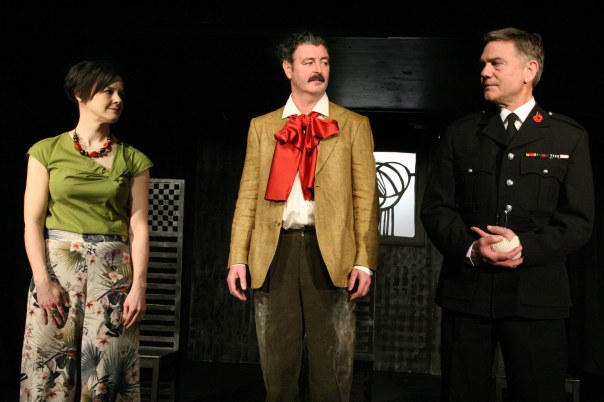
It was with a slight degree of apprehension that I settled down to watch Rob Drummond’s new one-act play at the Oran Mor today. “The Mack” is all about a hero of mine, Charles Rennie Mackintosh who died 90 years ago. His famous approach to life and art had some in his period smiling and others not. The stage was set in Mackintosh style, complete with three chairs in that distinctive ladder-back design.

Mackintosh himself took centre stage; James Mcanerney resplendent in the artist’s signature large cravat; it was like seeing the man himself brought to life. The two other characters came in the guise of an expert, a well-dressed Janet Coulson; and John Michie as a fireman in full uniform. The three don’t address each other, but talk to the audience directly and between them the story unfolds into the well-meant debate as to whether or not to once again save the internationally renowned Glasgow School of Art building that unbelievably caught fire for a second time. Included were all the various opinions and points of view we have all had about it, presented in an almost court-like discussion as to its importance or no.
Each character reveals insights into their individual points of view; vivid feeling of loss and appreciation of the work of a Master; rhetoric about the life and style of Mackintosh himself; the artist recalling his life in his letters to Margaret, his wife and long term partner. Somehow it seemed as if the artist himself was looking down in amusement at his work and what has famously happened to it, in reality some of his work has been salvaged from skips and suchlike. Each sometimes stands to make their point with dramatic force. There is real poignancy when the fireman reminds us of the dangers his firefighters faced when they fought a fire for the sole object of saving a building and some artefacts, questioning if it was worth risking their lives.
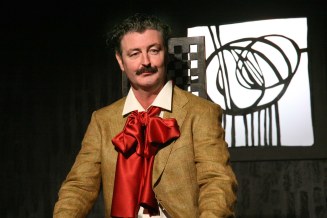
The three actors stood as the lights went down, without having come to a conclusion as to whether the Art School building should or should not be rebuilt. This three-point perspective offered compelling reasons for and against but they also found themselves unable to come to a definitive result. Having struck a balance in each debate, in the end it is left to us to decide. It could be done – there is enough of the design detailed on computer to make it exactly as was all those years ago. Whether it would be the same building raises the question of what art is anyway – the design or the building?
If you want my answer, I would wish it rebuilt. It’s intended beauty from the architect is as important to me as it ever was. But you can make up your own mind…
Daniel Donnolly
An Interview with Mangled Yarn
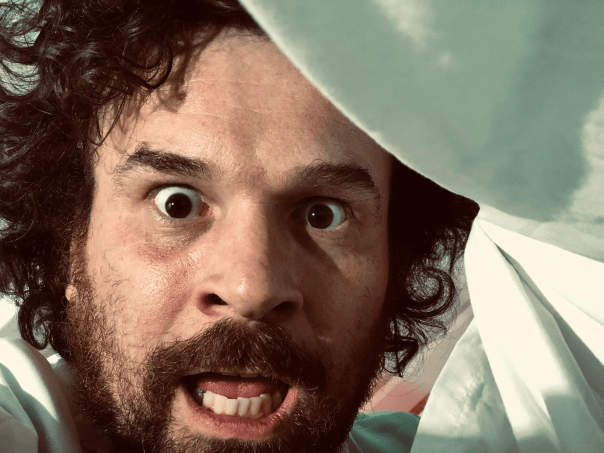
Edward Ferrow as Dr. Frankenstein
Neil Jennings & Chris Smart are at the heart of Mangled Yarn & their ebbulient take on the ultimate horror story
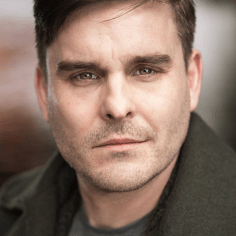
Neil Jennings
Hello Chris and Neil, first things first, where are you from & where are you at, geographically speaking?
Chris: I’m originally from Lichfield, in Staffordshire. It’s near Birmingham, but I’ve lived all over, including Italy and Denmark. I’m currently house hunting in Welwyn Garden City, in Hertfordshire.
Neil: I’m an Essex lad who grew up in the Forest of Dean in Gloucestershire. I now live in North London.
You are quite the creative polymaths, can you tell us about your fields of operation?
Neil: I trained as an actor at Bristol Old Vic Theatre School. I’m also a self taught multi-musician. My main instrument is Ukulele; but I can actually play it well! I’m also a keen illustrator, song writer and playwright.
Chris: I also trained as an actor, at The Royal Birmingham Conservatoire. I’m a multi musician too – Banjo, Accordion, Guitar, Mandolin. I write songs, sketches and plays and I also direct.

Chris Smart
When did you first develop a passion for the arts?
Chris: of course I could say I fell in love with Shakespeare and classic literature at a young age and that was it, (of course I do love those things the requisite amount!) but I was brought up watching John Hughes movies and laughing at people like John Candy and Steve Martin. I think I always held out hope that I would get to do that. In the end I managed to combine the two.
Neil: As a kid I sort of popped in and out of the arts. Sometimes I was very keen, other times it didn’t really bother me. It was at University (I studied Drama at Aberystwyth) where I truly found that this was the career for me.
Can you tell us about The Pantaloons?
Chris: We met six years ago at an audition for the company. It was an unusual audition in that it was just really fun and everyone seemed as lovely as they were talented. We both got the job and haven’t looked back. The company creates hilarious and accessible theatre from Shakespearean and classic texts. Using all kinds of influences and styles to put their own incredible spin on a well known piece. Music is used heavily too and has also challenged us both to learn new styles and instruments . If drama school taught us the foundations of Acting, The Pantaloons taught us how to be comedians. We will always love continuing to work with “The Loons”!

In a world where you can get entertainment ‘on demand’, what makes theatre special?
Neil: For me it’s the thrill of how are you going to stage something. CGI in films and television makes everything possible, but on the stage, there’s a real magic needed to create the same effects. I love, not only working out how to do a particular thing, but also watching how others achieve it. You can really learn from each other.
Chris: firstly I think because it is not “on demand” there is always a sense of occasion and excitement with theatre, you have to get off your arse and go somewhere to watch a bunch of real life human beings tell you a story. No matter how amazing the box set is, you can’t replicate that on your sofa at home. Secondly we both love, and work within a style that is immediate; it embraces and works with the here and now to create a truly unique experience. Bringing the audience into the action means that every night is different; it comes with different risks, different failures and different successes, all of which combine to make something truly special.
You’re washed up on a desert island with an all-in-one solar powered DVD/TV combo & three films, what would they be?
Chris: The Big Lebowski is a must, Uncle Buck because it’s John Hughes and John Candy but not tied into a season like thanksgiving or Christmas. Finally The Royal Tenenbaums, I love Gene Hackman in that movie.
Neil: It depends. Can the Back to the Future trilogy be on one disc? If not, then it’s those! If they count as 1, then I’ll throw in Labyrinth and Ghostbusters (the original).
Where, when, why & with whom was Mangled Yarn created?
Chris: At a Birthday house party last Summer. I think it was Neil’s birthday. We were a little drunk…
Neil: …very!
Chris: … and we were spitballing ideas for inappropriate text to style combo’s. Classic horrors as Pantomimes really got us laughing.
Neil: We joked about Frankenstein as a Pantomime for ages.
Chris: But the next day I couldn’t get the idea out of my head. I knew it would be a really interesting project and I was convinced we could make it work.
Neil: We thought for a bit about just doing a normal Pantomime with the characters of Frankenstein and the monster in it, but that’s not an original idea – it’s been done quite a lot.
Chris: often by amateur theatre companies.
Neil: So we then talked about trying to do a faithful telling of the whole story, but with a Pantomime trying to burst out the whole way through.
Chris: That’s really when we became Mangled Yarn. It’s a mangled quote from All’s Well That Ends Well. “The web of our life is of a mingled yarn, good and ill together”.
What is the Mangled Yarn ethos?
Chris: We want to take incredible professional theatre to everyone, that’s for everyone. We are particularly focussed on bringing our work to those people that, for whatever reason, don’t usually have access to live theatre.
Neil: We are passionate about taking source material seen as “difficult” or “inaccessible” and innovating with it, creating productions that are first and foremost enjoyable and entertaining, but also remain faithful to the spirit of the original text.

You’re performing at this year’s Brighton Fringe, what are you bringing to the table?
Chris: We’re passionate about comedy. We love to laugh and think it’s one of the most important things for an audience to do. If we can also give them the facts at the same time, we’re laughing… still.
Can you tell us about the musical side of Frankenstein?
Neil: Our cast are 5 actor musicians. We have both live and recorded music, and we’re going down a disco route. So we’ve written half a dozen disco parodies that tell the story!

Rhianna Compton will be playing The Monster
What lead you to the unlikely pairing of Frankenstein and a Pantomime?
Neil: A simple response would be that we found the idea funny. Is it possible to tell such a dark and harrowing story faithfully, yet in the style of a family friendly comedy? We knew it would be a challenge, especially dealing with the subject of life and death. I think we’ve managed to do a great job with that. The finale of our show is a perfect example.
Chris: People often see classic literature as “stuffy” or “difficult”. We wanted to find a way to challenge those preconceptions and help an audience find the joy of the source material. We thought Pantomime was the perfect tool.
What’s the last thing you do before you step out on stage / the curtain goes up?
Chris: I don’t really have any particular rituals, sorry to be boring! I used to always brush my teeth just before beginners but that’s about it.
Neil: It depends on the show and the company. I’ve done shows where we’ve got into an almost superstitious routine of actions and words. I don’t really have a “thing” that I always do, though.
You’ve got 20 seconds to sell Frankenstein to somebody in the streets of Brighton…
Neil: It’s Frankenstein as a Pantomime. If that doesn’t do it, I’m not sure what will!
What will you be doing for the rest of 2019?
Chris: We’re hoping to send Frankenstein out for a small UK tour this Halloween. We have a few venues pencilled in, including The Place, Bedford and the Old Library Theatre, Mansfield. We’re also going to begin work on our next project that we’re very excited about. We don’t want to say too much about it yet, but it’s very ambitious. What we can tell you is it WON’T be a pantomime.
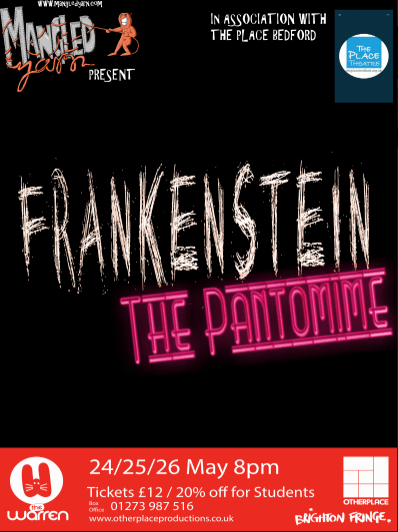
Frankenstein the Pantomime
The Warren: The Blockhouse
May 24-26 (20:00)

Around the World in 80 Days
Leeds Playhouse
April 13-28, 2019
Script: Stagecraft: Performance:
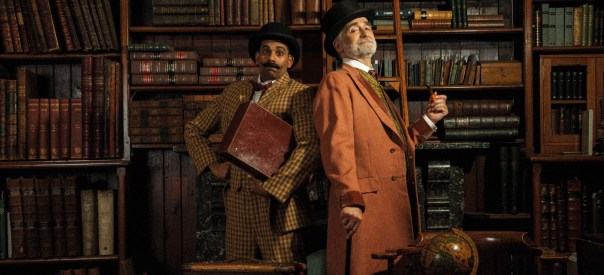
The play began with the trio of actors performing an a capella medley of music hall songs placing us squarely in Victorian England. The set was quite minimal for Leeds Playhouse, with a large clock facing the audience centre stage within a wooden partition behind which looms what appears to be the rafters of a ship’s hull. In the background various objects can be made out; an armchair, a globe, luggage cases. It looked rather like someone’s attic or a steampunk jumble sale.
After the initial musical medley we were thrown into the action as what appears to be a heist is committed by a be-cloaked thief. The struggling music, alarms and flashing red lights amidst the onstage gloom created a sense of excitement and intrigue which quickly fell away as we settled down into a scene in which we meet Phileas Fogg, and his assistant as they make preparations for their journey around the world. This scene however was soon broken by the intrusion of Jules Verne, the writer himself who admonishes the actors for their handling of his material and questions the nature of the performance. As soon becomes apparent this is no ordinary telling of the tale as these direct addresses and asides to the audience become an intrinsic part of the show as it goes on.
Breaking the 4th wall as it’s sometimes known is more often used as a kind of intellectual game to make a point about the nature of the work itself. Less rarely is it used – as it is here – as fuel for fun. One could see how it was used throughout the play to draw attention to the difficulties inherent in performing the play itself (3 actors attempting to represent a round the world trip with a multitude of characters) and also how the inclusion of the ‘Jules Verne’ character brought up questions about the nature of ownership and the difficulties inherent in adapting another’s work but mainly these digressions and asides created another layer of humour which flattered the audience’s ability to engage both in the plot whilst simultaneously recognising its artifice.
These narrative breaks worked very well and sometimes allowed for a rest from the sometimes hectic nature of the show. They worked even better however when they were seamlessly woven into the show. I particularly enjoyed the scene in which Jules Verne playing the princess read a copy of the titular novel whilst giving away plot spoilers to Fogg.

This aspect to the play was interwoven into a high speed adventure story which took us – not surprisingly – around the world. At times such as in the scene in Bombay the pace got a little too hectic and I felt a sense that the whole thing may come off the tracks like a runaway train but luckily there was a masterful driver at the helm and a very able crew of actors keeping things running smoothly. The sheer technical difficulties of performing so many characters at such a pace was impressive as was the physical dexterity required by the performers. All the actors though played their parts with real verve and energy.
Fogg was nicely underplayed by Robert Pickavance as a bemused fop with just the right touch of ambiguity to him leaving the audience guessing all along as to whether there was some ulterior motive to his trip than the mere winning of a gentleman’s bet. The show was really brought to life though by the brilliant buffoonery of both Joe Alessi as Passepartout and Darren Kuppan’s Inspector Fix. Both gave excellent comic turns as Fogg’s naively faithful retainer and his detective nemesis respectively. Kuppan’s turn was particularly notable for demonstrating his skills as a physical performer who has both the grace of a dancer and the expressiveness of a mime. His antics of running on the spot and hiding in disguise from Fogg were a joy to behold. Special credit too should go to Dan Parr’s Jules Verne who was played as a kind of endearingly eager and vulnerable man-child forever wanting to shoehorn his way into the show. The different minor characters too were brilliantly played with some faintly ridiculous regional accents and ludicrous costumes adding to the overall feel that at times we were watching something akin to a live action cartoon.
The quick change artistry of the performers playing this multitude of characters were ably abetted by the supreme skills of the props and costume team who managed to convey real individuality to all these minor characters. Whether this was done by a simple change of hat or a whole costume colourful and memorable characters such as the Indian temple musician in his silks and turban or the grizzled old bewhiskered sea captain were brought vividly to life.
The stagecraft overall was exemplary. Whether this was the soft yellow glow of an early evening in a wood panelled drawing room or the heat and light of an Indian bazaar subtle changes in lighting and the inclusion of found sounds and snatches of music managed to convey changes in time and place as we moved from continent to continent with Phileas and friends. The use of props too throughout showed real imagination as objects were twisted from one form to another and the relatively simple set was used in new ways from scene to scene. One minute it was a steamer ship on its way from Hong Kong, the next a train bound for Calcutta, the next an elephant charging through the Indian jungle. The way the destination and number of days left kept appearing throughout the play on handkerchiefs, jackets and umbrellas was also a charming touch. It brought a little ripple of pleasure from the audience to see which unexpected spot it would appear in next.
This was all part of the rich attention to detail and charm of the overall show. One never forgot that this was a world where – like children playing ‘let’s pretend’ – a tin bath could become a horse drawn carriage or a wooden slide could become an elephant. At times this was reminiscent of Harry Hill or even Monty Python and had a similarly endearing child-like sense of the playful and the absurd. The humour generally had a seriously clever silliness to it which combined word play with slapstick and several amusing running jokes. Though there were many moments of madcap fun the stand out was the chase scene on a train made from suitcases. Here we saw not only the team’s gifts with physical comedy but also their ability to interact with and transcend their environment creating with the audience a real belief that they were travelling at breakneck speed through the wild west. This scene seemed to represent the show at its best veering as it did somewhere between a giddy sense of fun and a knowing self-consciousness and inducing in the audience a sense of child like wonder throughout.
Ian Pepper
What Girls Are Made Of
Tramway
Glasgow
April 9-13, 2019
Script: Stagecraft: Performance:
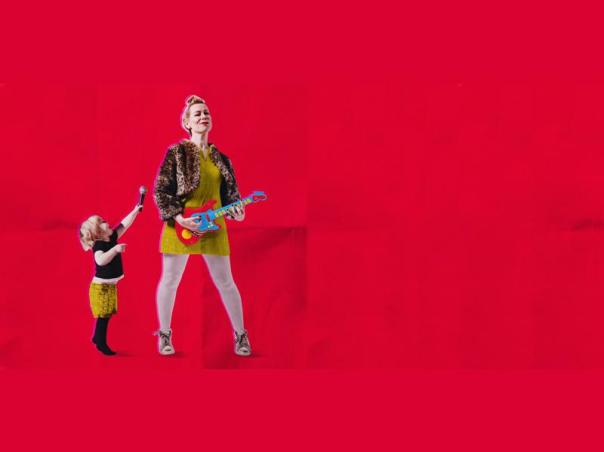
Walking in to the Tramway theatre is always a pleasure with its vast walls and ceilings, and a warm welcome. Smoke swirled around as we took our seats in the auditorium and the set was intriguingly set up to look like a rock concert. And sure enough, when Cora Bisset took to the stage, the story of her rise to fame began to emerge. What Girls Are Made Of is a play written by Cora herself from her own teenage diaries, and reprised here at the Tramway from last year’s smash hit premier at the Edinburgh Fringe.
As the other band members take to the stage, Cora, standing with arms folded at the front of the stage, tells us dreamily “I wanted to sing in a band”. It was all she ever wanted and she had the voice and persona to do it. They were lucky, success came quickly and the band found themselves signing a five-figure record deal and touring with the likes of Radiohead and Blur when they were still only naïve teenagers from Fife, a fact which she never forgot, despite the intoxicants and partying which inevitably goes with this kind of fame.
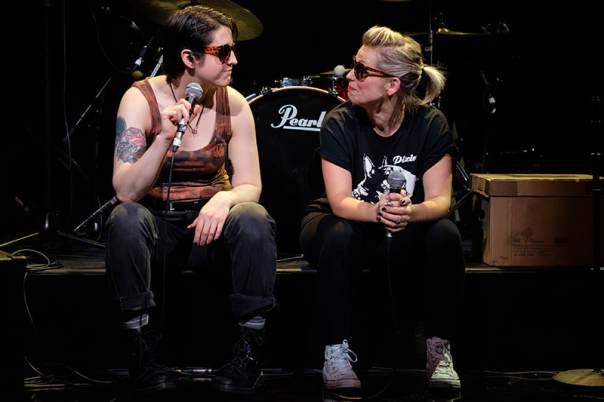
Cora shares with us her memories of this time in the early nineties, with herself and the band frequently breaking into song and entertaining us with full blown performances of their own music and songs from the likes of Nirvana and Blur; giving us a taste of the rollercoaster rock star lives they were living. As Cora’s memories unfold, the band members take the part of the various characters, throwing themselves into the roles with gusto, before coming together once again to perform yet another blockbuster.
With the wheels turning at a greater and greater pace, the rest of the world just fell away and we became more and more absorbed, and at times concerned, about the actress/ singer/ writer as she and her band navigated their way through their new found success and all the successes to follow. But their wicked manager was writing too many cheques and all too soon they were broke, with a hefty dept that there was no way of paying. The bubble had burst and what had seemed to be a rosy future gradually fell to the wayside and wound up as though it had never happened at all. With zero money and a large dept, Cora takes us into a darker side of her life where she loses her father to dementia and as she recalls laying him to rest, she lowers her head and weeps.
This play entertains and enthrals you on so many levels, spanning rock music, singing, poetry, tragedy, beauty, gritty reality. Like the story itself it surrounds you, pulls you in and spits you out. 25 years after the event, Cora is in her forties and presents herself self-reflectively to the audience with sincerity, abundance and joy. She is someone who could – and for a short time did – have made it, not because of the business but because she had the voice, style, and sheer heart. As we can witness for ourselves in this masterpiece of entertainment.
Daniel Donnolly
Lion Lion
A Play, a Pie and a Pint
Oran Mor, Glasgow
April 8-13, 2019
Script: Stagecraft: Performance:
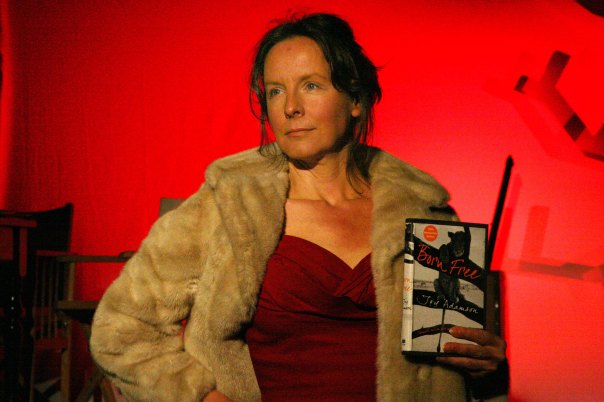
There was a great red lighting effect emanating from the Oran Mor stage as we gathered to take our seats with the venerable pint and pie laid out before us. The title, ‘Lion Lion’, indicated that perhaps the next hour would be taken up with some kind of dedication to those great beasts. And so indeed it proved, as the first scene bore witness when we find Joy Adamson (Selina Boyack), beside herself with grief at the death of her beloved Elsa, the famous lioness depicted in her book “Born Free.”
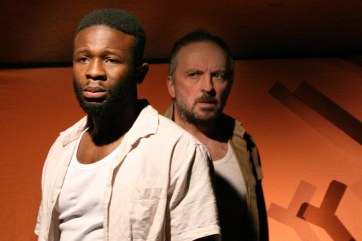
Sue Glover’s play had a strong focus on the survival of these animals in the wild today, something which really resonated with me and my own concern for these magnificent creatures that we seem to be hunting to extinction. We watch Joy with George her husband (Keith Fleming) and their assistant Makedde (Nick Ikunda), and the strong bonds they have formed with these wild animals as they work with them and camp out amongst them, dreaming of safeguarding their lives and habitat. But passions were running high and the relationships between the husband and wife was deteriorating. In their stress at losing Elsa, Joy and George argued again and again and the hapless Makedde seems stuck in the middle. We see three greatly different personalities united by their often savage undertakings, with growling lion sounds used to separate scenes. Joy could seem uncaring and unkind, but when she reflected upon her beloved Elsa with such care and grace and love, we had more and more sympathy with this benevolent side of her.

There was no doubt that Joy and George loved each other, even when she leaves him after one argument too many. But perhaps they loved the animals more and this was certainly used as a metaphor to depict our relationship with the environment, something that is becoming more and more important in our modern lives.
Though set in the 1960’s, this was not a piece stuck in any particular time. For Joy it doesn’t end well, for irony of ironies, she was killed by one of her beloved lions. But you couldn’t help question if she maybe thought it was a good way to go. Lions deserve our attention and our love and gratitude in a crazier and crazier environment, where we are more dangerous to them than they are to us. They deserve this hour of passion, passionate writing, passionate observing and passionate interaction, this play did all three and it was great to see it being put on here at the Oran Mor.
Daniel Donnolly
Aye, Elvis

Oran Mor, Glasgow
April 1-6, 2019
Script: Stagecraft: Performance:
When we see anything Elvis we rediscover and find our affection for that iconic 20th century artiste. The stage was set with a blue neon lighting of a famous picture of the man himself and Joan/Elvis (Joyce Falconer) took to the stage fully dressed in jumpsuit and rhinestones for the Ultimate Elvis event to come. So much was packed into this hour at the Oran Mor that it seemed to have entertained us for a much longer time. There were various transformations of the set, changing from the dreamer’s bedroom to the lounge where her mother Agnes (Karen Ramsay) sat with her walking stick, to the club where as an Elvis impersonator Joan performed her socks off.
The applause was loud as the one-liners flew by, and also included appreciation of well performed scenes. Joan’s Doric Elvis character gleamed and endeared from the start, touching your heart as she dreamed of stardom that will take her away from her humdrum and impoverished life. Her mother Agnes doesn’t see it though and tells her beloved daughter to give it up: she will never succeed.
It becomes clear that Joan really loves her mum and tells us that she feels that Agnes needs her as much as Joan needs her mum. But there is conflict because with every chat Joan became more and more certain of a great career in entertainment. In reality, her gigs are karaoke nights at a local, but her dreams, like The King himself, are so much bigger than that.
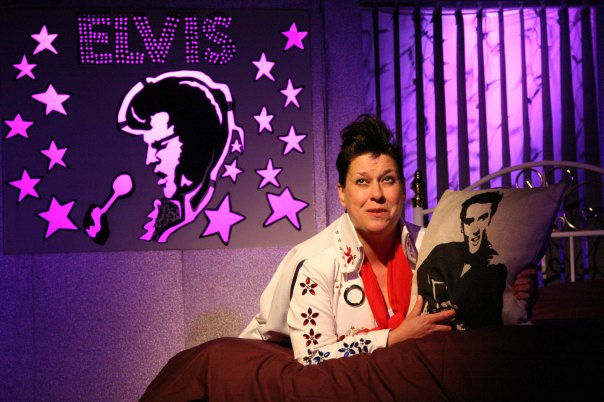
Stuck in her wheelchair, Agnes would bang on the floor with her walking stick when Joan was practicing loudly in her room. And when she discovered that Joan had earned £100 she starts to change her mind. Joan tries to hide her wages from Agnes instead buying herself a new laptop, something that means a lot to her as we understand when she has an online conversation with Fat Bob the DJ (David McGowan). Perhaps Fat Bob could be a possible romantic interest for Joan, except that her heart belongs to Elvis.
Joan’s desire to succeed as a female Elvis grows stronger and stronger. We are filled with respect for her sheer determination and even her mother is won over as she makes a complete turn around and encourages her daughter to go for it. Suddenly we see that even this wheel chair ridden tough old Ma can also be an endearing character who could still live a life of riley.
The world of Elvis was and is flamboyant and larger than life, with more than a hint of sadness. Joyce Falconer takes us into that world with the same indomitable strength of perseverance, acceptance and striving personality that was the man himself. A fitting tribute to the great man, the King, and the dreams he has engendered in so many. Like the living man so was she in costume, dance and vocals, singing her heart out “Love me tender, love me true”… You have to see this play, it’s a gem!
Daniel Donnolly
 Mumble Theatre