Author Archives: yodamo
The Ching Room
Broadcast
Glasgow
12th June 2017
Script:  Stagecraft:
  Performance:
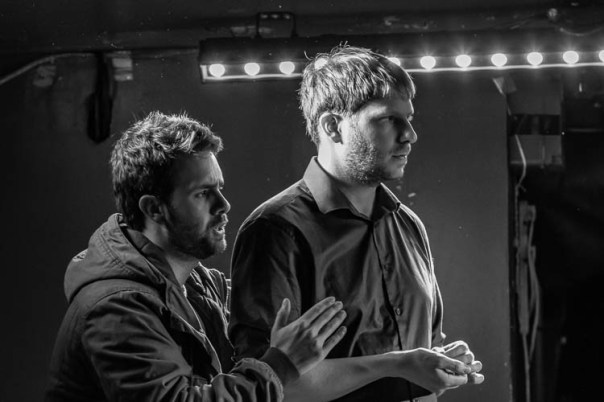
Mr Stewart Schiller is a pioneering young gentleman from Glasgow, who finding himself drenched in a music-mental conurbation is becoming ever more determined to bring theatre – affordable, pay-what-you-like-in-a-bucket-as-you-are-leaving kinda theatre – to his people. Last night I caught the 3rd of 4 performances round venues in Glasgow normally reserved for things rather less theatrical : Dram, Canal Station & Broadcast on Sauchiehall Street, where I found myself watching The Ching Room by Alan Bisset. Stewart had come across the play while looking for a decent one in his local library, & in a recent interview with the Mumble described his engagement with the play; ‘The Ching Room’s one of these plays that just jumps off the page. I try to read as many plays as I can and, after awhile, they can start to blend together. The Ching Room though is really arresting. It describes seedy acts with beautiful language, whilst also being really funny. That’s a rare combination that gets me really excited.’
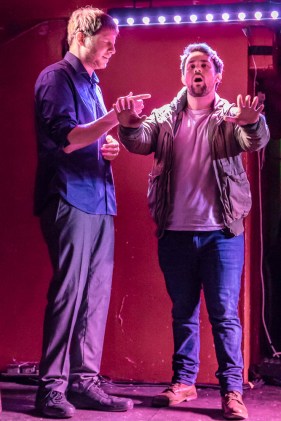
The set was sparse, although the entire thing was supposed to be set in a toilet cubicle, so I guess that didn’t matter. The two youthful actors, however, were smashing & eloquent & genuinely authentic. Rory – played by Simon Devon – crosses the sacred boundary into the Ching Room, where Darren – played by Alex Dodd – is holding his snowy court ‘on official nightclub business’. Well-toured & experienced, both actors crackled with chemistry (& chemicals) as they played out Bisset’s dramaturgical remembrances of a night or two on the tiles, one expects. In fact, the three of them managed to completely turn the seedy, urine-stained, drug-cutting, money-blagging, arrogant-sweating temple that is the coke-users toilet into somewhere quite fluffily enticing. In the Ching Room, drugs are good. It was all quirkily compelling, & full of great lines such as, ‘you don’t hurry Boss Ching, sir, Boss Ching hurries you.’ Then into the mix comes some saccharine poetry – but in a good way – & emotive backstories which are in the main believable & contribute to the overall effect of a short, snappy trip to the bogs with a couple of likable geezers. I’m really glad that Stewart Schiller brought this play back to life, for there are some beautiful & funny moments that go on in the lands of druggy hazes, but unfortunately no-one can remember them!
Reviewer : Damian Beeson Bullen

An Interview with Alex Fthenakis
2017’s On The Verge Festival – a small festival of big ideas and big ambition – kicks off later today, 21 performances at the Citizen’s Theatre (Tickets can be bought at the RCS box office or at the Citizens).
The Mumble managed a few words with its chief…

Hi Alex, so where ya from & where ya at, Geographically speaking?
Born and raised in Mountain View, California. That’s the heart of Silicon Valley, so at the time it was all HP, Sun, Cisco, and Lockheed employees. Now it’s Google, Facebook, and LinkedIn. That and retired 35 year old multi-millionaires getting ready to start their second (or third) career. It should come as no surprise that I feel rather out of place when visiting. Based in Pollokshields. I couldn’t love it more. Have been in Glasgow (mostly) since 2009. Along the way I’ve lived in LA, London, and, Chicago.
When did you first find yourself getting into the dramatic arts?
I think I was in first or second grade (age 6-7). It was a production of Peter Pan. I was a ‘lost boy’. After that it was school plays and Christmas Pageants for a few years before my interest really got going and I made a serious thing of it in High School. I was recently on tour performing in a Play, Pie, and a Pint show, His Final Bow, and made a joke about ‘taking the day off and watching from the house’ or something. It triggered a flashback to that Peter Pan – I remember throwing a big tantrum when I found out that being in the play it meant I wouldn’t ever get a chance to see it from the audience. These disappointments are rough when you’re six… Perhaps that was an early sign that I wanted to do more in theatre than just perform. That Peter Pan youth theatre must have been a racket too – they were a touring youth theatre that toured their shows but not the kids. So they would make a show and take all the tech, design, etc. on tour but recruit and rehearse new kids in for each new stop on the tour. Those participation fees must have added up quick. Sounds a bit like Harold Hill’s band when I think about it now.
In 2014 the Arts Council of England and UKBA endorsed you as an artist of Exceptional Promise for his work, cam you tell us about the process
I probably get asked about this more than about my work. It’s a really tough process applying for this visa category. Tyler Collins and some others have been in the press lately due to their struggles in applying. Basically you have to prove to Arts Council England that you have the potential to become a world leader in your field. There are probably about a dozen of us in Scotland – I’d bet that more than half are OTV alums.
This week sees On the Verge returning to Glasgow, what is it about this particular slice of student theatre that makes OTV so special
My (absolute lifesaver of an) Associate Producer Stephanie Katie Hunter keeps referring to OTV as a ‘DIY Festival’ and I think that’s a great moniker. OTV students make all their own work from scratch. They write, direct, perform, design, source props, build things, operate lights and sound for one another, write their own marketing copy, run their own social media campaigns, write their own risk assessments etc. They are mentored by some really fantastic tutors and guest artists, but the work they make is all their own and they’re tasked with self-sourcing almost all the resources to support it. For the audience I think that’s really special because it’s a chance to see the work of this next generation of theatre makers standing all on its own. Works are very much in-development and many of the students are just beginning to recognise who they are as artists, so it’s all less polished than you’d find with some of the drama school’s full productions. However, this is the first time an audience gets to see the nascent work of these students without it being filtered through outside professional directors, designers, technicians, writers, etc. Think of it as the theatrical equivalent of being able to claim that you saw Belle and Sebastian’s first gig at the Halt Bar before anyone had ever heard of them (disclaimer: lots of OTV shows have gone on to future success, but none have been quite THAT successful – yet…)
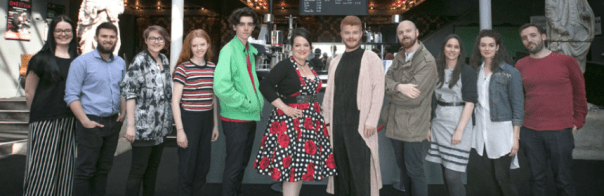
Some of 2017’s ‘On The Verge’ crop
What for you makes a good piece of theatre
I think all good art has to come from a place of both passion and exploration for all the artists involved. Beyond that, a good piece of theatre should never try to be something it’s not or apologise for being what it is. And it should do something that can only be done with a live audience in real time (i.e. something that’s not possible on film – this is a bugbear of mine with a lot of young American writers).
What do you think the students get most out of OTV
For those that know they want to make their own work after graduation I think it’s a great dry run at what their first endeavours might look like. Imagine you’ve just graduated and the industry doesn’t know you and you don’t have a track record yet, so you can’t get any funding or much formal support – you’re going to have to phone in whatever favours you can to try to get your first no/low-budget project off the ground. In a perfect world it would be easier than that but oftentimes it’s not, so it’s great to get a chance to try out this way of working in a context where audiences accept that the whole thing is a ‘DIY Festival’ of works-in-progress. It gives students a low-risk opportunity to discover where their strengths lie and where they need to spend more time cultivating relationships with specialist collaborators. For lots of students, though, OTV is the impetus for them to try their hand at writing or directing or designing or songwriting for the first time. Except for the 3 MA directing students, everyone in OTV is training first and foremost as a performer, so for quite a few OTV students this is the moment when they first discover (or first reveal) that they want to build a career as a multidisciplined artist. With the way the industry is changing (and has changed over the last 30 years), it’s more important than ever for a theatre artist to have multiple strings to their bow in order to make a sustainable career.
What does Alex Fthenakis like to do when he’s not being theatrical
I’m a pretty avid cyclist – not a lycra and racing bike kind of cyclist – I’d describe myself as an ‘adventure cyclist’. For me the bicycle is a tool to see things and go places that I couldn’t otherwise afford to see for reasons of either time or money. I’ve done the West Highland Way a couple times on a mountain bike (only takes 2 1/2 days at a slow pace), and several other ‘bikepacking’ type adventures, but just now I’m on a road touring kick. After OTV I’m headed up into Sutherland for a bit of cycle touring and tent camping. I’m trying to keep my itinerary flexible, but if all goes according to plan I think I’ll cycle round the new North Coast 500.
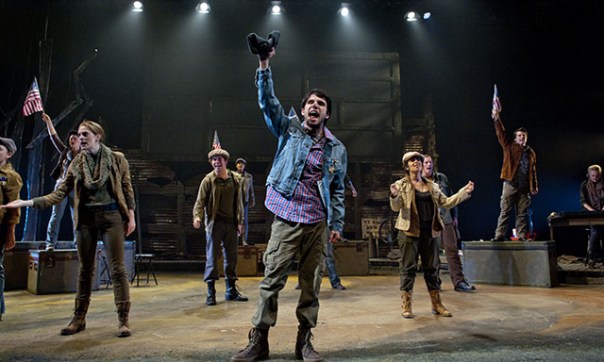
Why Do You Stand There In The rain?
Can you tell us about your baby, Rootstock Arts
Yeah – I think I first witnessed the guiding principle behind Rootstock in 2012. It was the first Pepperdine Scotland commission – Why Do You Stand There In The Rain? by Peter Arnott. I had a great discussion with the students one day about whether the play was Scottish or American – there was no real consensus, and I think that was the play’s biggest strength. Peter wrote a 7:84/Wildcat style agit-prop ceilidh play, but he wrote it for a dozen super-talented young Americans, and he wrote it about an episode in American history. He’d had the idea for the show sitting in his drawer for something like 20 years, but had never found the right group to write it for. It was a perfect situation where the whole became better than the sum of its parts and the resulting show was a huge success (and is probably a big reason behind my certification as Exceptionally Promising). Ever since then the key question when commissioning for Pepperdine Scotland is: what is the one story that THIS writer and THESE performers are better equipped to tell than anyone else in the world? Rootstock is about trying to facilitate work that answers that question in various situations where we bring international artists (or their work) together. It’s about making international theatre that represents true co-creation rather than just import and export of complete work. Since 2012 I’ve had a few Pepperdine-like ideas that ran into road blocks because there needed to be a separate company on board to handle the ‘international’ aspect of a project, so I set up Rootstock to help with this. As a company we’ve done a few little bits and pieces so far, but it looks like our first significant project activity probably won’t begin until either this Autumn or next May.
What does the rest of 2017 hold in store for Alex Fthenakis
Well for the next month or so I’m just going to take a break and regroup! It’s been one of the busiest spring seasons I’ve ever had and I’ve been working nonstop overlapping contracts as both an actor and a producer since about mid-February. I’m massively thankful for that, but now I’m also grateful for a bit of quiet time through early summer. This autumn it looks like I’m finally going to get some time to focus on some of my own projects – there a few shows I am making / want to make which require a bit of focus and TLC from me just now, so it will be good to spend some time on those. There are a few other things in the pipeline too, but they’re dependent on some still-pending funding applications so I can’t talk about them at present. Also if the apps get knocked back I’ll be looking for some more work this Autumn, so I’d better not make it sound like I’m too busy!
An Interview with Lucy Roslyn

Hello, so where ya from & where ya at, geographically speaking?
Hello! I was born and raised in Coventry but have lived and worked in London for the past *coughs into sleeve* years.
When did you first feel the pull of the dramatic arts?
I had hoped I would work in theatre and film when I was small – I have always felt passionate about them although it took me a while to get the courage to go on stage. I also thought it would be a good way to make friends, which it is. The dramatic arts are full of opportunity – they are worth looking after.
What for you makes a good piece of theatre?
I feel the best theatre starts a conversation. It will ask so many questions and answer only a few, and the solution is not always so straightforward. Something dark and character driven. I remember seeing Misterman at the National a few years back, the psychology of the character and Cillian Murphy’s commitment to the role – it was striking.

What can you tell us about the BoonDog Theatre company?
BoonDog came together as an umbrella for a series we are creating all set within the same Circus – it’s like the Marvel Universe but in 1930’s Dustbowl America. We are very much looking forward to bringing new collaborators into the fold as we make more work.
What do you like to do when you’re not being theatrical?
I am also a freelance illustrator on the side, so I enjoy being a hermit who stays in hunched over my desk. It’s a nice balance against theatre which is very sociable and collaborative. It takes a team to bring a project together.
You will be bringing Goody to Edinburgh this August, can you tell us about the play?
It is a darkly funny look into the relationship between one man and his ape – two characters unable to communicate on an equal level. Backstage at the circus we meet Goody, a performing chimpanzee, and her one companion: her trainer Frances. How does this relationship work? An ape is dangerous and volatile. Even with an animal you have known for years, things can flip in a moment.
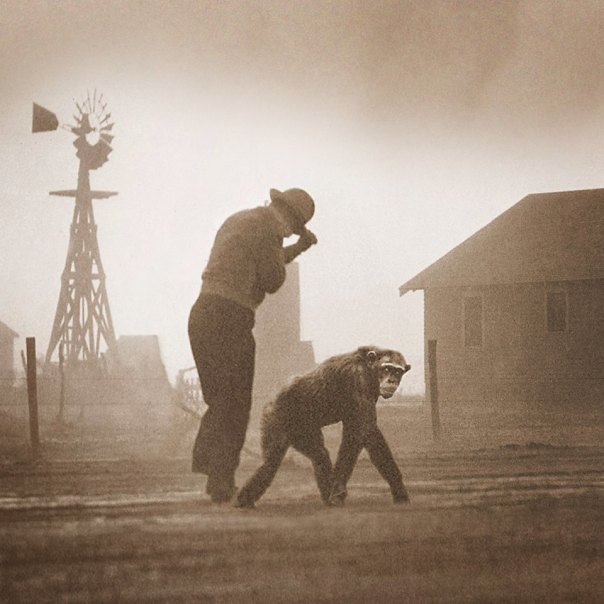
Creating Goody led you to visit ape sanctuaries and zoos to understand the relationship between humans and apes. How did this experience effect you personally?
Learning about performing apes and apes used for human demand has been as incredible as it has been heartbreaking. In many ways it has taught me more about people than apes, as it is people who dropped them into an incomprehensible situation from which there is no way out. I have been struck by the cruelty of some stories. Apes are impressive creatures, smart and emotional – seeing some of these apes in person is astonishing and we have had the good fortune to meet people who love and respect them, who make their lives fun and happier. However it is very bitter sweet to understand why they have ended up here at all, that they will never be wild and free again and, in some cases, that they have had to learn how to be a chimpanzee. Learn from scratch what you are, how to fit in, find yourself misunderstood – I feel many people could relate to these feelings.
How do audiences respond when it was performed?
The performance we have done so far won us the Greenwich Partnership Award, which we were blown away to receive. We were not sure what people would make of Goody, so this was a huge boost of confidence. We are looking forward to talking with our audiences in Edinburgh. We hope they will enjoy it.
In one sentence can you describe the experience of performing in Edinburgh in August
It’s like getting on a fairground Waltzer, but then staying on it for a month.
What will you be doing after the Fringe?
We’re looking forward to taking this show on to the next level and launching the next in the series. We had a reading of the next show, See The Elephant, at the start of the year, so we’ll be gearing up for that alongside Goody. One aim this year was to go all out, all guns blazing.
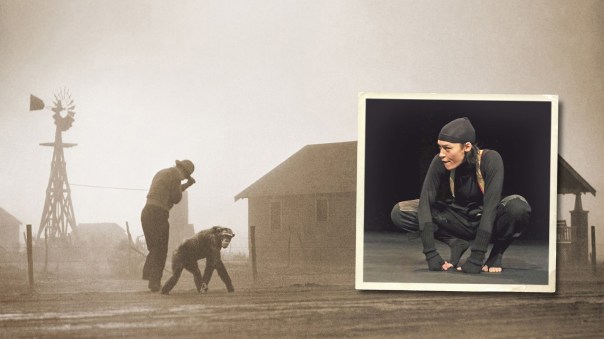
Goody will be playing at the Pleasance Courtyard (venue 33) : Aug 2-14, 16-28 (15.15)
An Interview with Laura Turner
This weekend, Chapterhouse are bringing their adaption of Pride & Prejudice to Thirlestane Castle, near Lauder.
————————
 Hello Laura, so where you from & where you at, geographically speaking?
I’m originally from Lincolnshire and the East Midlands and moved back several years ago to Lincoln, where Chapterhouse is also based.
When did you first realise you could write for the stage
I loved theatre and performing from a young age but it wasn’t until I went to university to study English Literature that I really got into writing. I realised I was particularly drawn to writing for the stage and specifically my career actually began with crafting adaptations of classic novels for the stage. With my literature background, it seemed a natural way for me to channel my more creative energies, whilst still working with the classic stories I loved so much.
You are a member of the Chapterhouse team, can you tell us about the company?
Chapterhouse was formed in 1999 and since then has gone on to become one of the UK’s largest touring open-air theatre companies. Every year we visit country houses, gardens and castles across the UK and Ireland with over 150 performances every summer. We also tour theatres during the winter and have recently begun taking productions to China as well. Chapterhouse specialises in presenting traditional but accessible productions of Shakespeare and classic novel adaptations.
When & how did you first join the team?
I first worked with Chapterhouse whilst at university, undertaking work experience with the company and from then on my involvement grew. I am now Associate Playwright with the company alongside my work for the stage and screen elsewhere and it’s lovely to still be so involved with the company that started my journey into writing and the theatre.
As a writer You have a penchant for adapting classic novels for the stage – what is it about this aspect of playwrighting that makes you tick?
It’s a huge privilege to work with classic novels – stories we have all grown up with and characters we know and love so well. For me, I learned how to write by studying the example set by authors such as Austen, Bronte and Dickens – how to shape a story, create unforgettable characters and keep your audience hooked. It’s really important to me when adapting a novel to both honour the author’s original intention, as well as bringing something of my own to the play itself, to make it a unique new adaptation that hopefully says something about who we are today as well as telling the story.
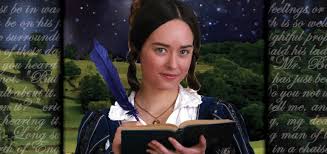
How did the process go with the ‘sacred’ text that is Austen’s P&P?
There’s definitely a lot of pressure working with stories that everyone knows and people feel so passionately about. I feel a responsibility to the author themselves, to reflect their work as they might have intended, and also to the audience who will be looking forward to seeing their favourite bits come to life! As with any adaptation, you inevitably have to leave things out but I hope that in doing so I still capture the overall feel and heart of the story. It’s never easy to make these decisions but the external factors of time constraints and the amount of actors I have to play with forces my hand, but I never make these cuts or changes without real consideration of whether it feels right. Hopefully it enhances the storytelling by making the production streamlined. I’d hate for an audience to get bored!
What does Laura Turner like to do when she’s not being all literary?
Being a writer, it’s definitely a calling rather than a vocation, so escaping the literary world isn’t really something I’m familiar with! It’s my passion so I spend a lot of my time with stories, whether that’s writing, brewing new ideas, reading, going to the cinema and watching plays. But I am trying to cultivate some time away from the laptop – especially with summer on the way I’ll be spending lots of time outdoors and walking…probably whilst thinking of some new play ideas!
Will you be coming to Scotland with Chapterhouse?
With several new writing projections on the horizon, I won’t be able to travel with the company as they go about the country, but I always look forward to visiting the teams and having the opportunity of seeing some of the beautiful venues and countryside we are so privileged to visit.
What does the rest of 2017 hold in store for Laura Turner?
My new play The Buried Moon recently premiered in London and transfers to the Petersfield Shakespeare Festival this July so I have that on the horizon as well as developing my first feature film script. I’ll be looking ahead to the rest of the year soon too when I’ll be developing a new strand of plays inspired by female characters from history and literature
Jane Eyre
Theatre Royal, Glasgow
5th May – 10th May
Script:  Stagecraft: Performance:
This tour of Jane Eyre for National theatre productions comes around with an entourage to match the titans. Starting in 2014 at the Bristol Old Vic it is a take on the story that delivers perhaps its most original meaning from Bronte that Sally Cookson, Director, was inspired by in the Orson Wells film noir version. The difference between the two is striking from the point of view of Jane Eyre. Wells distorted the idea behind the story making it instead a tinsel ride for Holly wood. Sally tells us that she thought of the tail as a life story rather than a love story which I think was correct from Bronte’s own point of view.
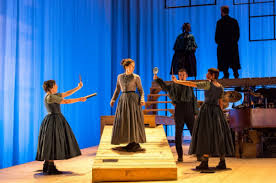
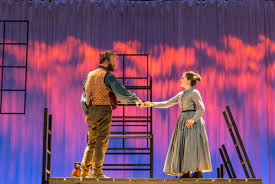
The epic quality to this play was set in plain sight in that we saw on the stage of perfect proportions a construction made of wooden levels and black metal ladders. This brought a curious feeling from the beginning. There were all sorts of theatrical nuances that played as pivotal a role as the music and costume, bringing with it a sense of theorising provoking thought. The production offered far more than collaboration instead looking to a group sense that played in the battle that shone with the light of Jane Eyre. The great leap from novel to play was made greater as the stage went beyond into the hearts of the characters.
Charlotte Bronte’s characters, who the group filtered for the stage, brought her droughts of admirable scenes particularly between Jane, played by Nadia Clifford, and Mr Rochester, played by Tim Delap, who converse about Jane and her position in his house. Jane’s story is the development of the play, which is as passionate as the book itself, her life as regarded by her and her early dealings with cruelty, and tragedy and each rung she would climb through with a strength that equality and justice deeply imbued in her as the story unfolded.
There was more than pushing of boundaries going on in this play, there was a creative urgency in almost every minute that Sally saw in the story and would passionately bring into her dedication to the cause of woman’s liberty at the end of the nineteenth century, here in a most harrowing way. Jane herself offers interludes of plain description during the evening, she talks with her colleagues in real time but is also followed by voices who debate what she is to do in her mind that was at times fragile, at times belligerent but always fair.
The representation part in this play was so intelligent, rich and fresh. In a complicated transaction from book to play on the surface planned immaculately and underneath allowed to grow as she did in pain, thought and above all action. There were bizarre moments that cut across the stage in the music and choreography, the stage brought to life in nineteenth century garb, they held a close scope to costumes so as to fit other ideas, as characters ran up and down the stage, shadows and silluetes as the stage darkened.
We could only imagine how Janes world would feel with her and the plays introductions she as orphaned as a baby, as an offering to her life. The ideas brought about in this play seem almost countless; visions arise as does life supported by the music band on stage and the various singing, melodies plucked from a pool of senses, and indifferent to Jane her own singing conscious that wore a red dress.
Visually this impact happened again and again, and deepened and was pulled back by loud appealing responses from Rochester who was perhaps Janes love that grew more passionate but again in her despair she was lost even after accomplishing so much.
Reviewer : Daniel Donnelly

An Interview with Stewart Schiller
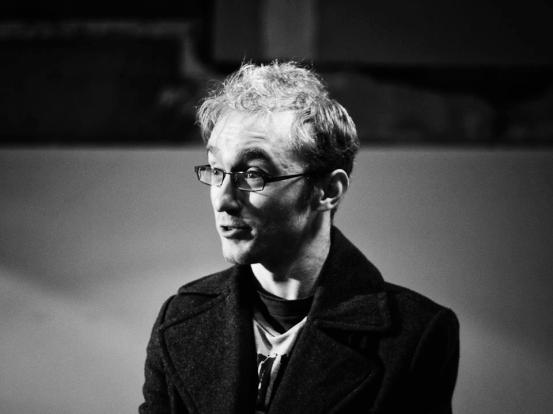
Attune Theatre are just about to take Alan Bisset’s ‘The Ching Room’ on a mini-tour. The Mumble managed to catch a wee shpiel with Attune’s artistic director, Stewart Schiller
—————————————————
Hello Stewart, so where ya from & where ya at, geographically speak?
I’m from Glasgow and still stay here.
Which paths did you take that led to becoming a theatrical artistic director?
I worked with Fablevision in Govan for a year. I learned about a lot of training in Theatremaking and Fundraising. I saw lots of ‘issue-based’ theatre and became passionate about it. I think that passion is what fuelled my desire to become an Artistic Director and form Attune.
Can you tell us about winning the IdeasTap with the BBC Writersroom?
Yeah, that was a really great experience. After winning I got to meet the head of the Writersroom and take part in a workshop explaining the BBC Commissioning Priorities. I got to meet a lot of other writers, at a similar level, from all over the UK, which was a lot of fun. I think the main lesson I took home was how the Specific can be Universal. For instance, look at Doctor Who it has very distinct ‘Britishness’ but is a huge worldwide success.
What does Stewart Schiller like to do when he’s not being theatrical?
I love Wrestling (purely the fake kind), Rugby, and Gaming in particular.
You are just about to bring ‘The Ching Room’ to Glasgow – can you tell us about the play?
The Ching Room’s one of these plays that just jumps off the page. I try to read as many plays as I can and, after awhile, they can start to blend together. The Ching Room though is really arresting. It describes seedy acts with beautiful language, whilst also being really funny. That’s a rare combination that gets me really excited.

Alan Bisset
How do you find Alan Bisset’s writing?
It might sound daft, but I find there’s a sincerity to it. In that, you feel like each play is a window to where his head was at at that specific time. So if you look a series of them, you can see his evolution as a writer and the Scottish Independence Referendum effected this psyche.
Not every play from the PPP system makes it back to the stage, But this one did. Why do you think that is?
Because it’s been printed. Unless I’ve missed something (possible). I don’t think a lot of a Play, a Pie, and a Pint scripts are printed so that greatly reduces the chances of a Director or a Producer finding the play. The play obviously stands out on it’s writing alone, but I feel that pragmatic issue has a huge influence.
Finally, what does the rest of 2017 hold in store for Stewart Schiller?
Well, on the 23rd of June I’ll be directing another piece for this year’s Tron 100 Festival. Other than that, it depends how successful we are with the Pay What You Decide model we’re using for this show. If it proves to be successful, we can go straight into Production on another show. If it doesn’t, we will need rethink things.
THE CHING ROOM WILL BE PLAYING @
Dram 10th June 2:30 pm & 7:30pm
Broadcast 12th June 8:00pm
Canal Station 13th June 8:00pm
An Interview with Liz Richardson

Hello, so where ya from & where ya at, geographically speaking?
I’m originally from Cumbria but now live in the Peak District, having moved from London a couple of years ago.
When did you first feel the pull of the dramatic arts?
There wasn’t an awful lot of access to the Arts on offer when growing up on the West Coast of Cumbria, so when my school teacher told my parents “I think she could be more than a clown in just the classroom” I joined the local Am Dram group and before you know it, I’m 17 and driving down to London with my Dad to audition at East 15 Acting School…the rest is history.
What for you makes a good piece of theatre?
A lack of elitism. An all-inclusive piece of art which can also be inspirational – I love to feel moved when I leave the theatre, both in an emotional sense but also from having been educated or taken on an unexpected journey. But then I also love to laugh – providing moments of relief where the audience can laugh out loud is a gift.
What do you like to do when you’re not being theatrical?
I love to be walking and running in the fells, mostly with my young daughter and dog. As much as I loved my 15 years in London and all it has to offer, the pull of the mountains (like where I grew up) brought me to the change of lifestyle and also allowed me to start a family.
What can you tell us about your role running the ‘Mothers Who Make’ group at Home?
Mothers Who Make is a wonderful outlet for mums who have, at some point, taken time out to have children but still want to be around those who, like them, are creators in the Arts. The sessions (which originate from London-based Matilda Leyser of Improbable Theatre) bring together such a huge range of talented mothers who, not only continue to grow their skills and build their careers within the industry but also grow and nurture our next generation. I co-facilitate these sessions with another actress/theatre maker and each month we are blown away by the incredible women we meet, their stories and their work. It can be an incredibly lonely time being self-employed and raising children and you can often feel like you’ve lost the essence of ‘you’ on the way, but Mothers Who Make allows you to share these experiences and often encourages you to keep ‘making’ and keep talking in order to achieve all that you want to. Being a parent is the most important job in the world and this is something that I think is still not recognised enough for there needing to be more support, especially in the arts.
You will be bringing Gutted to Edinburgh this August, can you tell us about the play?
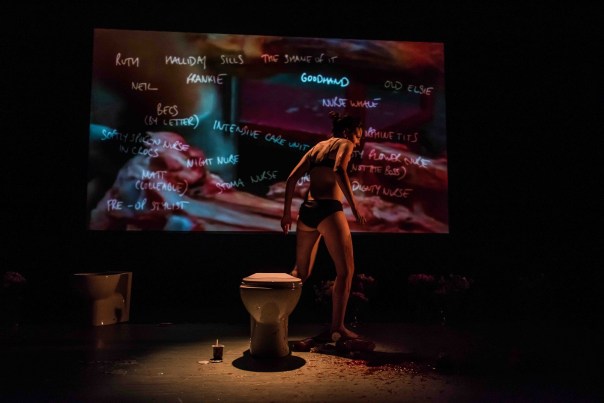
Gutted is a one-woman show about my life since being diagnosed in my early 20s with Ulcerative Colitis (an Inflammatory Bowel Disease). It takes the audience on a journey from partying hard, boyfriends and denial to building relationships with hospital patients and medical staff and my surrounding family. There are moments of tears and moments of laughter, free cake and beer and I leave my dignity at the door!
Do you find comedy develops well from adversity?
Yes absolutely- quite often this is when comedy is at its best. If you allow an audience to laugh at your expense, if you tell them how it was or is but allow them to see that it’s ok or can be, then you will have a much more receptive audience. Setting it up so you give permission to the audience to laugh rather than stifle the joy in the scenario, I think, warms them up to a lovely room temperature level…and then you can come crashing down on them with some terrible scene of tragedy where they’re left weeping.
In one sentence can you describe the experience of performing in Edinburgh in August.
It’s like eating chocolate digestives- at first you’re looking forward to it, then after the first indulging moments you start to regret starting but then you think a little more won’t harm you, and then you think what the hell am I doing and before you know it you’ve finished the lot and swear you won’t put yourself through that again, despite the highs. The next day you go to the shops and then do it all over again.
What will you be doing after the Fringe?
Eating. I can never eat before a show, I feel sick and anxious with nerves, and then quite often I forget to eat after a show as I’m usually propping up the bar. Sleeping too, although I’m hoping I can do a bit of that whilst I am off child minding duty. In-between eating and sleeping I’ll also be continuing work on my next piece of theatre making which I am starting to develop at the moment.
RCS & the Dundee Rep
Royal Conservatoire of Scotland joins forces with Dundee Rep
To stage annual musical theatre production
——————–

The Royal Conservatoire of Scotland will join forces with one of the UK’s leading theatre companies for its 2018 musical theatre production — the first to be staged in association with a professional company. Scotland’s national conservatoire, one of the world’s top three performing arts institutions, will partner with the award-winning Dundee Rep to bring the Broadway hit, Spring Awakening, to audiences in Glasgow and Dundee in March 2018. The venture will create a unique educational experience for Royal Conservatoire students who will work alongside and learn from the only permanent acting ensemble in Scotland and the theatre’s design and creative team.
As a cross-Conservatoire production, Spring Awakening will bring together students from the Musical Theatre, Music, Production Arts and Design and Production Technology Management programmes. The Royal Conservatoire of Scotland is ranked in the world top three for performing arts education and is number one in Scotland for graduate employability (97%). Scotland’s national conservatoire offers the only arts education of its kind in Europe, with specialised teaching across music, drama, dance, production and film.
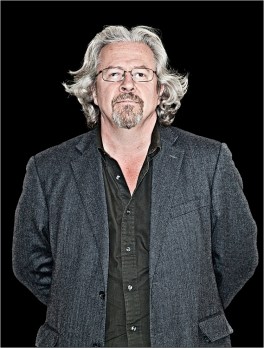
Hugh Hodgart, Director of Drama, Dance, Production and Film at the Royal Conservatoire of Scotland, told the Mumble; ‘The Royal Conservatoire of Scotland has had a very warm and collaborative relationship with the Rep for many years and past interactions have proved to be mutually beneficial to both organisations and our audiences — BA Acting students’ involvement in minor roles in the award-winning 2007 production of Peer Gynt being a shining example. That was an invaluable learning opportunity, not only for our students but for the members of the ensemble who seized the opportunity to act informally as mentors as well as welcome the students into the company as equals. This new joint venture is not merely a continuation but a step change in our relationship, being the first Royal Conservatoire of Scotland production to be staged in Scotland in association with a professional company, and with their actors playing key roles. There is an equally strong partnership planned for our production students who will be fulfilling key roles behind the scenes. I am absolutely delighted and most grateful to our friends at the Rep for joining us in this exciting venture. I hope it will be the first of many.’
Spring Awakening opens in Glasgow on March 13 2018 for four nights which includes an exclusive gala performance on March 16. It will transfer to Dundee Rep Theatre on March 22 for three nights. Both venues will include matinee performances. Students from the Royal Conservatoire of Scotland’s BA Production Arts and Design and BA Production Technology and Management programmes will create, build and operate the spectacular sets, costumes and stage effects that have become a signature of the Royal Conservatoire’s musical theatre productions. Around 20 first and third year technical and stage management students on the BA Production Technology and Management programme will work on Spring Awakening. There will also be input from around 30 students from all years of the BA Production Arts and Design programme during the construction period, who will work on set, props, costume and scenic painting.
Winner of eight Tony awards, four Oliviers and a Grammy for best original cast album, Spring Awakening redefined the boundaries between music and theatre when it debuted on Broadway in 2006. It’s a raw portrayal of adolescents on the brink of adulthood, who are trying to make sense of their strong new feelings. Desires, emotions and hormones rush to the surface in this hard hitting punk-rock musical. Professor Andrew Panton, Artistic Director of Musical Theatre at the Royal Conservatoire of Scotland and the newly-appointed Artistic Director of Dundee Rep, told the Mumble: ‘We took our 2017 production of Chess to a new city for the first time, to Edinburgh’s Festival Theatre, and we wanted to build on that as the students loved transferring to the professional stage.Working with Dundee Rep will give our students phenomenal industry experience. Our musical theatre students and musicians will share the stage with some of Scotland’s leading actors while our production and technical students will hone their skills not only in their ‘home’ theatre, the New Athenaeum in Glasgow, but in one of the country’s leading arts venues. Our students will perform in two great, creative, Scottish cities where audiences have the chance to support the next generation of Scottish, UK and International performance and production artists.’
Tron 100 Festival Announced
 TRON 100 FESTIVAL
20 – 24 JUNE 2017
The Tron 100 Festival is entering its second year with a week of new short plays written, performed and directed by members of the Tron Theatre’s professional development initiative, the Tron 100 Club. Spanning from new writing to devised work over five nights of performance, the Festival will celebrate the talent and creative collaborations established by the artistic community of the Tron 100.
Each evening of The Tron 100 Festival week, four creative teams, comprising some of today’s most exciting breakthrough playwrights, actors and directors, will present a line-up of fifteen-minute performances. Audiences will see a different programme of work each night, making every evening of the Festival a premiere of brand new theatre pieces.
For the Tron 100 Festival, members of the Tron 100 are being mentored by theatre professionals in the creation of their new works, receiving support and advice from Philip Howard, Lesley Hart, Susannah Armitage, Dougie Irvine and Lisa Nicoll to help bring their projects to the stage.
The Tron 100 Festival gives participants the chance to apply skills and practices they have developed throughout the Tron 100 workshops season in collaboration with theatre companies including Random Accomplice, Theatre Gecko, Bush Theatre, Royal Shakespeare Company, Paines Plough, Puppet Animation Scotland and Frantic Assembly and with individuals such as Stephen Greenhorne, Philip Howard, David Hayman, Gary Lewis, Joe Douglas, David Leddy, Gareth Nicholls, Morag Fullarton, and Rob Drummond
Glory on Earth
Lyceum, Edinburgh
20th May-10th June
————

Script: Stagecraft: Performance:
As spring and summer waltzes with flourish into the streets of Scotland’s capital, we are being given the wonderful opportunity to witness Linda Mclean’s adaption of the youthful adventures of Mary Queen of Scots. As a varied audience take its seats, the lone figure of John Knox (Jamie Sives) is standing clutching his bible, eagerly awaiting the arrival in Leith of Mary. With a moderate, but appealing, set design of chairs, arches and a central moving platform, the mood was set. Know was the only male actor, and his place amidst seven female roles was a fresh breath of theatrical air. Of these, Mary is of course the most important, & she is portrayed through different channels as her life is unveiled.

The delicate subject of Queenship and Religion is smoothed over with injections of modern humor and chart- topping songs, allowing the audience the chance to revel in unexpected laughter. Meeting after meeting, the intensity of Mary and John Knox”s relationship is apparent. The tone strengthens, the words tighten and the facial expressions twist. The tension is clear to see and feel; emotional , intriguing, moving, with the dramatic reliefs paced expertly, the consummate creativeness of this play is more than obvious.
Flowing like a fast river with an imminent dam at the end, this hollowed friendship is cursed by belief and religion. The tale of Mary Queen of Scots is well known to be full of sadness and difficulties, but this particular plays conveys a lighter and more graceful queen. To take a historical part of Scottish history and tell it with a twist and splash of humor was entertaining and genius. A journey of true feelings and satisfaction engulfed the auditorium as Mary said goodbye. Well crafted, scripted and acted, this is a definite one to see this spring.
Reviewed by Raymondo Speedie

 Mumble Theatre