Author Archives: yodamo
Small World
A Play, A Pie and A Pint
Oran Mor
Glasgow
Script:  Stagecraft: Performance:
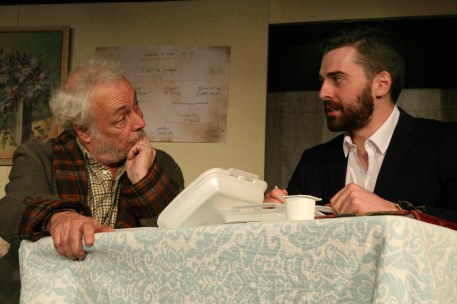
Impoverished and exiled in Scotland, old King Maximilian of Octavia (a land of mud, turnips and toxic waste) slumps in a seedy armchair with a tartan blanket round his legs, telling unlikely tales of his imperial past to his son, Crown Prince Pauli. Max’s reduced circumstances are made worse by the food his son insists on bringing home. Goji berries, green lentils and brown rice do not delight a royal palate, descended we are told from Charlemagne. Despite fears for his safety, Max daydreams of returning to his homeland. He makes plans for an international airport that will never be built and practices speeches that will never be heard. He swears there are riches hidden in lead lined trunks, buried high up an Octavian mountain but for now, he has only a wealth of ancient stories to pass on.
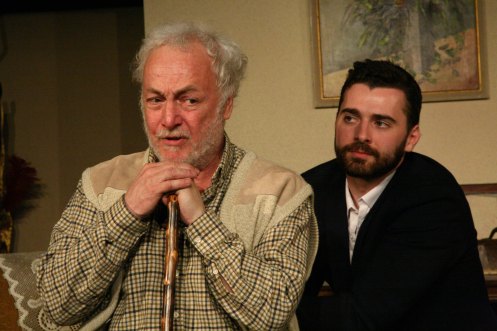
The script by Sean Hardie invites us to wonder if Max, (Jimmy Chisholm) is of noble lineage or a deluded senior citizen being humoured by a compassionate Pauli (Daniel Cahill). This is very much Max’s play and the excellent Mr Chisholm, at times fragile then positively Puckish, uses phones, windows and the audience itself to deliver yarn after entertaining yarn. Watch out for the hand jiving!
Reviewer : David G Moffat

An Interview with Adrian Berry
This August a certain play called ‘From Ibiza to the Norfolk Broads’ shall be winging its way into the Edinburgh Fringe. The Mumble caught up with writer/director Adrian Berry for a wee chat
————————–

Hello Adrian, so where ya from & where ya at, geographically speaking?
From: Nottingham, where a folk legend taught us to steal from the rich and give to the poor, an ethos I still live by. At: Helsinki, sitting on a harbour, waiting to meet a circus performer. Clear blue sky, aggressive seagulls and a shrimp on rye sandwich – possibly why they’re so angry at me.
When did you first feel the pull of the dramatic arts?
I did the sound effects for The Dracula Spectacular on my Juno S60 synthesiser at school, aged 13. I bought it from my mum’s catalogue with my paper round money. I didn’t want to perform back then but loved making weird scary noises to back the show.
What for you makes a good piece of theatre?
Anything that breaks through that audience/artist divide, draws you in, makes you feel active as opposed to passive. Great stories, physicality, visceral energy, focus, heart. Not Chekhov or Ibsen. My absolute turns-offs. Bit unfair maybe, but I find that classicist stuff so dull.
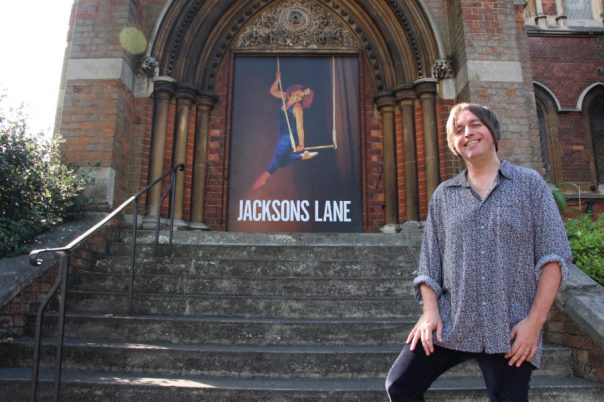
What can you tell us about your role as Artistic Director of Jacksons Lane contemporary circus theatre?
I get to create exciting programs of circus, theatre, art, cabaret, and travel to thrilling places to bring artists to the UK. I have a wonderful team who love and support the work and live for it. And I love our quirky old building and the diversity of our audiences. I wake up inspired, for which I feel so lucky.
What do you like to do when you’re not being theatrical?
I play bass and write songs and sometimes tour in the band Alberteen, I cycle to random places, I explore London on foot, I listen obsessively to vinyl, currently 80s west coast hiphop, Angel Olsen and Finnish blues (as of last night when an artist gave me a record).
You will be bringing From Ibiza to the Norfolk Broads’ to Edinburgh this August, can you tell us about the play?
It’s three stories that converge – a tale of our capital city and things that are lost, about a boy with mental health problems who escapes through his fantasies, and the amazing birth, childhood and journey of David Bowie. It all comes together at the end, and people seem to love it, happily.
As a musician yourself, is the play somewhat autobiographical?
In parts, yes. Less so the Bowie bit as that came later in life, but the claustrophobic working class upbringing, escapism through glamorous androgynous pop stars and the excitement of music….yes there’s a lot of me in there for sure.
How does your own experience in the band Alberteen influence the play?
Oh you knew about us. Ummmm…no I cannot say there is a comparison. Well actually maybe there is, as me and the boys went to the same school and I joined an early version of Alberteen as a creative outlet aged 14. It was everything I wanted to be – I still feel the pull of the band, more and more so. Everything I write has a musical influence- it all gels as part of my creative life I guess.
What has been the typical audience response?
Tears, joy, gratitude, loss, letters, gifts, hugs…genuinely. 75 shows, so much love and words. I didn’t expect it.
In one sentence can you describe the experience of performing in Edinburgh in August
A total headf*** rollercoaster beautiful expensive experience.
What will you be doing after the Fringe?
Recording a new EP with Alberteen and playing a tour of seaside piers in forgotten English seaside towns, and thinking about my next show based on a famous American hotel.
But That Was Then
A Play, a Pie and a Pint
Oran Mor, Glasgow
May 15-20
***

Script:  Stagecraft: Performance:
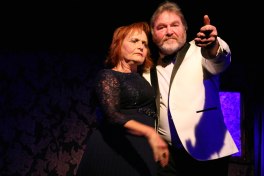 A Scottish living room of leather chesterfields, flock wall paper and a crackled mirror, hosts a theatrical couple preparing to go out for the evening, in this play by Peter McDougall. An aging actress Marcia (Alison Peebles), wearing a crown of hair rollers and walking with a stick, sets the frank tone by comparing her own wrinkled face unfavourably to King Kong’s arse. She has a list of waspish complaints about the modern theatre from the lack of glamour, to tattooed producers. Her younger husband James (Billy McBain), an unpublished playwright who we feel has listened to her numerous dramatic whinges many times before, encourages her to accept things as they are, not as they were. If he can cope with his lack of success why can’t she? Eventually their satin dressing gowns are removed to reveal full evening dress, for tonight is the night of the BAFTA Ball.
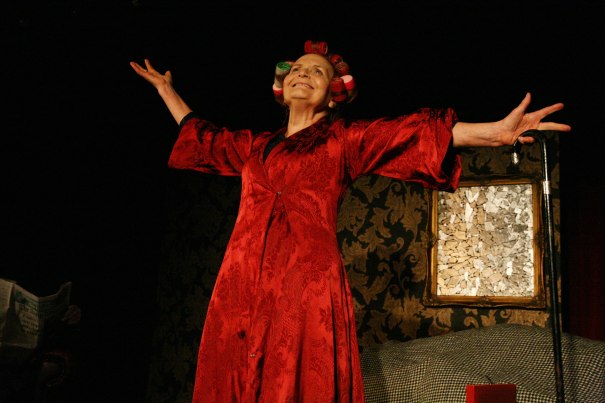
There are shades of Burton and Taylor in the ding-dong dialogue with a touch of Sunset Boulevard for good measure. A sort of ‘Who’s Afraid of Norma Desmond?’
This is a word-packed play with lots of laughter-inducing quips to enjoy but occasionally as the metaphors bounced back and forth, the discourse did sound a bit recited rather than acted.
Reviewer : David G Moffat

An Interview with Derek Crawford Munn
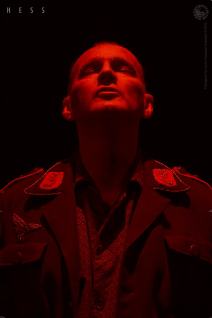
The Gilded Balloon and Kinbur Productions have revived Michael Burrell’s award winning one-man play, HESS, a poignant and haunting production that has stimulated, moved and provoked debate. A hit of the Edinburgh Festival Fringe 2016, directed by Kim Kinnie and ‘meticulously’ performed by Derek Crawford Munn, HESS has already played at Eden Court Theatre, Inverness, on 03 May and will hit The Tolbooth, Stirling on 20 May before it heads to the Prague Fringe from 26 May to 3 June 2017. The Mumble managed to catch MR Meticulous himself, Derek Crawford Munn, for a wee chat

Hello Derek, so where ya from & where ya at, geographically speaking?
I was born in Renfrewshire in the village of Inchinnan… although over the years I have lived in a few places around the UK, I’m now back in Renfrewshire near my family in Bridge of Weir.
When did you first feel the pull of the dramatic arts?
I’ve been ‘performing’ from an early age, in everything from school plays to local drama clubs. My first professional paying acting job was in 1988, which was closely followed by 3 years in The then Royal Scottish Academy of Music and Drama, and I’ve luckily been working in the industry since.
What for you makes a good piece of theatre?
I’m sure my answer to this question won’t be original, but good theatre for me is anything that completely engages an audience. Whether that be with laughter, tears or shocks. If you’re lucky enough to be either in or watching a great piece, the tell tale sign is the ‘pin drop’ moment, by that I mean the moment when both audience and cast are completely immersed in the experience.
What does Derek Crawford Munn like to do when he’s not being theatrical?
Hobbies? My dog I suppose, and a great love for travelling and exploring our beautiful country.
You are just about to take Michael Burrell’s HESS on the road. Can you tell us about the play?
HESS was originally performed by its writer Michael Burrell in 1976 at the Young Vic. The play is essentially the life of the Deputy Fuhrer. It also works on several levels as a comment on rehabilitation of the incarcerated, as a detailed description on the rise of the Third Reich, and finally but most importantly, a most timely and pertinent warning from history on the dangers of right wing extremism.
Hess was a complicated character, does that come out in the script?
Yes the complexity of his character is very evident throughout, and pretty much displays itself by both engaging the audience’s sympathy and it’s revulsion.
How did audiences respond when it was performed at last year’s Fringe?
The audience reaction at the fringe was pretty overwhelming. With almost everyone who saw the show being extremely complementary. Without question though, the best moment for me, was when I was visited by a gentleman in his 80’s, who had been a medical officer in the British guard contingent. Getting the compliment “You even caught his mannerisms” from a gentleman who had examined and actually spoken to HESS was a moment I won’t forget.
Does it not feel lonely up there, when you are doing a one-man show?
Not at all! In fact I don’t think I’ve ever been in a piece that engages with the audience as much as this one. If there’s any loneliness its during the rehearsal period, where there’s no-one to bounce off or even have a break and a coffee with.
You are just about to take Hess to the Prague Fringe, what’s the backstory?
No denying I’m hugely excited that I’m off to Prague for the festival there. There are many personal reasons I want the piece to do well there, not so much for my benefit, but for all those who surround it, and have been involved in getting us this far. As I said earlier, we sadly lost Michael in 2014, and considering the great success he had with it first time round, and of course his brilliant writing, I am very keen to give it as much exposure as possible, and that it should be the memorial to him it deserves to be.
What does the rest of 2017 hold in store for Derek Crawford Munn?
I’m hoping for more of the same really. At almost 60 years old I’m still pretty young in HESS terms, as he is in his eighties in the play, so it would be nice to think that I can tour the play for quite some time yet! And as any actor worth the name will always tell you, “this could be the one” So who knows, maybe you can interview me again in 20 years timE!
Daphne Oram’s Wonderful World of Sound
Tron Theatre,Glasgow
May 9th -13th
Script:  Stagecraft: Performance:
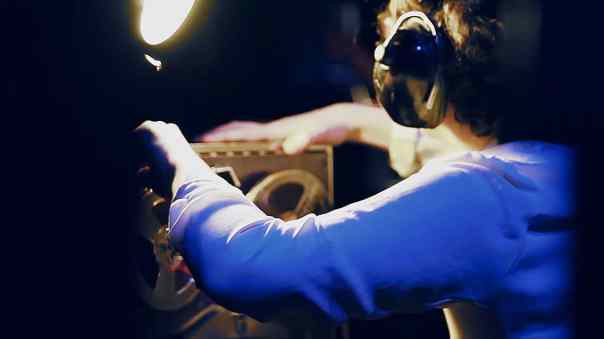
On entering the auditorium the audience find a stage tableau of four men frozen in the act of reading about, listening to or adjusting radio equipment. Their brilliantined hair, white shirts and braces (reminiscent of a Vettriano painting) place the inaction back in the mid 20th century. A throbbing bass note from the huge sound desk at the back of the stage contrasts with the terribly, terribly plumy voice of the play’s eponymous narrator portrayed by Isobel McArthur (joint author with Paul Brotherston). She informs us that humans are imperfect, incapable of making precisely the same sounds again and again, unlike a Radiophonic Workshop.
 What follows is the story of Daphne Oram’s fascination with sound reproduction, from a girl scribbling diagrams and doctoring radios to a woman pioneering audio effects for the BBC. A true visionary, she faces opposition or at best indifference from Aunty BBC and its committee culture. Eventually the redoubtable Miss Oram prevails via the Drama Department. (Those of a certain age will enjoy the references to PC 49 and the struggle to get a noise for danger that wasn’t a cymbal clash!)
There is much to admire here from the live sound score provided by Anneke Kampman to the ensemble cast of Robin Hellier, David James Kirkwood, Dylan Read and Matthew Seagar who skilfully vary roles, accents and genders; their slow-motion scene changes are a balletic delight. An excellent production that educates, informs and entertains.
Reviewer : David G Moffat

Beg Borrow Steal
Oran Mor
Glasgow
8th – 13th May 2017
 Review 1 : Daniel Donnelly
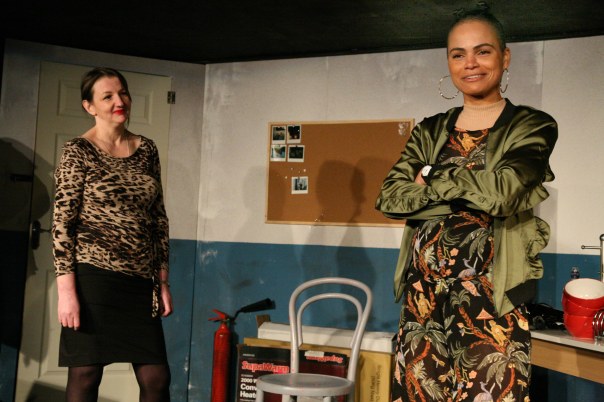
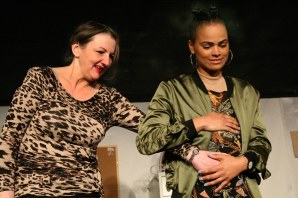
The Oran Mor is now a major venue for all things entertainment, including the play pie & & pint theatrical lunch break. On taking our seats, an announcement sprang up which told us both the venue’s success and the accomplishment of the award-winning production team behind Beg Borrow Steal, a modern take on the civil disparity between fairness and injustice. The play was quite realistic in dealing with the matter, a subdued mishmash of conversation set in a situational work piece. My friends have children, & I could well appreciate the times when Tess (played by Molly Innes) would break down while on the telephone. Character development is extremely important to this play; on the one hand we have a woman who really, really cares & on the other a youthful deviant at odds with the world.
I must admit there was a moment or two which felt out of place, a little over arty perhaps, but this play’s true strength lies in its uncannily accurate social commentary; are we actually seeing reflections of ourselves? Like all our personal relationships, Tess & Cher – played by Natalie McCleary – grew close then fell apart, while at all times carrying the emotional content of their liason in sometimes guarded words, and sometimes louder for emotional turmoil. Beg Borrow Steal & all its key messages felt right in just so many ways, & I enjoyed the thrill of piecing together an unfolding story, when as our thoughts reach their conclusions, these turn out to be more of beginnings than anything else.
Review 2 : David G Moffat
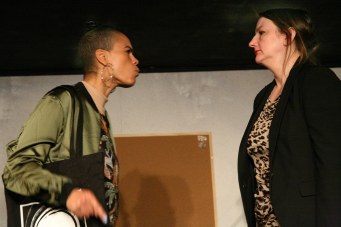
This play by David MacLennan Award winner Anita Alexander Rae, explores the relationship between Cher (Natali McCleary) a 23 year old shoplifter with attitude and Tess (Molly Innes) an incredibly understanding store-security manager. The latter has issues with her estranged daughter or more accurately her daughter’s voicemail which inevitably greets her every call. Perhaps this is why she has such sympathy for the younger woman and sees her repeated offending, not as straight-forward theft but more a cry for help. Over larcenous weeks a tenuous bond is established, with Cher becoming a kind of surrogate daughter to Tess, offering her advice on relationships and shoes while revealing bleak details of her own family life.
The different occasions when Cher is held in the office to have her fate decided (I counted five) are separated by slight scene changes accompanied with relevant sound effects which work well within themselves but do leave the overall action somewhat disjointed. Would anyone really give a shoplifter that amount of free passes? Wouldn’t store owner Mr Carrot insist a frequent offender be banged-up? Well if Hamlet topped his uncle in scene 1 there wouldn’t be a play. That said an hour’s running time did seem on the longish side.
Travels With My Aunt
Citizens Theatre Glasgow
3rd-20th May 2017

Script: Stagecraft: Performance:
 Henry Pulling, 55, a retired bank manager and confirmed bachelor, has been living a sheltered life in the leafy suburb of Southwood tending to his beloved dahlias. At his mother’s funeral he meets his formidable 76 year old Aunt Augusta for the first time in 50 years; his life will never be the same again as she coerces him into travelling with her to Brighton, Paris, Istanbul, Boulogne and, finally, Paraguay. In the course of their journeys he discovers that his aunt has lead a racy and dissolute life of petty crime and prostitution and has had several lovers over the years, the chief among these being the shady Mr Visconti. Over the course of the play Henry is increasingly drawn in to Aunt Augusta’s lifestyle and eventually becomes as immersed in the shady side as his aunt.
***
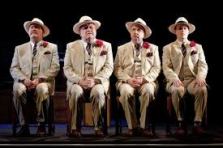
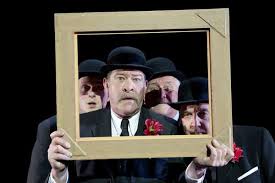 This play is an adaptation by Giles Havergal of Graham Greene’s 1969 novel Travels With My Aunt and although regarded as a comic novel there are some darker undercurrents at play as the story unfolds. The adaptation sticks pretty closely to the original story and, indeed, much of the dialogue is pretty much verbatim from the novel. Havergal’s device is to use only four (male) actors for all the 20 or so characters in the play and director Phillip Breen has made a good job of pitching the performance in such a way that serves the story well while avoiding any possible confusion as the actors rotate through their multiple parts. The stage set is very simple and stark and uses projected place names on the rear wall to keep you up with the locale of the action. Actor 4, Ewan Somers, is used almost as a mime-come stage-manager and has a hilarious turn as a German General’s Irish Wolfhound that comes to a very sticky end. Ian Redford is particularly effective as Henry/Augusta with Tony Cownie and Joshua Richards dealing with a multitude of different characters. A nice touch is the change from dark old-school city gent suits in the first part to tropical white suits in the second and the subtle lighting gave a real feeling of the Paraguayan heat.
 By no stretch of the imagination can either the novel or the play be categorised as laugh-out-loud funny although there are many moments which raise a smile and there is the occasional moment of real laughter. Some of Greene’s attitudes to race are very much of their time and would not be recognised now, although this play manages to curb the worst excesses. At nearly two hours in total the audience was kept unflaggingly entertained throughout and accompanying Henry’s journey to a possible idyllic life in Paraguay is well worth seeing.
Reviewer: David Ivens
Charlie Sonata
Lyceum Theatre
Edinburgh
May 2-13

Script: Stagecraft: Performance:
Even before Charlie Sonata begins, one look at the stage suggests it’s going to be an unusual kind of play, and certainly with an unlikely, tragic hero. Poor, drunken, childlike Chick (brilliantly played by Sandy Grierson) has returned to Scotland to find his two university pals Gary (Kevin Lennon) and Jackson (Robert Jack) from two decades earlier, now firmly along the expected trajectory of adult life. Somehow Chick hasn’t been able to ‘become a man’, and instead has lost himself in the cracks of imperfect, harsh modern life and holds up an alcohol-drenched, wobbling mirror to British society. Director Matthew Lenton has taken Douglas Maxwell’s peon to his good-hearted but troubled real-life friend and created a dreamy, seemingly incoherent drama, spiraling through time. Narrator Robbie Gordon, with his grey suit and intense stare, projects a simultaneously friendly and sinister presence, which sets the tone for the entire play.
Against the backdrop of his friend’s comatose daughter Audrey (Lauren Grace) lying in a clinical hospital room, poor incoherent Chick, in childlike fashion, wonders at the absence of expected warmth in the doctor Mr.Ingram’s (Barnaby Power) stiff manner; as he sways and squints drunkenly, aptly pointing out that the doctor’s ‘like a machine’. A stellar cast of nine takes us on a journey back and forth through time; the beautifully evocative lighting and set pushing us, by turns, gently and alarmingly to misty memories and encounters of Chick and others, from drunken love on the streets with expletive-laden, erratic Mo (Nicola Jo Cully), his opinionated friend Jackson’s philosophical rants at university in the early 90’s to hazy recollections of what may have happened to put the 16 year old daughter of his friend Gary and Kate (Kirstin McLean) into a coma.
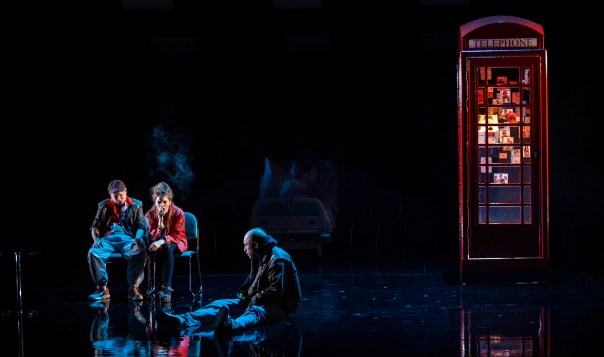
“I don’t mind dying,” says Chick, with this unwanted opportunity to finally become a hero. We root for Chick, with his soft smile and obviously warm heart, even when we know it’s pointless. His old friends care for him, but don’t seem to take his downward spiral seriously. The only one who actually asks about his well-being is Audrey, in the refreshingly direct way that teenagers have. “What happened to your girlfriend?”, she asks him, as he is proud to give her the only useful advice he has, and that’s how to begin a lifetime of drinking alcohol in the right way. Grierson’s powerful acting points us towards an appreciation of a whole world of love and loss and drama on the streets, that is generally shunned, hidden and ignored. Maxwell’s play forces us to feel for those sensitive people who fall through the cracks in our industrial, competitive society, turning to destructive crutches and never to be fully embraced again, as they become our source of shame; the neglected, the uncared for, the burden to a world running on adrenaline.
Meredith (played by Meg Fraser) is an intriguing and equally unforgettable character who unleashes her romantic and family problems on Chick as he visits the hospital. From a seemingly random meeting with Chick, Meredith is comic, angry and compelling to watch in her gothic ballet outfit with running mascara; she is part real, part dream world, the costume creating the bridge between the fairy tale and reality. These are the difficult, invisible people in touch with their messy feelings and we can’ take our eyes off her. Her existence is a clever dramatic device allowing for reflections not just on the art form of the play but also the dramas that play out incessantly in the mind and in life itself, as at times she operates like a part of Chick’s alcohol-sodden dreamworld.
Yet the play is very rooted in Scottish life, and the cultural references reflect that. At times, the dialogue feels a little too specific to time and place. Some of the references to pop and political culture of the past couple of decades feel a little narrow for the wide range of ages in the audience, and yet chuckles were elicited from some of the older members of the audience. However, the character of Chick is based on the tragic death of Maxwell’s university buddy, and the sympathy towards the leading man seeps out at every turn, even when he’s retching at the worst possible time. It manages to be highly visceral, relatable and other-worldly at the same time, which is not an easy feat to pull off. There are comic moments, tidbits of social commentary and highly touching moments, like the beautifully acted monologue from mother Meredith doting on the now comatose Audrey at her bedside, as she reviewed their relationship. “I was a fascist mum.” There are bittersweet moments where Chick laughs to Mo about his sad childhood with his sick father, and we get a glimpse of his inner suffering.
The set (designed by Ana Ines Jabares-Pita) and lighting (Kai Fischer) deserve a special mention. The artful combination creates a highly evocative atmosphere, from the inventive roving red phone boxes doubling as time machines to the careful arrangement of softly lit white ballet tutus. Even the garish artificiality of Jackson’s soft play area is familiar yet nightmarish in its comment on modern life; structured play not being real play at all. The brightly coloured balls trip up Jackson, and Chick struggles to complete his determined but precarious climb of the ropes in his quest to help his friends. Both thoughtful set and lighting decisively deliver us the dream-like experience of Chick’s inner world.

It’s hard to look at the rapidly degenerating Chick after a while, which is, of course how the other characters feel too. “Chick will always be Chick”, says one friend; an appreciation of his unique charm but also an abdication of responsibility towards a friend who can’t take care of himself. Chick is trying to do whatever he can to help Audrey, but is getting himself increasingly lost. But Chick has his chance to embody the twisted archetype of prince and saviour. As he tells his family’s story, he has the wherewithal to define himself, and proclaim himself by his proper name, Charlie Sonata. He has a certain disconcerting air of dignity even at the end, even as his ever more violent shaking leaves you with undercurrents that rock you well into the next day.
Reviewer: Lisa Michel Williams
Photography : Drew Farrell
———————–
Confessional
A Play, A Pie And A Pint
Oran Mor
Glasgow
Script: Stagecraft: Performance:
——————————————————————————————
Question – When is your uncle not your uncle?
Answer – When he’s a priest and you have to make confession to him.
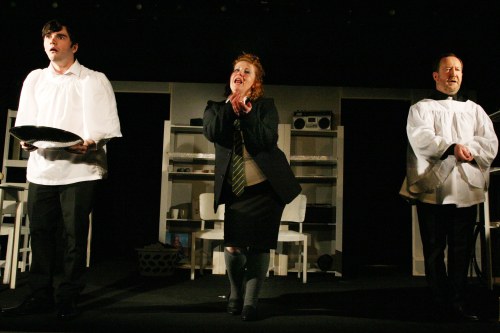
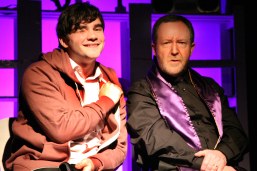 Kevin is an altar boy rapidly outgrowing his cassock as he tries to deal with nascent stirrings for the opposite sex. His Catholic family have that old dilemma, should their son join his uncle in the priesthood or fumble for happiness with ‘the one’, gum popping siren, Katherine? Mom and dad, granny, and grandpa, ‘God’s anointed’ Uncle Ignatius, even Kevin’s teacher, all have their say but could the answer lie in the concise thesis our hero presents to the Church? Set in the 1980s, this entertaining comedy by David Weir lightly treads familiar ground, with the cast of Jonathan Watson, Sally Reid and Cameron Fulton, all in fine, multitasking form.
The living room set is excellent, with a background of white shelving (displaying items of the period) framed by black curtained, confessional doorways. Through these, the rapid coming and going of characters becomes at times, appropriately farcical. The precise use of numbers throughout (14 cousins, 40 days of lent, 1,973 pupils, 56 hours of romance) lends a strangely satisfying counterpoint to the broad, brush-stroke humour. Verging on the cartoonish (Mr Watson does faces) this is a play that may not surprise but will amuse.
Reviewer : David G Moffat
An Interview with Paul Brotherston



Anneke Kampman

 Mumble Theatre