Author Archives: yodamo
Dr Johnson Goes To Scotland
Oran Mor, Glasgow
Play, Pie, Pint
24th-29th October 2016
Script:  Stagecraft:
  Performance:
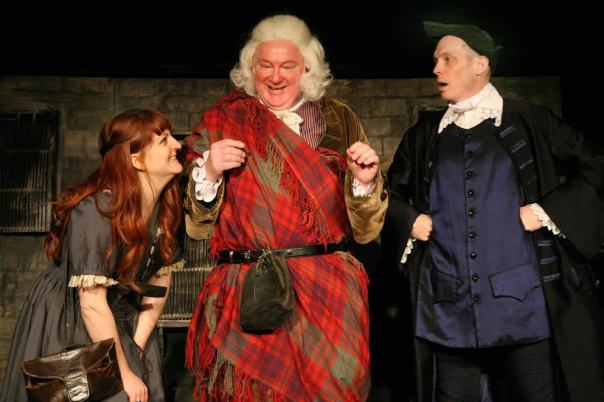
Written by James Runcie and directed by Marilyn Imrie, Dr Johnson Goes to Scotland was presented at the Oran Mor, A Play, A Pie, and A Pint, in association with the Traverse Theatre, provides an alternative look at the travel of Samuel Johnson, most famously known as the author of the English Dictionary (commonly referred to as The Johnston Dictionary), throughout Scotland in 1773.
As the 1987 hilarious comedy Planes, Trains and Automobiles follows the adventures of a travelling salesman and his journey home to his family, Dr Johnson Goes to Scotland, brilliantly compresses Samuel ‘Dictionary’ Johnson’s 87 days of carriage, horseback and boat into an hour of adventure, laughter and lovely Gaelic singing, with refreshingly simple yet effective use of stage and the actors.
Looking to experience the primate and wild Scotland of stories foretold, Johnson (Simon Donaldson) embarks upon a journey of Scotland with his good friend and scots born James Boswell (Lewis Howden) only to see his view and beliefs change as he is welcomed, treated with openness and warmth by those he encounters, eager to express their pride of being Scottish, their languages and culture.
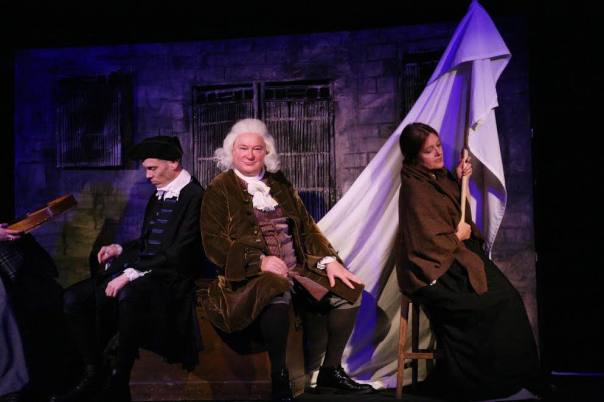
Johnson a believer of the superiority of the English Language, begins his journey in Edinburgh, and with Boswell as his translator, dives into the scots culture, the languages of Scots, Gaelic and early British Sign Language. After initial introduction to the language of Scots in Edinburgh, he travels by horse and carriage to Aberdeen where he encounters the language of Gaelic, and as they attempt to communicate we are treated to a hilariously scene of Johnson trying to request a bed for the night. With crude and basic hand gestures and signs, only for the bewildered woman, aghast at the prospect of a ‘threesome’ with Johnson and Boswell. Leaving the audience around me chuckling heartily at Johnson attempts to undo this misunderstanding.
Superbly supported by Gerda Stevenson, Morna Young and Ciaran Alexander Stewart, as the people he encounters throughout his journey we see Johnson treated to all things Scottish including food, tartan, whisky, and the best use of shortbread I have seen.
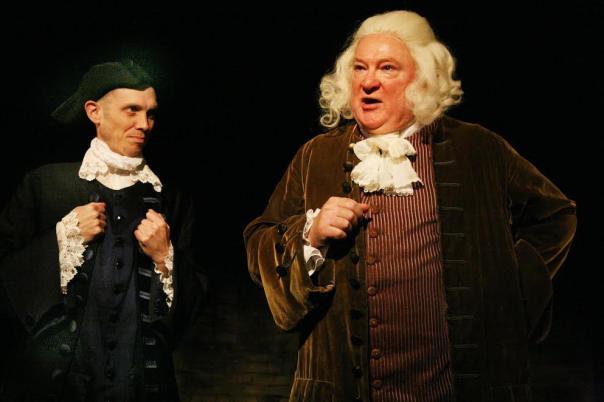
By boat he travels to the Isle of Skye where he wholeheartedly expresses his gratitude for the experience of the communication of sign language. He is genuinely in awe and wonders how someone (Ciaran Alexander Young) can communicate so well when they have never heard the spoken word. But not all his experience were enjoyable and he did find some of the journeys tedious and was quoted as saying ‘Journeys made in this manner are rather tedious and long. A very few miles requires several hours”, and he deplored the depopulation of the Highlands.
The haunting beautiful Gaelic signing of Stevenson and Young, combined with the enjoyment of watching the actors perform all the roles of the play, from the clippity-clopping horses and carriage, the swaying boat as it crossed to Skye, to the stall ladies selling their ware, the simple yet effective use of the stage only adds to the experience of Johnson journey.
Johnson clearly began his journey with a pre-conceived ideas of the Scots, primitive, uneducated, aggressive and uncouth, we watch as he warms to the Scots, impressed by their humour and resilience and pride for all things Scottish, despite the harshness of the lands, the humble and poor living surroundings, people expressed a warmth and kindness he was not anticipating .
Interestingly given the current world challenges around mass migration of people and immigration, this play does allow you to explore the connection between the language of a people, their culture and how it shapes their beliefs and desire to share it with others. How do you communicate, express yourself, and connect with others, be able share of yourself. You are most definitely left with the feeling of the Scots being openhearted, embracing their culture and heritage, proud to be scots and of their language.
Well written, well performed this play will provide you with an unforgettable journey into the maybe the final conclusion as in Johnson words – ‘No dictionary can define a nation.’
Reviewer : Kathleen Cooper

An Interview with Fiona Miller
The Mumble – Hello Fiona, so your play, the Flames is just to be turned up to boiling point, can you tell us more about it
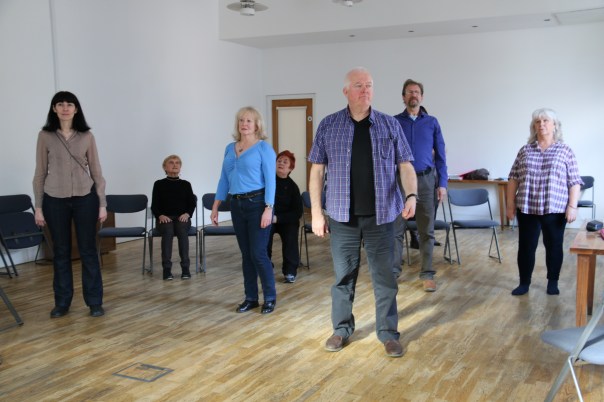
Fiona – It is indeed! The Flames is a new performance group for participants aged 50 and over and it is launching at the CCA in Glasgow on Wednesday 26 October as part of Luminate. We have been putting together a live performance based on the eight participants involved and playing with ideas of risk, daily routine and changing identity. It has been great fun devising a new play with them because they are totally up for throwing themselves into the process. It feels a bit dangerous at times! Live music is being created for the show and we have been recording images and bits of film that are integrated into the performance.
***
The Mumble –The Flames came together after a series of workshops (I believe) – can you talk us through a typical session.
Fiona – We start with a warm up. I find when working with adults, you have to reintroduce the idea of playing, which is usually trimmed out of us in high school. It’s also to encourage adults to stop thinking and just react to what’s happening when they start the devising process. The rest of the session is based around the participants responding to questions I ask; getting them to do tasks without words and then finding a way to join up all the different ideas that emerge using ensemble performance so that they are all supporting the dramas that are made. It is always a surprise. We never know what we will end up with at the end of the session! They put a lot of trust in me and in the process that it will work.

The Mumble – How are you finding the performance levels of the over 50s set.
Fiona – The same as mine! I love the balance between working really intensely then having a break and a chat. Energy levels go up during the sessions when they do something amazing and inspiring.
***
The Mumble – You founded Tricky Hat Productions in 2005. How has the company evolved in the past ten years
Fiona – A lot. We now have multiple projects on the go. We have a great team of people that we have been collaborating with for a few years which means we build the way we work artistically together. We are always looking for new collaborations with artists, organisations and with people who want to make new theatre. We are currently expanding our work internationally which is really exciting
***
The Mumble – What are your plans for both play & company after this stint in Glasgow.
Fiona – We want The Flames to spread across Scotland. The Flames is for anyone over 50 who wants to create a live theatre performance in five days so it is adaptable and transportable. As a company we can work anywhere. We can take inspiration and ideas from one Flames performance and inject it into another. We are looking forward to watching The Flames ignite and expand.
***
The Flames
CCA, Glasgow
Wednesday 26 October 2016, 2.30pm & 7pm
For more info or to get involved in future projects email: info@trickyhat.com
One Thinks of it All as a Dream
Oran Mor, Glasgow
Play, Pie, Pint
17th – 22nd October
Script: Stagecraft: Performance:
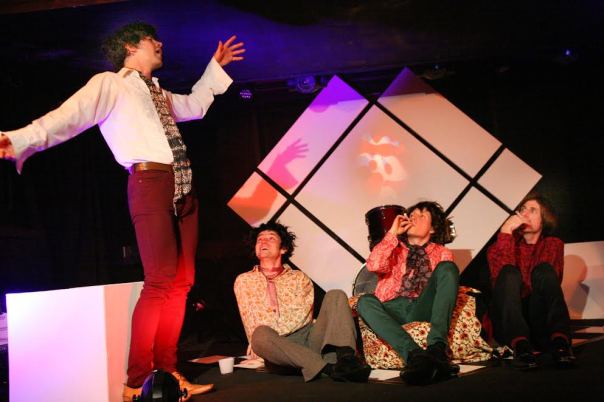 Specially commissioned for the Scottish Mental Health Arts and Film Festival and in association with Traverse Theatre and Aberdeen Performing Arts, this week A Play, A Pie and a Pint ‘One Thinks of it All as a Dream’ by acclaimed writer-director team Alan Bissett and Sacha Kyle centres around the enigmatic and immensely talented Pink Floyd frontman Roger ‘Syd’ Barrett (Euan Cuthbertson). From the outset you are immediately exposed to the erratic and confusing behaviour of Syd, as Cuthbertson, so dynamically vaults between seemingly normal behaviour and sparks of madness and volatility in behaviour.
As you absorb this beginning, the arrival of Syd’s bandmates Roger Waters (Andrew John Tait), Richard Wright (Ewan Petrie) and Nick Mason (David James Kirkwood), and effective use of stage lighting we are transported back in time and the lifelike feeling of being in the London Underground Music scene and the psychedelic world of the band. We are taken on their journey to the dizzy height of fame under the leadership of Barrett.
Flashbacks to his father reading him stories as a child to drug fuelled hallucinations interlaced with periods of clarity, brilliance expression of talent and musical ability that propelled Pink Floyd to the level of stardom in the Late 60’s, early 70’s. Cuthbertson vividly expresses through the immensely well written script, that Barrett was a visionary and wanted create the music of the 70’s. At times you question your developing opinion, is he suffering from mental health or simply playing a part, a role, performed for his artistic enjoyment and at the expense of others around him. 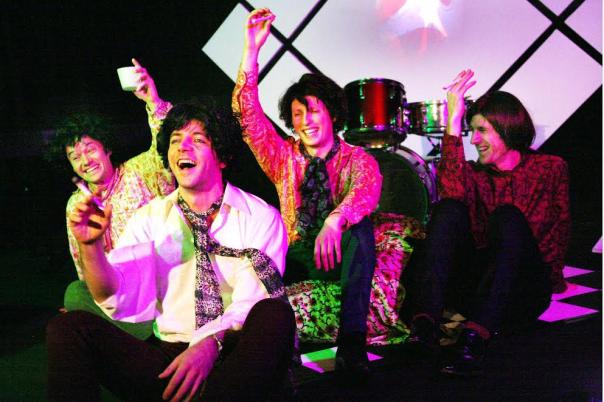

However all was not well and soon we are exposed to the alternate world of Barrett and the dark, destructive, emotional portrayal of a man haunted by his deteriorating mental health and the damaging impact it has upon his relationship with his band mates. Brilliantly supported by Tait, Petrie and Kirkwood I became engrossed in the internal politics of the band and each individual members battle to come to terms with Barrett and his increasingly erratic behaviour and inability to perform on occasions. Collectively torn between their loyalty for him and the demands of fame and the increasing commercial success, they eventually replace him. This plunges Barrett into the depths of isolation and as I watch the story unfold there is a real emotional connection to the despair, isolation and stigma attached to the poignant events, captured so eloquently by Cuthbertson, not only in his words but his body language and facial expressions.
Barrett retreats into his own world, no longer able to express his artistic talents through music, turns to art and painting as his solace. We are treated to moments of reflection by his bandmates are they reminisce over songs written and performed with Barrett and I genuinely felt their respect for him, for his talents, yet there is a melancholy, a feeling of loss, and the decision they made.
Fast forward some years and the reunion of Barrett with the band. When Barrett arrives so much has been the toil of his battle, he is unrecognisable to his band mates who initially dismiss him, his physical demeanour so dramatically and drastically different to their memories of him past. Only as he engages with them, expressing himself again, do they become awake to his presence and embrace him into the band once again.
Laced throughout the play, the funny and witty interaction between the characters shines a light onto the sometimes dark and taboo subject of mental health and the emotional, tragic and damaging impact it has upon the soul of person. Exploring Barrett’s journey provides a thought provoking opportunity to examine our own thoughts and feelings and I was left with a feeling of having gained a wonderful, if not poignant, insight in the life of the immensely talented Roger ‘Syd’Barrett.
Reviewer : Kathleen Cooper
An Interview with Cora Bissett

1 – Hello Cora. So, when did you first encounter April de Angelis’ Jumpy, and what was it about the play that first struck a resonance with you?
It was actually when David Greig suggested it to me among lots of other plays, all very different in style. I read Jumpy in one sitting whilst feeding my baby in bed one night, and had to stifle my laughter. I loved it immediately. I loved the humour April brings to these critical life stages. I also loved the way she very playfully toys with the different generational concepts of what it is to be a feminist: what did it mean then, and what does it mean now?
2 – How are you adapting the play for a Scottish audience?
We’ve relocated it to Glasgow, so certain details have changed to make it specifically Scottish. Some of those are very subtle things, like a family holiday in Norfolk is relocated to Carnoustie. We chatted for ages with the cast asking ‘which is funnier – North Berwick or Carnoustie?’!
3 – Have you worked with any of your cast before, and did you feel any of them were perfect for any particular roles in Jumpy?
I’ve worked with Stephen McCole on the STV BAFTA-winning series High Times. It was some years ago, and Steve played the most brilliant stoner. I’ve always loved his work. I’m a mega fan of Gail Watson, who I think is a comic genius, and I’ve tried to employ her on multiple occasions – same with Richard Conlon! And I’ve seen Pauline in many things, but was particularly blown away by her recent performance in This Restless House, so am delighted to have her in this. I’ve admired all my team from afar, so I’m pretty damn delighted to be working with them now.

4 – Has the production all been plain sailing, or has there been a mishap or two?
In all honesty, this has been one of the most straightforward and enjoyable processes I’ve experienced. It’s a great play, and April has created these wonderful, recognisable, contemporary characters going through things we all painfully recognise. The tricky part has been finding the balance between the comedy of it and the very real, desolate vulnerability in all of the characters, and to never overstate either side.
5 – What are your plans after Edinburgh?
I’m working with National Theatre of Scotland on a new play about a transgender boy for next year, and I’m developing another production with Theatre Royal Stratford East based on a very famous contemporary novel (which I can’t speak about just yet!)
The Suppliant Women
The Lyceum Theatre
Edinburgh
1st – 15th October 2016
£10.00

Script: Stagecraft: Performance:
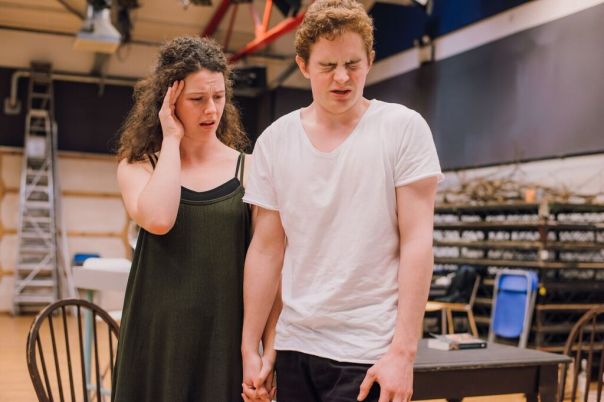
On a slightly chilly October night the Lyceum seemed like a warm environment to set oneself in order to take in this astonishing theatrical production of The Suppliant Women. A two thousand year old play with a subtle but new twist is brought to us by young enthusiastic actors from all over Edinburgh. With an introduction of a sea-slip stage with a slant, and four buckets of water the logic of the set was clear. After a small introduction, the stage is then engulfed with a wave of women. Enstrangled and desperate, they are fleeing domestic uncertainly and are looking to seek refuge in Greece under the protection of Zeus. A drama, a play and a musical, it tends to have it all. As the light dims the saga begins… huddled together , crossing a deadly ocean, braving winds and storms they reach the protection off the Greek Gods…
With branches and white ribbons as props and well-crafted movement, the play takes on an endearing mood. Sung in chorus and beautifully delivered we close our eyes, listen and take a step back in time. With tales of Gods, Kings, Ancient Cities, Greece, Egypt and with emotionally wounded women, this is an enchanting piece of drama. It was inspiring to see so many young people giving their time and talents to understanding our past histories. To take a piece of theatrical history and create an informal but educational insight to times passed is heart warming… the relevant points that relate to us today as well as 1000s of years ago are apparent to see within this production.
As the cast grows in size so does the tension. The musical score was haunting but soothing, driving the play along at full speed the anticipation builds around you. With the King and people granting the ladies asylum, a mad frenzy of joy and relief is unleashed. A stunned silence covering the audience and with a quietness of consideration – it was all rather like being in a church. Well rehearsed, delivered with heart and desire, this was a moving and thought-provoking play. Pushing the boundaries is a huge part of theater and these actors did just that. The Suppliant Women moves you and warms you to the understanding of human endeavours. If you get a chance to be involved in, or to witness this pay, please take time to support it & be educated in the ancient arts of drama.
Reviewed by Raymond Speedie
An Interview with Omar Ebrahim

The Mumble – Hello Omar, so how are you enjoying the city of Edinburgh?
Omar – Edinburgh is a great city and its National gallery is also home to the amazing seven sacrament paintings by Poussin! A lot to enjoy.
—
The Mumble – What is your take on the story of the Suppliant Women
Omar – First and foremost this play shows us the power of a chorus in a drama. In this case the chorus is formed of the women of Edinburgh
—
The Mumble – How are you finding working with the Lyceum’s triumverate – Gray, Greig & Browne
Omar – This play is very old and much of the work has been a kind of archaeological exploration based on what versions and fragments of the original text exist. The triumvirate (David Greig, Ramin Gray, John Browne) have invited us to join in this process through discussion, revision and encouragement to refire the imaginative engines that Aeschylus summoned when he first made the play.
The Mumble – There is also a lot of input from the local community – could you tell us more about this
Omar – The community have been working on material that John Browne has written as settings of David Greig’s translation for this piece. They have learnt by ear and so have formed a strong bond between themselves as a group. They have learnt dances and stagings and their presence as the central energy source is very clear.
—
The Mumble – Finally, what is the future for this production?
Omar – After the performances in Edinburgh we go on to Belfast and then Newcastle with different groups of women who will have undergone the same preparation process in order perform “The Suppliant Women” in theatres there.
Breaking the Ice
Oran Mor, Glasgow
Play, Pie, Pint
26th Sept – 1st October
Script:  Stagecraft: Performance:
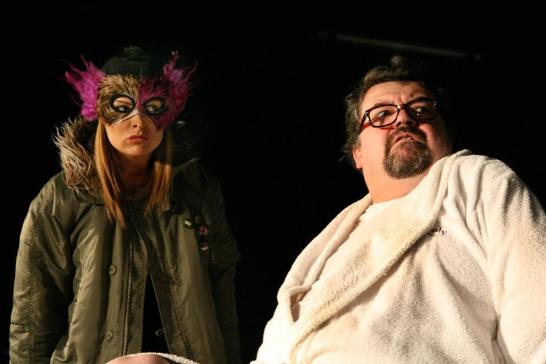
Presented in association with the Traverse Theatre this weeks A Play, A Pie and a Pint Breaking The Ice by Kieran Lynn is set in the Arctic and worth the watch. This topical farcical tale of treacherous bribery and corruption will have you in stitches from the outset. Meet Frank (Steven McNicoll) who has arrived to give a speech at the Arctic Council conference and the various characters, (Jimmy Chisholm and Nicola Roy) who between them play the hotel staff, an American marines, Russian delegate and a crazy weed selling shop worker and kidnaping duo. Never have I witnessed a door being used with such comical intent since Manwell and Basil got up to their shenanigans in Faulty towers.
This play has that level of humour mastery which comes with meticulous timing and funny accents. Chisholm transforms seamlessly from stiff upper lip bureaucrat to Yorkshire activist, Sami police chief to Russian professor of philosophy partial to toilet breaks mid sentence. Sound designer Andy Cowan has done a fine job making all the onomatopoeia pitch perfect throughout. Lighting designers Ross Kirkland/Chris Reilly make believable snow with a spinning disco ball.
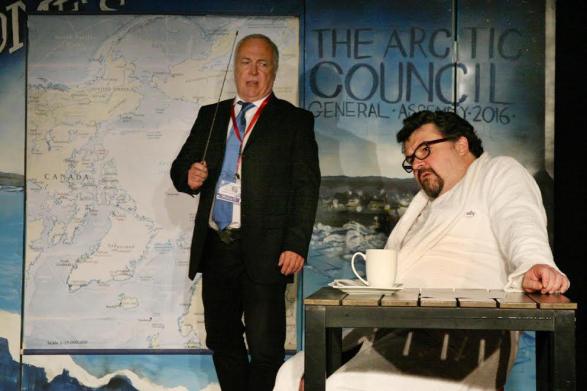
Frank, newly appointed Foreign and Commonwealth Office Chief Scientific Advisor to the Arctic Council is here to cover for the advisor struck down with ultra violet hepatitis – that’s technical jargon for snow blindness – and delivers his speech in his dressing gown. But why does he only manage to deliver it to the hotel waitress rather than the world delegates? The answer to that is the very essence of the witty twisting plot that gets more and more bizarre as events unfold leaving you satisfied that you got more than your money’s worth of laughter from this gem of acting filled with an-acronyms that are so well written and performed you will find yourself howling at the daftness of human nature always trying to sound more intelligent and failing.

‘ I say, really that’s something isn’t it, almost makes me wish I was blind.’ pukka British delegate retorts to Frank’s obsession with his new tactile business cards. A superb offering that shouldn’t be missed.
Reviewer : Clare Crines
The Rise and Inevitable Fall of Lucas Petit
Scottish Storytelling Centre
Edinburgh
20th September
Script: Stagecraft: Performance:

The Faustian pact is a well trodden road in theatre and art in general but, as a subject I have particular interest in, I am always willing to see a new interpretation. Here we have an ordinary bloke being lead astray by a camp jakey who may or may not be the Great All Mighty. It begins in a light enough vain, instantly recalling the Peter Cook / Dudley Moore classic Bedazzled (thankfully not the awful remake). The music is strong melodically and intelligent, recalling a burlesque or dance-hall feel with a contemporary twist, and the set design is as irreverent as it is creative. Set becoming props, props becoming costumes, all in a superbly imagined 2D cartoon style. So all in all the play is an audio and visual treat (and a particular mention must go to Nicola Sturgeon’s superb cameo). As for the plot we are soon launched into a fast paced adventure and barely have time to breath before our protagonist begins his dark descent. The interesting twist is that it’s God, not the other guy, who’s doing the corrupting this time. Apparently sick of Beelzebub having all the fun.
As the play continues it is fairly evident that the writer has teeth and doesn’t seem to think a great deal of this every man who has been caught up in this divine dual. Every hope of redemption seemingly dashed. The Lego Movie this ain’t. However the cruel wind it blows is a refreshing change from the tepid breeze of many modern productions trying too hard to please. Some of the gags can be a little obvious at times, local and cultural references thrown in all too frequently for a cheap laugh, but over all the writing remains witty and brutally insightful. Though I didn’t agree with many of the stances took by the play and found the comedy a little bit heavy handed at times (not averse as I am to the occasional tepid breeze), with the right audience this play would, and did the night I was there, go down a storm. So if you like your comedy to reassure you that everything’s all right, Lucas Petit might be worth avoiding, but if you’d prefer something with a little more bite then I suggest you seek it out in a town near you.
Reviewer : Steven Vickers
An Interview with Laura Pasetti
***
THE MUMBLE – Hi Laura – so can you tell me what ‘A Bench on the Road’ is all about, & what inspired you to create a play about it
LAURA – The play explore 100 years of Italian immigration in Scotland from the women’s perspective. Narrations, music and physical theatre give voice to many women that between 1850 and 1950 left Italy in search of a better future for their families. The play is divided in frames as each scene is like a living painting, Italian and English languages intertwine creating an interesting mixture of sounds and expressions. I was inpired to create the play by the story of my first friend in Scotland when I arrived at the age of 15 to learn English. She was an Italian Scottish woman and she introduced me to the story of immigration as I wasn’t aware that so many Italians lived in Scotland.
***
THE MUMBLE – There seems to be an awful lot of research gone into Bench – where did you source you materials
LAURA – The play was commissioned by the Italo Scottish Research Cluster- University of Edinburgh. It because of their archive and the support of many academics like Pedriali, Pirozzi , Colpi and Ugolini that I was able to write the play.
***

***
THE MUMBLE – Bench is a multi-media presentation, can you go into more detail about we have to expect.
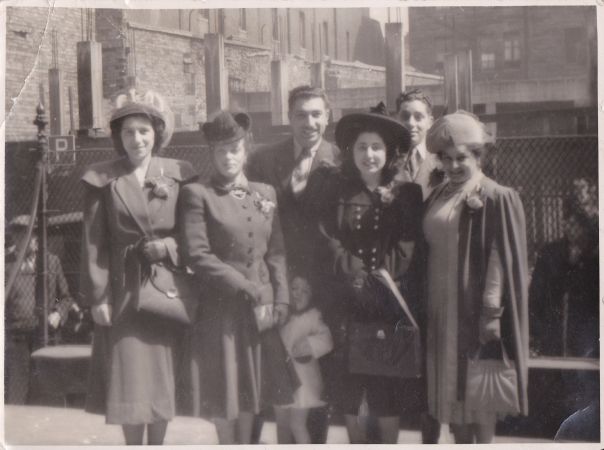
LAURA – The play has been framed in Kantor style where the images s are strong and express the core of the stories; the marriage of ancient Italian and Scottish folk songs support the presentation of each frame. The costumes are designed in the shade of grey and sepia, like an old photograph to give a clear “image from memory” to the spectator.
***
THE MUMBLE – You have seven actors playing the voices of the women. Who are these, & where are they from
LAURA – Vanda De Luca is Italian Scottish, Anna Carfora is Italian and lives in London, Nicoletta Maragno is from Italy. The three Scottish actresses are Scottish: Sian Mannifield, Helen Cuinn, Pamela Reid. The accordionist who is also doing actions on stage with the actresses and playing an important role is also Scottish: Caroline Hussey. I mus say there are an AMAZING cast. This is one of the main reason why I left Italy and founded an international company: to offer opportunities to actors of different nationalities to work together. I travel a lot myself when I was younger, in search of more opportunity to grow and improve as an actress. Actor are constantly under training and if they don’t understand this, they will be extremely unhappy. Researching is one of the main duty of an actor. I noticed that when I was working in Russia with German and Russian actors, we were very open, productive and the creative process unfolded easily. I wanted to do more of this kind of work and after my last trip to Russia I founded Charioteer Theatre.
***
THE MUMBLE – What is your personal background in theatre, Laura,& how did you come to be in Scotland
LAURA – I started as an actress in 1990 after the degree at Piccolo Teatro di Milano Acting School. The director was Giorgio Strehler. I immediately started to tour internationally and I think that I was pretty successful in my acting career. I won the Milano 90 Award as best emerging actress then the Virginia Reiter Award and then the Anna Magnani Award. I had the privilege to work with the best Italian directors and to have rewarding experiences abroad. I then became a writer, a director and an acting coach. I love teaching actors. I consider myself a real CAPOCOMICO, like in the tour companies of comedians in 1500, I lead my company artistically but I also drive the van on tour.
***
THE MUMBLE – So you are taking your play across Scotland – what do you hope that your prospective theatre-goers will get out of ‘A Bench on the Road’
LAURA – Possibly a new intake on a piece of Scottish and Italian history. I hope that they will perceive the play as a journey through which they can reflect on identity and sense of belonging.

 Mumble Theatre