Author Archives: yodamo
Competition : The Cheviot, the Stag and the Black, Black Oil
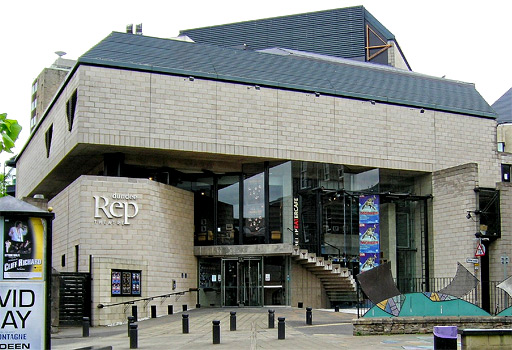
Dundee Rep Theatre are launching a nation-wide photographic Instagram competition in advance of the autumn tour of their hugely successful production ofThe Cheviot, the Stag and the Black, Black Oil.Two winners – one chosen from each age category – will receive four tickets to see the show at a venue of their choice (subject to availability), as well as having their photographs displayed at all five venues. They will also each receive a year’s subscription to the Adobe Creative Cloud Photography Plan, including Adobe Photoshop and Adobe Lightroom.
Ten of the best photos will be displayed at Dundee Rep Theatre as part of The Cheviot, the Stag and the Black, Black Oil exhibition which opens on the 12th August – just in time for the start of the game shooting season!
Joe Douglas, Associate Artistic Director of Dundee Rep Theatre and director of the production says: “The Cheviot, the Stag and the Black, Black Oil touches on so many stories, themes and issues across Scotland – from crofting communities to riggers in the North Sea. I’m looking forward to being inspired by some creative photographs from this beautiful country of ours.”
To enter the competition all you have to do is take a digital photo and upload it to Instagram using the hashtag #cheviotphoto. The subject of the photo can be up to you but the image should reflect Scotland’s historical and/or current political and economic story. Thematic examples include images of, derelict landscapes, land ownership, Scotland’s resources, The Clearances or Scottish cultural identity.
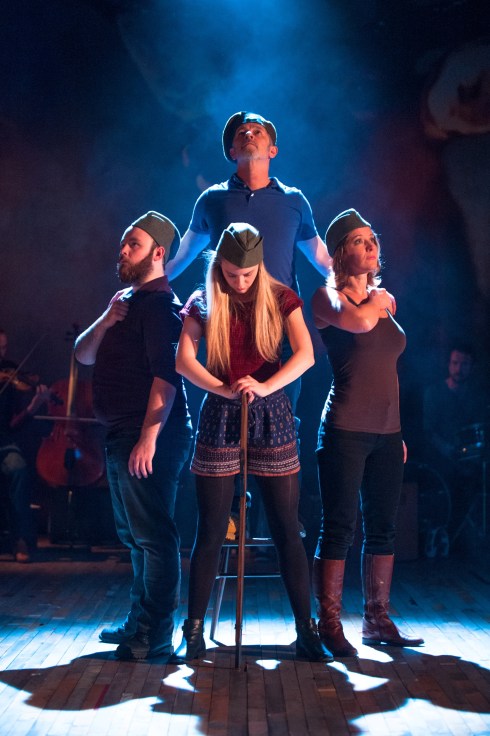
The competition will be divided into two categories (12-16 year’s old and 16+) with one winner selected from each category. The competition will end at Midnight, 25thof July and be judged by Joe Douglas, Associate Artistic Director of Dundee Rep Theatre and Director of The Cheviot, the Stag and the Black, Black Oil and Nicola Young, photographer and Communications Director at Belgrade theatre.
The Cheviot the Stag and the Black, Black Oil was written by renowned British playwright, director and political theorist John McGrath, who often took up the cause of Scottish independence in his plays.
Carlisle College of the Arts Theatre
Thursday 30th of July 2016
The End of Year Showcase
—-
![FB_IMG_1467392143203[1]_3.jpg](https://mumbletheatre.uk/wp-content/uploads/2016/07/fb_img_14673921432031_3.jpg?w=253&h=224)
What do you want from student theatre? I would say youthful exuberance, playfulness, energy, a developing confidence, skill and artistry; but also that the art has ideas as well as giving pleasure. Well, this production certainly provides all of these and in the words of the poet, John Dryden, “There is such a variety of game springing up before me, that I am distracted in my choice, and know not what to follow.” So, in that spirit, and as space doesn’t allow a comprehensive commentary, I’ll comment on parts of the show that sprang up before me.
The show begins with a dance routine, The Lion King, and the dance troupe led by the impressively energetic Whitney Bell certainly sets the energy bar high as a pride of lions prowl around the stage to The Lion King theme tune; the opening dance successfully fulfils its function: to encourage the audience to participate and prepare them for the games to come.
Following on we have a monologue from Finlay Eagleson playing what is now a stock comic character of British culture─the old-fashioned school master in a mortar board and cape: in my imagination, ranging through from the comics of my youth (The Dandy with Winker Watson and Mr Creep), the Ealing comedies, to popular music, The Smiths Headmaster Ritual springing to mind, with “Sir doing the military two-step/ down the nape of my neck.”.
One for the audience this as in this performance, a warm up for the evening show, there are many in the audience who work in the college ─ mind you, the gentleman sitting next to me whispers in my ear, “Takes me back to 1974 when I worked in…”. So still fresh in the mind for some. The sketch is essentially a roll call of names, reflecting the title of the piece, and for those old enough it certainly stimulates memories of the days, not so long ago, when the teacher with or without a mortar board would spend an eternity reading out the register pausing for sarcastic commentary on behaviour, attitude and work: occasionally enhanced by flying chalk or a board rubber for those deviant enough not to respond with a timely “Here sir!”.
The comedy here though comes from timing, gesture and from the emphasis and repetition of certain words: in this case the word “tweak” and its variations, as in one of the milder punishments of the past, the tweaking of the ear; Eagleson savours the word as if he is about to eat it, reminding me of the way Rowan Atkinson savours and elongates words for comic effect; I am also impressed with the way Eagleson had the confidence to pause for emphasis and use facial gestures to suggest the inner emotional strain caused by taking a register; a success and very funny, exemplified by the audience laughter. We also see the influence of Atkinson and his comtempories developed and made explicit in a later sketch, entitled Blackadder.
Another sketch that sprang up at me was Magic Mitchell; an old-fashioned variety show magic trick of the pick-a-card variety involving audience participation. I’ve no idea how he did the trick, but the whole thing was a lot of fun, enhanced by a member of the audience with an infectious laugh; Mitchell is another performer with a great face for theatre and he certainly was able to engage the audience in his act. I particularly liked the Tommy Cooper allusion when turning to ask the audience member with the pack of cards: “You didn’t shuffle the cards did you?” looking genuinely nervous; perhaps he was, who knows, the trick worked.
The second half of the show begins with a shift to a darker mood. The sketches exploring themes ranging from the sinister effects of developing technologies to the effects of an all-encompassing mass media, through interpretative and thought-provoking dance in Technology Takeover with the dancers moving surreptitiously in the gloom behind a flickering screen displaying well known mediums/logos and the message Weapons of Distraction prominent on the screen; the performance is brief but exemplified another theme of the show which is developed through references in dance to The Wizard of Oz and a solo Ben Taylor singing Music of the Night through the gloaming : the theme revealed in the conclusion to The Wizard of Oz when the wizard is revealed to be an old man pulling levers: the reality behind the deceptive curtain. Here I’d like to give a mention to Taylor’s performance, not always note perfect, but certainly a moving rendition of the song, and like many of the other performers, Taylor has an expressive face that does communicate with the audience.
I’d also like to mention the Shakespearean swopping of gender roles that worked to great effect in some of the sketches. In particular in Shakers a satire on stereotypical male behaviour where the male roles were taken by females, in this case Whitney Bell and Rebecca Stringer disconcertingly admiring the cleavage of the bar maid played by Beth Bradshaw (insert your own sexist clichés here, you’ll know them all). The switching of roles defamiliarized the situation making it more effective, but as usual: the drink provoking the desire, but taking away the performance.
As mentioned earlier, another very funny sketch was entitled Blackadder with impressive performances from Rob Joseph, Finlay Eagleson and Shane Mitchell. The sketch I presume is taken from the show, so guaranteeing effective comic dialogue; what I liked here is Rob Joseph’s Stephen Fryesque turn as a legless (literally on both counts) pirate captain, delivering his lines with perfect timing but also having the confidence to adlib effectively with the other performers but also with the audience: calling out “Bless you!” when an audience member sneezes. I also liked the clever update of the script to reflect the EU referendum: Finlay’s character hilariously unable to pronounce Calais properly, and having to be corrected by the legless pirate. They were also clearly enjoying themselves.
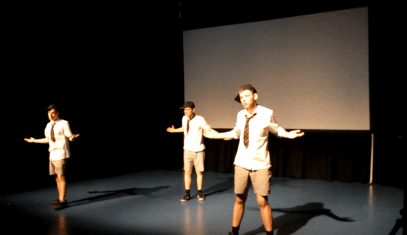
The show delivers on everything you would want to see in student theatre; perhaps in the second half the occasional sketch became a little didactic in terms of the themes of prejudice/equality and diversity, forgetting to show not tell; but then again modern education always demands that you’re ready for inspection: “Here sir!” But taken overall there is no serious disruption to the enjoyment of the production, all involved should be commended for their efforts, and I left the theatre with a line from one of the Blood Brothers sketches in my head: “Nothing’s sad, ‘til it’s over”, again reminding me of recent events.
Reviewer: Paul Rivers

Pippin
Stanwix Theatre
Carlisle
3rd June
–
Script:  Stagecraft:
  Performance:
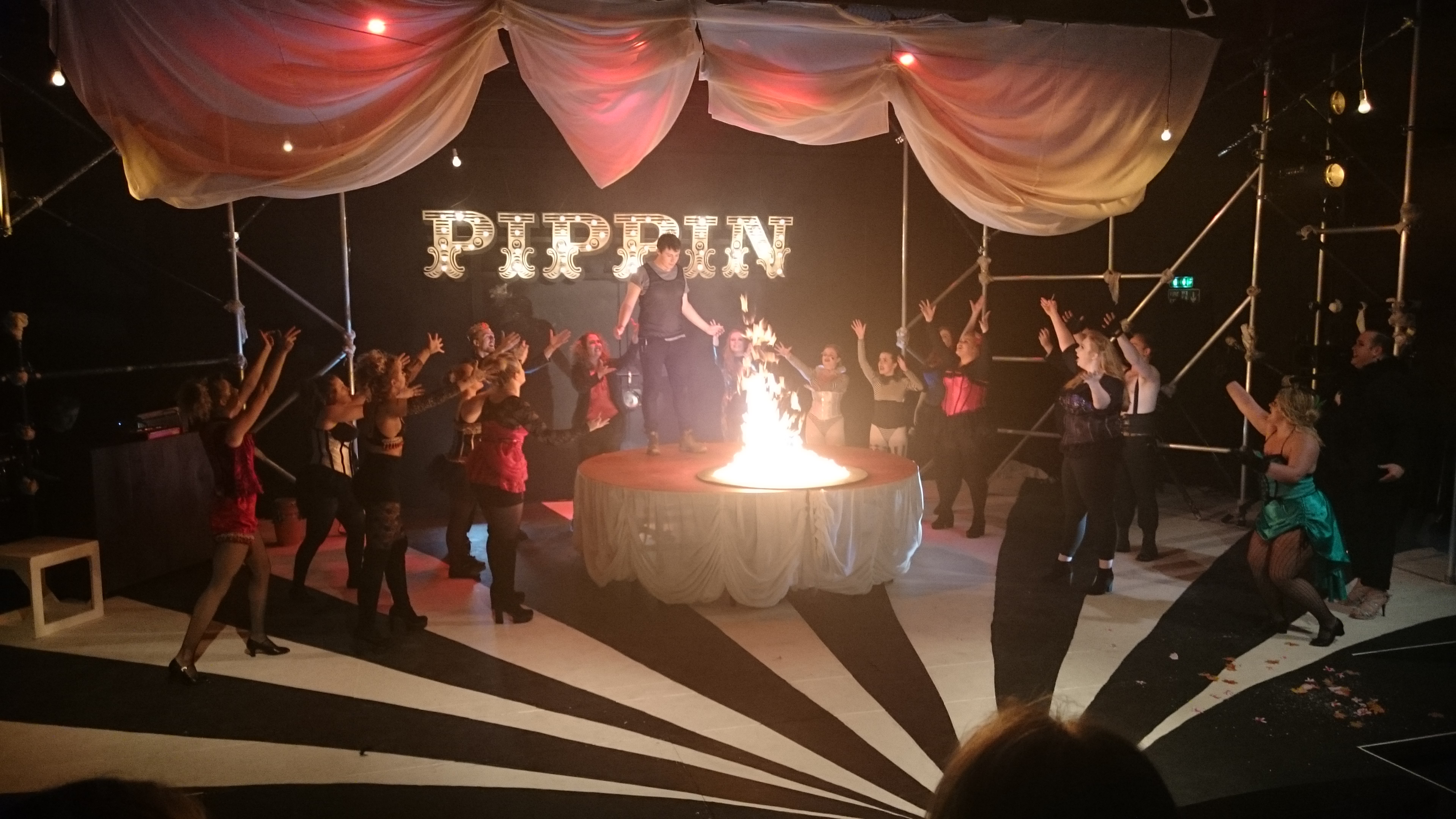
The yellow stage bulbs are low, the curtains are drawn, and the room is silent. Waiting in hushed darkness a spot light appears on the white draped curtain, and I am captivated by the silhouette of a tattooed woman seducing the audience with her erotic dancing. I hear the wonderful “Music to Do” echoing through the room but I am so intrigued by the mysterious figure behind the curtain that I fail to notice the Leading Player (Beth Simpson) make her physical presence known until she is standing centre stage. With long red hair and red lips adorning a tight purple corset and black leggings the rubenesque Leading Player introduces us to the rest of the troupe that will be entertaining the audience for the next few hours. Dressed in burlesque apparel the troupe immediately breaks the fourth wall shouting and leering at the audience “welcome!” in order to entice the audience to watch their magical show.
Pippin is a musical with an infectiously unforgettable score about the heir to the Frankish throne. Prince Pippin begins an existential journey as he has become unfulfilled with life as a prince and he believes there is more to life. Seeking “extraordinary” meaning and happiness in life through glories on the battlefield, temptations of the flesh and political power, the Leading Player allows us to join Pippin on his travels where Pippin finds contentment in the mundane when he meets Catherine (Megan Ryan) and Theo (William Teasdale).
The show begins with the wonderful Pippin played by Ciaran Keddy as he enthusiastically discusses the dreams and desires of a young man to capture his “Corner of the Sky” and to know his place in the world. It is during this scene that I am moved by the enchanting yet powerful vocals of Ciaran Keddy. His voice is akin to that of Idina Menzel. The quality pitch and tones of his voice left me stunned. Never had I heard such a voice that wasn’t already on Broadway and I was lost to his musical talent. With such raw artistic talent Keddy took the show to a new height.
However he did not do it alone. I was mesmerised by the towering Berthe played by the comic (Barrie Wilson) simply for mastering six inch, silver, sparkly, strappy stilettoes the entire evening. How he managed to elegantly sing and dance in stilettoes all evening demands an award; solely for his professionalism and commitment to the role of Berthe. Berthe (Pippins exiled grandmother) attempts to comfort Pippin after the spoils of war have left him despairing when he realises that there is no glory or victory to be gained in war. Berthe educates Pippin with her wisdom of years and persuades him to live in the now “No Time At All,” as life is precious and fleeting and it is the “simple things in life that count”.
Taking her advice, Pippin adventures further into his existential journey, as he explores the temptations of the flesh. With a choreographed erotic display of his womanising, orgies and threesomes, Pippin becomes embroiled into a fetish world of leather and men on leashes. Yet tasting all the carnal pleasures life has to offer Pippin is still unsatisfied with life. Despite enjoying many lustful liaisons he questions his desires – for what is carnal pleasure without love? It is here that Pippin recognises that relationships without love leave you “empty and unfulfilled.”

After a brief and unsuccessful political career after he murders his father Charles played by the talented Chris Honey the weary Pippin collapses when he is rescued by a widow (Megan Ryan). By beseeching Pippin to help her tend her large estate by completing mundane working tasks, she nurtures his wounded soul back to health and the two eventually fall in love; and Pippin begins to appreciate the joys the little things bring him. However when Catherine asks Pippin to take the seat as the head of the household Pippin retracts his affections dismissing their love as “not-extraordinary” and returns back to his castle breaking the sweet Catherine’s heart.
It is here that we are introduced to the wonderful finale, complete with pyrotechnics, singing, and busty burlesque actors dressed eloquently over railings, the troupe sing and entice Pippin to complete his final performance with the troupe. His last extraordinary act. However Pippin comes to realise that happiness does not lie in “extraordinary endeavours, but rather in the un-extraordinary moments that happen every day.” And he returns to his beloved Catherine.
Generally the performances were solid and convincing, the costumes and dance routines made the evening delightfully entertaining. The set was used to its maximum potential with the troupe often dressed over the scaffolding and always in view. The music was played flawlessly and the entire production was youthful and full of energy. Living in an age where thin is “in” and body shaming is an everyday occurrence it was wonderful to be introduced to a cast of many shapes and sizes both male and female dressed provocatively. Did this have a negative effect? Not at all. The crowd cheered, jeered, and laughed with the troupe and Pippin and the crowd left with smiles and words of congratulations upon their lips.
Such a wonderful performance left me both melancholy and exhilarated. As watching the show forced me to reminisce over my own life dreams and disappointments whilst leaving me naively optimistic that there is hope, and that perhaps I too will find my “Corner of the Sky.”
Reviewer : Katrina Hewgill
The Little White Town of Never Weary
Falkirk Town Hall
June 2nd
Children’s dreams and colour schemes / Stop little town from falling down
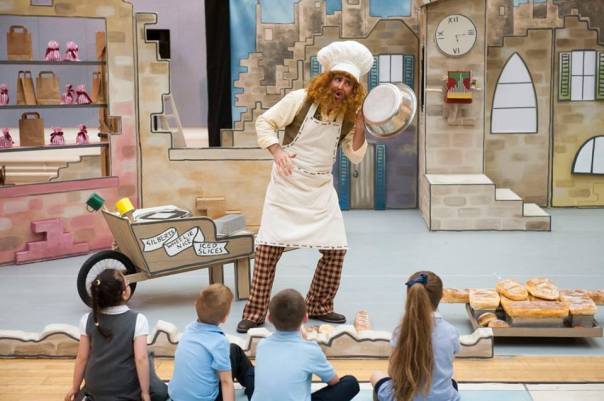
It’s 5pm in The Little White Town of Never Weary, a quiet as a mouse neighbourhood close to the far from bustling Boreland. Sweetie Megs and The Blue Swan are falling into disrepair. And the steeple, like the town, is decrepit, degraded and decayed after years of neglect, a lack of visitors and thunderous vibrations from the big, scary bell tower which dominates the square and for the last hundred years has chimed on the hour, every hour, and in so doing brought masonry and morale crashing to the ground.
“Can a cat, can a cat, cat a cat, can a cat not get a catnip around here,” miaows a ginger tabby who is awoken from his slumber by Jessie, a young girl with golden hair and twinkling eyes who is “never lonely when drawing”. Today’s dreams and colour schemes being a white swan on a blue lake, which she shares with her newfound friends of primary school children who surround her on a colourful floor cloth and are held spellbound by her soprano voice: “My name is Jessie. I like to make things. Anything is possible.”
One of the central themes of this delightful show for 5 to 8 year olds by Scottish Opera – directed by Julie Brown, with music and words from Karen MacIver and Martin Travers respectively – which is based on the illustrated novel by The Glasgow Girls artist Jessie M. King and will be touring schools and theatres throughout Scotland until 11 June as part of Festival of Architecture 2016. The other themes being “patience and imagination” and “friendship and determination”, as voiced by a melodious paper fortune teller.
With a sprinkling of audience participation, sophisticated wordplay which can best be described as McSondheim and a host of colourful characters such as Transylvanian schoolteacher Dame Lucky, a sweet-toothed granny “with a face like a winter’s apple” and Gilbert the Baker who is more doh! than dough, the four-strong cast led by a sweet-voiced Charlotte Hoather and supported by actor-musicians Stuart Semple, John Kielty and Frances Thorburn, return the tired town back to its technicolour glory by encouraging the children to not hide in their hair and be dull and messy, but pluck up the courage to create just like Jessie!

Script: Stagecraft: Performance:
Del Gesu’s Viola
A Play A Pie And A Pint
Oran Mor
Glasgow
May 30th – June 4th
This play, written by Scottish veteran playwright and adaptor Hector MacMillan, (The Sash, Moliere’s The Misanthrope are two of his notable successes) and directed by Liz Carruthers, is the last in the spring season of A Play A Pie And A Pint.
The setting is a precognition hearing at a Procurator Fiscal’s office and opens with Elizabeth Flett paying a beautiful piece on viola. The Fiscal (Eileen Nicholas) is hearing the testimony of a plaintiff (Finlay Welsh) and the accused (Peter Kelly). At issue is a viola which the plaintiff has bought from the accused for £1,900 under the impression that it may very well be a priceless instrument crafted by Bartolemeo Giussepe Guarneri ( known as Del Gesu) of Cremona, Italy, in the 18th Century. The fact is that Del Gesu was never known to have ever made a viola, only violins, although, confusingly, this particular instrument is the size of a conventional violin. Guarneri’s violins sell for astronomical sums and are regarded by some as superior to the better known Stradivari.
Both the accused and his naturalised (and now deceased) Italian father have made violins as a hobby and the instruments, though not really worth much are well regarded for their beautiful sound.
The plaintiff, a trader in old and valuable instrument’s wants the price he paid reduced because he thinks he has been hoodwinked by the accused, even though he was quite happy to pay a pittance for what he believed to be a possibly priceless viola.
The Fiscal has the tricky job of deciding whether a prosecution should go ahead.
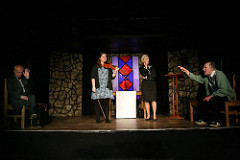 Hector MacMillan’s underlying issue in this piece was greed and why should the rich have possession of the best instruments, while perfectly good modern examples are relatively worthless? Many of the greatest instruments languish unplayed in safety deposit boxes and collections, steadily increasing in value as investment opportunities.
Although well acted, the basis of this piece was perhaps slightly insubstantial for those not really interested in the subject matter and without being too much of a pun, was very much a chamber piece with some moderately funny and thought- provoking twists. The beautiful sounding viola/violin in the play was, in fact, made by the playwright himself.
Reviewer : Dave Ivens
Script: Stagecraft: Performance:
Thon Man Moliere
The Lyceum
Edinburgh
20th May – 11th June
Script: Stagecraft: Performance:
In his parting words to the public as Artistic Director of the Lyceum in Edinburgh, Mark Thomson says, with a serious sense of self-satisfaction – after commissioning & seeing to fruition a play on the 17th century comic playwright, Moliere, by Scottish Makar, Liz Lochhead – that the result was, ‘something horribly, wittily, human.’ But its more than that. It is pastiche brought to perfection, a traditional model infused with fresh insights & ideas. It is history remembered & resurrected &, of course, refined.

Liz Lochhead
This is not Lochhead’s only flirtation with Moliere. Her first effort broke her into the Caledonian consciousness after she translated and adapted his masterwork Tartuffe in 1985: premiering at the Lyceum in ’87. The translation was into choicest broad Scots, & followed in a long line of Scots translations of Moliere, such as Hector MacMillan’s ‘The Hypochondriack’ (from Le Malade Imaginaire) & Robert Kemp’s ‘The Laird o Grippy’ (from The Miser). There is something about Moliere & the Scottish psyche that just, well, fits. In a 1790 letter from Ellisland, Rabbie Burns, while requesting certain books to be sent to him, invites, ‘a good copy, too, in French, of Moliere I much want. Any other dramatic authors in that language I want also.’ With these two bedfellows – Scottish writers & Moliere – must be added the Scots language, creating a menage a trois that stimulates all our affections, whether writer, player, or audience. Of Lochhead’s contribution to the gryphon, Thon Man Moliere‘s leading lady, Siobhan Redmond, gleefully recognizes that Lochhead’s Scots, ‘sounds like real life only better…. with a much faster beating heart, singing on a higher note.‘
Thon Man Moliere is a pseudo-biography of the man & his, what Lochead told the Mumble, ‘harlequin-chequered life of ironies, ups & downs, successes & failures, of Paris & the provinces, of plaudits & penury, of patronage lavished & patronage brutally & arbitarily withdrawn.’ Her leading man, Jimmy Chisholm added, ‘Thon Man Moliere isn’t a history play, its about these completely made-up characters out of some facts of Molier’s life… its not just a knock about Moliere comedy its not like that at all, its about the life & the stresses & the darkness & the things that surrounded that man & that company while they were trying to produce very, very funny pieces of theatre.’

Moliere
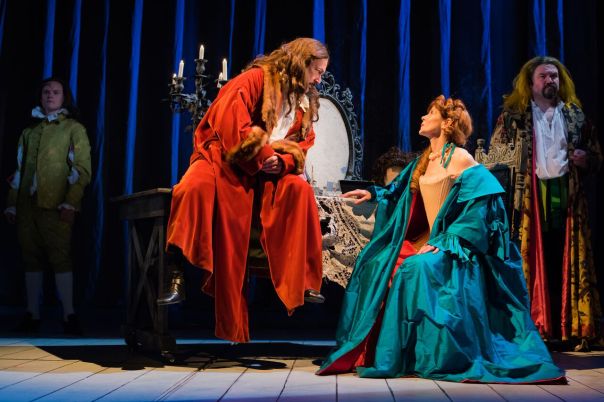
The story revolves around the sexual dynamics between Moliere (Chisholm), his leading actress & company-boss Madeleine Bejart & her 16 year-old daughter Menou (Sarah Miele), who may-or-might-not-have-been Moliere’s. This causes some dramatic tension, especially when Moliere & Miele get in on & have a couple of bairns themselves. Chisholm & Redmond work wonderfully well together, a sign of a lifetime friendship that has finally burst with some magic onto the stage. Redmond plays a fantastic Madeleine, & it seems that Lochhead had her in mind when writing Thon Man, telling the Mumble, ‘She’s a close friend, she’s like family & I wrote this play hoping but not thinking she would play Madelaine in it.‘ Just as in real life, Redmond’s class on the stage is reflected by Madeleine, & the part could well be a career-defining moment for Redmond, for she is brilliant in a brilliant play.
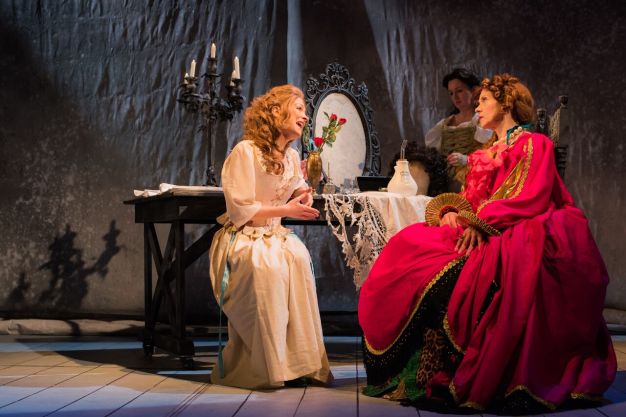
Nicola Roy as There Du Parc, in conversation with Madeleine Bejart (Siobhan Redmond)
Watching Thon Mon is a rare treat, a totally immersive experience which wings one’s thought-doves back to 17th century France with the loftiest ease. With Racine dipping into the plot from time to time, alongside some rather ‘excuisite alexandrians,‘ amidst an elegant set the colourful costumes leap from a monochrome stage – this is tragicomedy after all. Indeed, I loved Lochhead’s terse descriptions of tragedy – ‘any eegit can write that sublime shite’ – & comedy ‘everything is a mess / it gets worse / it all gets sorted out / there’s a happy ending.‘ These words are symptomatic of the delineating predilection of modern poets writing for other poets – in this incarnation Lochhead is, at times, a playwright writing for other playwrights. Luckily there is enough rough & ready realism & colloquial cocksurity to please all who are to be entertained.

Sarah Miele
Thon Man Moliere is not just about the playwrights, but about his illustrious company too – all of whom are interestingly deep characters in their own right, who interact with each other electrically, most of whom end up in bed with each other at some point. I enjoyed them all, especially the scenes when they were rehearsing a play – brilliant flies on walls on walls kinda thing. Steven McCicoll’s Gros-Rene du Parc was a classic larger-than-life lovey-darling, while Lochhead’s inextinguishable Feminism swarms out of the mouth of Du Parc’s wife, Therese, played by Nicola Ropy. Molly Innes, as Toinette the maid, keeps everything together , I always welcomed to the stage, while James Anthony Pearson as Michael Baron delivered the best lines, when he described his double-jointed magical music-box debut for King Louis XIV, bubbles of phantasie delivered with addictively watchable precision. Of them all, Sarah Miele was simply divine. Winner of this year’s Bafta Scotland New Talent Award, while all other characters came to us fully evolved, with hardly a change in temperament, Miele’s Menou blossomed from an innocent rose-sketching lassie, to a twice pregnant, penis-drawing actress of some quality. Miele steered this arc like the captain of a 17th century sloop traversing the Cape of Good Hope.
As I watched Thon Man Moliere, I was sensing I was watching a classic. Alright, it is a regurgitation, but it is also a rejuvenation & one that is immensely entertaining. Listening to Lochhead’s lingua franca is like being down a pub in Cumbernauld just before the beers kick in – that hour or two when everyone in the pub is funny & hilarious & full of wit. High-brow but low-dealt – its perfectly pitched & I reckon Moliere himself would be more than proud.
Reviewer : Damo Bullen

The Polar Bears Go Up
Falkirk Town Hall
20 May 2016
***

Script: Stagecraft: Performance:
Inquisitive bears travel near and far
To reclaim fast ascending golden star
Framed within a proscenium arch of green and blue rectangular boxes which tower over a black floor-cloth laced with orange and pink lines to suggest a map, a journey, an awfully big adventure, a polar bears’ picnic of cornflakes on toast watered down with an endless supply of tap water is rudely interrupted by the ringing of a doorbell and the unexpected delivery of a big brown cardboard box which contains … Is it a bird, is it a plane? No, it’s a golden star on which to hang your dreams on.
 The Polar Bears Go Up, a co-production between Unicorn Theatre and Fish and Game, and sequel to the latter’s highly successful co-production of The Polar Bears Go Wild with Macrobert Arts Centre, tells the story of two playful Tornassuks (the name Greenlanders use to describe polar bears, meaning “the master of helping spirits”) who out yawn and out sniff, out reach and out jump, out fly and out trampoline one another in their combined but competitive efforts to reclaim the golden star which has escaped their grip and lodged itself in a cotton wool cloud.
Using the minimum of props and maximum of creativity, the two creators and performers (Fish and Game co-founder Eilidh MacAskill and her ever-smiling collaborator Fiona Manson) are a sort of inverse Vladimir and Estragon in that rather than stay put and talk about going, they are forever on the move and bar a few sniffs and belches never utter a peep. Though their personalities and relationship are very similar to their Waiting For Godot counterparts in that slapstick and petty quarrelling is the order of the day. And Eilidh, being the taller of the two by a good twelve inches plus VAT, is curmudgeonly and direct, though never cruel; whereas teensy-weensy Fiona is warm-hearted and amiable, if a tad mischievous.
 Despite the absence of words, the target audience of two to five year olds and their accompanying parents were captivated from beginning to end because the characters were likeable, the performers engaging, the show jam-packed with Laurel and Hardy visual gags, moments of surprise and suspense, and there were ample opportunities for the children (both young and at heart) to join in both physically and vocally. None more so than at the end when, after the well-deserved curtain call, a second doorbell rang and – without giving too much of the plot away – the audience had a ball!
Reviewer : Peter Callaghan

Role Shift
A Play A Pie And A Pint
Oran Mor
Glasgow
May 16th -21st
Script: Stagecraft: Performance:
Yet another entertaining and absorbing fifty minutes of drama from Oran Mor’s A Play A Pie And A Pint. This week’s offering is so original and works on such a number of levels that it’s difficult to describe- but here goes…..
A co-production with Glasgow’s Bird Of Paradise Theatre Company, which promotes the work of disabled artists, Role Shift was by turns, a hilarious rollicking comedy, a comment on sexual mores and how the world views the disabled. Into the bargain it also warns “never trust the translator.”
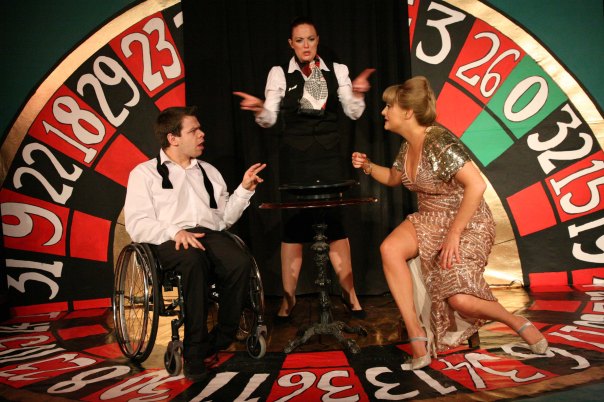
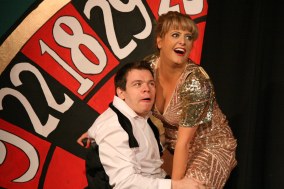 Mainly written throughout in rhyming verse, the action is set in the casino of a cruise ship and the three characters couldn’t be more contrasting. Ally, played by Robert Softley Gale (in real life too) is a disabled man in a wheelchair, Bernie, played by Louise McCarthy, is a big, blowsy woman, dressed up in a revealing glittery gown and Carrie, played by Natalie MacDonald and the cause of all the later trouble, is an interpreter for the deaf who signs the action throughout. A screen on either side of the stage also reproduces the dialogue as spoken.
From the outset Carrie makes it plain that she is fed up with “role shift” where she faithfully reproduces signing for the deaf on behalf of the two other characters and wants to become more a part of the action herself.
Bernie and Ally are both on the lookout for rich, handsome men at the roulette table and vying to snare a juicy catch. As the action hots up and more drink is taken Bernie and Ally discover they are attracted to each other but Carries intervention causes a calamity. It would spoil the plot to give away what takes place but the outcome is brilliantly played by all three and the plays’ title takes on a double meaning.
The actors had to pause several times during the performance to let the audience’s laughter subside, such was the comic delivery of a cracking script, This piece is both funny and thought provoking and definitely ends on a high. Written by Lesley Hart and directed by Garry Robson, Role Shift earned the players a rousing and well earned extra curtain call, most unusual at Oran Mor. Be there or be square.
Reviewer : Dave Ivens
The Love I Feel Is Red
Oran Mor
Glasgow
9-14 May
—————–
 Mona (Janet Etuk) is a late 20s mentally strong athlete who dislikes her tragically departed boyfriend Ty’s mother Susan (Heather William) and has a personality to be proud of, saying what she thinks no matter what. Writer Sabrina Mahfouz explores abortion, miscarriage, a woman’s right to choose her path and the subsequent raw emotion experienced as a result of these decisions.
Descriptions are graphic, shocking but very real. I found myself feeling for Susan who is performed with such poignant believability as a mother who has lost her son and, ‘ grandson, I know its’s a boy ’ within weeks of each other.
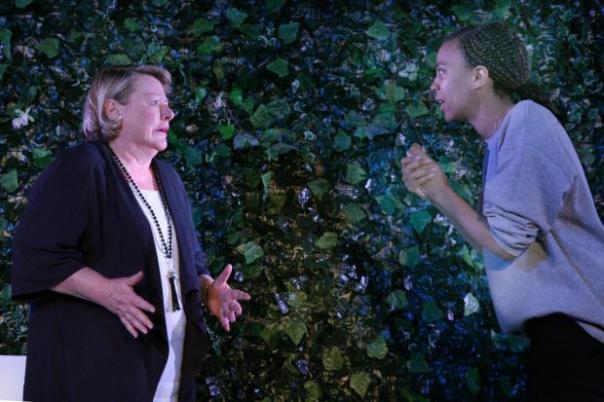
Is it her grandson or is it as Mona believes just, ‘cells ’ ? Deep, dark issues described so brilliantly by Mona in rapper type dialogue that firmly contemporises a topic that has been raging for centuries – whether medieval toxic herbs or two bitter pills – women still don’t get it easy if they chose to terminate a pregnancy.Although I ( and likely many sitting in the audience) could’ve done without the the graphic descriptions, knowing all too well what a miscarriage does emotionally and physically to a woman’s mind and body, there are many who don’t and this play is educational in that respect and therefor important.
There are no winners in this woeful play. Susan is left bereft as a woman who gave up so much of her own glowing career for her child, now gone. Mona, has to move on without her boyfriend, just her memories both good and bad and an instinctive will to not just survive but to thrive which we know in time she will. Directed by Nel Crouch and produced in association with Tobacco Factory Theatre this is worth seeing because the script and acting couldn’t be better in such a harrowing set of circumstances.
Reviewer : Clare Crines
—
Script: Stagecraft: Performance:
 Mumble Theatre