Author Archives: yodamo
Second Hand
APlay A Pie And A Pint
Oran Mor
Glasgow
May 2nd-7th
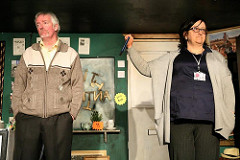
Ageing 71 year old Jim is about to open his dingy, down-at-heel antiques shop when there is a giant crash upstairs. It transpires that young Ash, kicked out by both his mum and aunt, has crawled along the tenement loft spaces from his aunts house and has been kipping above Jim’s flat over the shop. Going for a pee in the darkness he’s come straight through the ceiling, literally crashing in to widower Jim’s life.
This play by Paul Charlton, co-writer and co-star of BBC2’s The Ginge, The Geordie And The Geek and Directed by Mark Saunders is a wee gem of a piece with some great acting from Finlay McLean as Jim, Cameron Cunningham as young homeless idealist Ash and Elaine McKenzie Ellis as home visitor Alison.
Initially, thinking Ash is a thief, Jim holds him at bay with a putter but it soon becomes apparent that Ash has landed up homeless and destitute after having a run-in with the police at a rally for the low-paid.
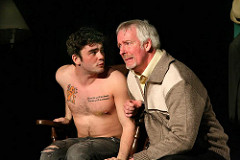 Alison, originally a carer with Glasgow City Council but now an employee of Cordia has been looking after Jim on a daily basis, much to his disgust, at the behest of his daughter who now lives in Australia.
The play started a bit tentatively but the actors soon got in to their stride and the piece never flagged, with some great comic and pithy exchanges, particularly between Jim and Ash.
By the conclusion we find that both young an old have something to learn from each other and that life just isn’t fair sometimes.
The play is touching, funny and poignant and an allegory for many aspects of modern life. Go and see it.
Reviewer : Dave Ivens
Script:  Stagecraft:
  Performance:
The Iliad
Lyceum
Edinburgh
20 April – 14th May
Script: Stagecraft: Performance:
There is an expression in English known as ‘Coming Full Circle,’ & it was while I was watching Mark Thomson’s final production for the Lyceum, The Iliad, that I really felt the truth in that wee phrase. Western civilisation begins with Homer, but there is a problem; who he was & if or how he created his two great epic poems – the Iliad & the Odyssey – remains mysterious, given the weight of millennia since they first appeared on the planet. Like any self-serving student of the theatre, I’ve had a poke into the ‘Homeric Question’ myself, & came to a private conclusion that text of the Iliad is nothing but a script of an ancient play, probably presented at the first Olympiad by the Spartan demagogue, Lycurgas. Scholars have noticed that the Iliad is about two thirds dialogue, while the other third could easily be worded by a narrator to the side of the stage. As I sat in my comfy, modern seat at the Lyceum, my theories as to the matter were given the most stocial support, for as the drama of the Iliad unfold before me, I felt it come alive once more, as if it had found its natural home in the footsteps & throat-beams of actors.
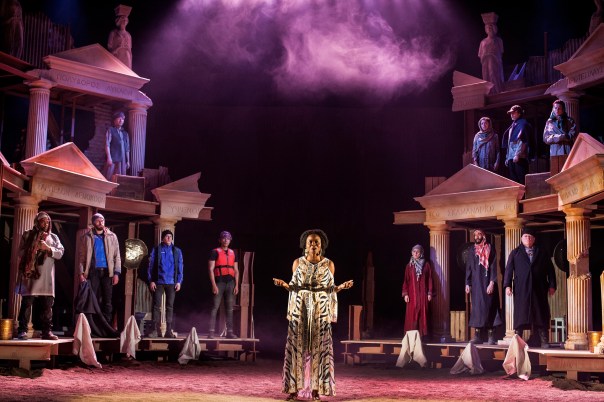
Adapted, or rather readapted, for the stage by Chris Hannan, the set was rather like that of the Handelian opera; two identical, double-floored Greek Templesque affairs facing each other over a dusty beach. This dust, by the way, would rise into the air & drift into the audience following the niftily choreographized blood-splattering battle-scenes, whose brutal thumping sword-on-shield moments were one of this play’s prime assets. All praise to Fight Director, Raymond Short, for this is an impeccable job, fella.

Hannan’s Iliad has been modernized, & obviously shortened, but it works, it works magnificently. Punctuated with funny puns & the occasional brusque brush with sexiness, Hannan has done a fantastic job of compression &, dare I say, digression, for he draws upon traditional Trojan motifs held outwith the Iliad & peppers them into the script, so the modern anticlassicist can follow the tune. Of Hannan’s effort, Mark Thomson tells us; ‘Chris’s version of the Iliad has a great deal of what inspires me in theatre: a big human story, language that is rich, poetic & deliciously speakable with themes that are timeless but resonate powerfully I the ears of a contemporary audience.‘
The plot of the Iliad centres around Achilles, & his ‘wrath.’ Falling out with pig-headed Agamemnon at the start of the play – played here by Lyceum stalwart Ron Donachie – he sulks in his tent while his best friend Patrocolus dons his personal armour & ends up being slain by the Trojan hero, Hector. This gets Achilles right on one & you can guess the consequences. In this production, Ben Turner’s Achilles is a wonder, what a guy. You can really tell that he’d had stint on the set of ‘300: Rise of an Empire’ : he knows all the moves & tonal inflections.
Elsewhere, Richard Conlon’s Zeus is cool, like an east-end gangsta living it large on on the Costa Del Sol. His, & I quote, ‘bad-tempered bitch of a wife,’ is Emmanuella Cole’s ciggy-smoking Hera, & she is undoubtedly the star of the show. Emanating authenticity & addictive to watch, her quality unfortunately puts into perspective some of the weaker actors/actresses. I mean, I don’t know if Peter Bary’s Paris was meant to come across like a soppy wet blanket for dramatic effect or not, but he definitely lacked balls. This, then, had a knock on effect to the chemistry between him & Helen – ‘the gorgeous scourge of mankind’ – played by Amiera Darwish. We were supposed to be watching one of the great romances of history – Napoleon & Josephine, Tristan & Iseult – but the chemistry they generated was more like Terry & June.
As for the stagecraft, I can’t really knock it. The splendid costumes were accompanied by the equally slendidly sung choruses in Greek which separated the scenes, bellowed beautifully by the entire cast. Indeed, towards the end of this really refreshingly fizzy production of the Iliad, I began to imagine the Corybantes singing & dancing before me, & the passage of three thousand years dissipating into mist.

Shafted
 Stagecraft:
  Performance:
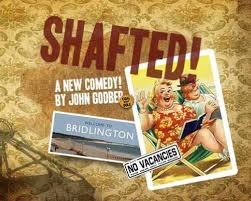
 From coal miner to window cleaner to banana counter to gnome painter, Harry and his wife Dot (played by real-life couple John Godber and Jane Thornton) have seen it, done it and worn the I Hate Margaret Thatcher, The Milk Snatcher t-shirt. As the title suggests, the play is inspired by the miners’ strike of 1984-85. But unlike popular films such as Billy Elliot, Brassed Off and more recently Pride which were set predominantly during the height of the troubles, Shafted, though using the immediate aftermath of what the BBC described as “the most bitter industrial dispute in British history” as its starting point, is more concerned with the long-term effects of Conservative anti-trade union and privatisation policies as Harry and Dot struggle to make ends meet over the following not one, not two, but three decades and like “two spent swimmers, that do cling together / And choke their art” almost go under.
—
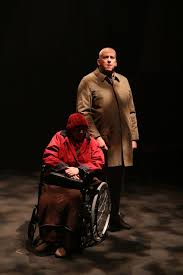 Almost, but not quite. Because despite facing financial hardship, physical illness, relationship problems, the curse of the black dog and the usual “slings and arrows of outrageous fortune” which accompany family life, what they possess is something which no politician or business person can buy or break – spirit! A spirit to endure, a spirit to fight, a spirit to stick together through thick and thin and a spirit to spit in the face of their enemies and laugh in the face of adversity. And laugh they do, as does the audience, from one dry one-liner to another as hapless Harry and doting Dot trade insults and sweet-nothings during a series of snappy duologues and confessional monologues which span the best part of two hours. A spirit which builds up to and is epitomised by Harry’s rallying war cry at the end of the play: “C’mon! We’ll take them all on!
—
There’s not much in the way of set and the play’s all the better for it, relying instead on the quality of the writing and the talent of the performers to hold the attention and provoke titters and thought – a few miners’ banners suspended from the ceiling; a green garden gate to denote the division between us and them, private space and public face; and a small crop of flowers at either side of the stage which are living proof that even in the harshest of climates there is always the possibility that green shoots of personal if not economic recovery can break through the hard earth and blossom. And the soundtrack, like the humour, is a blast of eighties disco to noughties pop which charts Harry and his ever-faithful wife Dot as they upsticks from Upton to Bridlington where they start afresh as B&B owners who sip Cava by the sea.
—
But what really hits home are the devastating and long-term effects of Thatcher’s brand of all-for-one and one-for-oneself Conservatism as famously set out in her 1997 interview for Woman’s Own: “there is no such thing as society”. There is. And if the gap between the richest and the poorest continues to widen, and the rhetoric of “workers” versus “shirkers” continues to pass as parliamentary discourse, and the worrying trend of low-paid and low-skill jobs and short-term and zero-hour contracts continues to become the norm, and the obscene practice of corrupt politicians lining their pockets with enough bungs and parliamentary expenses to clean a moat and morally bankrupt billionaires mooring their yachts in whichever tax haven will harbour their illicit financial flows continues to be swept under the luxury carpets of Whitehall and the City, then in the words of the Kaiser Chiefs: I predict a riot!
—
Reviewer : Peter Callaghan
Selkie
A Play A Pie and A Pint
Oran Mor Glasgow
Mon, 25 April, 2016 — Sat, 30 April, 2016

Script:  Stagecraft:
  Performance:
Written by Kay Singh, the third recipient of The David MacLennan Award, Selkie is slightly confusing with its mix of Scottish and Japanese storytelling. Directed by Caitlin Skinner, recipient of the 2014 Tom McGrath Maverick Award.
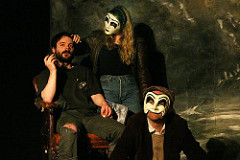 Meet Mac (Ross Mann), pill popper and hapless drunk in his wreck of a flat. He is having premonitions/illusions (take you pick – it is never clarified) of masked spiritual guides who persuade him to travel to his home island without any need of a ferry. Wouldn’t it be wonderful to roll up your trousers and wade over to an Scottish island of your choice? CalMac wouldn’t be so pleased but it would mean our islands would be accessible for all. Such is the nature of artistic license that Singh employs to convey that perhaps his mother is a Selkie that inexplicably disappears in search of skin when Mac was younger, probably putting him on his path of inebriated misery in the process.
Equally aloof Old Man (Keith MacPherson) is Mac’s unwelcoming father who won’t invite him in after so many years apart. It is only when Mac pleads with him that he begrudgingly lets him stay, never letting his whisky out of his sight. What a charmer! The Woman (Melanie Jordan) is never given a voice , sad and passive throughout. This play is in need of some humour to keep the audience wanting to relate to the central character who – despite a good performance – seems to be a lost cause.
Reviewer : Clare Crines

Blackout
Tron Theatre
Glasgow
19th – 23rd April 2016
Script: Stagecraft: Performance:
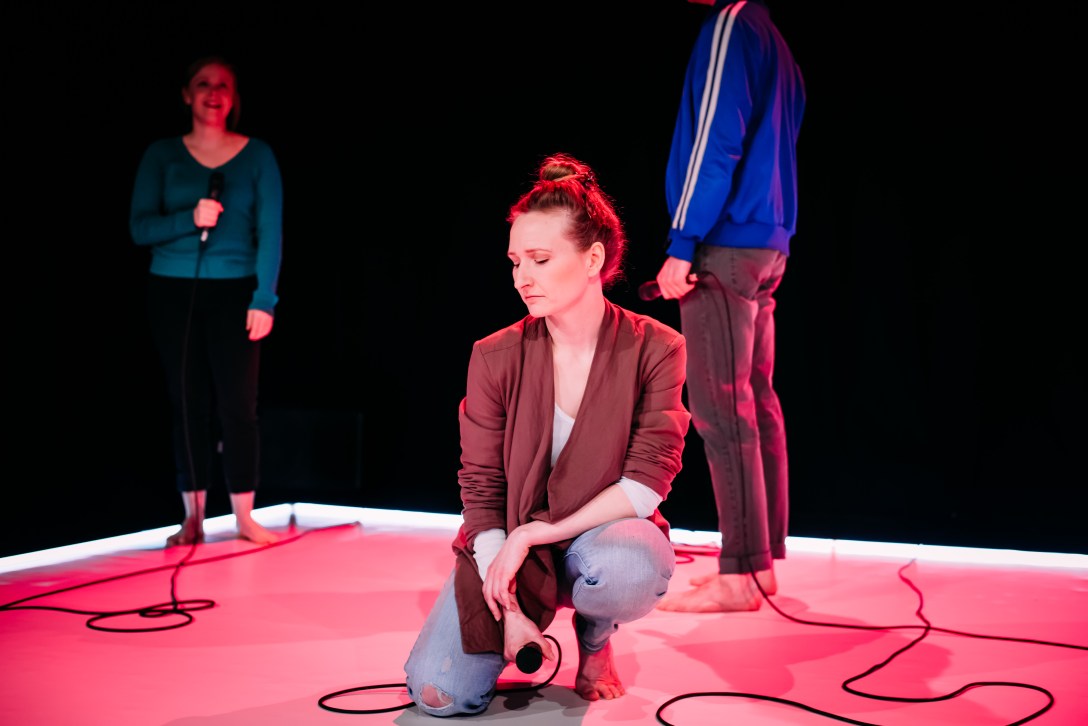
The fragility and contrastingly robust attitude of many different gods (group of drunks ) are under the microscope in this collection of interviews adapted for theatre. Not theatre for the faint hearted- it is what it is, a mass confession of all the capers, tragedies, stupidity, self hatred, loss and illusion that most recovering / or not alcoholics have to face and forgive.
This is tackled head on : no pussy-footing around the gay encounter gone wrong, no amount of microwaving or oven drying the piss saturated jeans of an alcoholic will ever lead to getting laid when he has almost set his hearts desire’s house alight melting his linoleum with his chargrilled remnants in the process. Stories to write blues tunes to. You couldn’t make this stuff up… if it wasn’t so real it would be funny. But that’s what’s so cool about this, it is funny. Although we might not directly relate to peeing from the top of Edinburgh’s Scott Monument we can visualise it easily enough. We are struck by the vulnerabilities and craziness excessive drinking provides, the sheer boredom that sobriety brings and the difficulty not so much in stopping but in staying stopped. Three female performers( Camille Marmie, Miriam Sarah Doren and Beth Kovarik) and two male (Ben Clifford and Mark Jeary) take us on a roller-coaster ride of scenarios that was recorded by writer/performer Mark Jeary.

Minimalist producer Callum Smith who leads Showroom, a platform for independent artists and small companies, has trumped the excellent How You Gonna Live Your Dash which was performed at the CCA in January this year.
Director/Designer Paul Brotherston who worked as Assistant Director in The Citizens Lanark: A Life in three Acts brings out the best in the already superb cast who between them have performed in television series Outlander, Oran Mor’s A Play, A pie and A pint and Bard in the Botanics. Accomplished Lighting Designer Simon Hayes ( Enchanted Forest in Pitlochry ) illuminates what proves to be challenging and riveting contemporary theatre that pushes boundaries re-humanising and re-dignifying our otherwise objectification of the common drunk.
Reviewer : Clare Crines
There Is Someone Who Hates Us
Play A Pie And A Pint
Oran Mor
Glasgow
April 11th-16th
13:00
Script: Stagecraft: Performance:
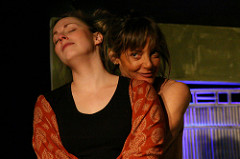
This play by Brazilian playwright Michelle Ferreira, adapted for the production by Lynda Radley and directed by Amanda Gaughan, is a dark and claustrophobic journey into the relationship between an unlikely couple. Fiery, lanky Brazilian, Maria, played by Maria De Lima, has brought petite, reserved and Scottish, Cate, played by Eilidh McCormick, to a small flat in Sao Paulo in the hope that a change of scene will kick-start their faltering relationship.
The flat was owned by Maria’s grandfather, who, it transpires, tortured opponents of a former repressive Brazilian government.
Maria can be pretty ruthless too, as she shows with her treatment of an injured bird that collides with the window of the flat.
Cate is worried by the noises in the old house and after a wild party where she was ridiculed by some of Maria’s friends, the doorbell rings and opening the door reveals a rudimentary homophobic drawing scrawled across it’s breadth.
Further incidents continue to unsettle Cate and it turns out that the young white son of a neighbour is the source of the trouble. The police aren’t interested in taking any action, much to Maria and Cate’s disgust. Without spoiling the plot things come to a nasty end and we are left wondering if there is any future for the pair.

This play also exposes the fact that attitudes to homosexuality in Brazil haven’t progressed and that the country can still be a dangerous and oppressive place.
Paticular mention has to be made of the sound and lighting, which were very effective in mirroring the changing moods and subtle shifts in the course of the unfolding drama. An intriguing piece.
————-
Reviewer : Dave Ivens
The Iliad : Cast News
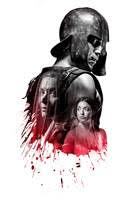
The Royal Lyceum Theatre, Edinburgh has announced the full casting for its epic production of the classical Greek poem, The Iliad, directed by its Artistic Director, Mark Thomson. Olivier Award nominee Melody Grove, currently nominated for ‘Best Actress in a Supporting Role’ for her critically acclaimed performance alongside Mark Rylance in Farinelli and the King in London’s West End last winter, will perform in this lavish and visceral production that explores the basic human emotions of love, jealousy and revenge against the backdrop of the Trojan War. This will be Thomson’s final production, as Artistic Director, after 13 years at Scotland’s largest producing theatre. The Iliad will run from 20 April to 14 May.
Melody will perform alongside a large, ensemble cast including Jennifer Black (who last worked with Thomson on Six Black Candles), Peter Bray (Twelfth Night, Shakespeare’s Globe), Emanuella Cole (who has featured on popular TV shows such as Eastenders, Doctors), Richard Conlon and Ron Donachie (both last seen at The Lyceum in The Crucible), Amiera Darwish (last seen at The Lyceum in Crime and Punishment), Ben Dilloway (Chicken, Paines Plough/ Hightide), Mark Holgate (who has featured on popular TV shows such as Coronation Street, Doctors), Reuben Johnson (who has featured on popular TV shows such as Doctor Who, Casualty), Daniel Poyser (who has featured on popular TV shows such as Waterloo Road, Coronation Street), and Ben Turner (who has featured in films such as 300: Rise of an Empire).
The Gods of Olympus take their sides and the fates of all men hang in the balance. On the battlefield of Troy the scene is set for the final conflict to claim the beautiful Helen. Only the invincible Greek warrior Achilles can tip the scales of war to glory or defeat, but humiliated by his leader Agamemnon, he is stubbornly refusing to join the fray.
The Iliad is a great tale about gods and heroes, love, jealousy and revenge and unveils the tragic and bloody climax to the 10 year siege of Troy; the darkest episode in the Trojan War. Homer’s Iliad is often credited as being one of the first known pieces of literature in Europe (dating back to approx. the 8th century BC) and the oldest human narrative about war. The themes of battle, displacement and anger are as relevant now as they were when written in ancient times.
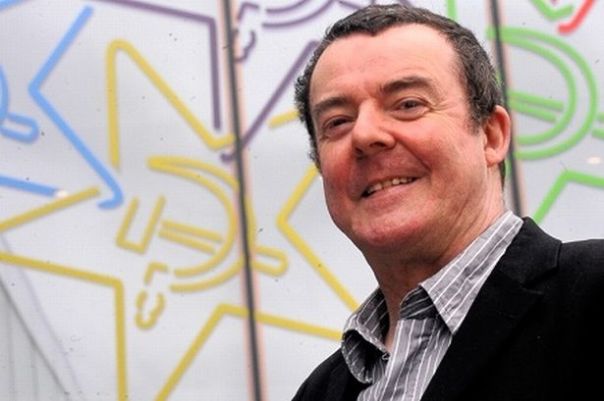
Chris Hannan
This new version of The Iliad has been written by Scottish award-winning playwright and novelist Hannan’s previous work at The Lyceum includes Crime and Punishment (a co-production with the Citizens Theatre, Liverpool Everyman and Playhouse, 2013) and Elizabeth Gordon Quinn (National Theatre of Scotland, 2006). His work has also been produced by the Royal Shakespeare Company, Old Vic Theatre, Bush Theatre and Traverse Theatre.
Award-winning director Mark Thomson joined The Lyceum in 2003 and during his tenure he has directed over 30 productions including, in recent years, Waiting for Godot, The Caucasian Chalk Circle, Union, Takin’ Over the Asylum. He won Best Director at the Critics’ Awards for Theatre in Scotland 2015 for The Caucasian Chalk Circle which also saw The Lyceum nominated for 17 awards, winning an unprecedented 6 awards for its 2014/2015 season.
Mark was previously Artistic Director of the Brunton Theatre Company from 1997 until 2002 and prior to that Assistant Director at the Theatre Royal Stratford East and the Royal Shakespeare Company and an Associate Director at Nottingham Playhouse.
He leads a stellar creative team that includes designer Karen Tennent (recent credits at The Lyceum include The Caucasian Chalk Circle); Lighting Designer, Simon Wilkinson (recent credits at The Lyceum include The Weir); Costume Designer, Megan Baker (recent credits at The Lyceum includeUnion) and Composer/Sound Designer, Claire McKenzie (recent credits at The Lyceum include The Lion, the Witch and the Wardrobe).
Director Mark Thomson says: “Chris Hannan’s clever adaptation of Homer’s The Iliad is fresh and classical and conjures an ancient world to engage with timeless human quandaries. A big story of war, lust and anger. Of the humans and the gods.”
Writer Chris Hannan says: “On the simplest level The Iliad is an action-packed love story set during the Trojan War, in a world crying out for forgiveness.
I was attracted to it because it feels like a story from the time when the world was young. Things are being experienced for the very first time; the grief of Achilles for Patroclus overwhelms not only him but the gods – the entire universe is turned upside down by his sense of loss.
Moral chaos in the universe. Ring a bell? “
Uncanny Valley

This was a cracker of a show, for older kids and adults alike. I can’t find a way to fault it. It’s an interactive affair, tightly constructed but still with room for the audience to shout out answers, have a go at narrating and get drafted in on stage for a cameo. It’s the story of a withdrawn teenage girl, Ada (Pamela Reid) and OKAY (Outstandingly Knowledgeable Android Youth), the robot that she’s created who is at risk of being sent to its destruction by the technophobic town mayor (Kirsty Stewart), It also asks an outstandingly varied array of questions about what it means to be human, and in what ways that might differ from a robot, packed into the confines of a fast-paced and intriguing show that runs at 70 minutes.
Rob Drummond, already known for successes with his adult shows Bullet Catch and Quiz Show, not only wrote this one, but acted as the ebullient school teacher who bounced out on stage right from the start, and the eager but frustrated adoptive parent of Ada. Kirsty Stewart who played the anachronistic mayor (with just enough touches of a Hogwarts teacher with her feather quill) and the excitable foster mother gave a particularly commanding, humorous performance. Pamela Reid as Ada looked so haunted and sad through most of the show we grew attached to OKAY along with her and really feared for its demise. The small cast were slick and enthusiastic, and drew their young crowd along with them on the quest to tell the difference between human and robot. They were keen from the outset to treat the children’s opinions with great respect, and the young audience didn’t disappoint either; answering questions from a place of deep thought, and due to brisk pacing, remained completely engaged throughout. No easy feat for 8 to 12 year olds for over an hour!
The set was simple but very effective, especially its use of lighting. The sound effects worked beautifully to make the sound of the robotic voice and eerie noises to raise the spook level. Amongst the drama and the soul searching, there was a smattering of silly antics and toilet humour to keep the kids laughing and the atmosphere light. Even though it was lighthearted and fun, this play asked some very deep questions to stimulate some thought about the role of robots in our lives forty years down the line.
The main climax of the play and the the main point of the debate came down to the ‘Turing Test’, a test devised by Alan Turing, the famous mathematician to see if a machine of artificial intelligence could fool people into believing it was human, then it would have reached a major milestone. My son had a crack at answering how long it would take someone to read the entire contents of the internet if they read 24/7. His guess was the highest at 1,000 years, but was way off the estimate of 57,000 years! Questions for the robot were gathered from members of the audience, who came up with some great ideas, like ‘can you recognise yourself?’, ‘are you aware that you exist?’ and, ‘do you love anyone?’ and integrated into the story line of the Turing Test. There was one particularly bright spark who came up with ‘do you value your own life?’
It opened up an entire world of new conversation with my 12 year old son on the walk home. What range of factors made a personality? What was the difference between having true empathy and faking it? All the way home…Which as it was the whole point of this highly engaging and thoughtful show, commissioned by the Edinburgh International Science Festival and Imaginate, I would rate it a grand success. I wonder what the future will hold. If the up and coming generation are all so equally engaged, then the future is in good hands; human or maybe even robotic! We, the parents and grandparents, might not be around to see. Which is a shame; I’d like to know the ending.
Reviewer: Lisa Williams
Neither God Nor Angel
A Play A Pie And A Pint
Oran Mor
Glasgow
28th March- April 2nd
Script: Stagecraft: Performance:
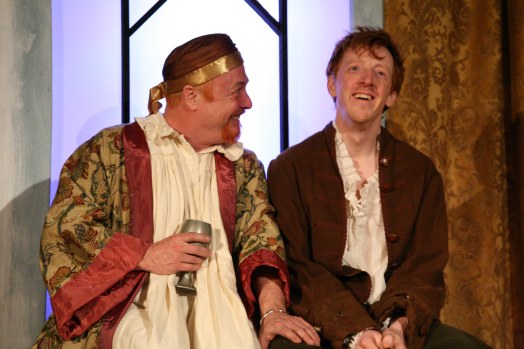
Warning! If you are easily offended by strong language the first lines of this play are peppered with much effing and blinding, but mainly effing. King JamesVI of Scotland, in Holyrood on the day before he is due to travel south to become James The First of both England and Scotland, has discovered that England, like Scotland, is in financial ruin.
He is now in a quandary, does he stay in Scotland as an unloved ruler, or does he head for the unknown of the English court? After several bottles of wine he’s the worse for wear and to his displeasure he can’t find anyone to bring him more.
Cue streetwise simpleton William who has come into the king’s chambers thinking there might be something worthwhile pinching now that James has gone. Unfortunately he’s a day too early but is luckily spared the chopper as he knows the whereabouts of the last available bottle of booze.
Jimmy Chisholm as the dyspeptic and drunken JamesVI and Gavin Jon Wright as goofy William are perfect comedy foils and play their parts to the hilt.
Written by Tim Barrow and ably directed by Ryan Alexander Dewar, the language is a strange mixture of cod-Elizabethan and Glasgow/Edinburgh patter, but effective in the context of the piece.
The play touches on the familiar themes of the loneliness and fallibility of being an absolute ruler, the financial misdeeds of the banking sector (a major problem even then) and the gap between the haves and the have-nots in society, albeit in a light-hearted way.
Shakespeare it’s not, but it was certainly an entertaining way to spend an hour at Oran Mor. Recommended.
Reviewer : Dave Ivens
I Am Thomas
Lyceum
Edinburgh
23rd March to 9th April
Script:  Stagecraft: Performance:
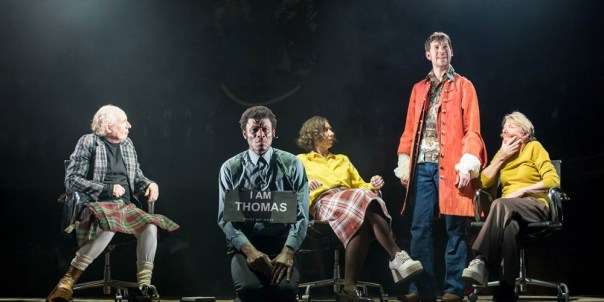 How do you solve a problem like, ‘I Am Thomas.’ Both brilliant & terrible at the same time, one wonders what the hell Thomas Aikenhead would have thought of this theatrical parody of his 1697 Edinburgh trial & execution for blasphemy. Then again, if I think about it a little, I reckon Thomas would have thought ‘what the fu3k was that!’
A few weeks ago I was reading through John McKendrick’s brillliant book on the Darien expedition, & came across the story of Aikenhead for the first time. ‘That would make a wonderful piece of theatre,’ I thought, the story being permeated with a great deal of dramatic tension, whose quaquaversal religious bigotry offered a great chance of relevancy to these our modern times. I Am Thomas, I believe, has missed a trick, giving us instead something akin to P1-P2 assembly play, but without the tall narrator from P4 giving us an overview of the plot from time to time to keep his straight.
Director Paul Hunter describes his attitude to the pastiching montage of styles that I Am Thomas incorporates into its fascinating fabric, when he told the Mumble; ‘From our earliest development on the project it felt very clear to me that I wanted the piece to have a contemporary feel… there was a range of influences on the piece, from some extraordinary Communicado shows that I saw at the Edinburgh Festival in the 1980s, to the blackly funny & oddly poiganat films of Roy Anderson.’
For me, Hunter’s choices, were ill-thought out & irrelevant, having Archie-Gemmel-era Scottish football commentators catting about the action at various stages in the play was not much better than a P6 Christmas special. But, what does save the play as entertainment are a spankingly charming selection of songs played mummer-like by a brilliantly talented troupe. John Cobbm Charlie Folorunso, Amanda Hadingue, Iain Johnstone, Myra McFadyen, Hannah McPake, Dominic Marsh & John Pfumojena are all multi-instrumentalists & sing sweetly together. Pfumojena’s voice is startlingly heavenly by the way, while the lyrics of poet Simon Armitage are, in the main, top-notch.
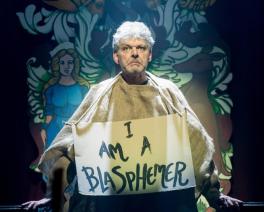
Armitage’s best song has the cast singing ‘Thomas Aikenheeeeaaadddd… who the fu3k is that,’ or ‘Thomas Aikenheeeeaaadddd… who the fu3k are you.’ The problem is, by the end of the play, we aren’t really any the wiser, & Aikenhead’s martyrdom towards achieving a reform’d Scottish religious landscape seems nothing but an ugly caricature. Still, as a spectacle “I Am Thomas’ should be witnessed, you may walk out at the interval shaking your head, or you may you rise in your seats at the surreal finale furiously clapping your hands & proclaiming its brilliance too all who will listen. A unusual piece this, quite groundbreak in its outlook, the production levels of I Am Thomas are so off piste its ridiculous… or is it brilliant… I still can’t quite make up my mind.
Reviewer : Damo Bullen

 Mumble Theatre