Author Archives: yodamo
We Can All Agree To Pretend This Never Happened
Oran Mor
9th-14th February
13.00
To mark A Play A Pie And A Pint’s 350th production, this week’s play was by American playwright Emma Goidel and was originally commissioned for American theatre group Tiny Dynamite. This international theme will continue through the current season of plays. The play, We Can All Agree To Pretend This Never Happened wraps up a serious topic (global warming) in what amounts to a classic comedy of errors. The action takes place in a scientific research lab deep in the furthest frozen wastes of Siberia and concerns four Americans (two male, two female) involved in climatic research. The characters are played by James Young (Lincoln), Robert Jack (Andrew), Sally Reid (Liz) and Helen McAlpine (Maya).
The well-designed and lit set placed the action firmly “in the round” both in it’s circular construction and position within the packed audience. The protagonists have obviously spent too long cooped up together in their isolated icy outpost (shades of The Thing?) , nerves are frayed and emotions and feelings, real and imagined, are running at fever pitch.
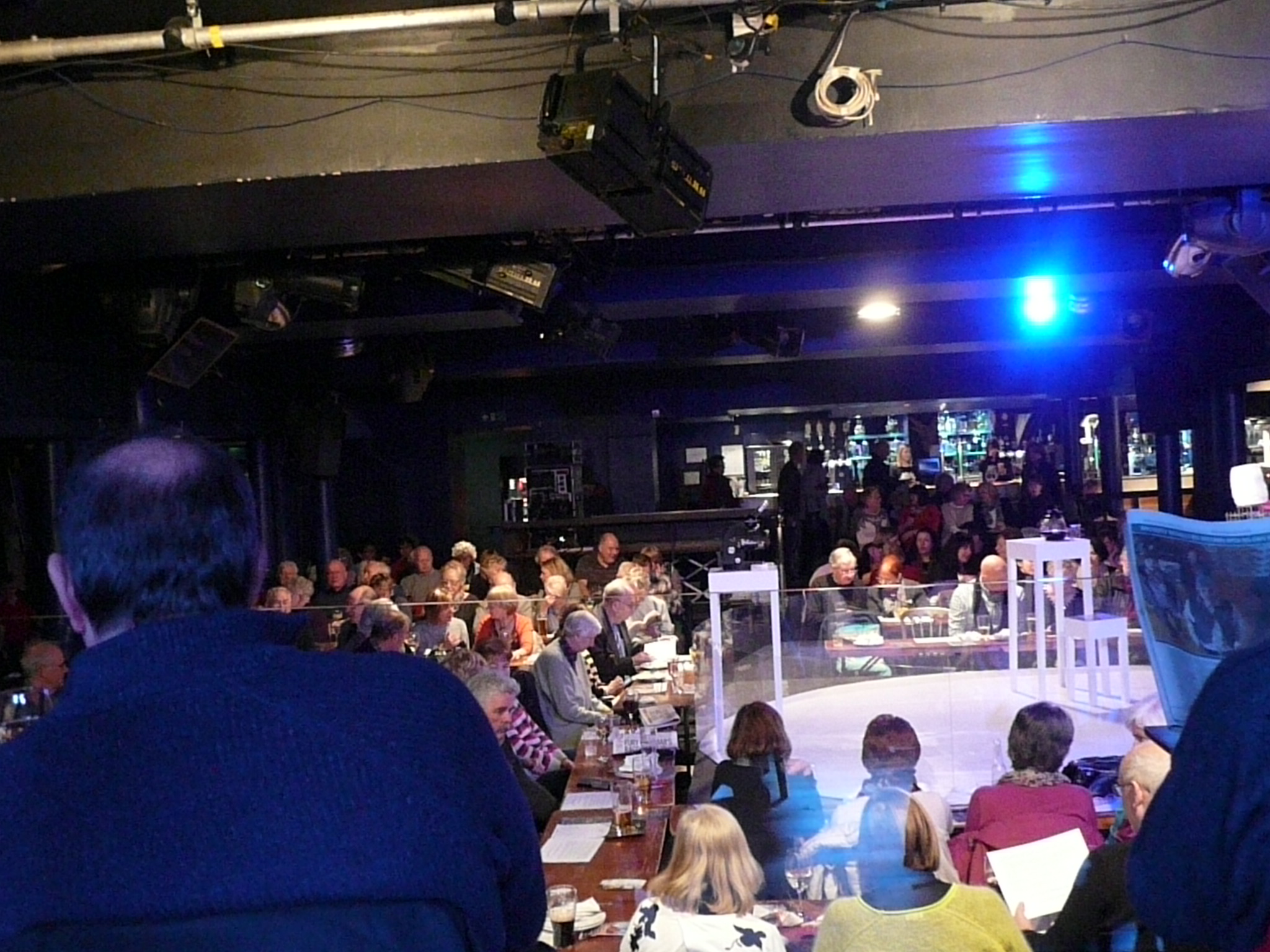
Thus, the scene is set for some farcical misunderstandings over romantic liasons and a plot to fake damning global warming data by the use of a manufactured deadly virus. To say more would spoil the plot, but the whole scenario was well acted by the ensemble, in particular James Young’s Lincoln was reminiscent of Richard Dreyfuss at his most exasperated and apoplectic.
The play was crisply directed by Gary McNair but never quite fulfilled it’s promise by being a little short at forty minutes and somewhat unfocussed in it’s ambition. Was it a comedy or a serious comment on global warming? We never really reached a conclusion in that respect. In any event, it was pretty entertaining and probably the only time I’ll be on the stage at Oran Mor. (Some seats had to be put there-it was so busy)
Reviewer : Dave Ivens
Mr. Carmen
Manipulate Festival
Traverse Theatre
7th February
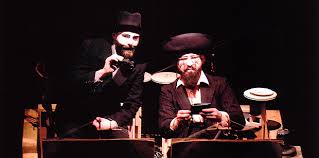
Two Creepy clown pirates with impeccable beards grace the stage as floating heads on a seaside style portrait-booth. These are cross-dressing alcoholics that smoke.. in front of a live audience. Actually, the smoking was fragrant, so clearly not the real thing but they made up for it by spraying a can of toxic spray paint to write Carmen. These demonic white-face-painted degenerates use the effects of smoking and severe alcoholism to animate their concerns in their small world created for themselves on stage. Their props, of which there seems to be an inexhaustible amount, include suitcases and doll. These dolls are tied to a reel that makes a square track around the two men. It appears like a boxing ring and they compete to see who can spell their words out the best. The words are Jose and Carmen, for the inspiration for this performance piece comes from Carmen by Prosper Merimee written in 1845 and of course is more commonly known because of the opera based on this story.
The words are spat out in wine through projected light, or written in silk atop a voodoo doll with the pins that are farrier’s nails. It is all very inventive, & its sheer brilliance to see such people really experimenting with how truly weird they can be : the world is way too full of people trying to be normal and these two men are clearly not that. The characters have a unique eccentric bond, and although they compete they are one and the same. In fact I had to ask myself how much these fellows are actually like this for real and if so I wondered where they they be heading for a drink next…..I’d like to join them! They stab at each other with knifes and steal each others cigarettes, as if they are siblings.
A performance of Carmen five years ago
The show is surrealistic in nature and quite like a horror in content, the score is dark and ominous at times or chaotic and unsettling at others. This creates an intensity that is a direct contrast to the more slapstick style comedy parts of the show, and it makes for an ingenious emotional roller coaster. The beards are pretty trashed by the end but that’s mostly because they are saturated in wine.
Reviewer : Sarah Marshall
[
Butterfly
Manipulate Festival,
Traverse Theatre
5th Feb
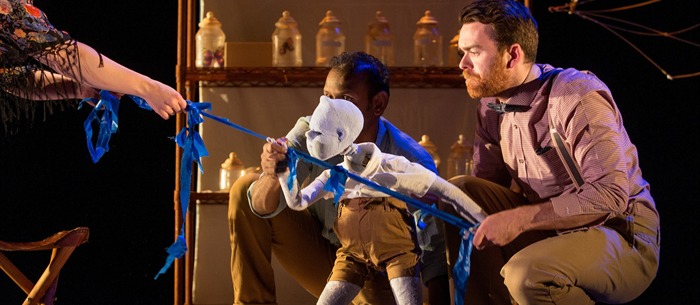
Some of us think we’ve had it bad in life , then all you need to watch butterfly to discover its not all that bad. The opening scene introduces our performers, Ramesh Meyyappan, Ashley Smith and Martin McCormick, in a synchronised dance. Ashley plays Butterfly a kite maker who’s affections are sought from a customer (McCormick) she is clearly not up for this but when Nabokov (Meyyappan) the butterfly collector comes along she changes her tune. The romantic scenes I found a bit cringe worthy….in fact in my notes it says BLERGH….and I found that the character Nabokov looked maniacal throughout this. Maybe this was deliberate as we realise his intention is not to nurture Butterflys individual creativity and freedom but to trap her in his world like the real butterflys in the jars he keeps. He is livid to find another man has affections towards her and tortures her as punishment. On finding the kite maker living with the other man her enraged customer takes her physically and rapes her. This scene is particularly traumatic. Slow motion movement is used and it directly contrasts with a scene next to it which is set in a blue lit ambience of the butterfly collector who is oblivious to violent red lit incident that is occurring in his absence. The customer is transformed from a gormless admirer to a predatory hillbilly.
As described by my friend Heidi, we then see the ‘butterfly effect’ of rape and domestic abuse. The scene is replayed over and over as the trauma causes Butterfly to be rejected by Nabokov and for fighting to become common place. As the show is without words various interpretations are triggered. In he following scenes we become less sure of what is dream, real or repeating memories. A shadow baby is projected onto one of the kites as a visually effective womb, Butterfly is pregnant. The baby is born and Butterfly is left alone looking after all the dead butterfly’s in jars. The baby grows to a toddler, a soft cuddly toy type puppet and although the movements created by the trio are very convincing the baby looks scary, like a mini Mr. Burns. Eventually the child breaks a precious butterfly and in a rage it killed by his own mother. The play ends here as the jarred butterfly’s flicker alive in the jars, perhaps symbolising the entrapment of this unfortunate woman in prison either a real one or metaphorically in her mind.
This play depicted real issues that effect many people. Domestic violence are tricky subjects to cover and it was an opening for myself and my friend to talk about it in a way that wasn’t too harrowing as thought we have about it could be referenced using the play. Cycles of abuse are common place in society, work like this gives people a chance to view such a taboo in a way that means you can be thoughtful without becoming overwhelmed by the horribleness of a situation that people too often have to go through. FOUR STARS

Reviewer : Sarah Marshall
Dead Simple
King’s Theatre
Edinburgh
Until 7th feb
19.00 (wed & sat 14.30 matinee)
£14.50-£29.50
The King’s Theatre is a beautiful venue with ornate marble stair cases, stained glass and carved wood. There is also many ornate plaster cast sculptures in the auditorium, your eyes are kept busy as you are reminded of the regal olden days of theatre! Dead simple is an adaptation of the novel by Peter James. It begins in Brighton and instanly reminds me of the movie Shallow Grave. The playful communal behaviour of financially adequate (posh) property developers. Two friends Michael (Jamie Lomas; Stella, Eastenders) and Mark (Rik Makarem; Emerdale, Torchwood.) Our lead lady Ashley ( Tina Hobley; Holby City, the Bill), Michaels soon to be bride and her Uncle Bradley ( Michael McKell; Casuality, Emerdale)have candid character building joviality in a grand sitting room. They are happy but we all know this isn’t going to last. The reason for this coming together is the wedding and a planned stag do….and a prank which involves the groom being buried alive in a coffin. Michael has to contend with suffering the worst fate that is possible, particularly when he discovers all but one of his friends have been killed in a car accident. The only person that can help him is Davey,(Josh Brown; Grange Hill, Shameless) a young man with learning difficulties who lives with and in constant fear of his father. He plays computer games in front of the T.V. in his bedroom and talks to Michael via a walkie talkie he finds at the crash site. We can see Michael through a veil in a hidden compartment behind the bedroom wall. The effect works well as a way of being able to experience the two contrasting environments at the same time. The use of the walkie talkie is not the only time technology is used as a plot device. Mobile phones, texts and recorded messages are used throughout this show in way where you know it would be impossible without them.
The story sees many unexpected twists, surprises and MURDERS. Lighting and sound effects make the whole show intense and moody. Particularly effective scenes were of cars approaching and turning in the woods of the burial site. This is achieved with a limited amount of space . Dark periods were made to create the feeling of suffocation, just like the fate of the man in the coffin. This is broken up with plenty of humor, our detectives are commonly joking around and taking cracks at each other as is familiar in T.V. Detective dramas. Our manipulative leading lady’s character hails from Morningside and I assume this will change at the plays next location, it was a nice touch for a place to be familiar…even if it was the location of a tragic car accident. Or was it…really you need to see this play to see all the twists and even if you don’t get a chance to I wouldn’t want to ruin the book either. The presence of familiar T.V. soap opera faces makes it reasonable to assume that this show isn’t supposed to be constantly intense, certainly the two ladies behind me find most of the show hilarious so we don’t hold back at the parts where we are not sure we should be laughing. ( Safety in numbers!) Its always interesting to meet regular theater goers and for these ladies this is just the first of three shows this week! FOUR STARS
Reviewer : Sarah Marshall
Hooray For All Kinds Of Things
By way of an explanation to those of you who have not come across the phenomenon that is A Play, A Pie And A Pint before, they are one hour plays performed at lunchtime in the crypt of what was once a large church, the entirety of which has been converted in to a bar/venue/restaurant complex called Oran Mor situated at the very top of Byres Road in Glasgow’s West End. The owner of the building, Colin Beattie and the Scottish actor and playwright, the now sadly deceased David MacLennan, had the idea of putting on lunchtime plays in the crypt. For your money you get, you guessed it, a play a pie and a pint (quiche, wine and soft drinks also available). The doors open at 12 noon which gives you ample time to finish your pie/quiche, read a paper or chat to your pals in the relaxing surroundings before the performance commences at 1 o’clock.
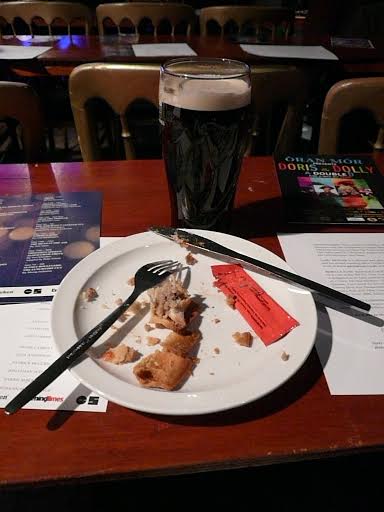
This week’s play, “Hooray For All Kinds Of Things,” was written by, and featured Sandy Nelson (Chris the postie in Still Game and self-confessed Jon Gnarr afficionado) in the lead role as Icelandic stand-up comedian and non-conformist ex punk, Jon Gnarr, who stood for and won the mayorship of the capital of Iceland, Reykjavik, in 2010. Supporting cast were Rebecca Elise as Heida Helgadottir as his election agent and (the very lanky) Jamie Scott Gordon as ageing punk and co-conspirator Ottar Proppe.
In 2008 the banking-led Icelandic economy had imploded and the population were completely fed up with traditional politicians who had led Iceland to the brink of total ruin. Into the breach strode Jon Gnarr and “The Best Party.” This play basically tells the story of what happened from The Best Party’s beginnings as a joke to cheer up the people of Iceland through to Jon Gnarr’s election as mayor of Reykjavik, by means of several scenes strung together as a flashback from Gnarr’s(Nelson’s) opening stand-up routine.
The Best Party stood for “Sustainable Transparency” and had the snappy slogan, “Hooray For All Kinds Of Things.” Aims included; A Polar Bear in Reykjavik zoo, free towels at the public baths and A Disneyworld with free entry for all. Gnarr proudly proclaimed that when elected, “I will go back on all my election promises.” They exposed icelandic politics for the worn-out, self-seeking, hypocritical mess it had become (some parallels with the UK I think) and in doing so won an election against all the odds.
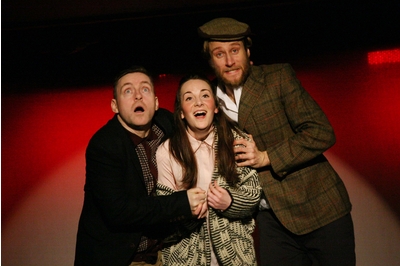
The play, directed by Gary McNair was very tightly written and never faltered over the hour’s duration. There were many hilarious moments including a very different version of “Simply The Best”(pun intended) which got a great round of applause from a very appreciative audience. A serious point was made, along the way, of the importance and place of Art and artists of all kinds in modern society. The acting and delivery was of the highest order and the only (very) minor criticism was that some of the lighting cues were not up to the mark. Much recommended. FOUR STARS
Reviewer : Dave Ivens
Cirque Berserk
Edinburgh Playhouse
1st Feb 2015
7.30pm
£21.90 – £29.90
![0[2]](https://mumbletheatre.uk/wp-content/uploads/2015/02/02.jpg)
Formulated in downtown Los Angeles, Cirque Berserk started on their road of performance at the Burning Man and continued to run shows all over the United States. Direct from four sold-out seasons in London’s Hyde Park Winter Wonderland, they come to Edinburgh.
With the Playhouse auditorium half full the floodlights went up, blinding the audience. An booming electro-rock soundtrack plays and on jump an all black athletic crew dressed in period suits, demonstrating their impressive physical abilities with a skipping rope and creating remarkable human towers, all possessing amazing physical strength and acrobatics, a feat of sheer synchronized athleticism. Followed by two aerial performers on silks, owning true agility, twisting and flipping providing many heart-in-mouth moments. Two drummers walked on stage after, one a Jack Sparrow look-a-like with good humour and the other, a fiery blonde, however their set progressed on to some underwhelming percussion with ropes. Of course no circus is complete without a clown, cue the dopey and clumsy clown, Tweedy, trundling on with an iron as a dog and a floor brush. He mimes a silly but softly amusing hat act. He then tries to fix the blown ‘CIRCUS’ sign lights, using a ladder that would have any Health and Safety officer having kittens! Another elegant glittery aerialist spins in the air but she is indistinguishable from the many others out there. An acrobatic dance duo (a swan and faun?) takes stage presenting impressive balancing feats and demonstrating exceptional strength and focus. Next up is Cuba’s eight-strong male crew (and token female) with rippling muscles and adorned in tribal feathered hats, who launch each other into high somersaults from a teeterboard. Less jaw dropping fillers parade the stage, such as flirty showgirls, Tweedy the clown returns and a robotic bouncing-stilt artist but too many acts feel ordinary.
Before the interval however we are given a taste of something quite out of the ordinary! A spherical steel cage, 14 feet in diameter, is wheeled into position one, and then two leather-clad Brazilians ride on and begin to loop the loop inside the sphere! It leaves the audience choking back exhaust fumes, but it is still breath taking nonetheless. After the interval we witness men competing at the game of limbo, the level gets lower and lower, the game gets serious when the level is set alight and one very flexible man is able to successfully limbo under a foot level. Subsequently ‘Jack Sparrow reappears spinning fire ropes from his mouth and his partner proceeds to spin various objects lying down with her feet! An outstanding contortionist follows demonstrating she can control a bow and arrow more accurately with her feet than most can do with their hands. There is knife-throwing which is scarily close and almost unbearably exciting, finishing on a turning wheel and fire daggers. Tweedy returns for some bicycle capers, before he ropes in two ‘tall strong’ men from the audience which results in some amusing tomfoolery. A female displays some breath taking balance acts and the athletic male strong crew revisits for some hoops leaping, it is as if they are made out of elastic.
The show’s finale sees the return of the jaw-slackening spectacle, the ‘globe of death’ where not two, but four motorbikes take on the human hamster sphere. A very brave young woman entered the sphere and the bikers jostled for space through a heart stopping sequence. The lighting was spectacular and over the roar of the bikes you heard individual people in the audience gasping… wow!
This being the first time I have seen a circus on stage, rather than a tent, made me think the space was a little restricting and they probably could not perform to their full potential. Upon reflection there was plenty going on, yet little sense of drama. Any magnificently dangerous moments were lost and weren’t emphasised with a high tension build up. Cirque Berserk does not meet the heady highs of Cirque du Soleil, yet there is great attention to detail in the costumes, make-up and industrial Area 51’s set. There is a plot somewhere about a traveling gypsy circus, however it is a bit fragmented featuring talented performers, who just needs some polishing. FOUR STARS
Reviewer : Sarah Lewis
Thomas Hicks
MANIPULATE FESTIVAL
Traverse Theater
Edinburgh
1st Feb
It’s all hushed in theatre two of the traverse for Thomas Hicks to describe his passion for his short animated films which are shown on screen. He sits up front with the interviewer who is evidently as as knowledgeable about the subject himself. He shows a series of his own work as well some that have inspired him. He makes a living by animating music for bands and individuals. He also mentors students at Greys School of Art in Aberdeen. Mr Hicks has a drawing style I would describe as kind of ‘jiggly shirgley,’ occasionally painterly with layers of overlay. The selection he has chosen for Manipulate portrays repeating themes, such as circus, fairground, pumping hearts, a masked couple and predilection for antique paraphenalia plucked from an older, technological time. It is always interesting to see that although many artists find themselves working with digital technology the mind is attracted to the past. Hicks uses mainly monochromatic imagery which backs up this theme. Not even a glimmer of Sci-Fi in sight!
His work lives in the time before colour even. The more he talks, however, the more apparent it is that much of what he does occurs through a process of default. He says he can’t understand digital technology which, to a ludite may sounds a bit unrealistic, until it’s realised that he is speaking comparatively. As part of a trio of films made by other animators he gives us Cyriak, an animator I know, which is very complicated stuff. My favorite was the one with the sheep which I am delighted to show you here
Hicks ends with a cartoon of an odd deformed couple with cricked necks getting it together. It’s tragic but humorous, a sweet finale. A happy ending perhaps, for the masked characters in his own shorts. He paints he draws, he spends a lot of time at a computer…he’s kept going by the eureka moments that come along when you make something pretty smart and new out a whole bunch of mistakes. Cheers for the insight.
Reviewer : Sarah Marshall
As You Like It
Royal Scottish Conservatoire
27th-29th January

This student production, directed by Peter Collins, was performed in the round, with music provided by supporting musicians and by the actors themselves. In his brief programme note the director pointed to Shakespeare’s use of the ‘affectation of country life’ to offer a critique of society and to pose some questions about fortune, nature, death and loss – as well as highlighting ‘love as a living relationship’ and the ‘power of language’ to light or obscure what may be true.
All this we get, in various measure, and perhaps the main credit to this performance is – thanks to the direction, and the lively, and often shrewd delivery of the actors – that we believe it, in spite of the strange setting, the daft occasions, the cock-eyed twists of the plot. What’s more, in this entertainment the comedy sustains our hope in humankind and genuine affection, while still allowing us scepticism and common sense. And that is so even when the foundation for many of the verbal twists and rallies has almost evaporated over time, and we may have to stretch a bit for the punch line or the context.
Much of the responsibility for keeping us in touch falls on Rosalind at the centre of things. On the night, Colleen Cameron, supported beautifully by Chloe-Ann Taylor as Celia and Conor Hinds as Orlando, was both radiant and mischievous, cheery and scathing, as required. It is one of the key twists in characterisation here that the central figure – among all the swirl of menace and foolery, of disguise in dress and switches in gender – turns out to be the most heavily smitten and yet she is the voice that most clearly mocks the conventions of love and courtship. Good in the opening scenes with Celia as her spirited companion, she gathered strength and confidence in Arden, and in her final ‘disclosure’ – where the knots of relationship were all unravelled – everything was brought to a joyful conclusion.
The rest of the company pitched in to very positive effect. Nicholas Barton-Wines as Touchstone had the energy, fun and perversity that the clown should deploy: both as barbed commentator, and as suitor to the formidable Audrey, who was played to good, licentious excess by Charlotte Driessler. Stephen Redwood was a slightly aslant but persuasive le Beau, as well as a sweet-pitched Amiens. Shane Quigley-Murphy and Tim Pollack both had three role switches to manage – presumably to display their range. The first showed best as an imposing Charles the wrestler, and as the solid and genuine, if mildly deluded (in ideal, pastoral terms), Duke Frederick. The second gave more as the truly menacing Duke Senior (later wafted away in two strokes of the pen) than as Adam the loyal servant (‘Still Game’ out of Blacks) or as Silvius the shepherd (kitted out for Alaska, but accented like Georgia). Emilie Mordal Konradsen, as Phebe, could be forgiven for her snappy responses, delivered with conviction, even though she too was lined up at the end with the others in pairs and headed for the happy Ark of marriage.
I haven’t forgotten Jaques, played by Robert Ginty in a fashion that caught his mixed character, which is mostly ‘melancholy’, though sometimes ‘merry’. Formerly (by the Duke’s account) a ‘libertine’; he appears in Arden keen for song and company, then apt to seek solitude. Eventually, having ‘bequeathed’ appropriate wishes like blessings on individuals in the company, he takes his farewell, called to ‘other than dancing measures’ and following the converted bad Duke to a cave of religious contemplation. It’s not easy to catch all that in ways that persuade. But Ginty did: conveying both Jaques’ vague and odd attraction, and also suggesting his depth and complexity, even as the character slipped away from the main stage. I don’t expect to see a better student Jaques; and if I see as good a professional one, I’d be perfectly content.
In other elements, there wasn’t much to be taken with the minimal stage setting – a bare square and rubber granules covering the floor around and perfuming the air not very pleasantly. Not much direct representation in this of the pastoral attractions of Arden – illusory or otherwise. Also I have hinted some of the costume choices (though definitely excluding Touchstone and Rosalind, and maybe the sheep) gave me pause. That said, the lighting worked fine, as did the swift changes and exits and entrances.
Summing up, I would identify the necessary strength of the production (and direction) was the way the company combined to create good feeling and generate amusement and pleasure. The wrestling match; the high jinks of the inhabitants of Arden singing and dancing round the campfire; the minimal but comic vocal contribution of ‘the sheep’ to the exchange between Corin and Touchstone; the eye contact of Ganymede and Aliena in the baiting of Orlando; the audience engagement when it had point, including the charm of the epilogue – all these provide fair examples. The text, too, was delivered pretty well by everyone ‘trippingly on the tongue’. Still, you don’t get comedy that works unless the actors actually bring spirit as well as conviction to it. But there was no problem here in that respect. FOUR STARS
Four Stars Reviewer : Mr Scales
Macbeth
Citizen’s Theatre (Glasgow)
2031st Jan
19.30 (matinees Sat & Wed)
£9-£17
To celebrate the coming of James VI of Scotland to the throne of England in the wake of the barren Queen of England, Elizabeth, the inimitable bard produced his only scotcentric production, the powerful & gory psychological tragedy that is Macbeth – think Lady Macbeth as bunny-boiling Glen Close in Fatal Attraction. Four centuries later, both the play (known as the Scottish play) & its poet are firmly entrenched in the collective consciouness of the British, & it is this fact that allows the cutting edge ‘Filter Theatre & Tobacco Factory,’ to tinker about with the play knowing full well that the audience will understand what the hell is going on.
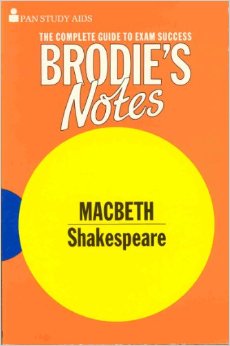
So essentially, this particular Macbeth is Shakespeare for the Shakesperians, in which at one point Macbeth (played perfectly by Ferdy Roberts) finds himself reading from the ‘Brodie’s notes’ on his own tragedy – talk about plays-within-plays.
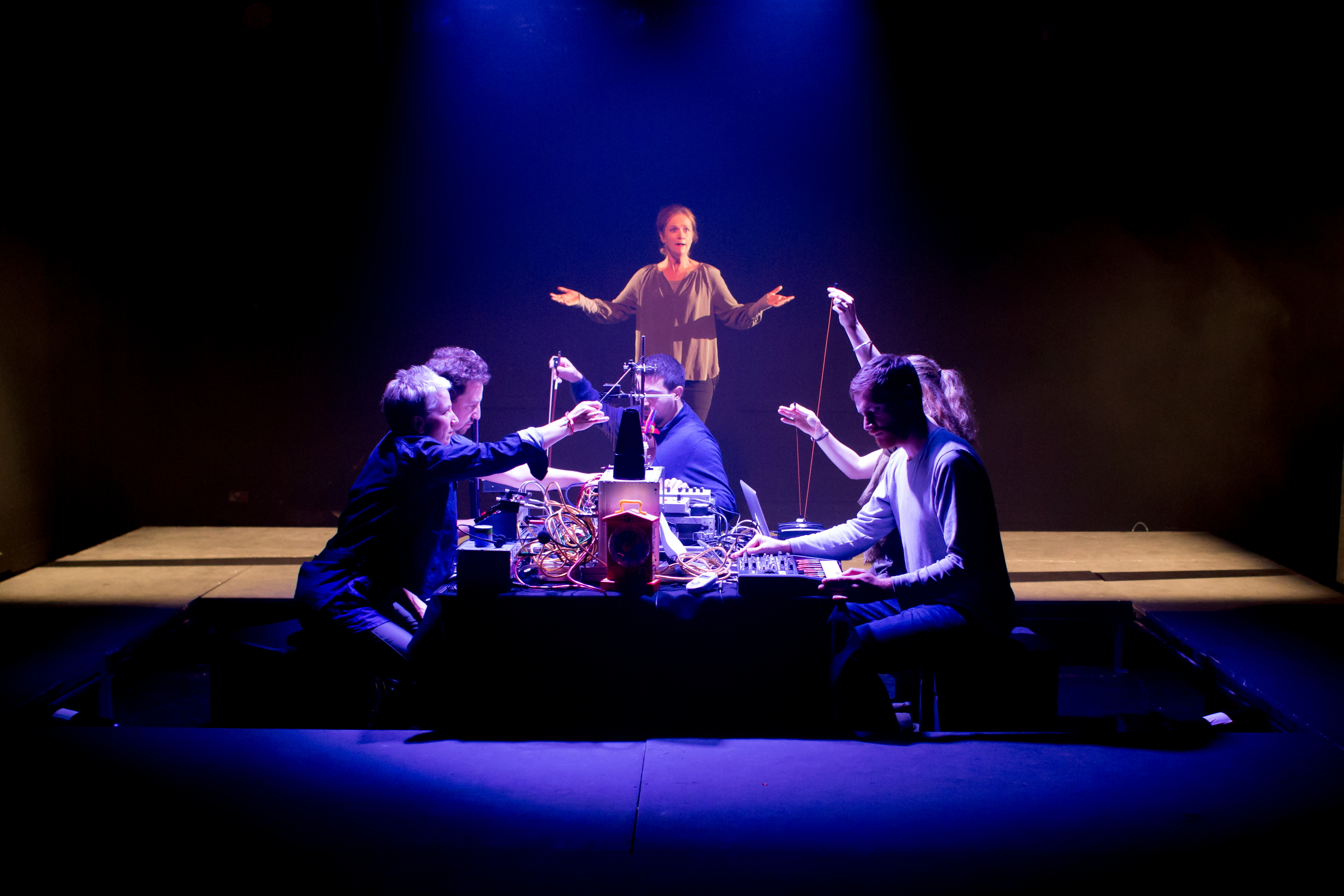
This rendition is pretty good, however, a Kafka-esque vision of apocalypse with mad little gremlins running about inside of your TV seat, twiddling buttons & carving out eerie soundcapes. That’s no metaphor, by the way, for the stage set is like a 1990s mound of music-emitting wires & gadgets, like a macrocosmic version of Musikfabrik’s ‘Delusion of the Fury.’ At its heart sat multi-instrumentalist Alan Pagan, a delight to listen to & observe his craft at first hand.
Of the board-treading troupe, I found the acting to be top notch, my favourite being Paul Woodson as Malcolm. The rest of the cast harmonized in the Greek fashion, & they together work’d this neo-modern, chopped & spliced, confectionary-included version of the Scottish play with some style. FOUR STARS
Reviewer : Damo Bullen
Faith Healer
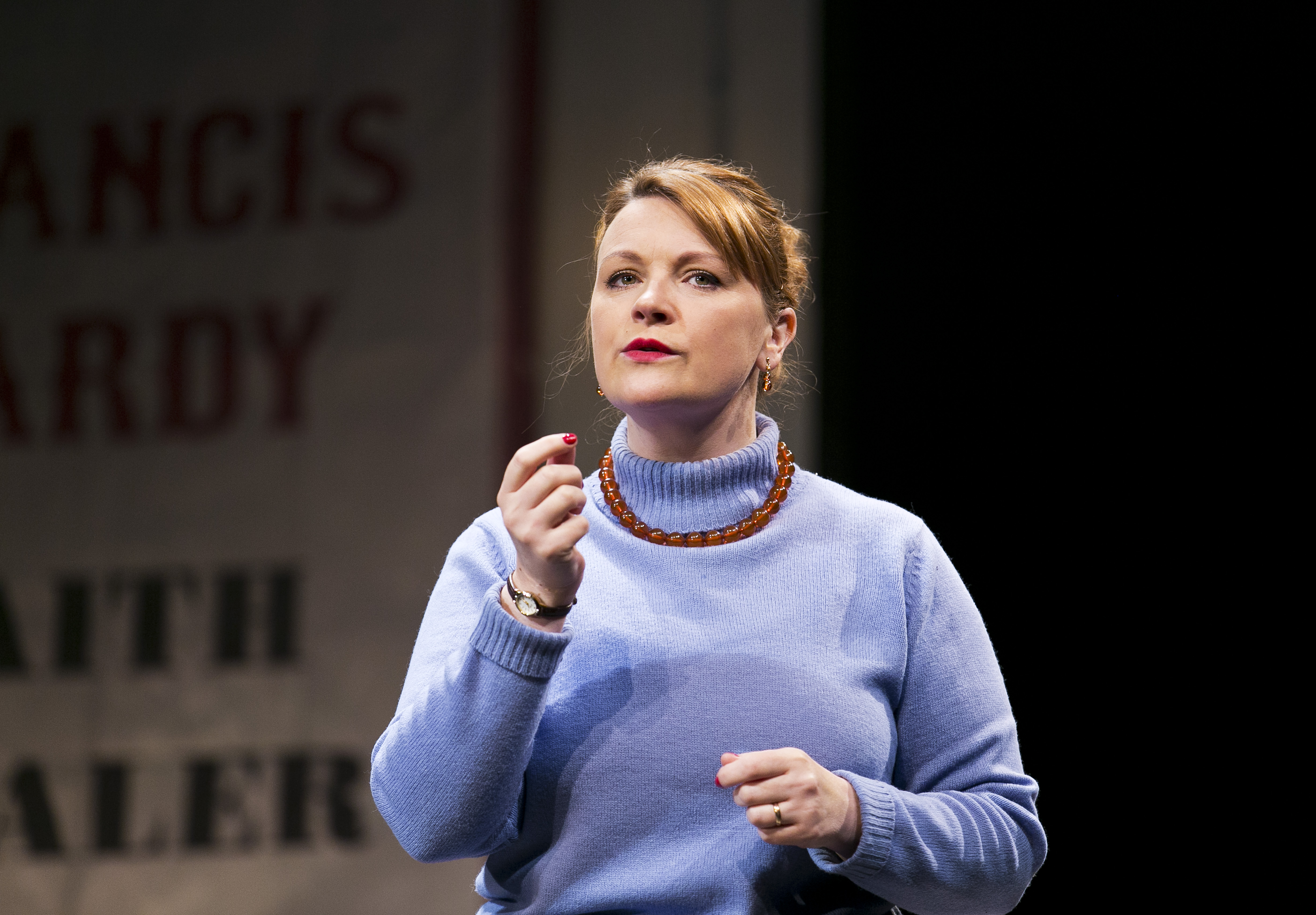
Niamh McCann as Grace Hardy

Sean O’Callaghan as Francis Hardy
Things began to improve with the second monologue, however, (the play consists of four intertwining monologues) & the third was even better. They allowed the fog to clear a little on the content and what was emerging was a reasonably cleverly scripted play. The three different perspectives on similar events weaving together satisfyingly. What was also refreshing was that we weren’t led down the obvious road of analyzing the practice of faith healing but were more concerned with the characters and the narrative. ‘Teddy‘ was particularly entertaining, all be it with a smattering of totally confusing surrealist humour

Patrick Driver as Teddy
.

 Mumble Theatre