Category Archives: Scotland
Mack the Knife
Oran Mor, Glasgow
Sep 16 – 21, 2019
Script:  Stagecraft:
Performance:  S.O.D:
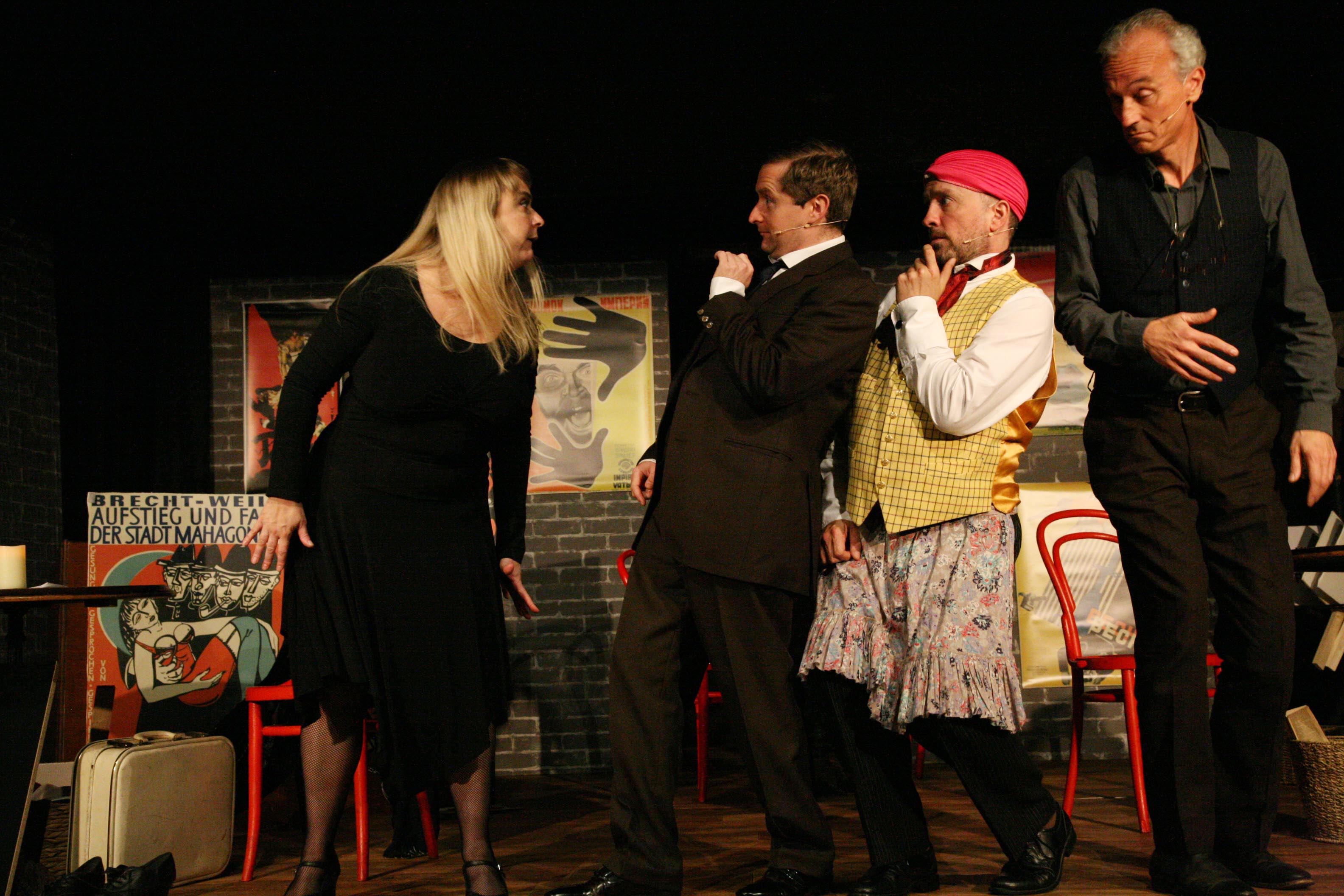
Oran Mor’s year of celebration continued with a revival of Morag Fullarton’s take on the Mack the Knife story about the period leading up to the production of what eventually became The Threepenny Opera. There was great upheaval at this time in between-the-wars in Berlin just before the rise of the Nazis, mirrored in the action onstage which was carefully choreographed to contain all the vivid, comedic activity. The entourage on stage included 4 actors, with some having double roles; Keith Fleming, playing Lotte Lenya’s, husband, doubling up as the delectable MacHeath and also playing guitar. The dialogue kept up a fast and furious pace, interspersed with frequent songs that grew in passion and significant the further we were hurled into the plot. Bertholt Brecht (George Drennan) came on – a larger than life character sliding the four of them together in theatrical style. All of which lead to Lotte auditioning for a show in Berlin. She was almost faced with the three men conspiring about her, all in the name of the show. The story stuck very well to the original style of the 30’s song by Kurt Weill who wrote it with Bertholt Brecht writing the lyrics. The comedy flew faster than a speeding light as did everything else, in a whirlwind and exuberant spectacle of dance, song and enticing comedy.
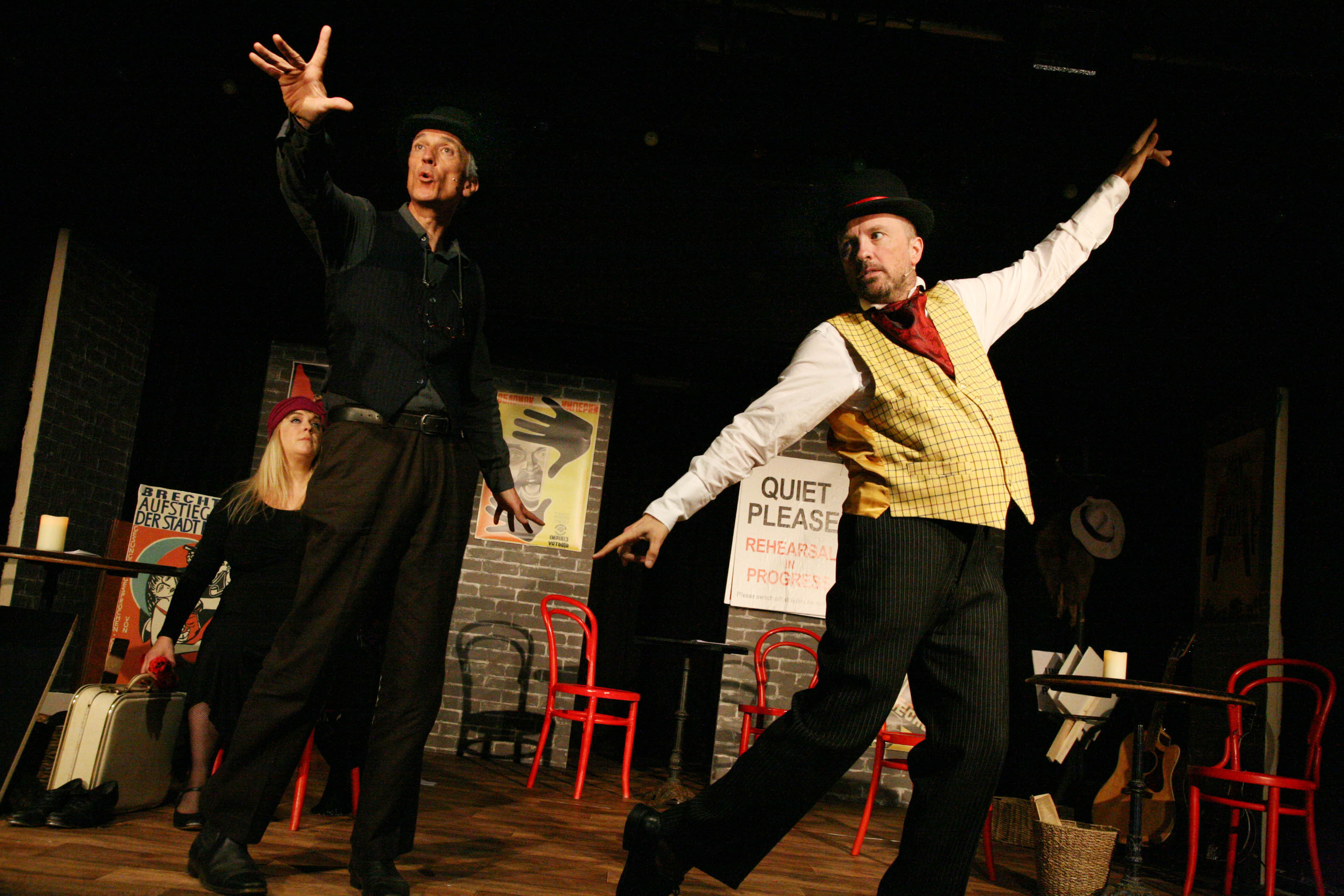
The said Kurt Weill (Kevin Lennon) was also big personality, stealing the show in every conversation and standing out in his showy, not to be ignored outfits. With Lotte on the verge of stardom the show crept ever closer and behind the scenes things were far from peaceful, with problems coming on all sides at Brecht who did well not to fall apart. In the end, the show finally became the Threepenny opera and when the song Mack the Knife was performed it was immediately loved by audience after audience, performance after performance, and word spread about how brilliant it was. But other forces were in play, as we saw when our four characters onstage were called to be part of the darkness in Berlin at this time. An officer dressed as a Nazi had the three in line questioning them about their lives as artists, leaving having decimated the show. Lotte was placed in a useful Jewish section of the world but their lives had already been thrown apart. Except that in the end, as we listen the strains of Mack the Knife at the end of the show, we were reminded that this great song was too well liked to just disappear. It seems appropriate to revive this musical now, at this time of turmoil in our own politics.
Daniel Donnelly

P.P.P. on T.V.
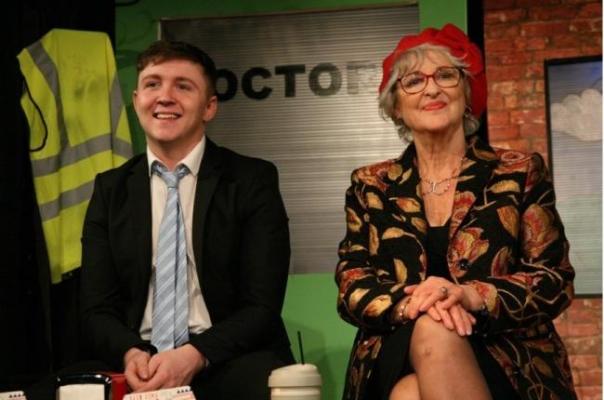
A Respectable Widow Takes to Vulgarity
The Mumble love the PPP at the Oran Mor – cutting edge theatre & a decent scran – its a winning combo. BBC Scotland are about to broadcast several plays – so folk can get their pies & their beers from the local store & watch from the comfort of their own home
The team at Oran Mor is justifiably proud of A Play, A Pie and A Pint, the distinctive lunchtime productions which year by year have grown in fame and popularity ever since their launch by founder, the late David McLelland, in 2004. And 2019 is a celebration year for PPP, marking as it does the 500th play, not to mention recognition of their achievements in the shape of the award for “Contribution to Scottish Culture”. All of which has generated the interest of BBC Scotland who will record and screen some of the plays for a new series.
Crocodile Rock
Oran Mor’s proprietor, Colin Beattie, himself a huge supporter of PPP, is “ ..more than pleased that A Play, A Pie and a Pint is at last being featured on national television… A lot of dedicated people have contributed to Oran Mor’s success… I have no doubt our founder, David McLennan is also pleased his legacy is being aired on the BBC.”
The excitement is shared by Artistic Directors April Chamberlain and Morag Fullerton who are keen to point out that having the TV cameras present won’t change anything – they’ll stick to their tried and tested formula for the live events and hope that the series will give a wider audience the chance to experience this unique “little lunchtime phenomenon” for themselves. Chamberlain points out that it will also afford an opportunity for “the fantastic writers, directors and performers that we work with the chance to engage with audiences on a wider scale.” “It would be fantastic,” she adds “if writers who haven’t worked on television before went on to be picked up for something else, and hopefully this will encourage everyone involved to take risks.”
Amen to that!
PPP is famous for showcasing both new and existing talent and I look forward to catching up with some of the best of the shows in the comfort of my own home – though I’ll have to supply my own pie and pint! Go to the i-Player to find “Ring Road” and “Chic Murray: Funny Place to Put a Window” as well as other productions which are scheduled to appear throughout the autumn. I can only agree with April Chamberlain when she states “It’s obviously different from the live experience but if it helps to grow an interest and an appetite for audiences, it could be the start of a great thing”. Cheers!
Daniel Donnelly
WATCH NOW ON BBC IPLAYER
Ring Road by Anita Vettesse.
BBC Scotland: Sunday 8 September 2019, 10pm.
A Respectable Widow Takes to Vulgarity by Douglas Maxwell
BBC Scotland: Sunday 15 September 2019, 10pm.
Toy Plastic Chicken by Uma Nada-Rajah
BBC Scotland: Sunday 22 September 2019, 10pm.
Meat Market by Chris Grady
BBC Scotland: Sunday 29 September 2019, 10pm
Crocodile Rock by Andy McGregor
BBC Scotland: Sunday 29 September 2019, 10pm
No 1 Fan

Oran Mor, Glasgow
September 9-14, 2019
Script:  Stagecraft:
Performance: S.O.D:
Today’s play, pie and pint offering was a three-hander intriguingly entitled No 1 fan, by Kim Millar and appeared at the Oran Mor as part of a tour of Scottish cities. Joyce Falconer took to stage as Jan in a striking red dressing gown, soon to be joined by David McGowan as Andy her husband. From the first it was clear that Andy had found himself a younger lover less than half the age of his long suffering wife. So poor Jan was in turmoil from get go, not only trying to deal with her husband cheating on her, but with someone so very much younger. The script was sharp and pointed as Jan energetically tore strips off her errant husband about the age of her rival, not to mention the moral issue of older men coupling with far younger women.
But Jan had a plan to get her own back. She would pick up a gentleman of her own. A darker side emerged when she revealed that in fact she was going to target a specific gentleman, a journalist named Jack (Callum Cuthbertson) whose newspaper column habitually degraded older women. Jan lured her victim to the house, where he appeared in a cravat and adopted a rather arrogant stance as a darling of the business. Until she slipped something in his drink causing him to regain consciousness slumped against a radiator with Jan standing over him holding handcuffs on a chain in an almost cabaret-like spectacle. At first he thought he was going to be in for some sexual shenanigans, but as Jan chains him to the radiator she made it clear that what she wanted was for him to write a column retracting his previous attitudes.
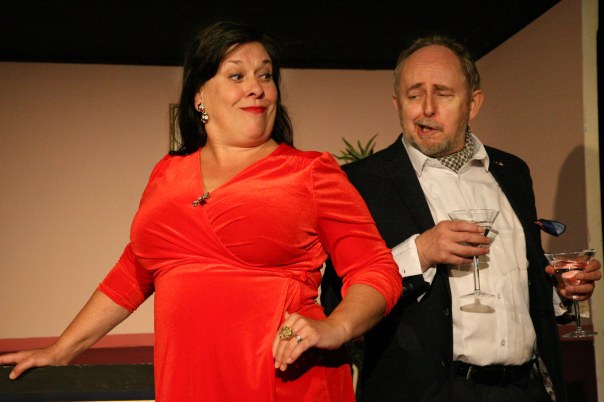
This play featured very strong performances from all three actors. Joyce Falconer totally over the top and dangerous as Jan, railing against the way older women are treated. David McGowan as Andy, trying to justify his infidelity, but coming in the end to remember what older women have to offer and asking for forgiveness. Callum Cuthbertson as Jack the charming journalist whose swaggering persona was perhaps hiding a feeling that he could be knocked off his pedestal at any moment.
In the end I found this quite a touching piece about the power struggle between the sexes, making its points with humour and absurdity, but coming in the end to some kind of resolution. When Andy asked for a second chance, Jan magnanimously replied with a toast to second chances as the lights went down.
Daniel Donnelly

Crocodile Rock
Oran Mor, Glasgow
Aug 26–31 , 2019
Script: Stagecraft:
Performance:  S.O.D:
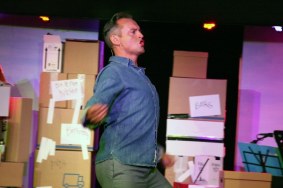
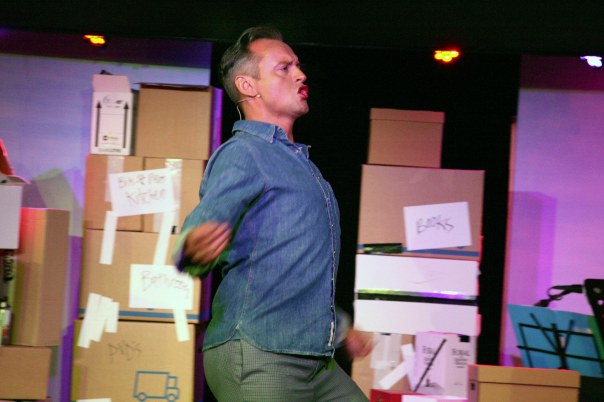
It was great to be back at Oran Mor where the year celebrating 500 productions of A Play, A Pie and a Pint launched into its autumn season with Crocodile Rock, a new one-man musical by Andy McGregor. Darren Brownlie plays 17-year old Steven McPhail who introduces himself in song from his makeshift music studio. But this joyous beginning is something of a false start as young Steven found that life at home on the Isle of Millport was tedious, empty and downright boring. The stage was strewn with piles of boxes containing his possessions, giving you the impression of someone who was trying to make decisions about his life and how to live it. By the way, the music in this show was top notch, ably supported by the 2-man backing band of Gary Cameron (keyboard) and Gavin Whitworth (bass and guitar).
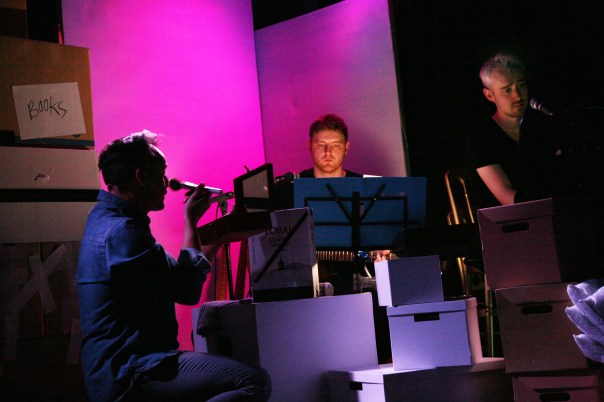
As the stories unfold in song, we learned about Steven’s adored mother and rather straight-laced father. We saw him going down to the beach to stare at Millport’s eponymous crocodile rock, which just reminded him of how detached he felt from his surroundings, and how much his soul longed for something different. All his ups and downs were expressed in the music as well as a large cast of imaginary characters. In places the show seemed almost operatic in its production and lyrical quality.
Out of the blue, and to our great delight, along came someone new – a drag queen from a larger world that Steven met by chance and found awe inspiring right from their first encounter. As we watched he seemed like a little boy being led into a new world of wonders he had never dreamed of – a world where at last he felt at home.

But he sang of great heartache as well. Having plucked up the courage to tell him, he loses his father’s approval and finds himself actually disowned. In tears he shouted “I won’t apologize for being who I am”. He had come onstage dressed as a woman, with long blond hair and a tight sequinned pink dress. Now the joke becomes serious, symbol of a great expression of overcoming. With every leap he took us with him, his songs becoming bold, and his world that little bit happier as he realised the true nature of his identity, the real Steven in full frock and make-up. This show was put together to make us laugh and cry, and it did that in spades. It also brought joy out of the heart of despair as we shared the quest to be your real self whatever it may be.
Daniel Donnelly
The Ugly One

Tron, Glasgow
July 4 – 20, 2019
Script: Stagecraft: Performance:
The Tron stage looked great as we took our seats for the Scottish Premier of The Ugly One by Marius von Mayenburg, an award winning writer from Munich. With a door to each side and two pairs of plinths with metallic fruit bowls, the walls, blinds, a conveyer belt all looked very plush and inviting. The characters, played by Martin McCormack (Lette), Sally Reid (Lette’s wife Fanny/rich old lady), Michael Dylan (Lette’s boss/Scheffler the surgeon) and Helen Katamba, carried on their chairs and sat centre stage in a row, launching straight into the action.
The plot revolved around a revolutionary new plug, invented by Lette, who was very excited about his invention. But the other characters seemed more concerned with who should promote the new product, agreeing unanimously that Lette himself was far too ugly to be entrusted with the task. This came as news to Lette and it was only when his wife agreed with the others that he conceded the point. Rather bizzarly, it was decided that plastic surgery was the way to go.
Movement around the stage was glorious, with people sliding on the conveyer belt, the blind on the walls gliding gracefully to and fro, keeping the action moving with pace in an every-changing set. The hilarities were also unending; clever to the point of showcasing all the facets of theatre, clearly a most accomplished piece packed with the sheer delight of writing and most glorious acting. In continuous use was a screen above the action. We were introduced to this for the first surgery scene that had me in stitches. They held a smart phone to the scene and proceeded to cut into fruit to simulate Lette under the knife
But the surgery turns out to have unexpected consequences, with the new-look Lette becoming subject to the demands of everyone, much to his dismay. The climax comes when Lette climbs on to one of the plinths, in seeming isolation – how dramatic, how captivating! In the ensuing confusion, Lette comes face to face with some very dark truths about human nature.
This show is the blackest of black comedies, touching upon the reality of modern life and how it is lived, making you think. But mostly making you laugh. This was fun, totally brilliant, I commend it and I recommend it. It’s on at the Tron until 20 July – don’t miss it!
Daniel Donnelly

Them!
Tramway, Glasgow
June 27 – July 06, 2019
Script: Stagecraft: Performance:
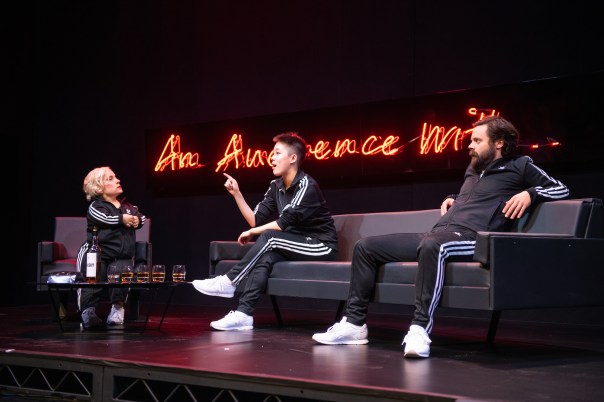
The Tramway was an expectant place as we congregated before the show. As we walked in we were handed ear plugs; you couldn’t have had a better forewarning of the event to follow. It was also testament to the Tramway’s complete versatility as a theatre venue with the whole space able to change at will. The performance event in question was a new show from the National Theatre of Scotland’s Stewart Laing and Pamela Carter. Them! was inspired by the classic 1950’s horror Sci-fi movie of the same name, in which giant mutant ants attack Los Angeles. No doubt then why the poster listed “the audience, the host, the guests, and band and the ants”. All of which elements were thoroughly examined in one way or another as the evening progressed.
Them! was a talk show, hosted by the irresistible and irrepressible Kirina (Pamela Carter) who began the evening’s interviews by turning to the audience and asking about who we are. An enormous proposition, but that’s just for starters… With Kirina at the centre, the show built with great professionalism, fun, and lots and lots of talking as the artists and musicians offered their own personal take on any and every issue under the sun. Topics were raised and just as quickly flew by as the passionate Kirina, enjoying herself tremendously, delved deeper and deeper, kept us straight as we tried to follow the chaos of the ever changing scenarios.

I have to say a word about the production – the whole enormous stage was filled with everything a major talk show might have: a couch and chair for the interviews, a performance area for the band (Pop Queen Carla, a young Glaswegian Indie band), all combined with clever lighting, spotlights and the large screen hung right in the middle, on which we could watch clips from the original 50’s movie and from the musical tribute remake produced by Stewart.
Again and again, the discussions came back to the question of who we are, what we are, what are we doing here and touched upon themes of loneliness and survival? All the “guests” offered diverse reflections and comments, which could have been baffling, but somehow we were guided throughout and if we got lost we had the sense of Kirina to rely on.

So where do the ants come in? As carefully as we were “captured” we were shown the escape and could choose to go into a tunnel (through the audience) where there was heavy strobing and beat music which seemed almost out of control. My choice was a whisky and the quiet exit which led to a room where there were two large glass tank filled with thousands of leafcutter ants all busy doing what they do – a fascinating watch.
Are we ants? No we are humans but with very similar tasks, strength and beauty. What do we need? What does it all look like? The idea of Them! showed up many times throughout this show in different guises and with deep and careful and skilled writing and creating. In the end the show explored all sides of being human and surviving the world, just like the ants.
Daniel Donnelly
Pink House
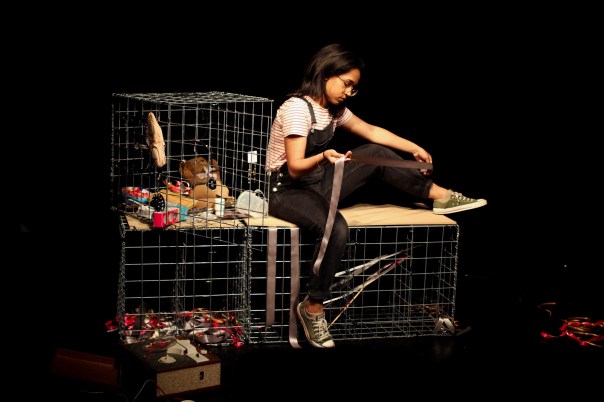
Assembly Roxy
Edinburgh
June 28-30, 2019
Script: Stagecraft: Performance:
Pink House is a new play by New Yorker, Madison Pollack, produced by Edinburgh theatre company Paradigm Lab. I got to see a preview before the show runs at Edinburgh Fringe this August, and whilst first performance nerves were certainly palpable I enjoyed the production a lot, especially Pollack’s thoughtful and emotive script.
Pink House explores the new relationship between a Jewish grandmother, Shira, who immigrated to America as a child and her adopted teenage grandchild, Peri, who she only meets after the death of her estranged daughter. As well as presenting the new co-existence of Shira and Peri and the seemingly insurmountable gulf between them, we see flashbacks of Shira’s childhood. These flashbacks depict a house of women and girls: Shira, her mother, aunt and sister, all with contrasting personalities. And this all-female cast adds to Pink House’s distinctive tone and perspective. The overall structure is chronological, but lacks rigidity, so that understanding of what has happened and is happening unfolds for the audience as the play goes on.
The strongest aspect of Pink House is its tender exploration of ideas around memory, family and what divides and connects people. The play deliberates over what makes someone family, and whether family is something you can choose. While Peri’s mother chose her through adopting her and did not choose Shira, but Peri and Shira are forced together through family connections. Pink House explores Anti-Semitism specifically through these questions of family, divisions and connections. Shira is faced with the childhood memories she has oppressed through the voices she hears (perhaps through senility) and the recordings on an old wire recorder, which her sister made “for posterity”. Memory becomes complicated when you are displaced from your family and culture by immigration and the repressing of trauma. For Shira this bottling up has resulted in cruelty to herself and those around her. And as we see throughout the performance, that certain things deserve to be remembered.
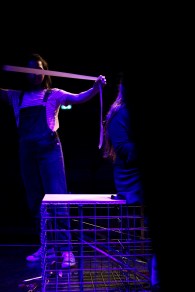
The abstract, minimalist set consisting of metal wire boxes which could be moved to create tables, chairs and cupboards, achieved the perfect balance of simplicity and flexibility required of a festival show. Although the movement between scenes was a little stilted it is sure to pick up pace by the run in August. The abstraction of the set pieces and how they are interacted with juxtaposes beautifully with the more concrete descriptions of the family home settings.
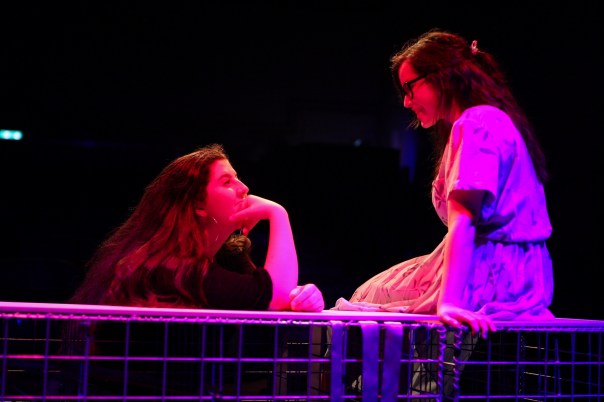
Alice Jackson had quite a challenge portraying both the younger and older Shiras. With no time for a costume change, let alone aging make up, as the scenes flow from past to present, it is all down to Jackson to make the shift clear to the audience. While there was a notable and satisfying change in her interactions with other cast members it would have been nice to see more from her physicality. Ania Myszkowska was particularly enigmatic as Rebecca, Shira’s younger sister, her energetic and youthful performance contributing a lot to the tenderness of the production and the heart-breaking revelations of the family’s experiences.
Pink House has a very original voice, a thoughtful script and some great performances and stage craft. If you are looking for some new writing that is more thought-provoking than provocative this Fringe, then I would recommend getting a ticket.
Katrina Woolley
Last Ferry to Dunoon
Oran Mor, Glasgow
June 24 – 29, 2019
Script: Stagecraft: Performance:
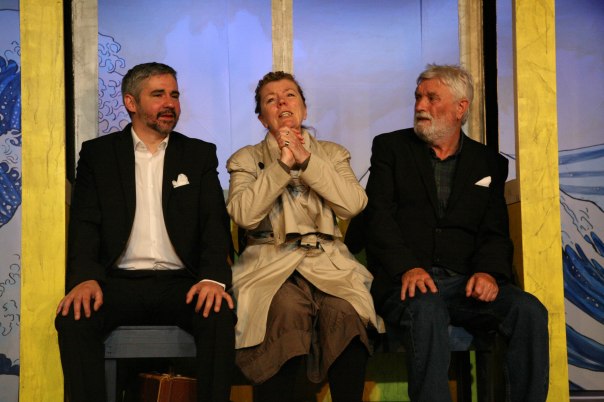
The set glowed blue with a backdrop depicting Katsushika Hokusai’s famous Great Wave print, perfectly setting the scene for us as our three characters sat together in a shelter on a stormy day, waiting for the ferry to Dunoon – it was unclear whether they planned to embark or were waiting for someone who was due to arrive. As they waited, the three – Karen (Linda Duncan McLaughlin), Aiden (Iain Robertson) and the aptly named Johnaboy (Laurie Ventry) – regaled each other with tales of the seaports and coastal towns they had visited, stories that seemed as large as the sea itself.
This week’s PPP was Peter McDougall’s amazing seventh play at the Oran Mor (he also co-wrote the very first) and opened to a full house with an eager and appreciative audience, full of relish for what was to come. And they weren’t disappointed, with the action moving from frolicking comedy to spotlit drama as the actors in turn held sway with the stories they had to tell about well-remembered summer trips down the coast to traditional destinations like Millport, Wemyss Bay, Rothsay.
As the stories unfolded, it felt as if there was more to this than met the eye as the characters revealed more about themselves and you wondered about what the relationship was between them. Karen seemed to be the cornerstone and to have the key that would tie the story together. When the storm exploded, with thunder and lightning roaring and flashing over the stage, the two fellas were thrown to the floor where they remained for a good ten minutes.
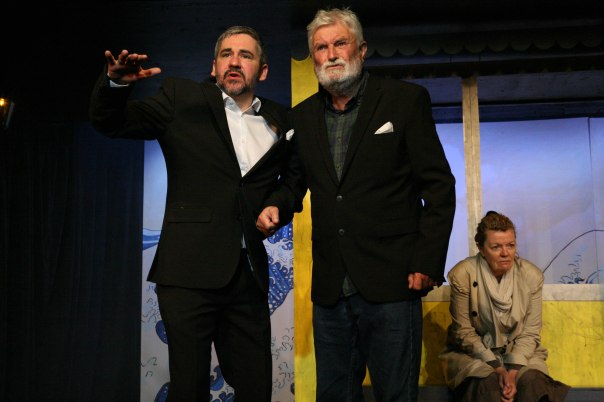
As a twirling twist Karen was repeatedly revealed in different guises, taking off her jacket to reveal an NHS costume, then later shaking out her hair to make her appear like some sort of god. There seemed to be a kind of mythical undertone to this section as she performed various small tasks over the prone men, delivering both blessings and condemnations as she woke them up obviously feeling very rough after their handling by the storm.
It seemed like no time before the hour was up and we were left slightly wondering what just happened – more than just waiting for a ferry while being blown about by the wind and the rain. A romp down memory lane perhaps. An invitation to explore the old and the new and perhaps the mythical in Scottish culture. An entertaining and intriguing experience, full of light and dark, just like the sea.
Daniel Donnelly
Dusty Won’t Play
Oran Mor, Glasgow
June 17 – 22, 2019
Script: Stagecraft: Performance:
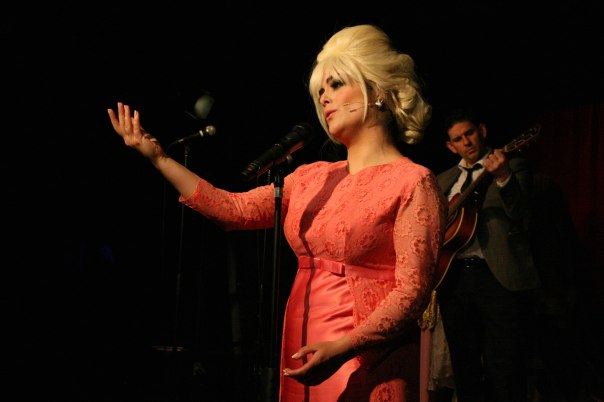
Today’s set was a marvellous confection of soft frilly orange material at the back with red on either side, with something of the look of a stall at the circus. And following on the big background came the big music as we were introduced to the inimitable Dusty Springfield who glided on stage and into song. A tribute to Dusty’s famous 1964 tour of South Africa, this play was written by well-known comedy writer and children’s author Annie Caulfield and is making its second appearance at Oran Mor, the first one being back in 2017.
Frances Thorburn as Dusty – at the height of her fame – passionately refused to go on tour in South Africa and play to segregated audiences. According to the law they would only be playing to segregated audiences, basically a gig without black people. Music and dialogue intertwined with lighting effects to build the plot, a story hard to hear for modern sensibilities.
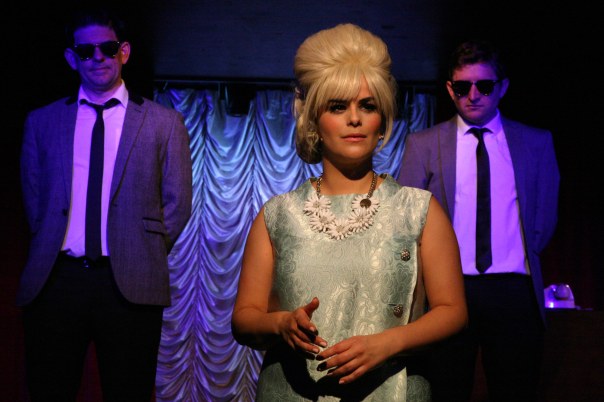
Kevin Lennon and Andy Clark both shared a number of roles, not least Clark’s portrayal of the South African Policeman, out for Dusty’s blood because of his zealous dedication to the extremes of South African apartheid law. Lennon played both Dusty’s band member and her Manager, working hard at watching Dusty’s back and making a very good job of it. They played a gig in Johannesburg to both white and black people where Dusty out-performed herself.
Frances Thorburn’s portrayal of Dusty captured all the magic and power of that unique voice, together with that legendary star quality which she used to battle over great opposition and in the end to triumph over it. Not that she didn’t have many moments of doubt, especially when she and her band found themselves in some seriously sticky situations – this was a South Africa that could be hostile and inhospitable. But in the end they stood firm; with Dusty at the wheel they all found themselves fighting for nothing less than human dignity, or at the very least raising awareness of the issues.
In the songs we laughed, we cried, we were treated to a voice that sang from somewhere beyond, and we laughed at the jokes. With the final iconic song ringing in our ears, we were left thinking that choosing Dusty’s legend was a great way of showcasing the sort of problems we see the world over, because everything changes and everything stays the same…
Daniel Donnelly
Ida Tamson
Oran Mor, Glasgow
June 10 – 15, 2019
Script: Stagecraft: Performance:
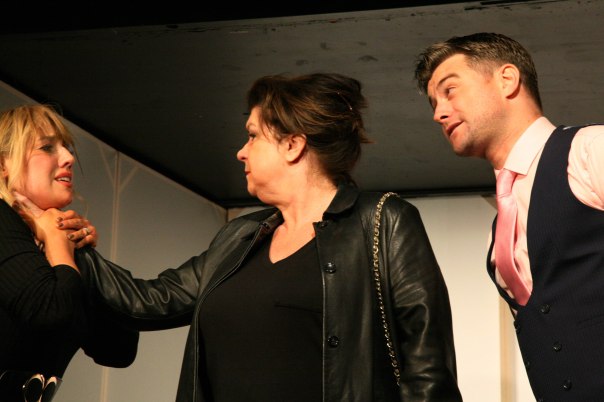
For Oran Mor’s offering this week, the set had a somewhat clinical feel with panels covering the back of the stage and a gap that would act as a door. There was a table with two dark seats and a mug on the table. As the play began, large magazines were projected on the panels. To the sound of rap music we saw Elaine C Smith and Joy Mcavoy join each other already deep in conversation. Smith was reprising the character of Ida, a part she first played in 2006 when Denise Mina’s play was first produced at Oran Mor to great critical acclaim.
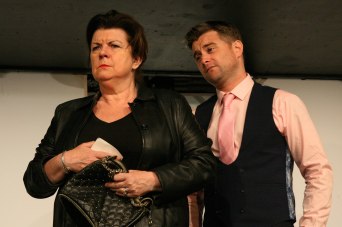
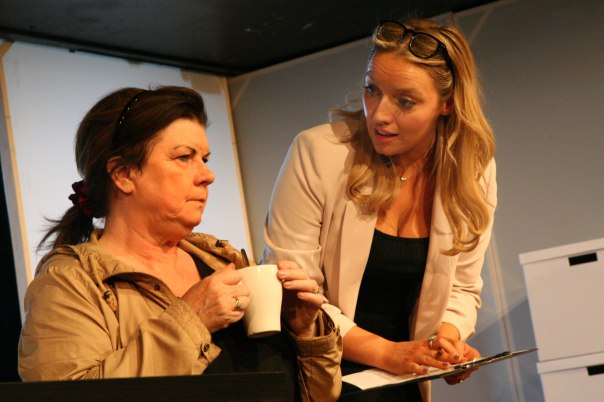
We got the measure of the two women straight away by the contrast in their attire, the middle aged Ida in her less expensive clothes compared with journalist Helen (Macavoy) in her plush business suit. Helen was chasing the story of Ida’s daughter Mary, victim of an overdose. In their conversation it turned out that Mary was dead, wasn’t dead, was dead again, becoming a farcical exchange between them and greatly frustrating Helen as she has became emotionally invested in the Mary situation. Every time the journalist felt she was making progress Ida shuts off and gave out her usual banter to get out of talking about the unbearable details.
Gradually the truth emerged and we realised that Ida’s humour was her way of trying to deal with the great grief of losing her daughter to drugs. Helen seemed to want nothing more than to represent Ida in telling her story, indeed she became quite passionate about that. But Ida remained aloof, never quite trusting this journalist who she felt was really only looking for a good story to boost her own career. In fact at one point Ida was so full of distrust and paranoia that she clasped her hands around the journalist’s throat, nearly strangling her. And it would be a good story because Ida had turned her back on a life as the wife of gangland drugs boss and was bringing up her lost daughter’s children on her own.
With a nifty change of scene (worthy of larger and longer productions), we were introduced to the character Fletcher (Paul James Corrigan) who it turned out was a rival drugs lord, and the person who got involved with Mary and got her into drugs in the first place. He was planning to move to Cyprus and wanted to take his son, Mary’s child, with him. He demanded that Ida allow him to do so, threatening violence if she didn’t. We saw all of Ida’s inner turmoil as she struggled to find the strength to assimilate yet another body blow made by this unreasonable man, who was already in reality the villain of the piece.
The play concluded with Ida sitting at Helen’s desk with the journalist frantically writing away. Ida had already lost so much, has had to dig deep into her inner reserves of courage and resilience in order to survive, but in the end we are left with a poignant vision of a heroic Glasgow woman who despite having lost so much, found the courage to acknowledge all that had happened and agreed to make her story public.
Daniel Donnelly
 Mumble Theatre