Category Archives: Scotland
What the Animals Say

Oran Mor, Glasgow
June 3 – 8, 2019
Script:  Stagecraft: Performance:
As we settled in our seats, the simple set (6 chairs and a screen) effectively took us to the waiting room of the Stranraer to Belfast ferry. This two-hander by David Ireland (first performed at the Oran Mor in 2009) concerns two young men, Eddie (Jordan Young) and Jimmy (Kevin Lennon) who encounter each other in the ferry terminal. The two soon discover that they are actually old school buddies from Belfast although they then took completely different paths in life. We get an inkling of this from their attire, with Eddie looking very smart in his expensive track suit and state of the art headphones, while Jimmy is scruffier in rather down at heel casual gear.
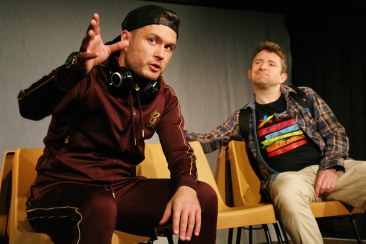
It turned out that Eddie had made it big as a football star and now captains Glasgow Celtic and hobnobs with celebrities. Jimmy, as he continually impresses upon Eddie, is an accomplished actor, but is still seeking his big break; the role that will really put him on the map. At the moment he was on his way to an audition which he hoped could change his life, to be in a new Mel Gibson film. As the two converse, we see Eddie’s larger than life personality as he becomes more and more personal with Jimmy, and exposes his own sectarian and racist attitudes. The military-sounding flute and drum music that introduced the piece had already given us a clue as to the underlying themes what would be explored.
The contrast between the two characters couldn’t be greater, with Jimmy quoting Shakespearean passages in the face of an increasingly threatening and volatile Eddie. The content came fast and hard with the whole thing seeming to be an emotional outburst about the sectarian sector we know of in our society. The writing had a straight attitude towards that by simply having them state, the hard facts that are on the road in the Glaswegian lifestyle. It also got to the heart of its subject by posing abrupt emotions; as they really seem to lie in us that they both did with the same sincerity but also lightening the mood as needed be.

In the second part of the play, there was a complete turnaround. The scene changed to a dressing room where Eddie was practicing his lines. It drove Jimmy mad that Eddie now wanted to try his hand at acting and has persuaded Jimmy to help him with his lines in return for an introduction to Mel Gibson. But after some more personal jostling they both wind up with balaclavas on their faces, a no holds barred and rather shocking effect that was done with a little humour. Eddie held a small bat in his arms with much too great a relish. In the end Jimmy was beaten with the bat as Eddie just loses it and can find no more use of words. With its straight down the line dialogue, this play challenges many levels of perception, perspective and reality. You cannot look away, it was strong theatre.
Daniel Donnolly

Cool Dads
Oran Mor, Glasgow
May 20 – 25, 2019
Script: Stagecraft: Performance:
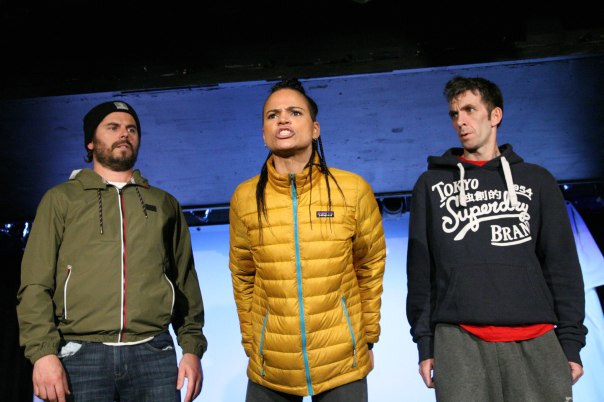
No sooner had the house announcer proclaimed “…with no further ado…” than the room fell silent and dark and we were catapulted straight into the action. The spotlight fell on an ever so green set, with two supporters standing on the touchline for the first round of the under 14’s Scottish Cup where their boys’ team, Mosspark, faces the mighty Kings of Rosshill. The banter between the sardonic Danny (Adam Robertson) and his pal Graham (Kris McDowall) was fierce and authentic, with Graham clearly terrified of the opposing team. Along comes the team coach, Paul (David McGowan), making a big impact in his tracksuit, along with larger than life Angie (Natali McCleary) who soon makes her presence felt.
The four of them, long term – and long suffering – fans, talk football and offer contrasting opinions and guidance from the side lines, yelling their gratuitous advice and instructions in the familiar manner of fans the world over. We see Danny unable to shift out of his negative mindset – even when their team scores, and then wins the match, he can’t find praise for the youngsters. His ranting becomes more and more aggressive as if he can’t stop himself while friend Graham keeps his back from any fray and tries to guide Danny towards a more peaceful mood.

It turned out there was history between Danny and coach Paul – they had a falling out when Paul’s football career was cut short due to an injury caused by Danny, something Paul had never been able to forgive. The two nearly come to blows, but Angie intervened and in an angry outburst she puts them in their place by shouting that life could ultimately be a lot harder and that in fact no-one had the right to think of themselves as the ‘cool dads’ that they think they were because there’s always something new to learn. In the course of these exchanges we came to realise that Danny had never known his own father, something he found hard to accept and which perhaps was at the root of all his troubles.
So there you have it – a great play not just about football (though that too) but about life and learning and living with our past. An enthralling hour full of gusto, passion and an ultimately moving story. What’s not to love?
Daniel Donnolly
Jocky Wilson Said
Tron Theatre, Glasgow
May 13 – 18, 2019
Script: Stagecraft: Performance: 
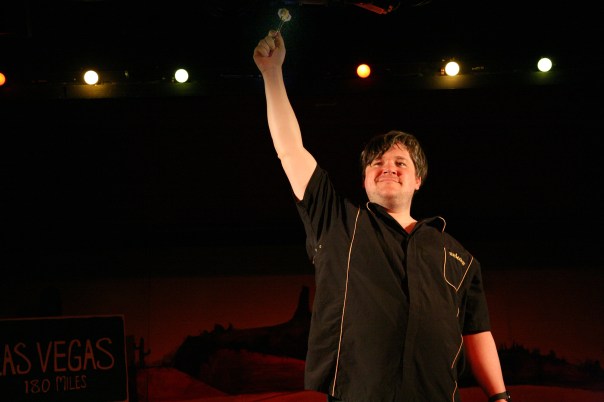
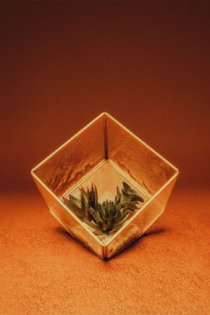
A desert scene stretched out from the back of the stage, with colourful backdrops and green fresh cacti. A solitary scene for the one-hander to come. It’s 1979 and Jocky Wilson was 184 miles from his destination, Las Vegas, but missed his connection and was forced to hitch hike his way there. But would the wait prove too much for him? Darts player Jocky Wilson (convincingly played by Grant O’Rourke) turned professional in the late 70’s and went on to win World Pro Darts Championship in 1982 and again in ’89. He always was the gallous character from Fife that was captured in this play written by Jane Livingstone and Jonathon Cairney. Jocky Wilson Said was first performed at Oran Mor in 2017.

Clothed in his professional darts garb – he was on his way to play an exhibition match – Jocky’s emotions fluctuated from elation to despair as he waited for a ride that at times didn’t look like it would even come. At one point he screamed angrily as a possible hitch passed him by. He started talking to a cactus and in the conversation reflected on his life and the journey which had taken him thus far. It was as if the stage was peopled with characters from his imagination as he recalled the huge, all- encompassing part that darts had played in his life, becoming a way out for him, but more than that giving him something at which he excelled. He told the cactus of his great triumph and how winning the championship was both a victory for himself and a victory over people he encountered who perhaps didn’t believe in him as much as he would have liked.
Jocky Wilson Said was very much a tale of the underdog made good, going through the elements of his life one by one like the pile of rocks he was sitting on. We saw the real man behind the image, got a feel for what made him tick. Not least because of a wonderful performance by Grant O’Rourke, who seemed to completely inhabit Jocky’s persona, from his accent and mannerisms to the very spirit of the man himself. And at the moment when a vehicle finally stopped for him, he gathered his things and as a goodbye from him to us he lifted an imaginary championship cup and he proudly and defiantly raised his hands to the sky. With that, the lights went out and he was gone.
Jockey Wilson’s character shone through this play, his courage, his determination; and in no small part, his humour. It set the stage alight as though it was big production with a big cast. But these were things it didn’t need. Altogether a skilful and accomplished piece of drama.
Daniel Donnolly
Toy Plastic Chicken
Oran Mor Glasgow
May 6 – 11, 2019
Script: Stagecraft: Performance:
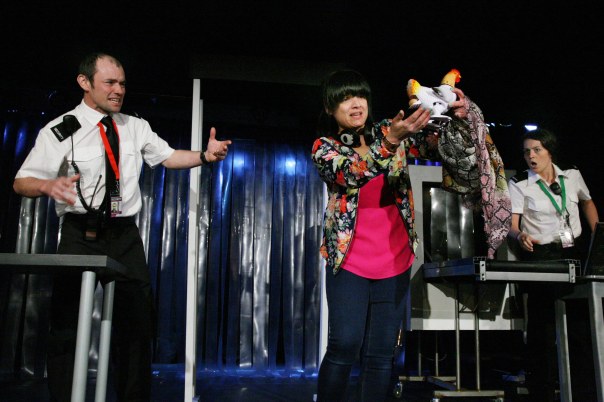
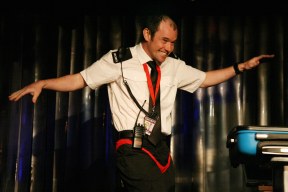
At the Oran Mor, this week’s set had an air of readiness about it, somehow clinical. Sure enough, when the lights were on it, a passport control point immerged. Ross (David James Kirkwood) and Emma (Anne Russell Martin) appeared as passport officers in full uniform. Ross seems happy in his work, while Emma is full of inner rage about her profession. The play, written by Uma Nada-Rajah, is set at Edinburgh airport and is a black comedy based on a true story.
Enter Rachel (Neshla Caplan), who seems like a victim from the moment she comes on stage and is put through her paces by the two officers. The set changes cunningly to depict the various sections of the airport kiosk, as the examination progresses. In one powerful scene, the hapless Rachel has been told to strip behind a screen, while the silent and furious Emma stands by. It is an extremely uncomfortable moment. Ross, the jokey male officer, provides an element of comedy. But his jokes have somehow an undercurrent of violence about them, highlighting another uncomfortable aspect of the action.
The eponymous plastic chicken is set on the table from the beginning as it is the only item left after Rachel has divested herself all metal and electronics. When the alarms go off, the toy chicken is deemed to be a bomb and uproar ensues. Protocol must be followed and Emma becomes more and more robotic in the discharge of her duties, though Ross can be relied upon for complaining to. Indeed Ross even professes his love for Emma, but she simply replies ‘…not today…’ The situation deteriorates drastically, and Rachel reacts badly, becoming distressed. As she has to turn her attention to the woman’s care, an increasingly conflicted Emma curses repeatedly “..f**k..” as she expressed her hatred of her life as a passport control officer.
The play ended as it began with a deliberately standoffish Emma and the ever-joking Ross directing a distraught traveler through Edinburgh passport control – a down to earth delving into the paranoia of modern life and the art of sticky situations, I found the dialogue dynamic and emotionally true. Yet another example of the high art of drama to be expected at the Oran Mor venue, well worth a watch.
Daniel Donnolly
The Mistress Contract
Tron Theatre, Glasgow
May 1 – 11, 2019
Script: Stagecraft: Performance:
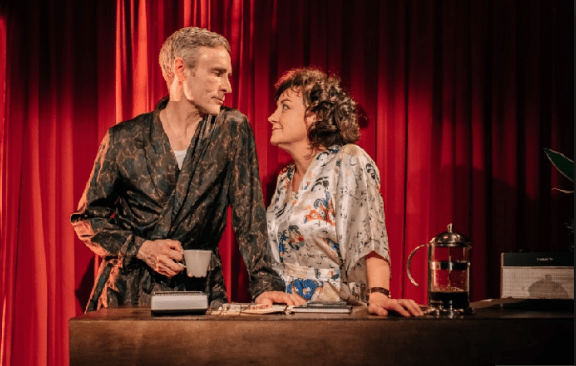
I felt solemn as I entered the tiny venue at the Tron Theatre Glasgow, expecting a serious play. The set was absolutely gorgeous – bigger than the seating area and plastered with props and dividers. It was a very plush living room with luxurious couch and a second level a red drape covering the half of it. All depicting the home of a wealthy man. As the lights brightened, yet more was revealed where the stage seemed to double in size.
The night’s play, inspired by the memoir ‘The Mistress Contract’ by ‘She and He’, was written by Abi Morgan and premiered at the Royal Court Theatre London in 2014, the same year it was written. Now enjoying its Scottish premier, the current production is directed by Glaswegian playwright and director Eve Nicole. Taking the role of HE is the uniquitous Cal MacAninch fresh from TV shows and theatre work around the country and SHE is played by actress Lorraine McIntosh, of Deacon Blue fame.
The Mistress Contract gets straight down to business with the two characters in conversation about their different perspectives on their sexual encounters with each other. Encounters which we learn arise from the contract that they signed thirty years before which lays out the deal in which she would favour him with sexual services in exchange for a home and a decent share of his formidable riches. But, she recalls, there was a period in what she refers to as their thirty year experiment where he couldn’t afford his side of the bargain, but she nonetheless allows him to owe it to her.
She produces a Dictaphone and recalls that when they signed the mutual contract in 1981, there was an idea that they would record this experiment to perhaps make it into some kind of a book. Today she is someone who is passionate about her books, her life, her house and garden. As they talked, music played and they undressed and sat together on the couch, still debating sexuality, gender equality, whether there was a difference between their perspective sexualities. Finding, 30 years on, that the difference was often profound.
They fought, they kissed, they relaxed they loved. As you watched, you felt that the crux of their relationship was a self-revealing, tangible and passionate love. The fact that it had endured for three decades seems to prove that the contract was a powerful one and signed by both in honesty and good faith. Never to marry, and only to love each other became exclusive as the years passed; they despair, they make up, they perform in love together. They were serious and enlightened, with kids and life to contend with but ultimately they come together as a real life couple who triumphed, and remained faithful to the contract they both signed thirty years ago, which is more than you can say for many marriages!
Daniel Donnolly
The Origins of Ivor Punch
A Play, a Pie and a Pint
Oran Mor, Glasgow
April 29 – May 4, 2019
Script:  Stagecraft: Performance:
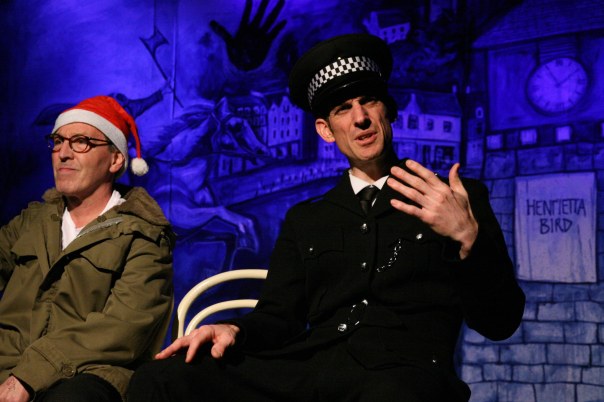
A blue-toned set depicting the Isle of Mull – or some similar remote island – greeted us as we took our seats. In the middle stood the grim looking Henrietta Bird clock tower. As the stage darkened we could just make out the movement of the three actors, all playing double roles; Andrew Tait, as Sergeant Ivor Punch and his ancestor Duncan, a postman, Tom McGovern as Ivor’s friend Randy and -no less – the great Charles Darwin; and Eva Traynor playing the famous Victorian explorer Isabella Bird and her sister Henrietta. This play, written by Colin MacIntyre, is quite a complicated piece, based on the author’s own prize-winning book, ‘The letters of Ivan Punch’, and touches upon ideas of identity and mythology, history and love – a tall order in the space of a mere hour!
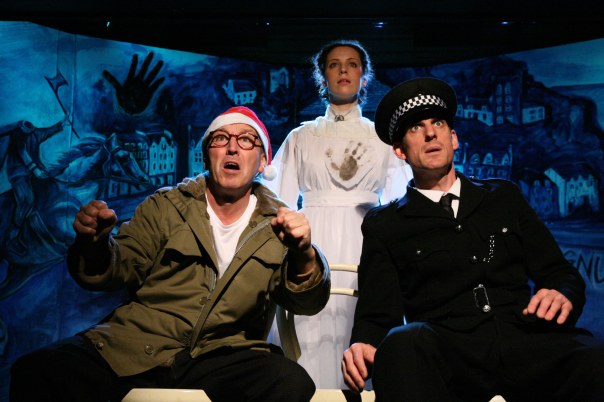
The action began with Randy and Ivor Punch sitting together in a car singing a song about angels. The purpose of their journey was humorously to steal a Christmas tree with Ivor ironically dressed in his full Police uniform on his way to commit a crime. But an angel, in the form of a woman in a white dress, Eva Traynor’s Isabella, who stated she was somehow there to help him. He was intrigued when she called him Duncan, a character Ivan was unaware of.
The words ‘God is love’ appeared graffitied on the side of a cliff and were introduced to the plot in a dramatic scene at the clifftop, a proverbial cliff hanger. Then bright lights shone dramatically upon the scene to invite us into another aspect of the story. This time, Andrew Tait appeared as Duncan, postman and jack of all trades, a man of few words, beyond a few well-worn stories. Henrietta falls for him, but you wondered if it was him or something he knew of that she wanted?
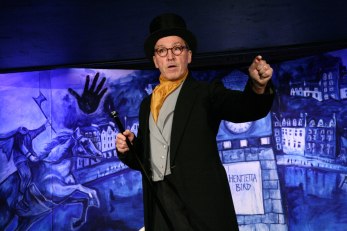
Through interactions between the various modern and historical characters, the story delved more and more into exploring the identity of Ivor and the factors which made up who he was. We had costume changes and found Charles Darwin, resplendent in top hat, waistcoat and pocket watch. Lofty ideas were analysed and Ivor revealed that he had put Darwin’s book ‘The Origins of…’ to the test with the ‘Bible’ and found that naturally the Bible was chosen every time. In the midst of all these weighty discourses, light relief was provided by Randy, with his down to earth, not to say rude, language.
The passion between Duncan and Henrietta was also explored, particularly in the dialogues between the two sisters. Ivan and Randy came to realise the identity of the name on the clock tower and in the final scene we found Henrietta offering support to Ivan as she professed her faith in his capability for love in all of life.
The way this story was built up, using a great many facets that all somehow mysteriously melded and joined together was much like the complex original book by Darwin himself. The play bounced along sometimes lightly, sometimes heavily, for the hour and after proposing many questions, somehow in the end had them all answered.
Daniel Donnolly

Turn of the Screw

Perth Concert Hall
Tues 16 – Sat 20 Apr
Script: Stagecraft: Performance:
A young inexperienced governess with a fertile imagination fuelled by gothic horror potboilers; two precocious children, altogether too knowing, in her care; a rambling, isolated country house witness to a history of cruelty; preternatural occurrences and eerie noises in the night. Henry James’ 1898 horror novella is the archetypal haunting story. Or, at least that’s one reading. It could equally be the account of the young governess’s incipient ‘female hysteria’. The novella maintains the ambiguous nature of the events at the house and James leaves the reader to make up their own mind over the causes of the horror. It’s a satisfying read.
Mercury Theatre Colchester and Wolverhampton Grand Theatre’s production of Turn of the Screw, adapted by Tim Luscombe, whilst replete with enough terror, puts the cause of all the haunting malarky on the governess, played by Janet Dibley with maniacal poise. Confirmation bias from the homely but astonishingly dim-witted housekeeper Mrs Grose (Maggie McCarthy) propels the governess ever onwards in her attempt to save the children, Miles and Flora, from what she thinks is supernatural attack from the spectral visitations of the previous governess Miss Jessel and the diabolical ghost of Peter Quint, the former upstairs-man, who had, and seemingly still maintains, a corrupting influence on young Miles.

Luscombe’s treatment turns the action into a taught psychodrama, that pulls out many of the threads in James’ story, such as the suppressed sexuality of the tale, hinted at in the relationship between the governess and young Miles, and the nature of Quint’s corrupting influence on the boy. It’s unfortunate therefore that the dramatic energy begins to disappear in the second half, as it becomes apparent that the cause of all the disturbance really is the governess’s psychotic break. With the loss of ambiguity of the cause of the haunting, whether psychological or supernatural, much of the tension of the story is also lost. It’s a different terror, altogether human, that is portrayed in the closing scene. This is an intelligent production that delivers some shocking moments in an entertaining evening that occasionally misses a chance to terrify.
Review: Mark Mackenzie
Photography: Tom Grace
The Mack
A Play, a Pie and a Pint
Oran Mor, Glasgow
April 15-20, 2019
Script: Stagecraft: Performance:
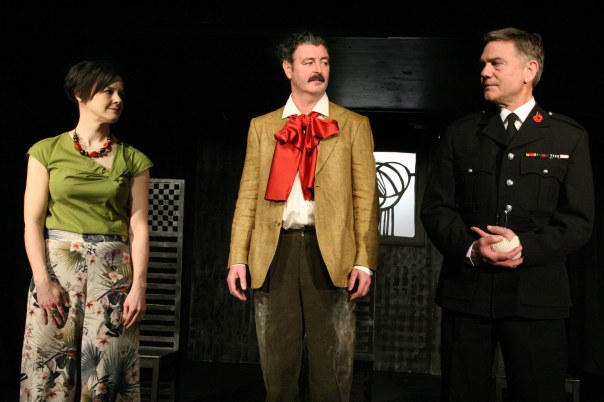
It was with a slight degree of apprehension that I settled down to watch Rob Drummond’s new one-act play at the Oran Mor today. “The Mack” is all about a hero of mine, Charles Rennie Mackintosh who died 90 years ago. His famous approach to life and art had some in his period smiling and others not. The stage was set in Mackintosh style, complete with three chairs in that distinctive ladder-back design.

Mackintosh himself took centre stage; James Mcanerney resplendent in the artist’s signature large cravat; it was like seeing the man himself brought to life. The two other characters came in the guise of an expert, a well-dressed Janet Coulson; and John Michie as a fireman in full uniform. The three don’t address each other, but talk to the audience directly and between them the story unfolds into the well-meant debate as to whether or not to once again save the internationally renowned Glasgow School of Art building that unbelievably caught fire for a second time. Included were all the various opinions and points of view we have all had about it, presented in an almost court-like discussion as to its importance or no.
Each character reveals insights into their individual points of view; vivid feeling of loss and appreciation of the work of a Master; rhetoric about the life and style of Mackintosh himself; the artist recalling his life in his letters to Margaret, his wife and long term partner. Somehow it seemed as if the artist himself was looking down in amusement at his work and what has famously happened to it, in reality some of his work has been salvaged from skips and suchlike. Each sometimes stands to make their point with dramatic force. There is real poignancy when the fireman reminds us of the dangers his firefighters faced when they fought a fire for the sole object of saving a building and some artefacts, questioning if it was worth risking their lives.
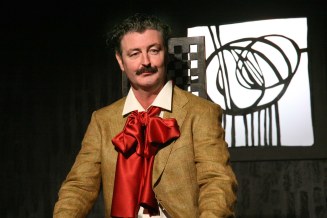
The three actors stood as the lights went down, without having come to a conclusion as to whether the Art School building should or should not be rebuilt. This three-point perspective offered compelling reasons for and against but they also found themselves unable to come to a definitive result. Having struck a balance in each debate, in the end it is left to us to decide. It could be done – there is enough of the design detailed on computer to make it exactly as was all those years ago. Whether it would be the same building raises the question of what art is anyway – the design or the building?
If you want my answer, I would wish it rebuilt. It’s intended beauty from the architect is as important to me as it ever was. But you can make up your own mind…
Daniel Donnolly
What Girls Are Made Of
Tramway
Glasgow
April 9-13, 2019
Script: Stagecraft: Performance:
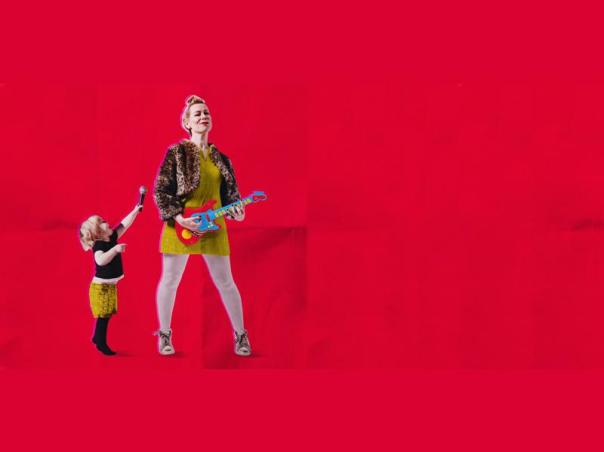
Walking in to the Tramway theatre is always a pleasure with its vast walls and ceilings, and a warm welcome. Smoke swirled around as we took our seats in the auditorium and the set was intriguingly set up to look like a rock concert. And sure enough, when Cora Bisset took to the stage, the story of her rise to fame began to emerge. What Girls Are Made Of is a play written by Cora herself from her own teenage diaries, and reprised here at the Tramway from last year’s smash hit premier at the Edinburgh Fringe.
As the other band members take to the stage, Cora, standing with arms folded at the front of the stage, tells us dreamily “I wanted to sing in a band”. It was all she ever wanted and she had the voice and persona to do it. They were lucky, success came quickly and the band found themselves signing a five-figure record deal and touring with the likes of Radiohead and Blur when they were still only naïve teenagers from Fife, a fact which she never forgot, despite the intoxicants and partying which inevitably goes with this kind of fame.
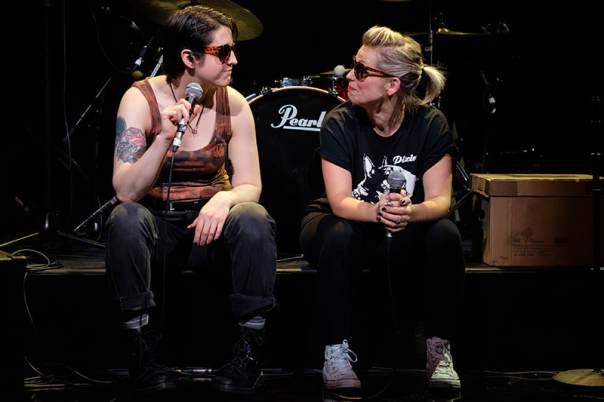
Cora shares with us her memories of this time in the early nineties, with herself and the band frequently breaking into song and entertaining us with full blown performances of their own music and songs from the likes of Nirvana and Blur; giving us a taste of the rollercoaster rock star lives they were living. As Cora’s memories unfold, the band members take the part of the various characters, throwing themselves into the roles with gusto, before coming together once again to perform yet another blockbuster.
With the wheels turning at a greater and greater pace, the rest of the world just fell away and we became more and more absorbed, and at times concerned, about the actress/ singer/ writer as she and her band navigated their way through their new found success and all the successes to follow. But their wicked manager was writing too many cheques and all too soon they were broke, with a hefty dept that there was no way of paying. The bubble had burst and what had seemed to be a rosy future gradually fell to the wayside and wound up as though it had never happened at all. With zero money and a large dept, Cora takes us into a darker side of her life where she loses her father to dementia and as she recalls laying him to rest, she lowers her head and weeps.
This play entertains and enthrals you on so many levels, spanning rock music, singing, poetry, tragedy, beauty, gritty reality. Like the story itself it surrounds you, pulls you in and spits you out. 25 years after the event, Cora is in her forties and presents herself self-reflectively to the audience with sincerity, abundance and joy. She is someone who could – and for a short time did – have made it, not because of the business but because she had the voice, style, and sheer heart. As we can witness for ourselves in this masterpiece of entertainment.
Daniel Donnolly
Lion Lion
A Play, a Pie and a Pint
Oran Mor, Glasgow
April 8-13, 2019
Script: Stagecraft: Performance:
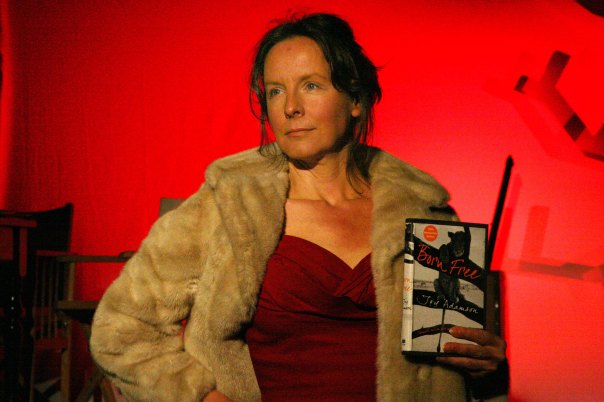
There was a great red lighting effect emanating from the Oran Mor stage as we gathered to take our seats with the venerable pint and pie laid out before us. The title, ‘Lion Lion’, indicated that perhaps the next hour would be taken up with some kind of dedication to those great beasts. And so indeed it proved, as the first scene bore witness when we find Joy Adamson (Selina Boyack), beside herself with grief at the death of her beloved Elsa, the famous lioness depicted in her book “Born Free.”
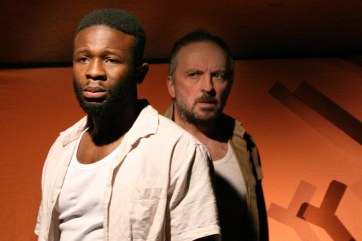
Sue Glover’s play had a strong focus on the survival of these animals in the wild today, something which really resonated with me and my own concern for these magnificent creatures that we seem to be hunting to extinction. We watch Joy with George her husband (Keith Fleming) and their assistant Makedde (Nick Ikunda), and the strong bonds they have formed with these wild animals as they work with them and camp out amongst them, dreaming of safeguarding their lives and habitat. But passions were running high and the relationships between the husband and wife was deteriorating. In their stress at losing Elsa, Joy and George argued again and again and the hapless Makedde seems stuck in the middle. We see three greatly different personalities united by their often savage undertakings, with growling lion sounds used to separate scenes. Joy could seem uncaring and unkind, but when she reflected upon her beloved Elsa with such care and grace and love, we had more and more sympathy with this benevolent side of her.

There was no doubt that Joy and George loved each other, even when she leaves him after one argument too many. But perhaps they loved the animals more and this was certainly used as a metaphor to depict our relationship with the environment, something that is becoming more and more important in our modern lives.
Though set in the 1960’s, this was not a piece stuck in any particular time. For Joy it doesn’t end well, for irony of ironies, she was killed by one of her beloved lions. But you couldn’t help question if she maybe thought it was a good way to go. Lions deserve our attention and our love and gratitude in a crazier and crazier environment, where we are more dangerous to them than they are to us. They deserve this hour of passion, passionate writing, passionate observing and passionate interaction, this play did all three and it was great to see it being put on here at the Oran Mor.
Daniel Donnolly
 Mumble Theatre