Category Archives: Scotland
Aye, Elvis

Oran Mor, Glasgow
April 1-6, 2019
Script:  Stagecraft: Performance:
When we see anything Elvis we rediscover and find our affection for that iconic 20th century artiste. The stage was set with a blue neon lighting of a famous picture of the man himself and Joan/Elvis (Joyce Falconer) took to the stage fully dressed in jumpsuit and rhinestones for the Ultimate Elvis event to come. So much was packed into this hour at the Oran Mor that it seemed to have entertained us for a much longer time. There were various transformations of the set, changing from the dreamer’s bedroom to the lounge where her mother Agnes (Karen Ramsay) sat with her walking stick, to the club where as an Elvis impersonator Joan performed her socks off.
The applause was loud as the one-liners flew by, and also included appreciation of well performed scenes. Joan’s Doric Elvis character gleamed and endeared from the start, touching your heart as she dreamed of stardom that will take her away from her humdrum and impoverished life. Her mother Agnes doesn’t see it though and tells her beloved daughter to give it up: she will never succeed.
It becomes clear that Joan really loves her mum and tells us that she feels that Agnes needs her as much as Joan needs her mum. But there is conflict because with every chat Joan became more and more certain of a great career in entertainment. In reality, her gigs are karaoke nights at a local, but her dreams, like The King himself, are so much bigger than that.
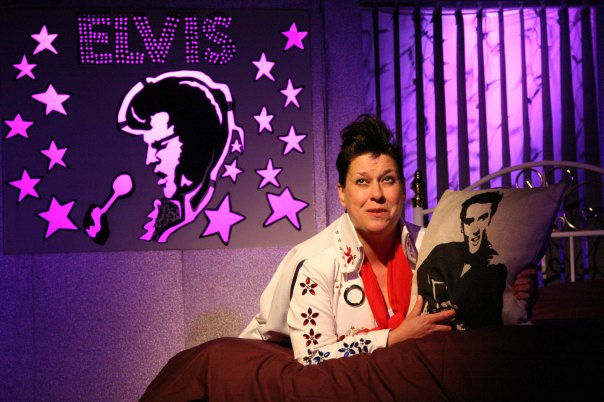
Stuck in her wheelchair, Agnes would bang on the floor with her walking stick when Joan was practicing loudly in her room. And when she discovered that Joan had earned £100 she starts to change her mind. Joan tries to hide her wages from Agnes instead buying herself a new laptop, something that means a lot to her as we understand when she has an online conversation with Fat Bob the DJ (David McGowan). Perhaps Fat Bob could be a possible romantic interest for Joan, except that her heart belongs to Elvis.
Joan’s desire to succeed as a female Elvis grows stronger and stronger. We are filled with respect for her sheer determination and even her mother is won over as she makes a complete turn around and encourages her daughter to go for it. Suddenly we see that even this wheel chair ridden tough old Ma can also be an endearing character who could still live a life of riley.
The world of Elvis was and is flamboyant and larger than life, with more than a hint of sadness. Joyce Falconer takes us into that world with the same indomitable strength of perseverance, acceptance and striving personality that was the man himself. A fitting tribute to the great man, the King, and the dreams he has engendered in so many. Like the living man so was she in costume, dance and vocals, singing her heart out “Love me tender, love me true”… You have to see this play, it’s a gem!
Daniel Donnolly

Dear Europe
Galvanizers, SWG3
Glasgow
29th March 2019
It was to have happened on the cusp of a very significant day. Living on an island, however, means we all know about delayed departures. Stewart Laing from National Theatre of Scotland was certainly prepared for anything and had asked all the 6 groups of commissioned artists to explore the idea of uncertainty as well as feelings about and relationships with Europe. I had just booked flights and accommodation for a week in Berlin next month, so I was feeling quite the European, and as the capacity audience filled three enormous tables the buzz was helped by drinks vouchers and 99 Red Balloons and similar on the soundtrack. Whatever the current Brexit situation, the show would be a truly historic cultural event, a chance to articulate something through art which could resonate and speak beyond the current fog. I, for one, was looking for some new perspectives.
With Gary McNair as MC, Tam Dean Burn was up first with Aquaculture Flagshipwreck, featuring music from fabulous mermaid and harpist, Rachel Newton. Up and down we were taken through a routine of standing and sitting to words from a Singing Kettle song after scrunching up pages from the FT to throw at the Mythical Wild Salmon dangling from the roof. Next a rather marvellous Scottish (Mexican) wave. Some vague jokes got vague laughs, but we rather enjoyed ourselves amid learning and repeating unpalatable information about salmon farming. Soon it was time for Tam Dean Burn to finish with a quote from Tom Leonard’s Flag, To the infant the sucking blanket/ To the adult the flag. /Salute.
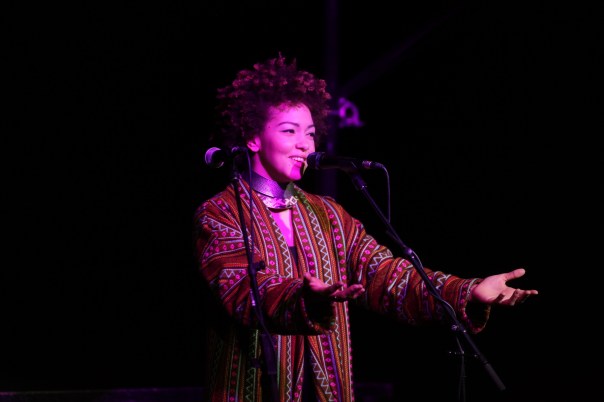
We were underway and with a quick up the revolution Tam was off. But you don’t forget quotes like that, nor indeed invocations to revolution, however solitary. The audience were then split, half going upstairs to watch the dance performance whilst the rest saw moving through shadows, a film by Nima Sène and Daniel Hughes. I see I scribbled down a bit of a hotch potch just before the penny dropped that this was the beautiful point. Soundtrack of traffic, scenes within a Nigerian shop in Poland gave a warmth and reality to Ifi Ude’s story of the rich cultural synthesis which goes on when people travel and stay to create a new home. This should resonate with all of us time, if not cultural, travellers, living through change. And it did, especially as the performance slipped from film to live singing from Ifi herself. Having just flown in from Poland that afternoon, her singing was gorgeous and generous, both literally and metaphorically like a lamp in the dark. She sang a melancholy song from the Warsaw uprising and after this, who would not want to follow her to hear more Polish music, and find out more about the Haitian connection with Poland and the worship of the Black Madonna/Erzulie Dantor . Two stand-out quotes from this piece were, firstly from the film, It’s not home I miss, but belonging to the place, and secondly from the song Cię jutro Warszawo ma!/ Warsaw has tomorrow, one of the many calls to face the future which came throughout the evening, though one born of much more physically desperate times than these.
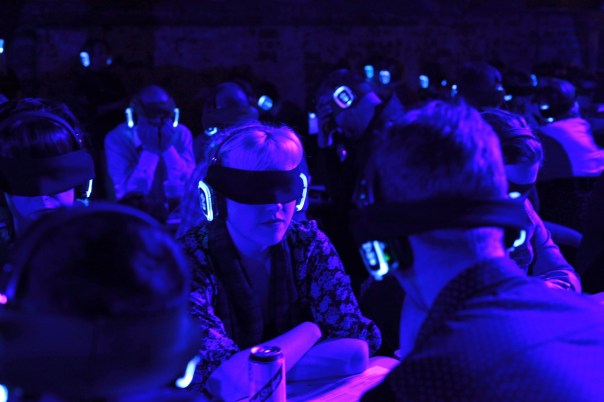
Some might say an alternative strategy could be to continue to face backwards and concentrate on controlling our borders. Leonie Rae Gasson’s piece, Death Becomes Us began with the mass distribution and instruction as to how to use headphones and blindfolds. Suitably sorted we heard urgently whispering voices, including Theresa May’s, telling us to take back control. What are the rules? The rules of origin, repeated again and again was our unsettling reminder of the ultimate foolishness of fixing all concepts of home in the past and for valuing backward facing visions above those facing forwards. Another gorgeous musical commentary followed orders to remove blindfolds and headphones with stunning singing and performance from Beldina Odenyo Onassis and a community chorus of women and non-binary European migrants who owned the resonant space they created and completely won over the audience.
By this stage (well OK, a lot was retrospective) I felt that important things had been said, and emotionally we had moved forward, but there was still a vagueness and a lack of a feeling of relevance. Two people changed all that, Louise Ahl and Ruarì O’Donnabhàin with their dance piece (created by Ruari and Nic Green) d’tùs maith is leath na h’oibre/ A good start is half the work. Their performance together was such a good example of the power of art to embody complex situations simply and powerfully. They were two dancers with a chair each which had been sawn in two but which they still had to use to sit on, balancing it with difficulty, changing position on it with tortuous care and manoeuvring with an awkwardness that was completely mesmerising. It seemed entirely fitting, and here was the proof that Dear Europe really was speaking to our times.
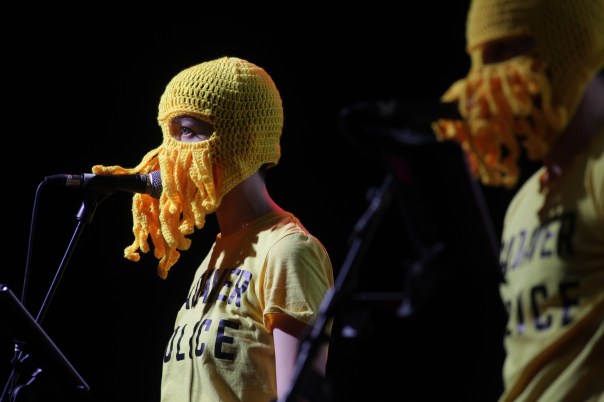
In contrast Cadaver Police in Quest of Aquatraz Exit was the entertaining, predominantly yellow, tee-shirt flinging, dystopian sci-fi creation of Alan McKendrick, and it rather passed me by, but was undoubtedly done with great panache and was well received. The band and actors were great, I just didn’t engage with the substance of the piece much though I did despite myself, really enjoy it.
So it was left to Second Citizen from Angus Farquhar (which he rhymed with darker, NB Garry McNair) to end the evening. The first half of his piece was as lucid, straightforward and ever so slightly dull as the Cadaver Police had been out there, elusive and exciting. Angus recounted his family’s European story, how WW1 had devastated many of its lives and ended several. He told us how he himself survived violent experiences of bullying and ostricisation, how, with the help and support of like minded people, he set off travelling, making music of great energy and edge at the same time. And it was his music that he left with the audience who could only wish that such inspirational energy could be directed where it is needed.
But one thing at a time. It had been a unique and memorable evening and it was late when the house lights came up and the audience went out into the dark to find their ways home.
Review: Catherine Eunson
Photography: Drew Farrell
Gaslight
Perth Theatre
Thu 21 March – Saturday 6 April
Script: Stagecraft: Performance:
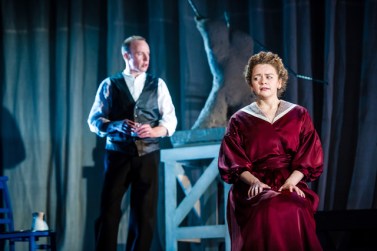
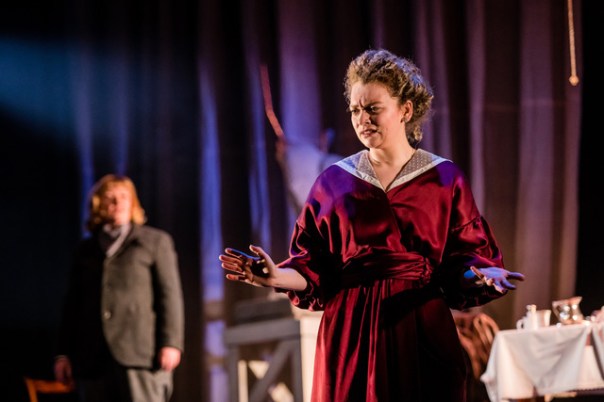
Kai Fischer’s Perth Theatre production of Patrick Hamilton’s 1938 melodrama serves us a reminder that mental abuse in marriage is not a new phenomenon. In the psychologically claustrophobic setting of a Victorian era parlour, we watch husband Jack Manningham assert brutal control over wife Bella, who’s mind is crumbling under his suffocating and sustained attempt to undermine the foundations of her sanity. Bella appears to lose trivial everyday objects, bills, jewellery and has begun hiding things around the house. This infuriates Jack, who, near the end of his tether, has threatened Bella with the asylum if she doesn’t stop. But Bella can’t stop and what’s worse, when Jack goes out at night she has begun to hear strange noises coming from the unoccupied rooms upstairs and the gas lights dim eerily only to brighten when he comes home. She’s lost control.
Esme Bayley plays a suffering Bella with an air of hand-wringing paralysis. At times she stands, ghostlike, at the side of the stage and comments on the action of her husband, as he toys with the churlish maid, Nancy, played by Ruby Richardson, and it seems like she’s resigned herself to incipient insanity. That is, until Rough, a retired policeman enters out of the smoggy London evening to turn her life around. He’s been watching the comings and goings of the house for some time and knows about Jack’s attempts to derange Bella. Meg Fraser’s Rough is a breath of fresh air into the stifling gloom of the Victorian parlour, infusing spirit into Bella and the resolve to reclaim her sanity. Having the ageing constable played by a woman works wonderfully, suggesting that in the face of abuse like this, it’s women who must confront abusive male greed and coercive power with the liberating truth, concern and right.
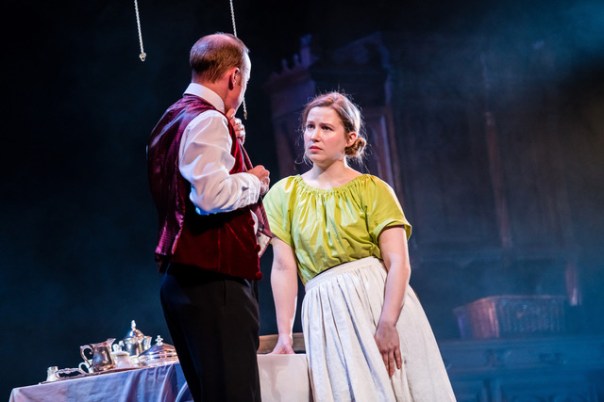
With Bella’s dawning realisation, Jack’s true nature is uncovered. Robin Laing portrays a thoroughly cold and cunning Jack, who treats everything as his to be used. A snake in a suit, he’s outwardly respectable and charming but oozes corruption self-interest and greed. I’ve not enjoyed disliking a character so much in ages. Needless to say, the ending of Gaslight is not a little satisfying. It’s an interesting thought that laws recognising emotional coercion or “gaslighting” (yes, that’s where it gets the name) as a crime only came into effect recently. Yet the behaviour, clearly, is not new. Gaslight left me wondering just what does go on behind ordinary everyday closed doors, when the curtains go down and the lights get lit.
Review: Mark Mckenzie
Photography: Mihaela Bodlovic
Chic Murray
Oran Mor, Glasgow
March 25-30 2019
Script: Stagecraft: Performance:
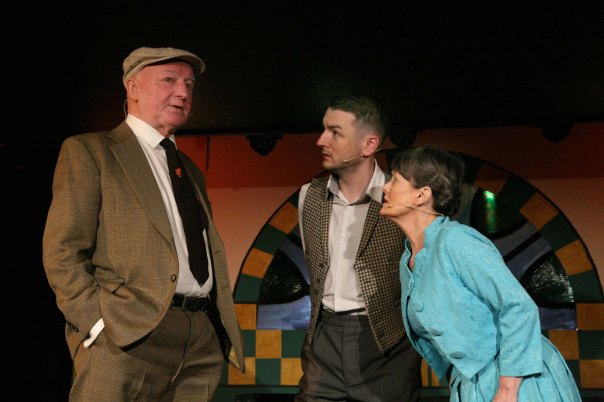
Oran Mor’s Pie, Pint and Play never fail to entertain and this week’s offering was no exception. The set had an arty feel about it with a stained glass window, some grimy London underground style tiling, a green couch and a piano to one side. Chic Murray: Funny Place for a Window is Stuart Hepburn’s affectionate musical tribute to the well loved comedian whose career took him from engineering all the way to sell out concerts at the London Palladium. This three-hander first appeared at this venue in 2018 and I welcomed its return as part the special year when Oran Mor celebrates 500 productions.
From the moment when Chic (Dave Anderson) comes onstage and declares, in typical Chic fashion, “funny place for a window” the quips are continuous and the audience helpless with laughter. Chic and his wife Maidie (Maureen Carr) were reminiscing, together with various other characters played by Brian James O’Sullivan.
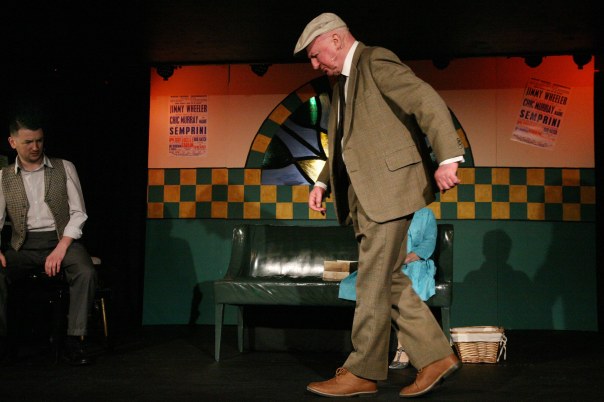
 The music tied up the action in the same clever way that the play itself was written, moving easily from dialogue to music numbers with the piano and an accordion. Maidie seems happy enough as she reminisced on the high points in Chic’s life and had a loving attitude to his failures but in the end she had had enough and left him before his untimely death in 1985. In his life, Chic had found a loving wife with whom he shared his sense of humour and wit. She always found him endearing, even when her cajoling was met with comedy and humour, which seems to be Chic’s larger than life response to everything.
The three performers come together as thick as thieves, engaging the audience completely and accompanied by roaring laughter and applause as we lapped up the jokes that came at us thick and fast. But the writing goes well beyond the bounds of comedy, instead writing as if Chic himself were somehow brought to life again after his death that was announced in the final scene and all became clear when the loose ends were tied up through the simple biographical dialogue of the life of this man.
As we come to the end of this vibrant production, we pity Chic his fate and wonder whether his smiles were real or some kind of defence mechanism. But I suppose that’s the punchline he took to his grave with him, leaving us with a legacy of side-splitting comedy that will never fail to raise a laugh.
Daniel Donnolly
Nora: A Doll’s House
Tramway, Glasgow
15 Mar 2019 – 06 Apr, 2019
Script: Stagecraft: Performance:
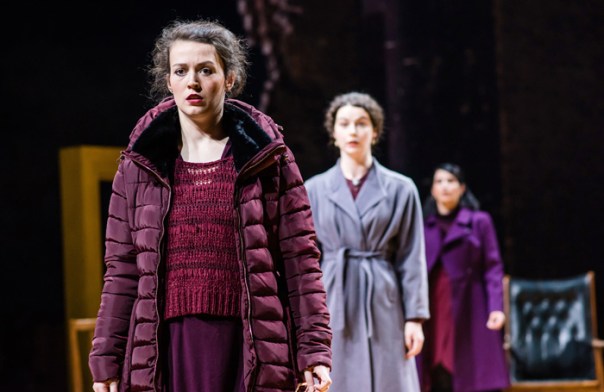
Nora: A Doll’s House is Steph Smith’s new and radical re-working of Ibsen’s classic drama, which caused outrage when it was first performed in 1879, with the critics pronouncing it immoral, which was perhaps the response Ibsen wanted. In this version, produced at the Tramway by the Citizens Theatre, the role of Nora is shared by three different actors (Maryam Hamidi, Anne Russell-Martin and Molly Vevers), portraying the character in three different time periods.
Tramway’s multi-dimensional set served to indicate the varying time zones, and also, with its closeness to the audience, to suggest the stifling nature of Nora’s environment and the male dominated world which traps her. As the play begins, on the surface all seems well with the family, with Christmas coming up and a few quid in husband Thomas (Tim Barrow)’s pocket. Things may be looking up as he’s been promoted. But there is an air of sadness about Nora, and a hint of controlling from Thomas, so slight that we are inclined at first to let it go. But we see Nora distracted and nervous; it is painfully obvious that her mind is fragile and desperate. Her musical theme, which recurs throughout the piece, is one of melancholy.

In despair, Nora strives to understand her pain and to find her own lost self through her tortured dialogues with the different manifestations of herself, and with her friends. One is Christine, who she is cautious of meeting, for to complain seemed like a betrayal. And then there’s Daniel, who sees through all the pain to the façade of her marriage, and tells her that she is worthy of love, and worth more than just to be an ornament in the home and subservient to a husband whose attitude is less than savoury. Nora’s point of view becomes more and more clear and we become increasingly frustrated at the restricting predicament that this world seemed to offer her. Such is the multi layered intention in the re-writing of Ibsen’s play that we cannot escape the realisation, when the three periods come together, that this is the struggle women have faced over far too many years.
But with the introduction of an incriminating document, the already fragile Nora comes under the threat of blackmail from Nathan, a former employee of her husband’s. Her persistent fears come to the fore and this seems like the final straw that will destroy her. So low is she brought that she imagines drowning herself in a nearby river and taking her children with her. It’s not clear whether it’s because of the damning document, evidence of a fraud she committed when in desperate dire straits, or her own unfathomable pain which she can never shake off.
In the end Nathan tears up the document, but not before Thomas finds out and almost strangles his wife. Only then does he realise his love for her and begs her forgiveness. But it’s too late, there’s no way out for them. As the stage darkens we are left with an overwhelming feeling of sadness and the idea that maybe we’ve not made as much progress in the last 100 years as we would like to think.
Daniel Donnolly
Dr Faustus
Royal Conservatoire of Scotland
Glasgow
March 19th-22nd, 2019
Script:  Stagecraft: Performance:
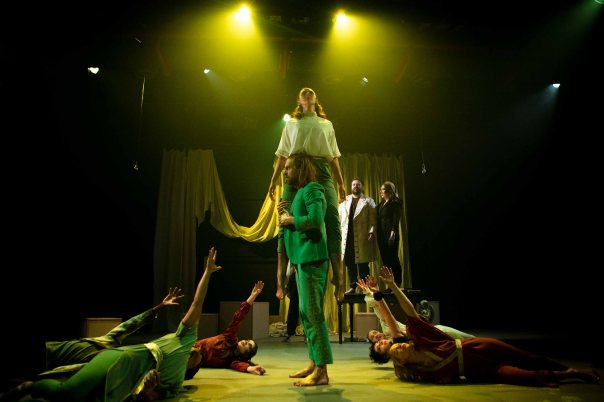
I returned to the Chandler Studios at the RCS to see a performance of Doctor Faustus, Christopher Marlowe’s famous Elizabethan tragedy, adapted and directed by Jennifer Dick for a modern-dress version by students of the RCS’s MA in Classical and Contemporary Text. Sparse props and a backdrop consisting of a huge torn piece of fabric set the scene for the tragedy to come.
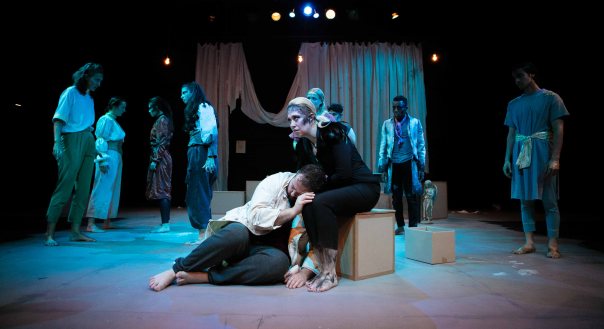
 The drama begins with one, then two, then a whole entourage of characters invading the stage to set about the terrible damnation of the unfortunate Doctor Faustus. Faustus, a revered astrologer, was persuaded (or does he choose?) to sell his soul to the devil for the sake of a life of power and excess. His scholarly nature is emphasised by his books which feature prominently as a device in the plot, as he argues with the scene-stealing fallen angels, quoting passages from his tomes while they dance and cavort around him. Then comes the thrilling – and chilling – moment when Faustus makes the famous declaration:
“Go bear these tidings to great Lucifer: / Say I surrender up to him my soul,
So he will spare me four and twenty years, / Letting me live in all voluptuousness;
Having thee ever to attend on me; / To give me whatsoever I shall ask.”
Words which still have the same terrifying power as they did five hundred years ago when they were first written, showing that the glory of a play can and does last for hundreds and hundreds of years and still blow the competition away. But Faustus was not alone with the fallen angels from hell. Present too are heavenly angels in amazing Flash Gordon style outfits, who, in their patient way try to persuade the scholar not to choose eternal damnation, coming to blows with their evil counterparts as they tussle for the man’s soul. The contrast between the groups was vast, the good angels quiet and dignified, the fallen ones giving us a glimpse of hell as they exclaim with glee to be returning to their sacred father Lucifer, touching themselves and writhing in a glorious hypnotic display of badness.

Faustus meets the great Lucifer, his presence signified by billows of smoke and the darkening of the room to a deep red, his words expressed through the unison of voices of the closely bonded fallen angels. Faustus proclaims his fear, tries to reason with the presence, to find an argument in his books. But his pleas are ignored – the deal for his soul has already been done. As Faustus’ desires begin to be fulfilled,a he starts to inhabit his new role as emperor and exercises his new found power, mocking the pope and granting wishes to whosoever he pleases. Finally, we are drawn into his emotional turmoil as he inevitably realises his position at the very gates of hell and to his horror is dragged off to the torments of fire and eternal terrifying torture. We weep for his loss and for the heavenly angels who could not save him from his damnation.
This performance can only be described as a marvellous celebration of the dramatic arts presented with great creative ability – glorious words, huge themes, mesmerising choreography, stage movement and scene setting; it is hypnotising in its powers and force. Don’t think twice, just go!
Daniel Donnelly

The Scurvy Ridden Whale Men
Oran Mor, Glasgow
March 18-23 2019
Script: Stagecraft: Performance:
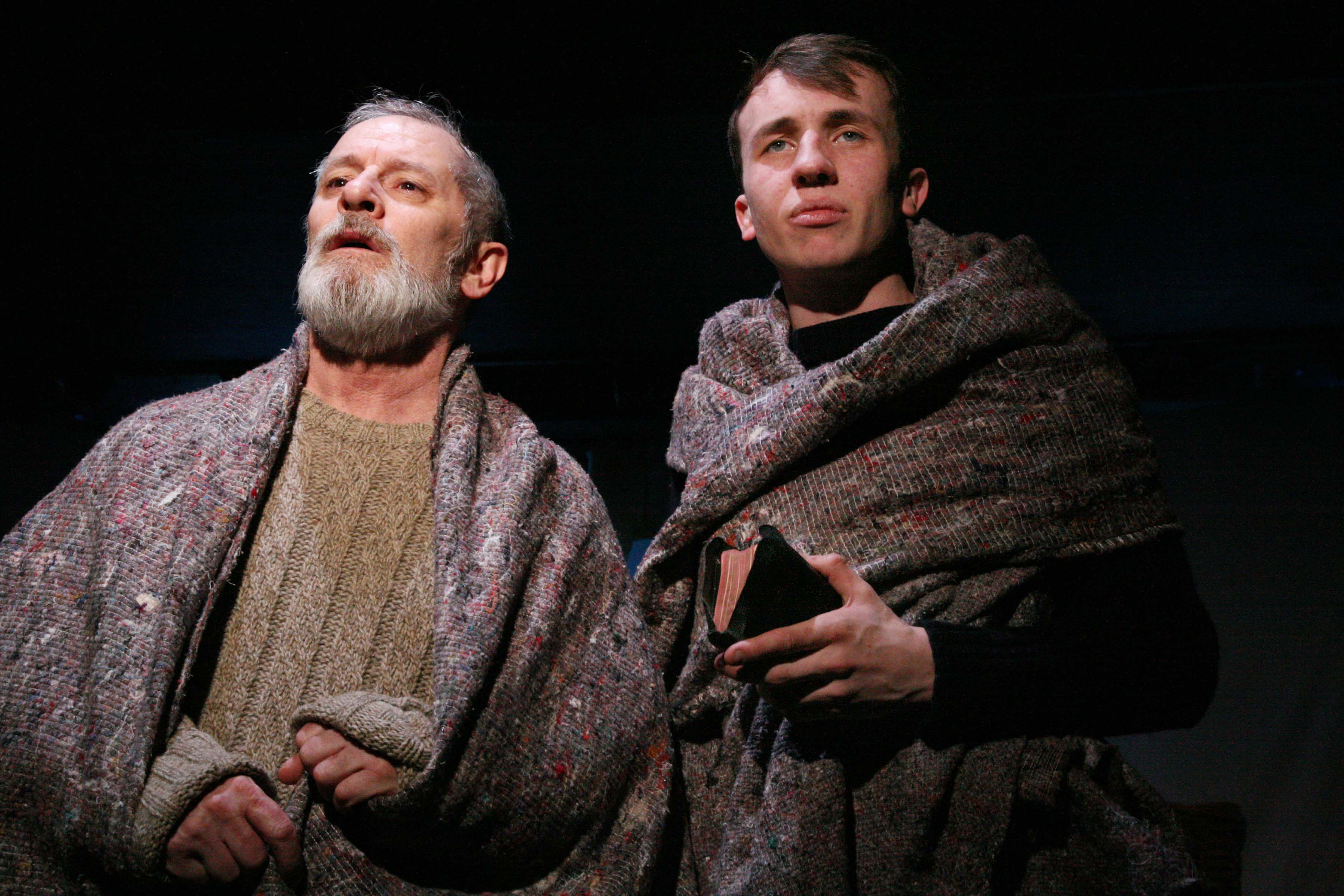
Walking into the Oran Mor venue, we saw the stage dressed as a humble room with laundry hung up to dry and a very comfortable looking chair. The Scurvy Ridden Whale Men by Steven Dick tells of a 19th century whaling disaster, a tale of tragedy and the loss of the crew of the Viewforth to the icy sea, starvation and scurvy. Mrs Humphrey (Janette Foggo) was a larger than life character in brown brogues who presided over the temporary hospital set up in her home to tend to the only two survivors She settled herself down to tell the grizzly tale with gusto and black – very black – humour.

First up is young Peter (Ronan Doyle), flying high on his own emotions. Mrs Humphry keeps trying to bring him down to earth and bring him to his senses, but those senses have been heightened by the tragedy of the boat that sank at sea. Her words of common sense contrast with his excited dialogue and increasing fixation with the need to find his bible, which has been misplaced. She tries to get him to focus on his need to be looked after, shows him his laundry which has been attended to. As she peels her vegetables, we see a darker side to her as she speaks about the loss of her own two boys, Robert and Donald, whose boat it was that had been lost at sea.
When the black storm that caused the tragedy was mentioned, the room dramatically darkened and a howling gale blew through the PA system. Captain Reid (Billy Mac) is depicted at the at the helm during the terrible storm that killed all but himself and the traumatised youngster. The contrast between the safe warm house and the terrible sea scape served to underline the tragedy that had befallen these characters. It was almost as if they were in different dimensions that were tearing them apart as things go from bad to worse. Captain Reid was increasingly riddled with guilt and young Peter was more and more obsessed with the need to find his bible, for that was his only means of salvation. He becomes more and more sure that Mrs Humphrey had taken it and had hidden it away.
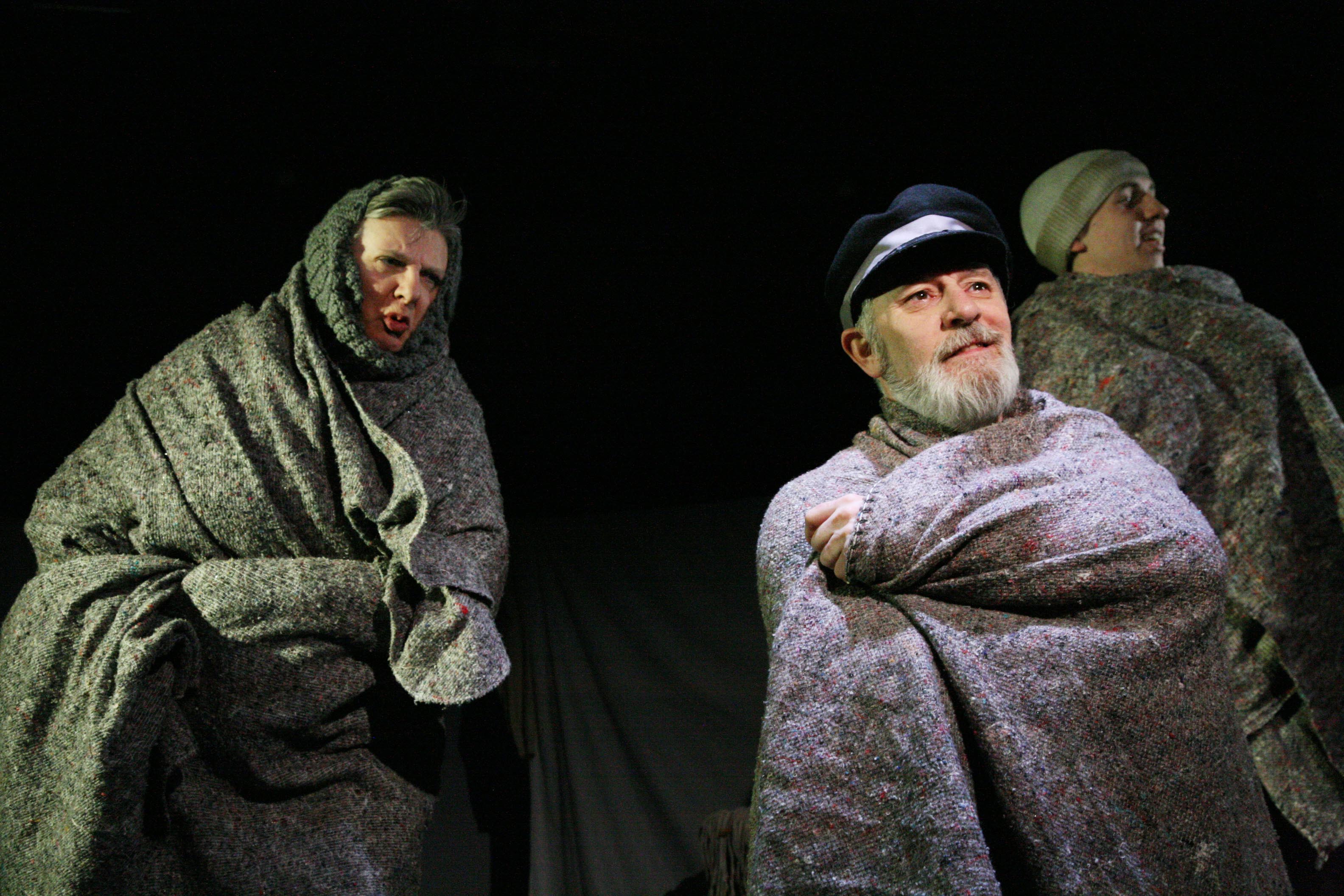
He became further convinced that she had plotted from the outset to get the two fisherman to stay with her in her hospital and becomes more and more fervent in his insistence. Things come to head when Peter pulls a knife on her, a seemingly outrageous act, but one that brings about something of a reversal in the story and we start to suspect that his suspicions might have had some truth in them after all when she mutters that she was never trying to hurt anyone, what has she done? We were left wondering whether her act of kindness might have a different, darker motivation, perhaps something to do with the loss of her two sons? We just don’t know.
Daniel Donnolly
Ring Road
Oran Mor, Glasgow
March 11-16 2019
Script: Stagecraft:  Performance:
Cast within the natural limitations of the parameters of a PPP production, some plays often feel void of a certain something – characterization, drama, story even – but not Ring Road. This is a remarkable strike of the match, creating a somewhat quite brilliant flame as it deals with modern issues, & handles them with a sort of fluffy grittiness. Ring Road, by the way, is definitely not one for the school holidays!
“At first I thought you were a snooty cow…” Mark
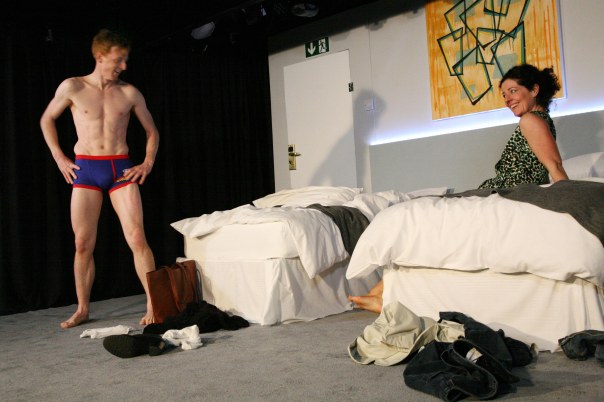
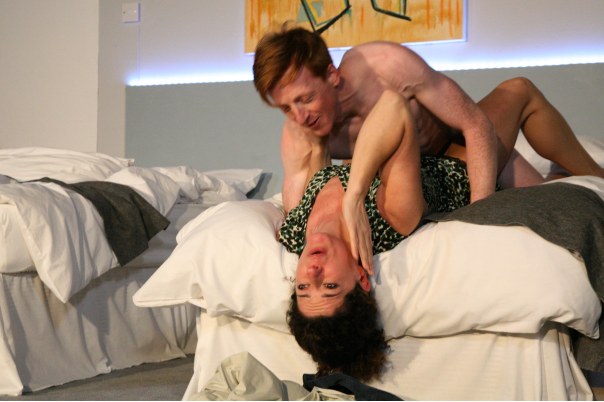
The set is a hotel room – twin beds -, a consummate stage in which unfolds the key bedsheet of the play, a dangerous slice of extra-marital nookie to be conducted between in-laws. Enter Anita Vettesse, starring as Lisa in her own pencrafted play. Her brother-in-law, Mark, is brought to life with bouncing aplomb by Gavin Wright; while her husband, Paul, turns up only in timely & plot-stirring phone-call soliloquies.

Despite their sordid swaggerings, Lisa & Mark are actually quite like-able characters, with their personal inter-plays & polish’d possessions of an excellent script really helping to raise this play up to be widely praised. There are several levels to the story, all of which are relevant. I especially enjoy’d Mark’s reminiscences of when there might or might not have been some kind of chemistry/sexual tension in the earlier encounters of their lives. That Lisa always shirks an answer shows the depth & talent of Anita Vitesse’s craft.
“We’re attracted to each other, & you’re the double of Paul.” Lisa
All in all a wonderful offering from the Oran Mor, which as I said at the start carries on its shoulders just exactly what PPP is all about – top notch drama from a small cast, mixed with classy & contemporary writing!
Damian Beeson Bullen
The Witch of Edmonton
Royal Conservatoire of Scotland
Glasgow
March 6th–9th, 2019
Script: Stagecraft: Performance:
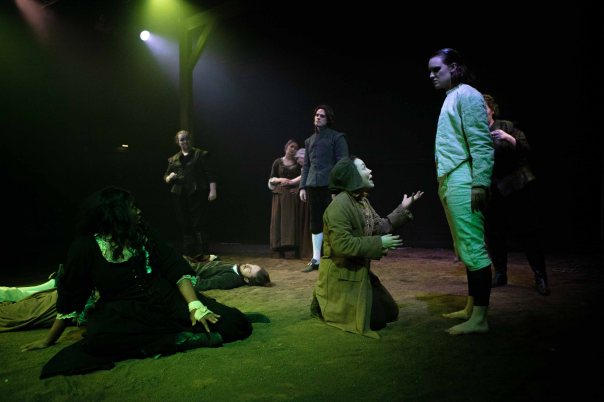
The atmosphere in the Royal Conservatoire’s Chandler Studio Theatre was dark and murky as we took our seats, set up in a double row on three sides of the stage. The set itself added further intrigue as out of the smoky darkness arose two great hinged planks of wood suspended from the ceiling. There was just time for one more cough in the audience before we settled down to enjoy, at close range, the performance of The Witch of Edmonton, written in 1621 by William Rowley, Thomas Dekker and John Ford and based, it seems, on real life events that had happened earlier that year. This adaptation is by Mark Silverschatz.
We witness a town meeting in which all sorts of townsfolk take part – a real crowd scene, with the characters, both rich and poor, comfortably attired and seeming to be happy with their lot in life. Cheerful uproar ensues as plans for the further development of Edmonton are approved. But this blissful state does not last for long: with each subsequent town meeting and encounter the subjects become more and more disruptive and disingenuous as it becomes clear that everyone is really only thinking of themselves and nothing else, even to the extent of cold blooded murder.
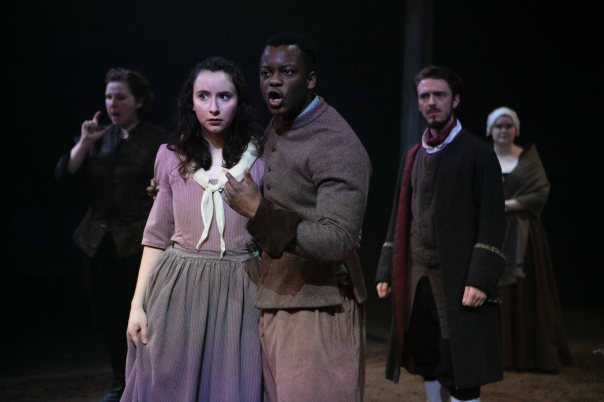
We start to see the true nature of the town when the haggard figure of a woman, Mother Sawyer, crawls on to the scene, totally distraught after being accused of witchcraft by the townsfolk. A terrible judgement that would reap terrible outcomes for all involved. Especially when a new character, a black dog called Tom leaps on stage, crouching behind the accused woman and offering her the revenge she so badly desires after her unfair treatment by the town. In order to reap this revenge, she makes a bargain with the devil, for that is the true identity of the dog.
Then follows a complicated intertwining web of subplots involving various characters; starting with love, bigamy and treachery, and progressing to murder and the way the devious mind can work to avoid being captured. At every turn, the devil dog Tom is always there, lurking and manipulating everything, unknown to the protagonists who cannot see very far beyond themselves; a source for great frustration and a genius opportunity for crowd participation.
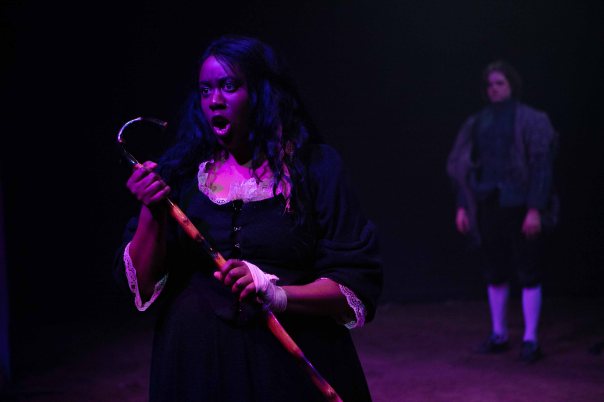
The play casts a spotlight upon human weakness, whether prompted by the devil or not. It does not shy away from grim and graphic confessions of sensuality, rape and cruelty. Love tries to hold out with a wistful dialogue between earth and heaven, but it is as if the world beneath them is shaking like a vision of hell. We are drawn into the tragedy, held together by fragments of speech between the many and the few. At one point, in mourning, they huddle cross legged in the freezing cold, only to be woken again by further grief.
The devil must be paid and leaves only tragedy in her wake; the ‘witch’ who seems no better off than when she started and a population that seems only good for servitude and slavery. The play grabs you by the proverbials and doesn’t let go until it is finished with you, a feeling enhanced by your proximity to the action. Strong stuff!
Daniel Donnolly
Coming Clean: Barbara

Oran Mor, Glasgow
Mar 4-9, 2019
Script: Stagecraft: Performance:
‘Coming clean; Barbara’ is a solo piece written by the award winning writer Alma Cullen, this being the fifth in a series written for Oran Mor. Wendy Seager as Barbara takes us on an intense emotional journey, conjuring up a whole series of conversations as her story unfolds. The set, neat and professional with a desk and a hat stand combines with her smart blue jacket to give us an idea of her smart lifestyle and acquaintances. In sharp contrast to the emotional turmoil that is about to be revealed.

The show opens with Barbara opening her heart to the audience, her voice full of emotion and despair. The momentum never flags as she recalls one dialogue after another, piecing together the catastrophe that has happened in her life. The lights would dim as she comes to the end of one section, only to immediately light up the solitary figure again as she recalls something else. Even the moments of silence afford no respite, just a moment for reflection before we are yet again reeled in. When she converses with her husband Andy, a senior policeman, and her son Gavin, she reflects on love, kisses, fondness, despair, reality. Things were good before they went very awry. She becomes sadder and sadder, focusing all her energy on events that seem to have become too much for anyone to bear. Events that, as a wife and mother she can only watch from the side-lines as life becomes surrounded by the law and the consequences of breaking it.

Her lawyer, Mr Maxwell is almost her salvation, at times breaking through her grief, but ultimately failing because it seems limitless. The priest Eric is no comfort and drives her to go over and over the case by herself. We follow her conversation with Andy as she manages to talk to him in a clear voice and takes us in the imagination to the courthouse where he is convicted of a sexual offense and sentenced to 3 years in jail and a permanent sex offender licence. She falls apart; her voice growing high and urgent as she becomes more and more upset and breaks down before us, weeping on her knees. Barbara tries to hug Andy’s memory close, to remember the scent of him. But in the end her anger and despair only grow as she comes out with all the revelations of what happened and acknowledges the personal sacrifice she has been asked to make. Coming clean indeed. This is a wonderfully sweet, concerning, in-depth piece of writing and acting. Yet another reason to turn up at the Oran Mor on a Monday and sign on for an hour on the roller coaster of entertainment.
Daniel Donnolly
 Mumble Theatre