Category Archives: Uncategorized
The Beaches of St Valery
A Play, A Pie and A Pint
Oran Mor
Glasgow
Mar 6-11
Script:  Stagecraft: Performance:
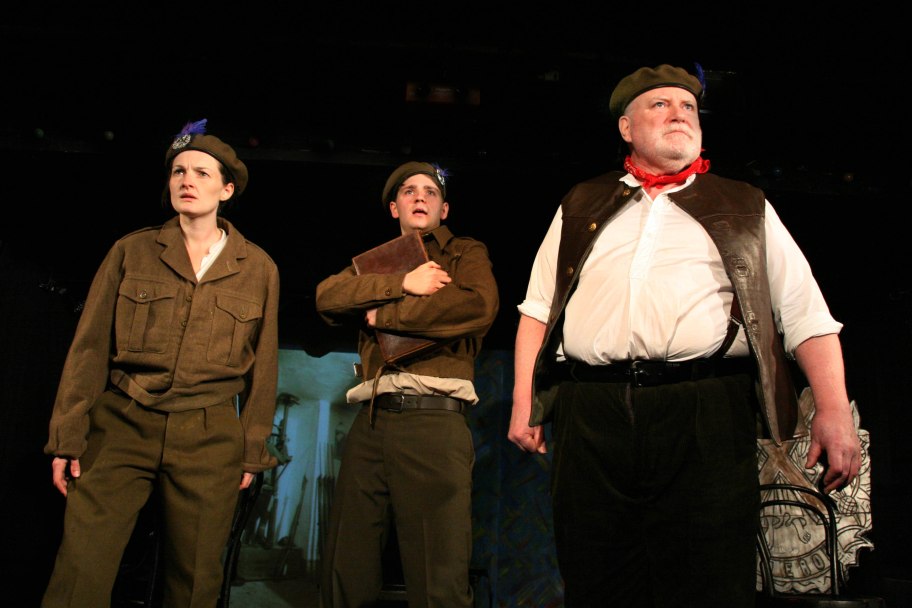
A series of letters to a much loved brother, link events in Scotland and France, before and during WWII. They’re written by Callum, a young Cameron Highlander in the British Expeditionary Force, captured at St Valery by the victorious German Army. He faces deportation to Poland until fate intervenes, in the form of a patriotic French lass and her father.
The cast of three (Ron Donachie, James Rottger and Ashley Smith) are excellent and ably assisted by the clever use of back-projected images of the time (embarking Scottish troops, battle damaged towns, advancing tanks and triumphant Wehrmacht officers). Sound also plays its part, from the rasping cry of a corncrake in the Scottish Highlands to the menacing drone of planes over Normandy, from the war time songs of Britain and France to the cast’s live and haunting version of the of The Flowers o’ the Forest.
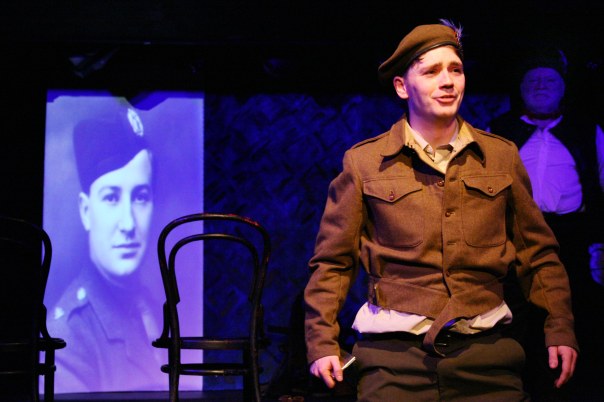
The contentious subject of the sacrifice of the 51st Highland Division at St Valery is explored in discussions between the older sergeant and younger soldiers. The former stressing the need to continue fighting to ensure the French army doesn’t collapse, the latter bemoaning the lack of bullets. We are reminded how quickly young men grow up in times of war – and how some don’t have that opportunity.
Reviewer : David G Moffat

World Domination
A Play, a Pie and a Pint,
Oran Mor, Glasgow
27th Feb to 4th March
Script: Stagecraft: Performance:
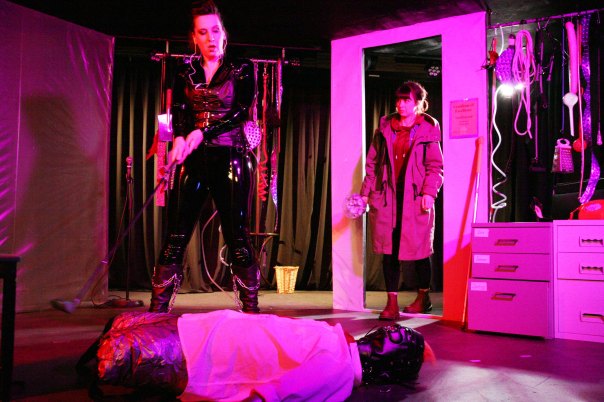
World Domination is a meandering vision of a broken family, anchored upon a suburban dominatrix dungeon. The madame of the crypt is played by Louise Ludgate, who at first rejects the return of her errant sister, Hannah Donaldson. What follows is a gradual shifting of the spheres as the-at-first stoic dominatrix begins to crumble, while the once-flakey, ketamine-bombing sister begins to ‘dominate’ proceedings, in the most gentlest of ways that is.

The two actresses bob along with an unstrained & effortless chemistry, & the script stands up to scrutiny. This is playwright Lesley Heart’s fifth A Play, A Pie and A Pint staged, & it’s a moving, snapshot of the mediocratic malaise which effects modernity. I particularly liked the script at:
- : This is my dungeon, my place of work
- : Its quite a change from human resources
- : No I don’t think it is
An excellent addition to this season’s PPP, especially if you like your theatre clad in lycra & your scenes divided by hard-core German Techno.
Reviewer : Damo Beeson Bullen
An Interview with Dave Robertson
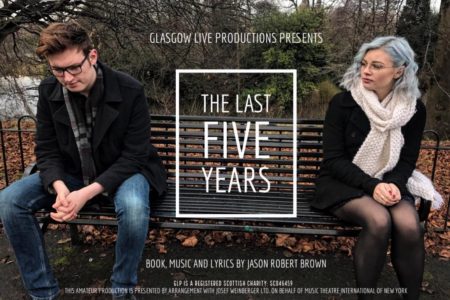

The Last Five Years is on at the Webster’s Theatre, Glasgow
Mar 2nd-4th
An Interview with Stuart Hepburn
 THE MUMBLE : Hello Stuart, where are you from & where are you at, geographically speaking?
STUART: I am from Glenrothes in Fife. I worked in a Paper Mill and Carpet factory for 7 years before I went to Stirling University where I studied politics. I am based in a small mill village in Perthshire .
THE MUMBLE : You clearly have a love of the theatre, when did it all begin?
STUART: The first play I ever saw was 7:84 and John McGrath’s “Little Red Hen” at the Adam Smith Centre in Kirkcaldy in 1975. I was absolutely entranced by the sight of Bill Paterson playing with a little monkey on a stick and talking about “Mulrothes New Town. I couldn’t believe that anyone could mention where I came from on a stage.
THE MUMBLE : How do you think the Scottish Theatre scene has changed in the 30 years you have been involved?
STUART: It’s very hard to be objective about this. I haven’t checked the data so i can’t make any definitive statements about this, but my impression is that regional theatre and touring have been completely emasculated and cut out of existence. There are pockets of excellence but I feel the breadth of professional work has decreased. There has been an expansion of zero-funded or minimally supported semi-professional productions which erupt from time to time in a scattergun pattern. This leads to underfunded productions, a lack of a Scotland-wide dramatic strategy, and poverty-stricken performers.
THE MUMBLE : Could you tell us a little bit about the Beaches of St Valery?
STUART: The play tells the story of a fictional soldier of the Queen’s Own Cameron Highlanders from 1938-1946. It’s central metaphor concerns the surrender of the 51st Highland Division at St Valery-en-Caux in June 1940.
THE MUMBLE : What inspired you to write the play?
STUART: More men died on the road to St Valery than at Culloden, and 9,000 of them were marched to incarceration till the end of the war. They were forced to surrender and sacrificed in a political deal between Churchill and De Gaulle, but because their story did not fit in with the prevailing narrative of “the miracle of Dunkirk”, they have been ignored by history. I am boiling with anger at the unfairness of it all I want to do whatever I can to tell their story.
THE MUMBLE : How are the cast, Ron Donachie, James Rottger and Ashley Smith, getting on so far with it?
STUART: Rehearsals are going very well and I could not be happier with their dedication and performance, but you should ask them what they think of me!
THE MUMBLE : How are you finding directing your own play?
STUART: I am enjoying it more than anything I have done professionally in years. However it’s an intimidating position to be in and means I do not have the support of an objective director to help me with the re-writes. I have no one to blame if it all goes wrong.
THE MUMBLE : What does the rest of 2017 have in store for Stuart Hepburn?
STUART: I am forming a Screenwriting Company with my daughter, Cat Hepburn, and doing a bit of University teaching, and I want to return to acting. As to Directing, we will have to see how the play goes and take it from there.
Coming Up : My Country; a work in progress
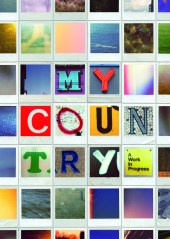 In a month’s time the Citizen’s Theatre in Glasgow will be host to a very special production. The National Theatre has collaborated for the first time with the Citizens Theatre to create a new play inspired by the recent EU Referendum. The views of people from across the UK, including Glasgow, have been interwoven by Poet Laureate, Carol Ann Duffy, and will be presented on stage at the Citizens Theatre from 28 Mar – 1 Apr, beginning the production’s UK tour following dates in London.
In the days following the Brexit vote, a team from the National Theatre of Great Britain spoke to people nationwide, aged 9 to 97, to hear their views. In a series of interviews, they heard opinions that were honest, emotional, funny and sometimes extreme. These testimonials are blended with speeches from political leaders to create a new play by Carol Ann Duffy, Poet Laureate, and directed by National Theatre Artistic Director Rufus Norris.
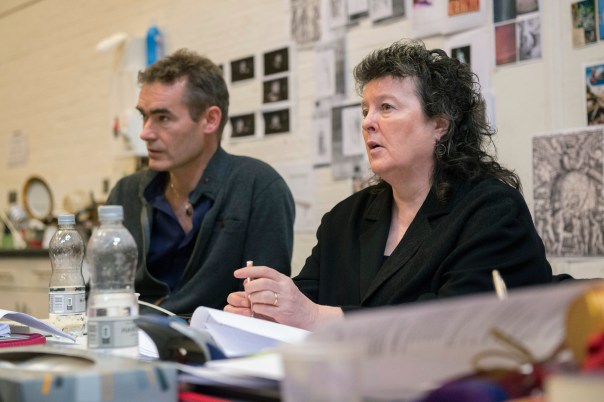
Of the collaboration, Dominic Hill, Artistic Director of the Citizens Theatre said, ‘I have never known a time when people are so engaged, angry, frustrated or excited about what it going on in the world. It feels like the referendum voted unleashed these feelings. The Citizens Theatre has a duty to respond to these events – to offer a platform for debate and argument and to create opportunities for imagining, understanding and listening to differing opinions. That is why I’m so thrilled that we are part of ‘My Country’. We are at the heart of a Glasgow community – this will be a chance to listen to that community and to other voices from all across the country.’
Cast for My Country; a work in progress includes: Seema Bowri, Cavan Clarke, Laura Elphinstone Adam Ewan, Penny Layden, Christian Patterson and playing the voice of Caledonia, Royal Scottish Academy of Music and Drama alumnus Stuart McQuarrie.
Artistic Director of the National Theatre, Rufus Norris, said, ‘One of my ambitions for the National Theatre is to make it truly national and through collaboration, embrace the creativity and opinion around the UK. The Brexit vote unleashed a host of questions about our country, way beyond the issue of Britain’s role in Europe. It articulated a deep disaffection. Those elements provoked a need and opportunity to create a piece of theatre that responds to that palpable sense of frustration and disillusionment. Art has always responded to what is happening now and it’s what I hope we achieve with My Country.’
Last Tango in Partick
A Play, a Pie and a Pint,
Oran Mor, Glasgow
20 to 25 Feb 2017

Script: Stagecraft:  Performance:
An Tango Mu Dheireadh Ann Am Partaig is wryly comic, poignant and entertaining. If your lunch is hour free you could do a lot worse than take in this compact and competent drama at Oran Mor. In essence this is the story of Moira (Mairi Mhoireasdan) and Iain (Daibhidh Walker), a married couple from the Isle of Lewis. Under pressure from empty nest syndrome and Iain losing his job the marriage begins to fall apart. And this is the core of the drama performed in Gaelic with helpful English subtitles for those unlucky enough not to have received much Gaelic language education.
The conflict between Moira and Iain is rather low key. This is not ‘Who’s Afraid of Virginia Woolf’. Iain is largely sulky and defeated. Moira is contrastingly bright and optimistic. They are not a couple who are cruel or vindictive to each other, there is no great falling out, throwing of plates or trading of insults. Theirs is a marriage or a love that has run out of steam, or juice: the spark that sustained them for over twenty years has somehow been extinguished despite Iain’s protestations that he is ‘still the same man I was when I married you.’
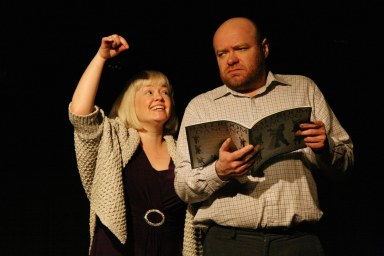
From Moira’s point of view it appears that he is not the same man at all. He is a man struggling to come to terms with the loss of his job and of his children leaving the family home, and branching out on their own. The fact that his marriage, this last cornerstone of his life, starts to come under stress seems to him to be somehow inevitable. The strains arise when Moira asks him to take ballroom dancing lessons but Iain refuses and she goes on her own. She becomes a little smitten by dancing instructor Lachaidh (Iain Beggs) who hails from Barra and brings a certain comic naïveté to the proceedings. At a more serious level Lachaidh’s role highlights the fact that all three characters are Gaels who live in Glasgow as migrants. While home is never that far away in terms of distance, leaving the islands to come and live and work in Glasgow seems somehow like an irrevocable change and life will never be the same.
All three characters project a kind of inner strength that is tested by life’s events. The question is how this strength might be used to move life forward or whether it is simply a tool for survival. And there is always a little humour to help along the way.
Reviewer : Dr Jim Ferguson
An Interview with Muireann Kelly
THE MUMBLE : Hi Muireann, so where are you from & how did you end up in Glasgow
MUIREANN : I am originally from Westport, Co. Mayo in the west of the Republic of Ireland. I came here to train at the Royal Conservatoire of Scotland(in those days known as the RSAMD).
—
THE MUMBLE : What was it that first attracted you to the Theatre
MUIREANN : I was taken to see touring theatre from when I was quite young. As an teenager I went to boarding school in Dublin and was lucky enough to have been taken to see both Theatre and Opera, we also had very inspiring music and drama teachers. From very young I’ve always loved the immediacy of the live event and grew to be fascinated by the bond between an audience and live performance.
—
THE MUMBLE : There is a great rapidity to the PPP process : how do you find the pressure to get things right i nso little time?
MUIREANN : It is a challenge for sure, and I’ve tried to get A’s ahead and prepared as we could be with our production. I have directed at Oran Mòr before and learnt a lot from the last time and this has informed the whole process but particularly the subtitling process.
—
THE MUMBLE : Last Tango in Partick will be performed almost entirely in Gaelic : how are you handling the subtitles
MUIREANN : The subtitling process is a very long and time consuming one, and as the artistic director of Theatre Gu Leòr, a contemporary Gaelic Theatre Company, I’ve learn more and more with each Gaelic production about subtitling. The aim each time is to try and find an artistic solution to integrating the subtitles into the design as much as possible so that they become a part of the set and world of the play and not an option add on. This also requires 3 different drafts of the scripts, the Gaelic original, the English translation and a condensed subtitle draft. It is not necessary to subtitle every word, as it becomes impossible to read and also a huge amount of the play is communicated by what is happening live and through the physical interaction of the actors, so it is important to strike a balance and allow space for the audience to engage with the live action too. We then work hard on recording timings and the spacing and speed of the delivery of lines and between lines each time we do a rehearsal. Then that person controlling the subtitles is Q-ing them as accurately as they can to mirror the timings of the actors delivery, that they have become familiar with in rehearsals. I think if you notice the subtitles, we’ve not done our job. We are very lucky to have Clare McNeil on the team who is a Gaelic learner and a technical Stage Manager and brings skills she has learnt in both these and does an amazing job.
—
THE MUMBLE : What is it about the play that stood out from others during the open submission process
MUIREANN : I was not involved in the open submission process or the commissioning of the play. Representatives from Bòrd na Gàidhlig, MGAlba, The National Theatre of Scotland and A Play a Pie and a Pint chose and commissioned the play. Alison Lang, the writer then worked with the then literary editor at The National Theatre of Scotland dramaturgically on it, developing it. I presume they were drawn to the title, the dance element, the age demographic of the characters thinking it would work well for a PPP audience.
—
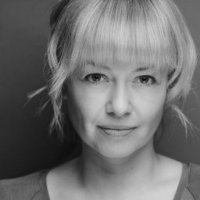
Mairi Morrison
THE MUMBLE : How are your three cast members – Mairi Morrison, David Walker and Iain Begg – getting on together. Have they acted with each other before?
MUIREANN : They all know each other as Gaelic Theatre is a pretty small world. Mairi Morrison and Iain Beggs worked together on Theatre Gu Leòr’s last production Shrapnel which I directed. They are all at different stages in their careers and having more experienced actors work with younger actors is always important in terms of developing the Gaelic drama sector.
—
THE MUMBLE : What emotions & thoughts do you expect the audience to experience in the aftermath of watching
MUIREANN : Last Tango in PartickI hope they will enjoy the brief romance not just in the piece but the also with the Tango itself. I think that having a character like Moira as a middle aged woman on stage taking control of her own destiny, is something to be celebrated.
The Winter’s Tale

Script: Stagecraft: Performance:
The Winter’s Tale is one of Shakespeare’s later plays, a tale of sexual suspicion & abandoned babies set in Sicily & the Bohemian foothills of central Europe. Of its place in the Shakesperean canon, the Lyceum’s commander-in-chief, David Greig, told The Mumble, ‘I love ‘late style,’ the work an artist does at the end of their career, whether it’s the deep melancholy of Beethoven’s late quartets, David Bowie’s final burst of reflection & exploration, or Rembrandt’s last self-portraits. ‘Late style’happens when a great artist begins to take down the scaffolding they’ve spent a lifetime building around their work &, instead, simply, lets the art stand.’ Of the play itself, Greig added that it was something he returned to, ‘again & again because its heart is an ache & a faith. An ache for redemption & a faith in spring… a yearning which can surely speak to all of us, no matter what stage of life we find ourselves.’

To interpret well for the modern stage the peculiar & monstrously unfathomable genius that is William Shakespeare is the touchstone against which all noble-minded directors & producers must test themselves.Whether lauded or laughed at, when it comes to Shakespeare the watching public, especially the British, sit in their seats with daggers drawn like intoxicated hashassins, puffing their perfumed opium, waiting to strike. So precarious is the artistic license, that one false step will have those poison-barb’d daggertips hurtling at the company before even the curtains come down.
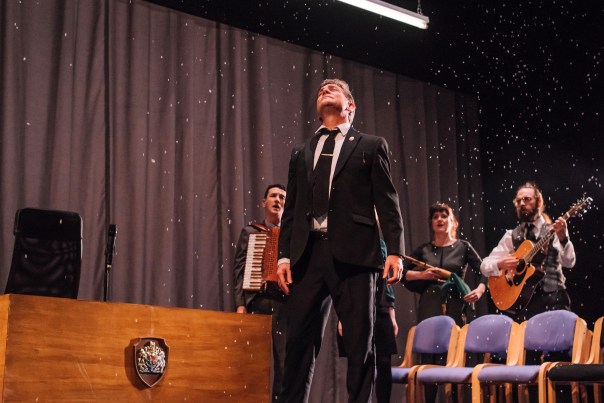
The Lyceum’s Winter’s Tale, then, is a game of two halves The first is brilliant; glossy & well-acted, its the purist’s dream – where modern touches such as mobile phones, christmas jumpers & the DNA test/Delphic oracle are lovely little nuances. John Michie as Leontes was particularly consummate in his role, striding onto the soliloquy’s senate floor with breath-taking, silence-stalking confidence. His playing was matched by Maureen Beattie’s highly believable Paulina & also David Carnie’s wee Mamillius, from whose charming lilt & gallant focus it seemed as if the cherub-faced boy-actors of the St Paul’s Troupe were playing among us once more.

The first half ended with the Bard’s most famous stage direction : ‘Exit, pursued by a bear’ – & it was done superbly, a real credit to the production team. Down went the curtain & I wandered into the busy half-time hub-hub with my appetite royally whetted for an equally distinguished second half. Not long into this half – about ten minutes – I began to feel that somebody had spiked my interval drink with ayahuasca or some other natural hallucinogen of the Amazonian Rain Forest.The actors were now speaking giddily in broad Scots, the colours grown quite overgaudy & the dramaturgy had transmorphed into a gala fete in Fife. Yes, Shakespeare intended a mood-shift, but I do not believe he ever meant it to be so overwhelmingly drastic!

Did it work, for some perhaps, for myself less so. After such an astonishingly sublime first half, the spell of mercurial fancy had been rudely broken & my imagination left reeling like a sidewinder in the sands. This production of The Winter’s Tale is a hybrid, not quite a mighty gryphon with the body of a lion & the wings of an eagle, but more a hyperactive spaniel with the wings, downy feathers & penetrating eyes of a beautiful swan. By the play’s denoument things had actually settled down somewhat, & the play reverted to its early brilliance, perhaps the ayahuasca had worn-off, who knows, but this play – for various reasons – should live long in my memory, which is the real raison d’etre, is it not, of the theatrical tradition!
Reviewer : Damian Beeson Bullen
Dirt Under The Carpet
A Play, A Pie and A Pint
Oran Mor, Glasgow
Feb 13-18
Script: Stagecraft:  Performance:
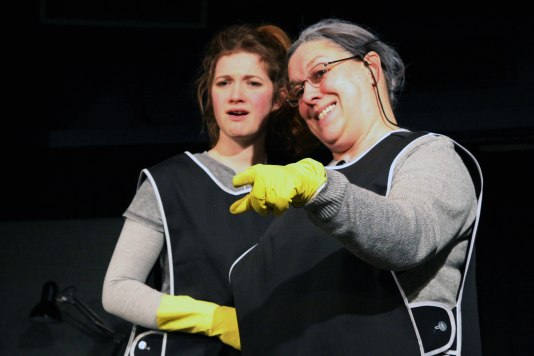
Set in the basement of a Granite City office block as profits from the black gold are declining, Rona Munro’s two hander yields a bounty of drama and black humour. A frightened young cleaner tells her older mentor that she’s been grabbed by the uncle (not a family conflict but Aberdonian for ankle) except she couldn’t have been because the supposed grasper is… a corpse. Not only that, the head wound has bled all over the white carpet, a nightmare for the two women charged with keeping the premises spotless.
Dressed in monochrome uniforms that reflect the repetitive dreariness of their twilight occupation, Lorraine (Karen Fishwick) and Muriel (Joyce Falconer) disparage the malicious Mr B over his dead body, while debating the identity of his assassin. The more experienced Muriel’s deduction of character from desk content and debris, is a delight worthy of Sherlock Holmes.
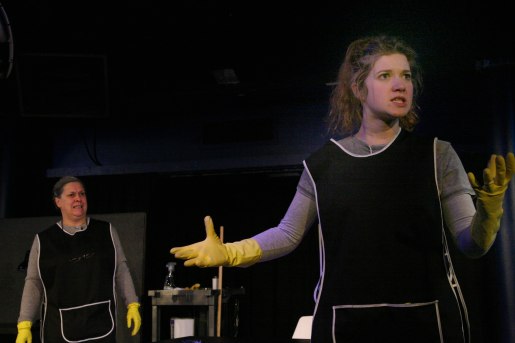
Office politics and romance, thwarted ambition, secret pasts, all are skilfully unveiled with gesticulating Marigolds, in a drama peppered with memorable lines. It’s a whodunit so ‘lips tighter shut than a mussel at high tide’. The play moves to Aberdeen next week where uncles and other kin will not be disappointed.
Reviewer : David Moffat
Cuttin’ A Rug
Cuttin’ A Rug
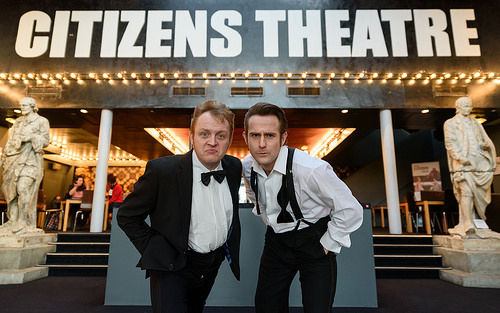
Citizens Theatre, Glasgow
£12.50 – £22.50
8 Feb 2017 to 5 Mar 2017
Script: Stagecraft: Performance:
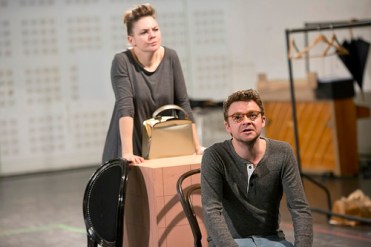 In John Byrnes second part of The Slab Boys Trilogy Phil and Spanky have escaped the dire monotony of A. F. Stobo & Co. Carpet Factory in Paisley and are heading to the annual staff dance. 1950s industrial Scotland and all that entails have been shoved under the carpet for a night out, even Phil losing his job and his hope of getting into art school are all waylaid for a night on the tiles. Directed by Caroline Paterson (Ruth Fowler,Eastenders) superb spot on lighting by Grant Anderson this fiasco is funny, slick, sharp-witted and surprisingly contemporary for being set over sixty years ago.
On arrival, I was greeted by the female staff all in 50’s outfits with freshly sprayed quiffs and made up faces.Quite a sight.In the foyer the rockabilly, rock’n’roll and r’n’b band Cutting A Rug comprising of Chris Harvey on vocals and guitar, Raymie McCabe drums and Davie Currie on double bass were giving it laldie and the awaiting punters were lapping it up while supping their pre-theatre drinks.

The old footage from cinemas of that era was comical and the fascination that Glasgow had with all things American was evident in the Elvis idolatry, the brylcreem and the soft top convertibles, albeit with a puddle or two on the upholstery in the back. The main characters Lucille and Bernadette are hysterically entertaining with their two faced attitudes and penchant for American cocktails that stumps the bartenders and Hector in his oversized suit aiming to impress Lucille.
Bernadette’s sharp tongue cuts Phil McCann down to size when he tries to chat her up .The way this play has been wrote where the characters tell you their innermost private thoughts prefight or post punch is insightful and absurdly amusing. Aldus Huxley is given a few different careers thanks to the ignorance of the characters .The character that stole the show for me was Sadie , the factory tea lady who took no prisoners especially reveling in noising up old Mrs. Walkinshaw, ‘ from the terrace hooses.’ A highly recommended riotous romp with laughs abounding, this peek into a bygone era will warm the cockles of your heart.
Reviewer : Clare Crines
 Mumble Theatre