Category Archives: Uncategorized
The Diary of Anne Frank
Bedlam Theatre
Edinburgh
Feb 7th-11th

Script:  Stagecraft: Performance:
In the 18th century, a fire raged through a library in England, singeing but not destroying the only manuscript of the great Anglo-Saxon poem, Beowulf. Without it, our knowledge of the past would be much depleted. In the same fashion, as the Gestapo ransacked her family’s secret hideaway in Amsterdam, like a finger of flame reaching out for the Beowulf MS, in the Bedlam Theatre in Edinburgh last night the teenage Anne Frank reached out to grab her diary, but was shunted on by the brash Gestapo guard. Saved from the fires of Nazi oppression, Anne Frank’s diary would eventually resurface, a poetically written & detail-laden account of her two years in hiding that would become an international best-seller. Ten years after the war was finished, Frances Goodrich & Albert Hackett brought Anne’s diary to the stage – but their effort was seen as an inexcusable sentimentilization of a tragic & angry document. Then in the 1990s, Wendy Kesselman rewrote the play, bringing back the darker mental shades of life in captivity & incorporating more of Judaism, such as hanuka gifts & songs in Hebrew.
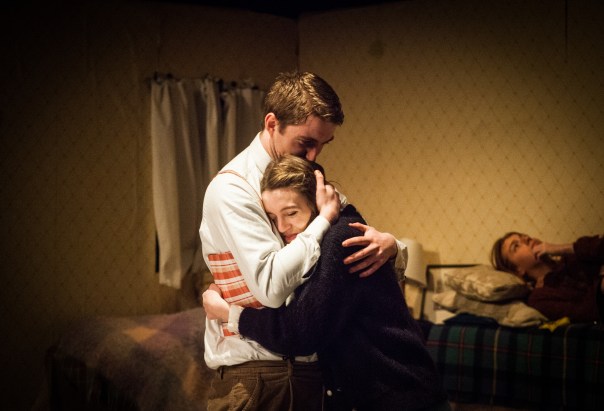
Last night I witnessed such emotional & theatrical clay being moulded into something quite noble by a group of young Edinburgh students marshaled into order by Marion Bretagne. In an earlier interview, she told the Mumble, ‘it is a very emotional play, not only because it has a tragic end, it is emotional because it will make the audience go through all the range of possible emotions in 1h45 min, following the 2 years of the inhabitants; Sometimes it’s really funny, because Anne, who was a very funny, very energetic girl, made a joke, and then it can before fearful, and then sad. It is a play about the Holocaust, but also a play about family, about growing up, about living in extreme conditions, about human feelings. Some might find that this script is still ‘not sad enough’, but Otto Frank approved it and he’s the supreme authority in that regard.’ As Marion says, this play may be seen as ‘not sad enough,’ but to the Frank family – & the Van Daams – their two-year stay in the secret annex was a veritable paradise in comparison to what was happening to the rest of the Dutch Jews.
 If Otto Frank – Anne’s father – was wishing to remember the joviality of his daughter, then chirpy-as-a-chipmunk Lucy Davidson was perfect for the role. Over the span of two years we see her grow from a smart-arsed 13 year-old girl into a hormone-happy paragon of young womanhood. Around her smoothly hypnotic performance, the cast gave sturdy support. Her father, Otto, played by a charismatic Peter Morrison is a glimpse into how Liam Neeson would have been in his tenderer years. Katrina Wooley’s Mrs Van Daan was also quietly absorbing, but its hard to place praise anywhere really, for the cast worked together as a team, on a cramped & constantly moving stage. While in one corner, two characters were lost in silent conversation, in another corner others knitted or read. One scene in particular was perfect, where every three seconds a light burst into brightness then faded to dark, with the gerbil-like actors & actresses flurrying about the stage – as days on days were passing by. Indeed, there was a true familial energy about the cast’s onstage chemistry which really helped us to warm towards them all.

This was an excellent production, with majestically authentic wartime costumes strolling about a highly-realistic set, all interspliced with BBC radio transmissions & Hitler speeches. It would have been the perfect play, one expects, if it would have ended simply with the capture of the two families hidden in the Secret Annexe. As they are led out the stage is immersed in darkness for a thought-provoking while. Then the lights raise up again on an empty, search-scattered annex, & you’re like perfect : then Otto Frank walks through the door & proceeds to give a swift, sickly-sweet soliloquy on how Anne & the rest of his family died. Less is more sometimes, & it is a rare person indeed who is not able to project what would have happened to Anne. Despite this, I feel I have just witnessed a remarkable performance of a riveting play about a very famous event – the writing of Anne Frank’s diary.
Reviewer : Damian Beeson Bullen

Made In India
The Tron, Glasgow
Feb 8th-11th

Script: Stagecraft: Performance:
*****************
‘The surrogate is only a carrier, you are renting a womb’
When we found ourselves sitting down at the play, one may ask oneself, ‘what am I actually here for?‘ A story, of course, well told, but we can get that from a good book. What the theatre does offer is the ability to witness character development & interactions at first hand, & it is in a play such as Made in India that these dramatical evolutions take centre stage. Of its inception, in an earlier interview playwright Satinder Chohan told the Mumble, ‘I was applying for the Adopt A Playwright award and was inspired by a shocking article about a white middle class English woman who paid an Indian village surrogate to birth her baby. (My play!) The woman described her surrogate as a ‘vessel’. With my Indian village roots, the surrogate could have been any number of my female relatives or if my parents hadn’t emigrated to the UK, even me. The story was loaded with so much conflicting emotion, culture and politics, I knew I had to write a play around the situation, to explore and understand its fertile terrain. I submitted the idea, won the award, began writing the play.‘
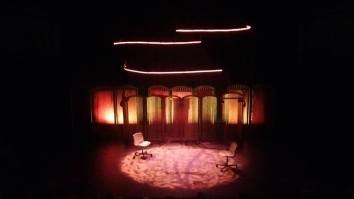 Made in India has three characters; the poor, womb-healthy, pregnancy-sweet-spot-hitting 28 year old from a Gujurati village, the female doctor at her own clinic & the desperate 40-something British down to her last few eggs. Together they form a menage a trois which begins chirpily enough & ends with great drama. The entire backdrop of Indian surrogacy is painted with great detail, but never obstrusively into what is an excellently conceived, written & ultimately performed piece of theatre.

All three actress pull of highly believable portraits, while the stagecraft is sublimely effective – a combination of light changes & screen-shuffles enabling us to really place ourselves in steamingly hot India. The colours are all deep purples & gold, like the feathery tail of a peacock wafting before our eyes. The script is also littered with Indian touches, like lassi-cravings & the showbiz nature of Indian politics. Made In India is also a story of obsession played with a nervous brilliance by Gina Isaac. Her character Eva is so determined to produce a baby with her dead husband’s sperm, that all around her are sucked in the maelstorm. This play is a rare thing in today’s theatrical landscape – for it teaches without being didactic, & entertains without slapping the drama on with a thick butter-knife. Well done to all concerned.
Reviewer : Damian Beeson Bullen
—————————————————
Made in India is in Scotland for another week or so
Macrobert Arts Centre, Stirling
14 February, 7.30pm
www.macrobertartscentre.org / 01786 466 666 / £5.50 – £12.50
Traverse Theatre, Edinburgh
16 – 18 February, 8pm
www.traverse.co.uk / 0131 228 1404 / £8.50 – £16.50
Dusty Won’t Play
Oran Mor, Glasgow
6-11 November
Play, Pie, Pint (1pm)
Script: Stagecraft: Performance: 
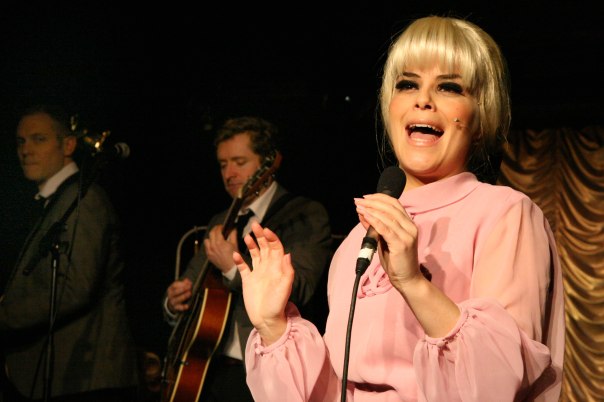
 Dusty Won’t Play is an explosively brilliant start to Oran Mor’s 2017 Play, Pie & a Pint season. Completely sold out, I was forced to sit at the back of the room on the bar itself, which at least let me for the first time truly acknowledge the excellent acoustics of the theatre – I could hear everything in pinpoint precision. The play is the brainchild of literary legend Annie Caulfield, a composite blend of Dusty’s best tunes (sung with entrancing impeccability by Frances Thorburn) & Springfield’s fateful tour of South Africa in 1964. Donning a good blonde wig, slapping the eyeliner on thick & singing some cracking numbers, in 1964 Dusty was a rising star & was just about to reach international fame – tho’ not in a war she would ever have wondered growing up in the back streets of Ealing.
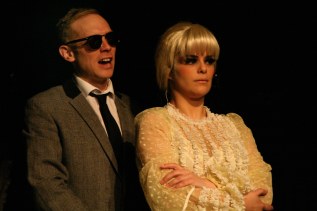 The timing of this play is karmic: where Donald Trump in America is causing cultural schisms, so in 1964 apartheid & racial segregation were raging wildly in South Africa. Just as our speaker of the house, John Bercow, has stood up against Trump’s bullying, so did Dusty refuse to play to all-white audiences. The chief drama of the play revolves against the bullying of the SA authorities – house arrest, threatening behaviour – & Dusty’s resolve to stand in defiance against them. The music was brilliant: Springfield’s ‘band,’ The Echoes, consisting of Simon Donaldson & Kevin Lennon, played guitar & piano along to Thorburn’s miraculous, almost shamanic renditions of classic motown numbers – it was almost as if Dusty was back in the room. At only one point did the music blend with the theatre, when Dusty sang ‘You Don’t Own Me’ to an overheavy SA policeman (played also by Donaldson), but this little slice of cheese really set off the trimming-laden quarter-pounder served up alongside the pies & the pints. Brilliant.
Reviewer : Damian Beeson Bullen
An Interview With Gerry Lynch
 THE MUMBLE : Hi, Gerry, so how is the Dirt Under the Carpet project coming together?
GERRY : It’s coming together well (I hope!). Karen and Joyce are working very well together and we are discovering new things about the play and the characters every day. The play takes place in one setting but it crosses a few different time zones between the past, the present and limbo when Karen talks to the audience. Finding the transitions has been a bit tricky but I think we have cracked it!
THE MUMBLE : Can you tell us a little about the play?
GERRY : The show is transferring to Aberdeen after it opens in Glasgow, and it’s part of the Granite Noir Festival there and is a great thriller/mystery….apart from that I’m not giving anything away! No spoilers here!
THE MUMBLE :The playwright, Rona Munro, has had recent spectacular success with The James Plays. Dirt Under the Carpet is very different from an epic historical trilogy – how do you feel Rona has handled the change in tempo & scope?
GERRY :I would never even dare to make comment on how Rona has handled that. I’m not a writer. I can only talk about the experience of her plays from my own perspective as a director and actor. To me she is an absolute genius. The first play I directed was Iron by Rona and I kind of fell in love with her language and style and most importantly these amazing characters she writes. I know these people, I’ve met them, grown up with them. They mean something to me….I’m sure I sound like an absolute wanker there but it is true!
THE MUMBLE : How are your two actresess – Joyce Falconer and Karen Fishwick – getting on with their roles?
GERRY : Very well I think. They are finding some lovely stuff. Joyce has been very generous in helping Karen and I with the accent and she has a great presence on stage. Karen is wonderful, she is really making the part her own. She always finds something new in the character each time we rehearse and as a director that is a really exciting thing to watch. They are working very well together and creating a real, fully formed relationship between them. It’s quite a complex play and they are really making it work (don’t tell them I said that though!)

Joyce Falconer
THE MUMBLE : What emotions should next week’s PPPP (play, pie, pint, punter) expect to be stirred by Dirt Under the Carpet?
GERRY : I have no idea. I really don’t. It’s not my intention to try to make them feel anything. I’m really enjoying watching these two great actors work with a fantastic script and a great story. I hope we can do it justice. I can’t possibly predict what emotions it may stir up….
THE MUMBLE : What does the rest of 2017 have in store for Gerry Lynch?
GERRY : We transfer to The Lemon Tree and then after that I go back to acting and assistant directing The Lions Of Lisbon which will tour across Scotland. I’ve also got a monthly pub theatre by my company UnSub Actors that I’m setting up at the Citz (hopefully) where we will do staged readings of some classic Scottish plays. We also have workshops set up with Kahleen Crawford, Danny Jackson a new writing workshop with Philip Howard and Martin McCormick, a theatre workshop with Gareth Nichols, a workshop with Shakespeare’s Globe and Mike Alfreds, and hopefully a Shakespeare workshop with Lu Kemp and Liz Lochead. Apart from that I’m just going to go up the road to see my 2 wee boys and my beautiful Ginger wife Marianne X
***********
Dirt Under The Carpet will be playing at the Oran Mor
Feb 13-18th (1PM)
An Interview with Satinder Chohan

THE MUMBLE : Have you been to Scotland before?
SATINDER : When I had just started writing for theatre, I was accepted on a residency at the Traverse Theatre in Edinburgh. It was a beautiful baptism – developing my play ‘Lotus Beauty’, lodging, meeting and chatting with other writers and discovering exciting Edinburgh – perhaps most memorably when I decided to scale Arthur’s Seat and not even a quarter of the way up, got knocked over by the blustery winds and slid right back down the hill on my very muddy backside! I’d love to spend more time in Scotland. As a huge Liverpool fan, Kenny Dalglish is a hero – my sister and I supported Scotland (and Brazil of course) in the 1982 World Cup. We still have Scotland’s World Cup song ‘We Have a Dream’ on 7” vinyl! So Scotland has always been close to my footie and political heart and I’m so proud the play is touring there.
—
THE MUMBLE : What was the original idea or story that sparked Made in India?
SATINDER : I was applying for the Adopt A Playwright award and was inspired by a shocking article about a white middle class English woman who paid an Indian village surrogate to birth her baby. (My play!) The woman described her surrogate as a ‘vessel’. With my Indian village roots, the surrogate could have been any number of my female relatives or if my parents hadn’t emigrated to the UK, even me. The story was loaded with so much conflicting emotion, culture and politics, I knew I had to write a play around the situation, to explore and understand its fertile terrain. I submitted the idea, won the award, began writing the play. I think the story also chimed because there had been instances of altruistic egg donation in my community. So I had always wondered about the generosity of one woman towards another in those situations, wondered what drove a woman to offer her eggs to another, to have a baby for another, without payment. So commercial surrogacy in which both strangers and payment were involved was fascinating to me.
—
THE MUMBLE : Why this play now? (Global and local relevance)
SATINDER : Globally and locally, we’re living in a time when there is a serious conflict between rampant financial markets and human morals – more often than not, morals are sacrificed for markets. Through market fundamentalism and the ‘commodification of everything’, everything is for sale in our neoliberal times including education, health, emotions, bodies…and women like these surrogates have to sell themselves to make a living, literally. When I began the play, commercial surrogacy was rife in many countries. During the writing process, India, Nepal, Thailand and Cambodia introduced surrogacy bans. In India, the ban feels like a nationalist reaction against global neoliberalism and a right-wing government trying to realign India with traditional family values – altruistic surrogacy is allowed but only for childless Indian couples – not gay people, singles or foreigners. Yet it is also a nationalism that has raised questions about the reproductive freedoms of women and use of reproductive techniques in these countries. So the play and surrogacy itself is a topical lens through which our changing global and local political landscape is filtered. It’s a compelling story about gender, economics, reproductive technology and ethics that continues unfolding across nations in the real world outside.
—
THE MUMBLE : The play is set in Gujurat – is that your native state & how did you end up in the UK
SATINDER : My family is actually from Punjab, which neighbours Gujarat in India. But as in Gujarat, commercial surrogacy was big business in Punjab too.
I was born and brought up in Southall, West London, widely known as ‘Little India’ or ‘Little Punjab’, with all its Indian and Pakistani shops and restaurants, gurdwaras, mandirs and mosques. So I consider myself a Punjabi Londoner more than anything else! My grandparents came to the UK from Punjab in the late 1950s and my parents in the late 1960s. We’ve lived in Southall ever since.
—
THE MUMBLE : Can you tell us how you got involved with Tamasha & the Belgrade Theatre
SATINDER : After my first play ‘Zameen’, I began developing a new play ‘Lotus Beauty’, set in an Asian beauty salon, with Tamasha. Later, Tamasha’s then Artistic Directors Sudha Bhuchar and Kristine Landon-Smith nominated me for the Adopt A Playwright Award, which I won with the idea for ‘Made in India’. Fin Kennedy was actually on the interview panel and during my Adopted Year, became my (exceptional) mentor/dramaturg as I began writing the play. In a serendipitous turn of events, he later became the new Artistic Director at Tamasha and took the play with him, where we continued developing the piece. It’s now his first main production as Tamasha’s Artistic Director and it feels so fitting we’ve come full circle back to Tamasha with it. Belgrade Theatre came on board as co-producers later on. We’ve just enjoyed a fantastic run of the play in Coventry with them – such an excellent, supportive place for new writing.
THE MUMBLE : Tamasha is unusual in having a playwright as Artistic Director, what does this bring to the creative process?
SATINDER : It brings a highly talented individual to the creative process – an Artistic Director, playwright and dramaturg rolled into one! It’s a supremely skilled all-rounder who can focus on the smallest detail in the text, while keeping an eye on the bigger picture of a possible production. It helped the process hugely that Fin is a writer too. He easily understood my creative objectives, obstacles and was always quick to suggest a wealth of dramatic solutions. As a writer, he could help me shape the drama much more effectively than I could alone as he could easily understand the play I was trying to write and help me work out the best possible way of writing it.
—
THE MUMBLE : How have you worked together, as two writers, to develop the play?
SATINDER : From the beginning of our 15 plus drafts (!), I would write a draft and then we would have the most brilliant, searching, synergistic dialogues about the play that went on for hours! From talking about the play itself, to character details, surrounding issues, transactions, politics, neoliberalism, reproductive technologies, infertility and so on…It would take a couple of days to all process but was massively helpful in moving onto the next draft. We did this intermittently for about three years – discussion, draft, feedback, discussion, draft, feedback etc. During my Adopt A Playwright Award year, we also had three rehearsed readings and another reading and intensive workshop later, so other vital feedback from directors and actors also pushed the play on dramatically. About a year and a half ago, when I thought I was finally finished with the play, the Indian government decided to ban surrogacy. That decision upended a lot of the play and so we had to reshape the story, which took a few more discussions and drafts, expanding and contracting til the final distilled version of the play! After director Katie Posner came on board, Fin took a step back. For the last few drafts of the play, Katie and I have been drafting and discussing together, although thankfully, Fin continues to feedback into that process too. I’ve just learnt so much from my work and all those creative discussions with him – it’s been an intensive, invaluable process and an incredible experience working with him.
—
THE MUMBLE : What do you hope the audience will leave the theatre thinking, feeling, wanting to do?
SATINDER : I hope the audience will be emotionally affected by the play because while it’s about surrogacy, it’s also about the bigger interconnected neoliberal world we live in. In the UK, we’re all privileged Westerners and consumers who rely on marginalised workers all over the world to provide the material stuff of our lives. In that power dynamic, we are the ones who can afford to blank out who those people/workers are and what their lives are actually like. I hope this play is a small reminder of the people who inhabit those worlds, their lives and struggles, who create and build our worlds from afar. Even though commercial surrogacy is a very complicated issue, I don’t think it’s right that we live in a world where a village woman delivers a baby for a more affluent woman for money. The surrogate should not be so financially disadvantaged and socially neglected that she is driven to deliver babies for money. So I hope the audience thinks about the inequitable world we live in, the way that our consumer and materialistic, ‘everything is for sale’ lives and attitudes impact on less fortunate others in other parts of the world. I really hope some audience members might feel compelled to do something about those inequities in their own lives or the lives of less fortunate others.
—
THE MUMBLE : What advice do you have to aspiring young playwrights?
SATINDER : Choose another profession! Haha, I jest. For all its endless challenges, I’m glad I ended up here. It’s incredibly tough to survive as a writer, so I’d say, be patient, work hard, keep developing your voice and honing your work, keeping it true and honest. Also, find a paid job on the side that complements the writing because playwriting sure doesn’t pay. I’ve had to rely hugely on the generosity of family and friends to write – I don’t own a house, a car, material possessions, have kids – I’ve tried to streamline my life so that I live to write – but I’m an extreme example. If you simply have to write, you will find a way to make it work for you. Also, don’t compare yourself to other writers – everyone grows and develops as a writer at their own pace, in their own way, telling their own stories – you have to stay firmly on your own path, voice it and write it as strongly and uniquely as only you can.
MADE IN INDIA
An Interview with Marion Bretagne

THE MUMBLE : Hello Marion, so Anne Frank is coming up soon at the Bedlam Theatre, how is it going?
MARION :It’s going very very well as a matter of fact, a week before the show and the actors know their lines, we’re already doing full runs, have all the props ready and are selling really well. For a first show as a director, I am blessed! I like to think that my background of producer has helped the organisation, but also I am working with a very hard-working bunch.
—
THE MUMBLE : How well does Wendy Kesselman’s script bring out the original book.
MARION : There was a lot of criticism with the first version of the play written by Frances Goodrich and Albert Hackett. I did read it, and thought something was odd. I remembered The Diary of Anne Frank as being a piece of literature that was all about the hope, the everyday, the fights, the fear but the first version tended to be a ‘feel-good’ sort of play which is odd. Wendy Kesselman has brought back the Jewish components and seriousness this subject needs. Yet it respects the tone of Anne Frank. It is a very emotional play, not only because it has a tragic end, it is emotional because it will make the audience go through all the range of possible emotions in 1h45 min, following the2 years of the inhabitants; Sometimes it’s really funny, because Anne, who was a very funny, very energetic girl, made a joke, and then it can before fearful, and then sad. It is a play about the Holocaust, but also a play about family, about growing up, about living in extreme conditions, about human feelings. Some might find that this script is still ‘not sad enough’, but Otto Frank approved it and he’s the supreme authority in that regard.
THE MUMBLE : How difficult has it been to recreate the secret annex on stage
MARION : Not so difficult/ We went to Amsterdam to visit the house of Anne Frank during Christmas. The set is obviously not an exact replica of the annex and we’re doing with what we can and our budget but the set and stage managers Neb and Kitty are absolute stars! I can’t wait to see it.
THE MUMBLE : Can you tell us about your cast for the play, & how they are blending together
MARION :This cast is incredible. Each of them is just perfect for the role. The characters all have very different personalities, which makes living together really difficult.
THE MUMBLE : As people, everyone really gets along, and rehearsals are really nice.
MARION : As character, it really feels like everyone has their own personality. we worked a lot on character development, using passages from the diary, and improvising from that. I had a chat with each actor to talk about their character, they made research on the background. The characters all very complex and human. It’s pretty incredible to see how far we’ve gone, in terms of becoming the characters since the first rehearsal.
THE MUMBLE : What do you expect the audience member to be thing about, ruminating on, as they leave the theatre.
MARION : The most important, I hope they’ll remember that the Holocaust is more than a big name for a horrible historical event, and that the death of Jews is so much more than a figure. I hope they’ll remember it’s about real people. Obviously I am expecting them to be sad. But I hope, they’ll understand that the joyful moments in the play are here to remind them that the victims of the Holocaust are real people who also had fun in their lives. Sadly, the play is still very relevant, and O hope that it will make people think: refugees are more than refugees, there are individuals, same with victims of the Syrian War and so many other places. Maybe the media tends to presents facts, and forgets to remember the lives of these people and their feelings. Hopefully this play reclaims the humanity of the victims of history.
THE MUMBLE : Could children enjoy your production
MARION : One of my main aim for this production was to have children to come because it is such a good educational piece but honestly I have found it harder than planned to market toward schools and younger children. There is no violence at all on stage and most of the play is every day life in hiding, but still there are a couple scenes that are emotionally quite intense. Then, with BOB, we were quite surprised to see very young children in the audience – I don’t think they could understand everything but seemed to enjoy it, and that was way more bold and adult. I think children will really enjoy it and that will be an amazing educational entertainment as well, but would keep in mind that some scenes are not easy.
THE MUMBLE : What does 20176 have in store for Marion Bretagne
MARION :I am afraid this is as far I as know, my last theatre production. I am moving to Porto in May after I graduate to work in a Design Agency. I hoping that maybe when the time comes, I can do some theatre in English in some European cities after my day job but for now, no big plans theatre-wise.
Picnic At Hanging Rock
Royal Lyceum Theatre, Edinburgh
January 15-28
Script: Stagecraft: Performance:
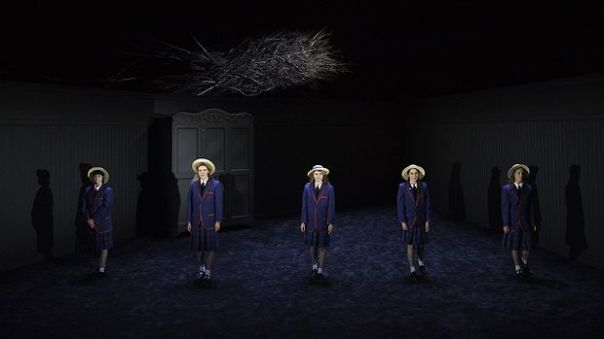
Seeing Tom Wright’s adaptation of Joan Lindsay’s iconic Australian story in its first run outside of its home country was a real treat. Although feeling apprehensive about the psychological horror I knew we were going to witness, I was excited, knowing that the cast had been on their long flight over just days before. A collaboration between Australia’s Malthouse Theatre and the Black Swan State Theatre Company, and directed by Matthew Lutton, this powerful retelling of the original story manages to create a well rounded and highly believable show using just five young female cast members. Harriet Gordon-Anderson, Arielle Gray, Amber McMahon, Elizabeth Nabben and Nikki Shiels pull us with them on a emotionally harrowing journey back to Valentine’s Day, 1900, when three schoolgirls and their teacher disappeared while climbing in the outback. Harnessing their incredible versatility and equally commanding stage presence, they created a compelling ninety minute performance.
The play opens with the girls narrating the story as a group of modern schoolgirls; their crisp, delineated school uniforms strangely bringing both an air of ancient authority and youthful freshness to their words. The modern uniforms are an enduring symbol of both belonging and exclusion, fittingly, as the play explores those notions of the fear of the ‘Other’; that ‘other’ also encompassing ‘unacceptable’ feelings within oneself. Wright’s script still hints at the tentative, metaphysical exploration into the mystical nature of Time that was central to Lindsay’s personal experience, that past, present and future are all one. It also underscored the continued relevance of the story, that we should wake up and pay attention, now we are faced with the devastating social, psychological and ecological effects of colonialism; the fractures in our psyche, our lack of unity as human beings and disregard for the natural world. This story, written in 1966 in a matter of a month, explores the damaging psychological effect of colonisation on the colonisers themselves. Perhaps the story lingers as an indelible stain on the Australian psyche because the history of a ruthless and violent near-extermination of Aboriginal people over centuries, is, on the whole, still repressed and denied.
It’s testament to the talent of all the actors, that they able to embody so many different characters between them, and make us believe in them all. Elizabeth Nabben is particularly mesmerising as the perfectly-accented English Mrs Appleyard the sadistic headmistress; her repressed violence hinted at from the start by the slightly excitable shine in her stare and the tightness of her lips. We never trust or care for Mrs Appleyard, even when she talks about loss of her husband and her frustration at being in an alien land that she despises. It’s hard to peel our eyes from her calculated and vicious abuse as we wish we could help rebellious but powerless, increasingly victimised and broken Sara. Arielle Gray’s twists and slumped body language draw out all our compassion, even without her deferential whispers and agonised whimpers, as we watch her try to survive against the odds.
With such a stark set and small cast, the actors use their voices extremely well, in order to create both variety and atmosphere. As their voices become higher and faster in tandem with the increased sharpness of the discordant music, just like a classic horror film it creates both anxiety within us and a heightened sense of urgency in the atmosphere. Something foul and distressing is about to occur or be revisited, flashing out of the darkness that descends between scenes. It almost doesn’t matter which, from future, past or present, suggesting, as Lindsay did, that distinctions between them are purely a mental construct. With no cathartic rituals of mourning, the colonists’ firm insistence that ‘Nightmares belong in the past’, does nothing to keep traumatic flashbacks of loss, grief and shock at the disappearances on the rock at bay. Denying personal and collective trauma in a form of cultural amnesia always leads to trouble down the line. With a slight descent into a deeper voice and English upper class accent, Amber McMahon transforms into Michael, the visitor obsessed with Miranda, and makes him a real and sympathetic character. In a way, the switching of voices and clothing messes with our binaries of male and female, made all the more interesting because of Lindsay addressing the repression of female sexuality in her book in the late sixties, her allusion to lesbian attractions, and now in this play the homoerotic frisson between the Englishman and Albert the Australian. Albert presents himself to us through Harriet Gordon-Anderson with a more marked change in body language, bolder, wider, with swag. He has a loose way of standing and walking, which shows his freedom as a male, and as an Australian man less constricted by colonial conventions.
There’s a awkward and poignant scene where Irma, played by Nikki Shiels, is trying to navigate a emotionally honest conversation with Michael (Amber McMahon) about their mutual grief at losing Miranda. We can feel their great trauma and loss as they are barely able to corral their emotions within the stifling arena of the constricting social mores of the time. The scene was so sensitively handled that you are rooting for them to present themselves authentically with each other but not to the point where they have a breakdown all over again and be deeply ashamed of their outburst. It’s easy to feel great empathy as the push and pull between both them and their own emotions and defences are so skilfully acted. Miranda is what brings them together as they compete in indirect ways about who loved her more. The simple but dramatic separation of her dainty tea cup from her saucer and splitting them widely apart hints at the loosening up of her own mind, or perhaps an signal that she might crack up completely? She tries so hard to make sense of what has happened to her, yet all she can come up with is ‘I think I am a replacement’ of what she once was. His woodenness increases in relation to her rising ‘hysteria’, acting as an anchor in an expected male Victorian way, and we can understand this as a psychological burden for men at a time of rigid gender roles.
The colonists have brought words for ‘things’, to name in order to ‘own’ what they can categorise, but they have no words to fully illuminate and navigate their emotional worlds. This bubbling magma of emotion finally erupts with vicious and alarming force in the gymnasium. This famously disturbing scene builds with an ominous portent, where we witness the girls’ natural movements regulated, forced and militaristic. Irma is violently attacked by the other girls for what she represents; their impending abandonment and her enviable yet unattainable freedom. This confrontation seems so real that it’s a truly horrifyingly visceral experience to witness. As Appleyard’s frustrations with trying to ‘civilize’ an immature Australia fully coalesce into uninhibited violence, we collectively cringe as she terrorises Sara with impunity.
Irma’s bold assertion that her admiration for Miranda’s loving, intuitive wisdom was far more influential than anything she has learned in school makes Appleyard crack with fury, and her volcano erupts through the fissures. Poor Sara, the most powerless of all the girls due to her situation, has been unable to escape Appleyard’s hatred and violence.The inevitable result of the fear, denial and emotional repression that go hand in hand with the upholding of a class system and the terrorization of Aboriginal communities is a death of spiritual wisdom. However, we are left with the enduring myth of ‘Miranda’ as a symbol of hope for the culture of post-colonial white Australia. Miranda, who loved St.Valentine, a female quasi-Christ, preaching love, communing with nature and valuing the intuition of the heart. We feel the collective pain of her loss, but knowing that true freedom comes from walking a pilgrimage of sorts; to surrender to that which is greater than us. That which cannot be ‘named’, but merely listened to.
Reviewer : Lisa Williams
Alice in Wonderland
Lyceum Theatre
Edinburgh
26 November – 31st December
Script:  Stagecraft: Performance:
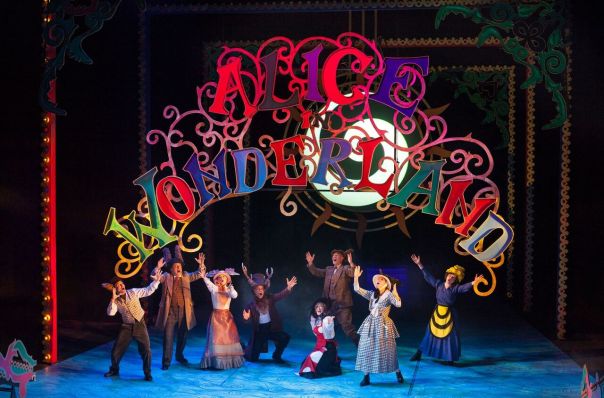
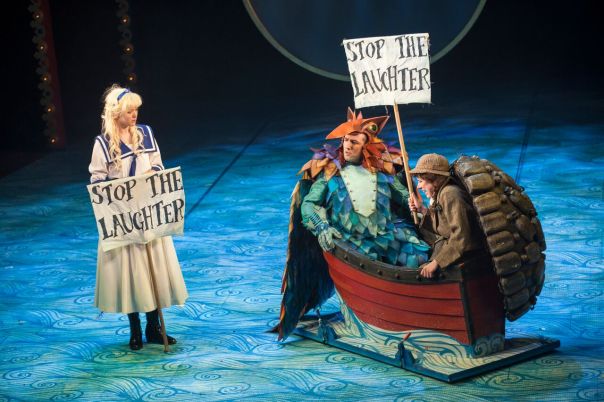
Whether frolicking with one’s family this season, or wanting to spoil yourself if the wee flutterlings are elsewhere, in absentia, the Lyceum’s Alice in Wonderland is a true jewel. This kafkaesque pantomime is a metaphorical glass of bubbly in the middle of the Christmas heave-a-thon, & Lewis Carroll would be like, ‘how the hell did they pull that off,‘ by which I mean the stagecraft conjured by director Anthony Neilson & designer, Francis O’Connor, was quite marvelous, an all-immersive, slightly surreal, costume-clever journey worth the ticket alone.
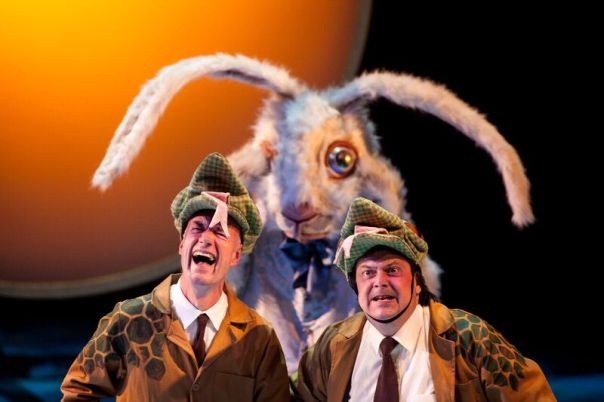
Performance-wise, all the cast are on top form – they all looked like they were having a ball. Jess Peet makes her debut with a stylish sincerity which belies her years, her commanding stances & mellifluous speeches carving an Alice to remember. Around her, in the multi-tasking ensemble, start-turns abound; Zoe Hunter’s Hookah-puffing Caterpillar & Tam Dean Burn’s Hatter among them. For me, Alan Francis’ Duchess was sublimely entertaining, & I found myself flashbacking to when I went to the pantomime as a child with my gran’s ‘works’ – pure unadulterated childhood joy in a man of 40 years. There was also music, the occasional short set-piece interlude interspersed through the action which worked perfectly.
I’d taken the wife, by the way, & the kids, & all four of us left the Lyceum in the finest of fine spirits. Our seven-year old had giggled through 30 percent of Alice & stared boggle-eyed in wonder at the rest. The wife, who likes the theatre but doesn’t adore it, told me in no uncertain terms that that she’d hardly spare a thought for a seeing a play a second time, but with Alice she would definitely go back. The story of course, is a simple one, & it is not for the story I expect – but what the Lyceum have done with it is wondrous.
Reviewer : Damo Bullen
On The Sidelines
Oran Mor, Glasgow
14-18 November
Play, Pie, Pint (1pm)
Script: Stagecraft: Performance:
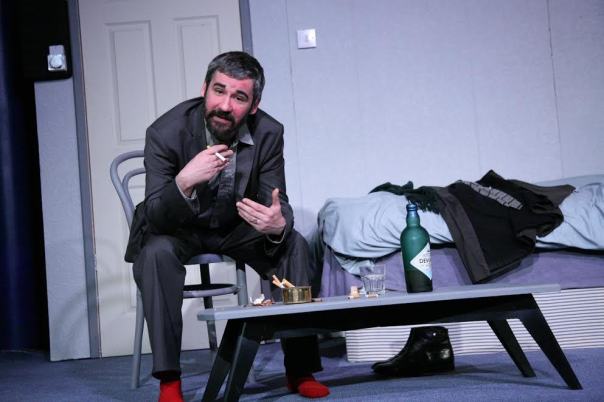
This peach of a play by the late great poet and writer Willie McIlvanney ( Laidlaw, The Papers of Tony Veitch and Walking Wounded )resonates all the more having been revamped since its first airing in 2004. Energetic and genuinely funny insights into the twists and turns of new divorcee John Mitchell,(Iain Robertson) will have you in stitches, this is Oran Mor’s magical theatrical hour at its shiniest best.
From the set to the lighting – not to mention the audience participation – and finally to the acting itself , this well scripted piece of west coast escapism does just what you want it to, it transports you out of your own head. John, romantic idealist who has nothing to show for his 16 marriage except some spellbindingly funny memories entertains us with words of wisdom as well as his upbeat approach to what can only be called dire circumstances , have you ever seen someone fill the kettle with the water from their hot water bottle?.And make you laugh watching him do it?

Optimist John guides the audience through the antics of his latest love life with patter that is as fresh now as was when penned over a decade ago. Such capers hit the spot because the raw Weegie underworld is never too far away for John, even in the midst of his suave dalliance with Sally who he believed to be ‘ the one.’ His amorous toyings with the lovely Sally end differently than he imagined but there is no doubt that he won the heart of the audience even if he doesn’t manage to find the woman of his dreams.
Excellently directed by Gillies Mackinnon (Small Faces)invited by Robertson who played thirteen year old Lexi in his semi-biographical feature film twenty two years ago to direct McIlvanney’s one man performance. What more could you want? Don’t miss this chance to see this riveting play by the father of Tartan Noir who wrote 1985 movie The Big Man ( Liam Neeson, Billy Connolly) and won a Bafta for his screen adaptation “Dreaming”.
Reviewer : Clare Crines

The Rivals
The Citizens Theatre
Glasgow
November 2-19
Script: Stagecraft: Performance:

As the audience filled into the lavishly decorated stalls looking up to see balcony and high ceiling the massive stage was busy with props such as tables and chairs but also alternate clothing rails with what looks like fancy and expensive clothing. The acting began before the play in a way that let us in with a welcoming and relaxed feeling easing us into the heightened evening’s performance.
Dialogue began introducing three characters who were dressed in finery that was French in appearance, in a period where the story of ‘the Rivals’ was set, as rich as though you were there in France. In a sporadic way, or seemingly so, the stage comes to life as a space that was enticingly able to vary its character. First of the scenes suggest to us a drama of large proportions that the backdrop carried. We were invited to observe the stage as an interchangeable medium localised into French stylish fancies.
Classical dialogue ensued well where the characters dress would implicate their positions in society but also in the play. It did a dance between poetry, poetic meaning, and the clause of word of mouth to be acted upon. Self-reflection became a clear motive from about the third act on, as the musical nature of the players who moved in ways to enhance the visual spectacle, now undoubtedly unfolding into the story of love that takes many to understand, undoubtedly a motive for each and every conversation.

One can take two or three steps back during the action and dialogue that played with word, feeling and suggested themes of honour that were particularly bestowed upon the Captain Jack character; who was played well by a soft spoken Rhys Rusbatch an accomplished actor since his days at learning and with the Royal Shakespeare Company. The idea behind looking at characters in this way was no less than a brilliant ploy that moves faster and into better and better shapes we could only see in joy. There was also a very distinct comedic rhetoric that the audience really appreciated and is an inherent part of this style of theatre script.
The introduction of the character Lydia Languish played by experienced actress Lucy Briggs-Owen would have stolen the show from the very beginning if she had not been so taught, and had a semi innocent brashness moving from ecstasy to laying her comedic self upon the stage floor. The backdrop provided their separating function well, partly because of the sheer size of the stage, and because they moved the feelings of the scenes and thus coincided with the acting and dialogue. This was another display of experience and adherence to the idea that is the art of playmaking including a side splitting aw that serious acting can spring from.
Lively, active, poetically sincere; a mesh of characters that helped play the field that ultimately was all dedicated to the course of love between well matched couples. The play was served to a great extent by enhancement of everything that went into it, including a distinct emotional bond that had a wealth to it in the form of taking us along for the ride. In the jovial play of characters was the Welshman Bob Acres played by Lee Mengo who was a strong character though fraught with weakness and then actively participated in a great crescendo of the play where comedy tied together meaning for character and the unfolding discourse.
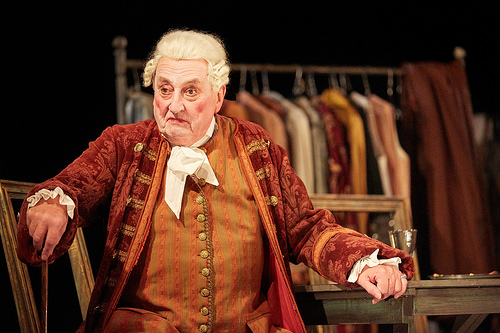
An element of persuasion does dominate the sense of scenes but it was never despaired upon in more reflective moments. On the theme of reflecting it was Sir Anthony Absolute’s character who offered sense to dialogues but he too developed a dodgy sense of humour as he guides the play into a sense of Captains Jacks honour as a man. Mrs Malaprop (the most comedic name), played by Julie Legrand had perhaps the largest role in her fancy costumes, she wore two dresses one red the other lilac. To call this play expert would I think be missing the point of an evening such as this. There was a touch of pantomime but it was only a hint of it because the play was more seriously governed as a play to contend with and in the quality behind it. Mrs Malaprop was the device behind the desire that Captain Jack and Lydia who languish should become together in love; a sentiment which she was not alone in. At certain times we could see her solitude, lending her a grace that we could also appreciate.
The most luxurious character had to be Lucy played by Lily Donovan who is a recent graduate from Bristol Old Vic Theatre School. In her we saw the drama of the evening unfold through her heartfelt reasoning and bargaining. We followed her around the stage as she grew in the hearts of us, telling no jokes but also living no lie but to heed the voice of her powerful character. This gave the theme of love a very level direction on the strengths of her alone.
Larger than life, characters, costumes, props, backdrops; this is a night that will hold your attention, marry you to the stage, love the characters, relish in the heady dialogue laugh out loud at the absurd treatment of some of the dialogue and general sense of the play. Be impressed at the sense of ease, excitement, sometimes enthralling atmosphere of word, language accent delivery, and genuine sense of love that is ultimately where every point turns to. Come along to the Citizens for an evening of entertainment that may enthral you.
Reviewer : Daniel Donnelly

 Mumble Theatre