Category Archives: Uncategorized
Pippin
Stanwix Theatre
Carlisle
3rd June
–
Script:  Stagecraft:
  Performance:
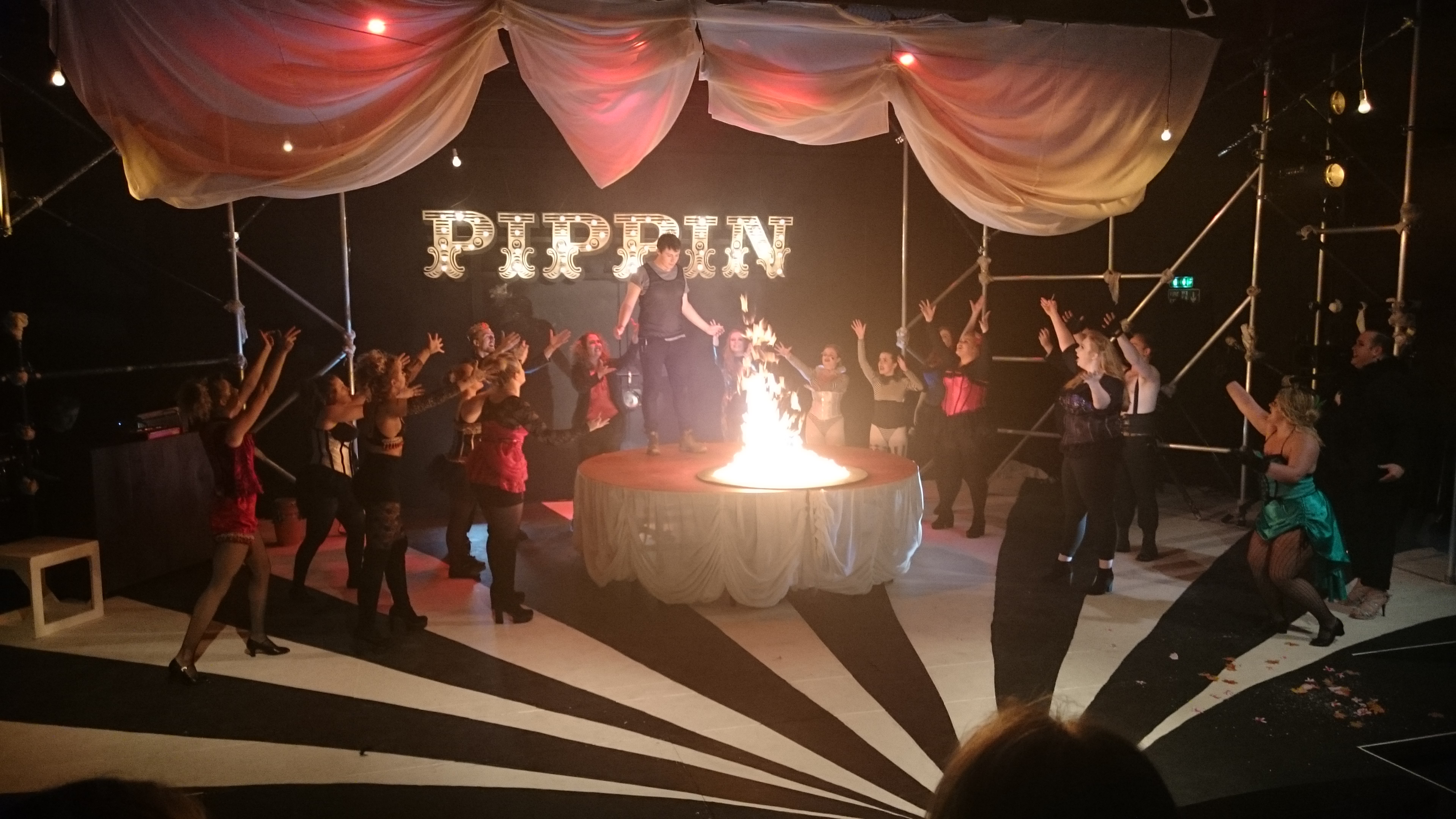
The yellow stage bulbs are low, the curtains are drawn, and the room is silent. Waiting in hushed darkness a spot light appears on the white draped curtain, and I am captivated by the silhouette of a tattooed woman seducing the audience with her erotic dancing. I hear the wonderful “Music to Do” echoing through the room but I am so intrigued by the mysterious figure behind the curtain that I fail to notice the Leading Player (Beth Simpson) make her physical presence known until she is standing centre stage. With long red hair and red lips adorning a tight purple corset and black leggings the rubenesque Leading Player introduces us to the rest of the troupe that will be entertaining the audience for the next few hours. Dressed in burlesque apparel the troupe immediately breaks the fourth wall shouting and leering at the audience “welcome!” in order to entice the audience to watch their magical show.
Pippin is a musical with an infectiously unforgettable score about the heir to the Frankish throne. Prince Pippin begins an existential journey as he has become unfulfilled with life as a prince and he believes there is more to life. Seeking “extraordinary” meaning and happiness in life through glories on the battlefield, temptations of the flesh and political power, the Leading Player allows us to join Pippin on his travels where Pippin finds contentment in the mundane when he meets Catherine (Megan Ryan) and Theo (William Teasdale).
The show begins with the wonderful Pippin played by Ciaran Keddy as he enthusiastically discusses the dreams and desires of a young man to capture his “Corner of the Sky” and to know his place in the world. It is during this scene that I am moved by the enchanting yet powerful vocals of Ciaran Keddy. His voice is akin to that of Idina Menzel. The quality pitch and tones of his voice left me stunned. Never had I heard such a voice that wasn’t already on Broadway and I was lost to his musical talent. With such raw artistic talent Keddy took the show to a new height.
However he did not do it alone. I was mesmerised by the towering Berthe played by the comic (Barrie Wilson) simply for mastering six inch, silver, sparkly, strappy stilettoes the entire evening. How he managed to elegantly sing and dance in stilettoes all evening demands an award; solely for his professionalism and commitment to the role of Berthe. Berthe (Pippins exiled grandmother) attempts to comfort Pippin after the spoils of war have left him despairing when he realises that there is no glory or victory to be gained in war. Berthe educates Pippin with her wisdom of years and persuades him to live in the now “No Time At All,” as life is precious and fleeting and it is the “simple things in life that count”.
Taking her advice, Pippin adventures further into his existential journey, as he explores the temptations of the flesh. With a choreographed erotic display of his womanising, orgies and threesomes, Pippin becomes embroiled into a fetish world of leather and men on leashes. Yet tasting all the carnal pleasures life has to offer Pippin is still unsatisfied with life. Despite enjoying many lustful liaisons he questions his desires – for what is carnal pleasure without love? It is here that Pippin recognises that relationships without love leave you “empty and unfulfilled.”

After a brief and unsuccessful political career after he murders his father Charles played by the talented Chris Honey the weary Pippin collapses when he is rescued by a widow (Megan Ryan). By beseeching Pippin to help her tend her large estate by completing mundane working tasks, she nurtures his wounded soul back to health and the two eventually fall in love; and Pippin begins to appreciate the joys the little things bring him. However when Catherine asks Pippin to take the seat as the head of the household Pippin retracts his affections dismissing their love as “not-extraordinary” and returns back to his castle breaking the sweet Catherine’s heart.
It is here that we are introduced to the wonderful finale, complete with pyrotechnics, singing, and busty burlesque actors dressed eloquently over railings, the troupe sing and entice Pippin to complete his final performance with the troupe. His last extraordinary act. However Pippin comes to realise that happiness does not lie in “extraordinary endeavours, but rather in the un-extraordinary moments that happen every day.” And he returns to his beloved Catherine.
Generally the performances were solid and convincing, the costumes and dance routines made the evening delightfully entertaining. The set was used to its maximum potential with the troupe often dressed over the scaffolding and always in view. The music was played flawlessly and the entire production was youthful and full of energy. Living in an age where thin is “in” and body shaming is an everyday occurrence it was wonderful to be introduced to a cast of many shapes and sizes both male and female dressed provocatively. Did this have a negative effect? Not at all. The crowd cheered, jeered, and laughed with the troupe and Pippin and the crowd left with smiles and words of congratulations upon their lips.
Such a wonderful performance left me both melancholy and exhilarated. As watching the show forced me to reminisce over my own life dreams and disappointments whilst leaving me naively optimistic that there is hope, and that perhaps I too will find my “Corner of the Sky.”
Reviewer : Katrina Hewgill
The Little White Town of Never Weary
Falkirk Town Hall
June 2nd
Children’s dreams and colour schemes / Stop little town from falling down
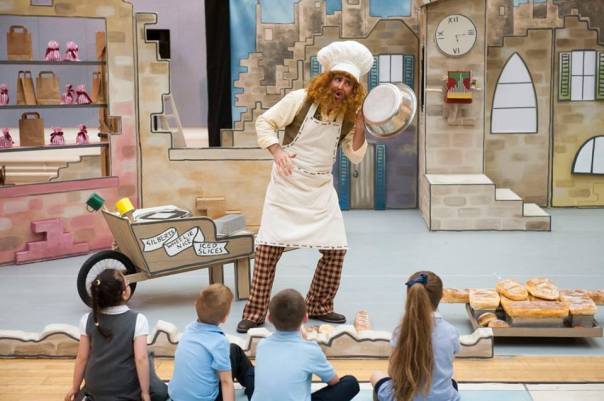
It’s 5pm in The Little White Town of Never Weary, a quiet as a mouse neighbourhood close to the far from bustling Boreland. Sweetie Megs and The Blue Swan are falling into disrepair. And the steeple, like the town, is decrepit, degraded and decayed after years of neglect, a lack of visitors and thunderous vibrations from the big, scary bell tower which dominates the square and for the last hundred years has chimed on the hour, every hour, and in so doing brought masonry and morale crashing to the ground.
“Can a cat, can a cat, cat a cat, can a cat not get a catnip around here,” miaows a ginger tabby who is awoken from his slumber by Jessie, a young girl with golden hair and twinkling eyes who is “never lonely when drawing”. Today’s dreams and colour schemes being a white swan on a blue lake, which she shares with her newfound friends of primary school children who surround her on a colourful floor cloth and are held spellbound by her soprano voice: “My name is Jessie. I like to make things. Anything is possible.”
One of the central themes of this delightful show for 5 to 8 year olds by Scottish Opera – directed by Julie Brown, with music and words from Karen MacIver and Martin Travers respectively – which is based on the illustrated novel by The Glasgow Girls artist Jessie M. King and will be touring schools and theatres throughout Scotland until 11 June as part of Festival of Architecture 2016. The other themes being “patience and imagination” and “friendship and determination”, as voiced by a melodious paper fortune teller.
With a sprinkling of audience participation, sophisticated wordplay which can best be described as McSondheim and a host of colourful characters such as Transylvanian schoolteacher Dame Lucky, a sweet-toothed granny “with a face like a winter’s apple” and Gilbert the Baker who is more doh! than dough, the four-strong cast led by a sweet-voiced Charlotte Hoather and supported by actor-musicians Stuart Semple, John Kielty and Frances Thorburn, return the tired town back to its technicolour glory by encouraging the children to not hide in their hair and be dull and messy, but pluck up the courage to create just like Jessie!

Script: Stagecraft: Performance:
Del Gesu’s Viola
A Play A Pie And A Pint
Oran Mor
Glasgow
May 30th – June 4th
This play, written by Scottish veteran playwright and adaptor Hector MacMillan, (The Sash, Moliere’s The Misanthrope are two of his notable successes) and directed by Liz Carruthers, is the last in the spring season of A Play A Pie And A Pint.
The setting is a precognition hearing at a Procurator Fiscal’s office and opens with Elizabeth Flett paying a beautiful piece on viola. The Fiscal (Eileen Nicholas) is hearing the testimony of a plaintiff (Finlay Welsh) and the accused (Peter Kelly). At issue is a viola which the plaintiff has bought from the accused for £1,900 under the impression that it may very well be a priceless instrument crafted by Bartolemeo Giussepe Guarneri ( known as Del Gesu) of Cremona, Italy, in the 18th Century. The fact is that Del Gesu was never known to have ever made a viola, only violins, although, confusingly, this particular instrument is the size of a conventional violin. Guarneri’s violins sell for astronomical sums and are regarded by some as superior to the better known Stradivari.
Both the accused and his naturalised (and now deceased) Italian father have made violins as a hobby and the instruments, though not really worth much are well regarded for their beautiful sound.
The plaintiff, a trader in old and valuable instrument’s wants the price he paid reduced because he thinks he has been hoodwinked by the accused, even though he was quite happy to pay a pittance for what he believed to be a possibly priceless viola.
The Fiscal has the tricky job of deciding whether a prosecution should go ahead.
 Hector MacMillan’s underlying issue in this piece was greed and why should the rich have possession of the best instruments, while perfectly good modern examples are relatively worthless? Many of the greatest instruments languish unplayed in safety deposit boxes and collections, steadily increasing in value as investment opportunities.
Although well acted, the basis of this piece was perhaps slightly insubstantial for those not really interested in the subject matter and without being too much of a pun, was very much a chamber piece with some moderately funny and thought- provoking twists. The beautiful sounding viola/violin in the play was, in fact, made by the playwright himself.
Reviewer : Dave Ivens
Script: Stagecraft: Performance:
Thon Man Moliere
The Lyceum
Edinburgh
20th May – 11th June
Script: Stagecraft: Performance:
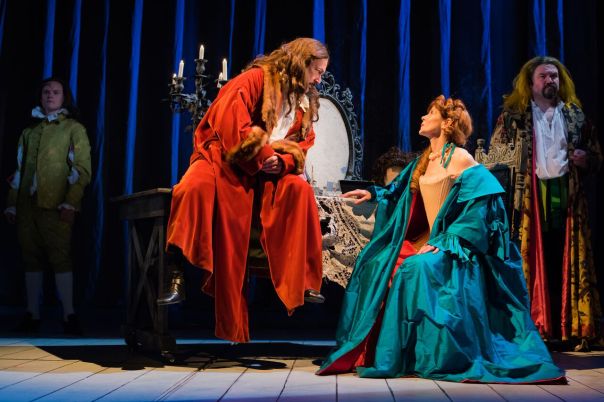
In his parting words to the public as Artistic Director of the Lyceum in Edinburgh, Mark Thomson says, with a serious sense of self-satisfaction – after commissioning & seeing to fruition a play on the 17th century comic playwright, Moliere, by Scottish Makar, Liz Lochhead – that the result was, ‘something horribly, wittily, human.’ But its more than that. It is pastiche brought to perfection, a traditional model infused with fresh insights & ideas. It is history remembered & resurrected &, of course, refined.

Liz Lochhead
This is not Lochhead’s only flirtation with Moliere. Her first effort broke her into the Caledonian consciousness after she translated and adapted his masterwork Tartuffe in 1985: premiering at the Lyceum in ’87. The translation was into choicest broad Scots, & followed in a long line of Scots translations of Moliere, such as Hector MacMillan’s ‘The Hypochondriack’ (from Le Malade Imaginaire) & Robert Kemp’s ‘The Laird o Grippy’ (from The Miser). There is something about Moliere & the Scottish psyche that just, well, fits. In a 1790 letter from Ellisland, Rabbie Burns, while requesting certain books to be sent to him, invites, ‘a good copy, too, in French, of Moliere I much want. Any other dramatic authors in that language I want also.’ With these two bedfellows – Scottish writers & Moliere – must be added the Scots language, creating a menage a trois that stimulates all our affections, whether writer, player, or audience. Of Lochhead’s contribution to the gryphon, Thon Man Moliere‘s leading lady, Siobhan Redmond, gleefully recognizes that Lochhead’s Scots, ‘sounds like real life only better…. with a much faster beating heart, singing on a higher note.‘
Thon Man Moliere is a pseudo-biography of the man & his, what Lochead told the Mumble, ‘harlequin-chequered life of ironies, ups & downs, successes & failures, of Paris & the provinces, of plaudits & penury, of patronage lavished & patronage brutally & arbitarily withdrawn.’ Her leading man, Jimmy Chisholm added, ‘Thon Man Moliere isn’t a history play, its about these completely made-up characters out of some facts of Molier’s life… its not just a knock about Moliere comedy its not like that at all, its about the life & the stresses & the darkness & the things that surrounded that man & that company while they were trying to produce very, very funny pieces of theatre.’

Moliere
The story revolves around the sexual dynamics between Moliere (Chisholm), his leading actress & company-boss Madeleine Bejart & her 16 year-old daughter Menou (Sarah Miele), who may-or-might-not-have-been Moliere’s. This causes some dramatic tension, especially when Moliere & Miele get in on & have a couple of bairns themselves. Chisholm & Redmond work wonderfully well together, a sign of a lifetime friendship that has finally burst with some magic onto the stage. Redmond plays a fantastic Madeleine, & it seems that Lochhead had her in mind when writing Thon Man, telling the Mumble, ‘She’s a close friend, she’s like family & I wrote this play hoping but not thinking she would play Madelaine in it.‘ Just as in real life, Redmond’s class on the stage is reflected by Madeleine, & the part could well be a career-defining moment for Redmond, for she is brilliant in a brilliant play.
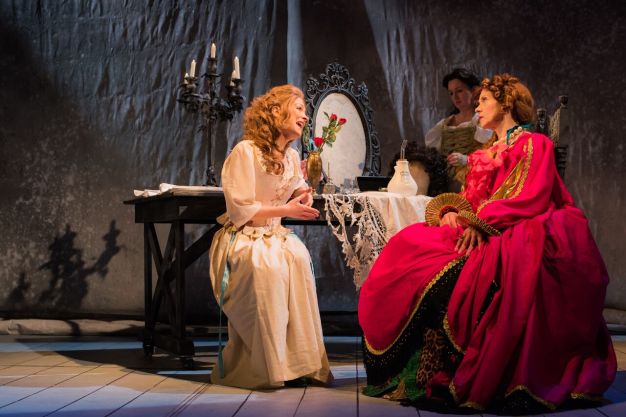
Nicola Roy as There Du Parc, in conversation with Madeleine Bejart (Siobhan Redmond)
Watching Thon Mon is a rare treat, a totally immersive experience which wings one’s thought-doves back to 17th century France with the loftiest ease. With Racine dipping into the plot from time to time, alongside some rather ‘excuisite alexandrians,‘ amidst an elegant set the colourful costumes leap from a monochrome stage – this is tragicomedy after all. Indeed, I loved Lochhead’s terse descriptions of tragedy – ‘any eegit can write that sublime shite’ – & comedy ‘everything is a mess / it gets worse / it all gets sorted out / there’s a happy ending.‘ These words are symptomatic of the delineating predilection of modern poets writing for other poets – in this incarnation Lochhead is, at times, a playwright writing for other playwrights. Luckily there is enough rough & ready realism & colloquial cocksurity to please all who are to be entertained.

Sarah Miele
Thon Man Moliere is not just about the playwrights, but about his illustrious company too – all of whom are interestingly deep characters in their own right, who interact with each other electrically, most of whom end up in bed with each other at some point. I enjoyed them all, especially the scenes when they were rehearsing a play – brilliant flies on walls on walls kinda thing. Steven McCicoll’s Gros-Rene du Parc was a classic larger-than-life lovey-darling, while Lochhead’s inextinguishable Feminism swarms out of the mouth of Du Parc’s wife, Therese, played by Nicola Ropy. Molly Innes, as Toinette the maid, keeps everything together , I always welcomed to the stage, while James Anthony Pearson as Michael Baron delivered the best lines, when he described his double-jointed magical music-box debut for King Louis XIV, bubbles of phantasie delivered with addictively watchable precision. Of them all, Sarah Miele was simply divine. Winner of this year’s Bafta Scotland New Talent Award, while all other characters came to us fully evolved, with hardly a change in temperament, Miele’s Menou blossomed from an innocent rose-sketching lassie, to a twice pregnant, penis-drawing actress of some quality. Miele steered this arc like the captain of a 17th century sloop traversing the Cape of Good Hope.
As I watched Thon Man Moliere, I was sensing I was watching a classic. Alright, it is a regurgitation, but it is also a rejuvenation & one that is immensely entertaining. Listening to Lochhead’s lingua franca is like being down a pub in Cumbernauld just before the beers kick in – that hour or two when everyone in the pub is funny & hilarious & full of wit. High-brow but low-dealt – its perfectly pitched & I reckon Moliere himself would be more than proud.
Reviewer : Damo Bullen

The Polar Bears Go Up
Falkirk Town Hall
20 May 2016
***

Script: Stagecraft: Performance:
Inquisitive bears travel near and far
To reclaim fast ascending golden star
Framed within a proscenium arch of green and blue rectangular boxes which tower over a black floor-cloth laced with orange and pink lines to suggest a map, a journey, an awfully big adventure, a polar bears’ picnic of cornflakes on toast watered down with an endless supply of tap water is rudely interrupted by the ringing of a doorbell and the unexpected delivery of a big brown cardboard box which contains … Is it a bird, is it a plane? No, it’s a golden star on which to hang your dreams on.
 The Polar Bears Go Up, a co-production between Unicorn Theatre and Fish and Game, and sequel to the latter’s highly successful co-production of The Polar Bears Go Wild with Macrobert Arts Centre, tells the story of two playful Tornassuks (the name Greenlanders use to describe polar bears, meaning “the master of helping spirits”) who out yawn and out sniff, out reach and out jump, out fly and out trampoline one another in their combined but competitive efforts to reclaim the golden star which has escaped their grip and lodged itself in a cotton wool cloud.
Using the minimum of props and maximum of creativity, the two creators and performers (Fish and Game co-founder Eilidh MacAskill and her ever-smiling collaborator Fiona Manson) are a sort of inverse Vladimir and Estragon in that rather than stay put and talk about going, they are forever on the move and bar a few sniffs and belches never utter a peep. Though their personalities and relationship are very similar to their Waiting For Godot counterparts in that slapstick and petty quarrelling is the order of the day. And Eilidh, being the taller of the two by a good twelve inches plus VAT, is curmudgeonly and direct, though never cruel; whereas teensy-weensy Fiona is warm-hearted and amiable, if a tad mischievous.
 Despite the absence of words, the target audience of two to five year olds and their accompanying parents were captivated from beginning to end because the characters were likeable, the performers engaging, the show jam-packed with Laurel and Hardy visual gags, moments of surprise and suspense, and there were ample opportunities for the children (both young and at heart) to join in both physically and vocally. None more so than at the end when, after the well-deserved curtain call, a second doorbell rang and – without giving too much of the plot away – the audience had a ball!
Reviewer : Peter Callaghan

Role Shift
A Play A Pie And A Pint
Oran Mor
Glasgow
May 16th -21st
Script: Stagecraft: Performance:
Yet another entertaining and absorbing fifty minutes of drama from Oran Mor’s A Play A Pie And A Pint. This week’s offering is so original and works on such a number of levels that it’s difficult to describe- but here goes…..
A co-production with Glasgow’s Bird Of Paradise Theatre Company, which promotes the work of disabled artists, Role Shift was by turns, a hilarious rollicking comedy, a comment on sexual mores and how the world views the disabled. Into the bargain it also warns “never trust the translator.”
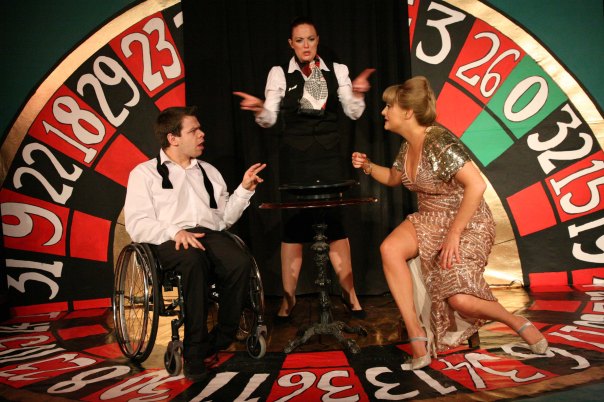
 Mainly written throughout in rhyming verse, the action is set in the casino of a cruise ship and the three characters couldn’t be more contrasting. Ally, played by Robert Softley Gale (in real life too) is a disabled man in a wheelchair, Bernie, played by Louise McCarthy, is a big, blowsy woman, dressed up in a revealing glittery gown and Carrie, played by Natalie MacDonald and the cause of all the later trouble, is an interpreter for the deaf who signs the action throughout. A screen on either side of the stage also reproduces the dialogue as spoken.
From the outset Carrie makes it plain that she is fed up with “role shift” where she faithfully reproduces signing for the deaf on behalf of the two other characters and wants to become more a part of the action herself.
Bernie and Ally are both on the lookout for rich, handsome men at the roulette table and vying to snare a juicy catch. As the action hots up and more drink is taken Bernie and Ally discover they are attracted to each other but Carries intervention causes a calamity. It would spoil the plot to give away what takes place but the outcome is brilliantly played by all three and the plays’ title takes on a double meaning.
The actors had to pause several times during the performance to let the audience’s laughter subside, such was the comic delivery of a cracking script, This piece is both funny and thought provoking and definitely ends on a high. Written by Lesley Hart and directed by Garry Robson, Role Shift earned the players a rousing and well earned extra curtain call, most unusual at Oran Mor. Be there or be square.
Reviewer : Dave Ivens
The Love I Feel Is Red
Oran Mor
Glasgow
9-14 May
—————–
 Mona (Janet Etuk) is a late 20s mentally strong athlete who dislikes her tragically departed boyfriend Ty’s mother Susan (Heather William) and has a personality to be proud of, saying what she thinks no matter what. Writer Sabrina Mahfouz explores abortion, miscarriage, a woman’s right to choose her path and the subsequent raw emotion experienced as a result of these decisions.
Descriptions are graphic, shocking but very real. I found myself feeling for Susan who is performed with such poignant believability as a mother who has lost her son and, ‘ grandson, I know its’s a boy ’ within weeks of each other.
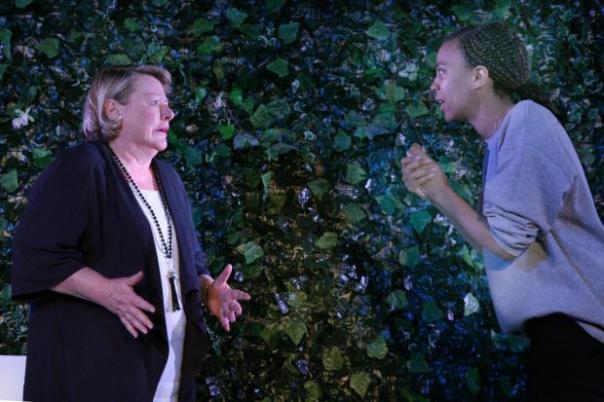
Is it her grandson or is it as Mona believes just, ‘cells ’ ? Deep, dark issues described so brilliantly by Mona in rapper type dialogue that firmly contemporises a topic that has been raging for centuries – whether medieval toxic herbs or two bitter pills – women still don’t get it easy if they chose to terminate a pregnancy.Although I ( and likely many sitting in the audience) could’ve done without the the graphic descriptions, knowing all too well what a miscarriage does emotionally and physically to a woman’s mind and body, there are many who don’t and this play is educational in that respect and therefor important.
There are no winners in this woeful play. Susan is left bereft as a woman who gave up so much of her own glowing career for her child, now gone. Mona, has to move on without her boyfriend, just her memories both good and bad and an instinctive will to not just survive but to thrive which we know in time she will. Directed by Nel Crouch and produced in association with Tobacco Factory Theatre this is worth seeing because the script and acting couldn’t be better in such a harrowing set of circumstances.
Reviewer : Clare Crines
—
Script: Stagecraft: Performance:
Second Hand
APlay A Pie And A Pint
Oran Mor
Glasgow
May 2nd-7th
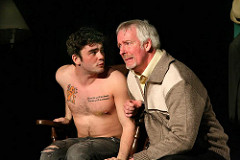
Ageing 71 year old Jim is about to open his dingy, down-at-heel antiques shop when there is a giant crash upstairs. It transpires that young Ash, kicked out by both his mum and aunt, has crawled along the tenement loft spaces from his aunts house and has been kipping above Jim’s flat over the shop. Going for a pee in the darkness he’s come straight through the ceiling, literally crashing in to widower Jim’s life.
This play by Paul Charlton, co-writer and co-star of BBC2’s The Ginge, The Geordie And The Geek and Directed by Mark Saunders is a wee gem of a piece with some great acting from Finlay McLean as Jim, Cameron Cunningham as young homeless idealist Ash and Elaine McKenzie Ellis as home visitor Alison.
Initially, thinking Ash is a thief, Jim holds him at bay with a putter but it soon becomes apparent that Ash has landed up homeless and destitute after having a run-in with the police at a rally for the low-paid.
 Alison, originally a carer with Glasgow City Council but now an employee of Cordia has been looking after Jim on a daily basis, much to his disgust, at the behest of his daughter who now lives in Australia.
The play started a bit tentatively but the actors soon got in to their stride and the piece never flagged, with some great comic and pithy exchanges, particularly between Jim and Ash.
By the conclusion we find that both young an old have something to learn from each other and that life just isn’t fair sometimes.
The play is touching, funny and poignant and an allegory for many aspects of modern life. Go and see it.
Reviewer : Dave Ivens
Script: Stagecraft: Performance:
The Iliad
Lyceum
Edinburgh
20 April – 14th May
Script: Stagecraft: Performance:
There is an expression in English known as ‘Coming Full Circle,’ & it was while I was watching Mark Thomson’s final production for the Lyceum, The Iliad, that I really felt the truth in that wee phrase. Western civilisation begins with Homer, but there is a problem; who he was & if or how he created his two great epic poems – the Iliad & the Odyssey – remains mysterious, given the weight of millennia since they first appeared on the planet. Like any self-serving student of the theatre, I’ve had a poke into the ‘Homeric Question’ myself, & came to a private conclusion that text of the Iliad is nothing but a script of an ancient play, probably presented at the first Olympiad by the Spartan demagogue, Lycurgas. Scholars have noticed that the Iliad is about two thirds dialogue, while the other third could easily be worded by a narrator to the side of the stage. As I sat in my comfy, modern seat at the Lyceum, my theories as to the matter were given the most stocial support, for as the drama of the Iliad unfold before me, I felt it come alive once more, as if it had found its natural home in the footsteps & throat-beams of actors.
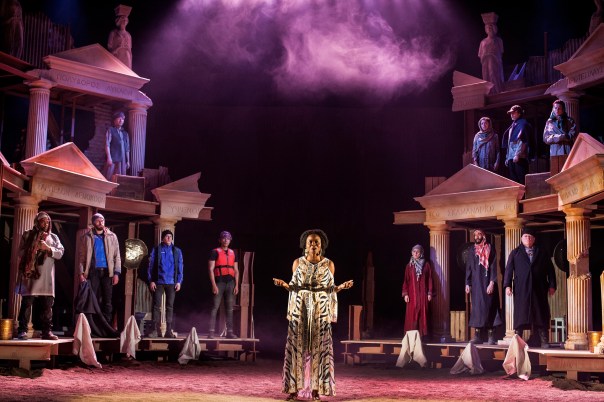
Adapted, or rather readapted, for the stage by Chris Hannan, the set was rather like that of the Handelian opera; two identical, double-floored Greek Templesque affairs facing each other over a dusty beach. This dust, by the way, would rise into the air & drift into the audience following the niftily choreographized blood-splattering battle-scenes, whose brutal thumping sword-on-shield moments were one of this play’s prime assets. All praise to Fight Director, Raymond Short, for this is an impeccable job, fella.

Hannan’s Iliad has been modernized, & obviously shortened, but it works, it works magnificently. Punctuated with funny puns & the occasional brusque brush with sexiness, Hannan has done a fantastic job of compression &, dare I say, digression, for he draws upon traditional Trojan motifs held outwith the Iliad & peppers them into the script, so the modern anticlassicist can follow the tune. Of Hannan’s effort, Mark Thomson tells us; ‘Chris’s version of the Iliad has a great deal of what inspires me in theatre: a big human story, language that is rich, poetic & deliciously speakable with themes that are timeless but resonate powerfully I the ears of a contemporary audience.‘
The plot of the Iliad centres around Achilles, & his ‘wrath.’ Falling out with pig-headed Agamemnon at the start of the play – played here by Lyceum stalwart Ron Donachie – he sulks in his tent while his best friend Patrocolus dons his personal armour & ends up being slain by the Trojan hero, Hector. This gets Achilles right on one & you can guess the consequences. In this production, Ben Turner’s Achilles is a wonder, what a guy. You can really tell that he’d had stint on the set of ‘300: Rise of an Empire’ : he knows all the moves & tonal inflections.
Elsewhere, Richard Conlon’s Zeus is cool, like an east-end gangsta living it large on on the Costa Del Sol. His, & I quote, ‘bad-tempered bitch of a wife,’ is Emmanuella Cole’s ciggy-smoking Hera, & she is undoubtedly the star of the show. Emanating authenticity & addictive to watch, her quality unfortunately puts into perspective some of the weaker actors/actresses. I mean, I don’t know if Peter Bary’s Paris was meant to come across like a soppy wet blanket for dramatic effect or not, but he definitely lacked balls. This, then, had a knock on effect to the chemistry between him & Helen – ‘the gorgeous scourge of mankind’ – played by Amiera Darwish. We were supposed to be watching one of the great romances of history – Napoleon & Josephine, Tristan & Iseult – but the chemistry they generated was more like Terry & June.
As for the stagecraft, I can’t really knock it. The splendid costumes were accompanied by the equally slendidly sung choruses in Greek which separated the scenes, bellowed beautifully by the entire cast. Indeed, towards the end of this really refreshingly fizzy production of the Iliad, I began to imagine the Corybantes singing & dancing before me, & the passage of three thousand years dissipating into mist.
Shafted
 Stagecraft: Performance:
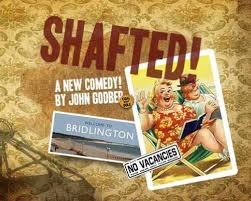
 From coal miner to window cleaner to banana counter to gnome painter, Harry and his wife Dot (played by real-life couple John Godber and Jane Thornton) have seen it, done it and worn the I Hate Margaret Thatcher, The Milk Snatcher t-shirt. As the title suggests, the play is inspired by the miners’ strike of 1984-85. But unlike popular films such as Billy Elliot, Brassed Off and more recently Pride which were set predominantly during the height of the troubles, Shafted, though using the immediate aftermath of what the BBC described as “the most bitter industrial dispute in British history” as its starting point, is more concerned with the long-term effects of Conservative anti-trade union and privatisation policies as Harry and Dot struggle to make ends meet over the following not one, not two, but three decades and like “two spent swimmers, that do cling together / And choke their art” almost go under.
—
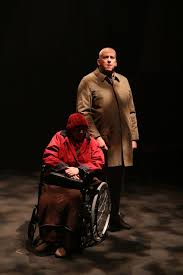 Almost, but not quite. Because despite facing financial hardship, physical illness, relationship problems, the curse of the black dog and the usual “slings and arrows of outrageous fortune” which accompany family life, what they possess is something which no politician or business person can buy or break – spirit! A spirit to endure, a spirit to fight, a spirit to stick together through thick and thin and a spirit to spit in the face of their enemies and laugh in the face of adversity. And laugh they do, as does the audience, from one dry one-liner to another as hapless Harry and doting Dot trade insults and sweet-nothings during a series of snappy duologues and confessional monologues which span the best part of two hours. A spirit which builds up to and is epitomised by Harry’s rallying war cry at the end of the play: “C’mon! We’ll take them all on!
—
There’s not much in the way of set and the play’s all the better for it, relying instead on the quality of the writing and the talent of the performers to hold the attention and provoke titters and thought – a few miners’ banners suspended from the ceiling; a green garden gate to denote the division between us and them, private space and public face; and a small crop of flowers at either side of the stage which are living proof that even in the harshest of climates there is always the possibility that green shoots of personal if not economic recovery can break through the hard earth and blossom. And the soundtrack, like the humour, is a blast of eighties disco to noughties pop which charts Harry and his ever-faithful wife Dot as they upsticks from Upton to Bridlington where they start afresh as B&B owners who sip Cava by the sea.
—
But what really hits home are the devastating and long-term effects of Thatcher’s brand of all-for-one and one-for-oneself Conservatism as famously set out in her 1997 interview for Woman’s Own: “there is no such thing as society”. There is. And if the gap between the richest and the poorest continues to widen, and the rhetoric of “workers” versus “shirkers” continues to pass as parliamentary discourse, and the worrying trend of low-paid and low-skill jobs and short-term and zero-hour contracts continues to become the norm, and the obscene practice of corrupt politicians lining their pockets with enough bungs and parliamentary expenses to clean a moat and morally bankrupt billionaires mooring their yachts in whichever tax haven will harbour their illicit financial flows continues to be swept under the luxury carpets of Whitehall and the City, then in the words of the Kaiser Chiefs: I predict a riot!
—
Reviewer : Peter Callaghan
 Mumble Theatre