Category Archives: Uncategorized
Hamlet
Royal Conservatoire Scotland
Glasgow
15th March – 18th March
Script:  Stagecraft: Performance:

A good sized stage and various accoutrements such as hanging frames, a desk, a comfy chair and more. Lights dimmed and an actor stood at the stage right. Eerie music was coupled with very little light which set the scene. Lighting designer Simon Hayes helped to create a grey serious place for the play to commence.
Hamlet (Samantha McLaughlin) was dressed in 19th century clothing as were all the costumes. Hamlet’s official status as lord and prince was highlighted when two soldiers in period uniform recalled a ghastly scene with him about war.
Music and light were used to create minute changes with subtle chiaroscuro reflecting the mood. Lofty, American accented Polonius, (Chris Ginesi) had great stage presence throughout. Such a pivotal character managed to convey solitude as he set about his various duties. His touching relationship with Hamlet provided the milk of human kindness that was much needed amidst such treachery. Victorian military and royal costumes replaced the much worn out tights of Shakespeare’s era
Every detail was carefully crafted by the creative team; Gertrude’s character, the Queen of Denmark (Lisa VillaMil) was larger than life in her fluid red dress. King Claudius’s care and consideration for her was evidenced in his choice of vessel silverware when pouring her a drink. Hamlet draws us into his emotions and then kicks us back out.
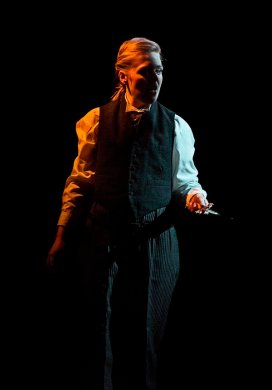 Scenes flew by without unnecessary costumes changes. Drawn in by poetry and philosophy, dialogue switched from public speaking to intimate and damning conversation. Bright colour touches on the actors costumes enhanced the visual atmosphere amid a plethora of grey and white. Ophelia’s immaculate white dress struck a chord complimenting the luxuriant red dress of Gertrude.
Through many speeches the plot revealed some great scenes of theosophical outcries from Hamlet as he mourns his father’s premature passing. Delving into scenes of his solitude and darkness that Hamlet saw clearly sharpened his wit and brought irony to his sense of humor. Hamlet’s conversations in the play helped him work through his grief addressing both actor and audience. He becomes more surer of the course he must take to appease himself of the death of his father Claudius.
Hamlet’s anger and determination is a clear theme for director by Gordon Barr’s who takes the story of Hamlet more and more into his own hands in a steady development. Ophelia and Hamlets clarifying conversation on the impossibility of their love is a prequel to leading to her tragic demise. This and Hamlets prophetic nightmares send Hamlet over the edge.
Fight director Marc Silberschatz turned this old story into a Tarantinoesque contemporary drama. I’m glad I saw this exciting play.
Reviewer: Daniel Donnelly

Billy (The Days of Howling)
Oran Mor
Glasgow
Play, Pie, Pint
14-18 March
Script:  Stagecraft: Performance:

 This a strange play. Disconnected, waffling – it is as if we are led in bed with our three actors after they had drank far too much caffeine after ten o clock. They cant get to sleep & they are just thinking aloud – thinking & speaking aloud. None of this is in harmony, however, until the end that is, when finally the three separate soliloqueal strands fuse together in a sweary & shouty finale. Is this the Howl, one asks, or it more the voice crying into the hurricane, when Ginsbergdeclaimed, ‘I saw the best minds of my generation destroyed by madness, starving hysterical naked.’
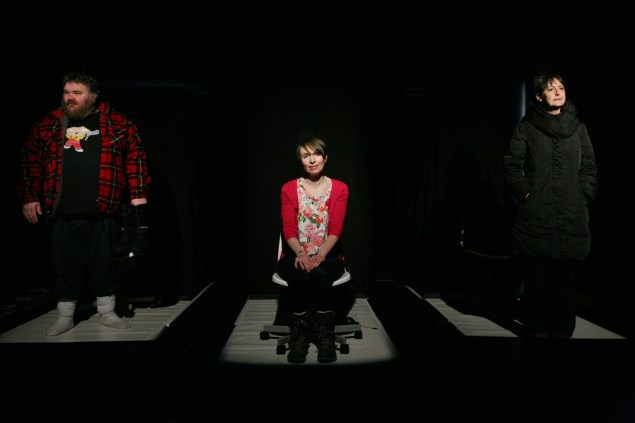
Billy’s main theme is the chaos that ensues after an adult makes the wrong step in the minefield that is kindergarten playground. In this case, Alice’s mum notices Billy eating & Cheeto — & the rest is history (or for me rather, it should have been left in the historical records.) I wasn’t convinced by this piece at all, although the hour was definitely saved by the spirited acting of Hoary Lyon (admin lady), Rosalind Sydney (Alice’s mum) & the big-boned & bubbly Anthony Strachan (Billy’s dad). Perhaps that is down to translation, not perhaps of the language so much, but more the format conjured by French playwright, Fabien Cloutier.
Before I entered the Oran Mor was in a pretty good mood, but left having something of a personal existential crisis. Perhaps that was the point, I’m not sure, or maybe I am….
Reviewer : Damo Bullen

Get Carter
Citizens Theatre
Glasgow
£12.50-£25

Script:  Stagecraft: Performance:
A dramatic cacophony of bricks designed by 59 productions sets the stage… a dark sinister atmosphere, smoke swirling in the low artificial lighting. A drummer/ ghost brother on the far side.
We are at the brick pit where the protagonist Jack Carter (Kevin Wathen) had spent his childhood playing hide and seek with his now murdered brother Frank (Martin Douglas) and Frank’s childhood shotgun. So now he is back from swinging sixties London and seeking retribution.
This gritty production uses the same recording techniques as would have been used by Roy Budd who famously composed Get Carter’s soundtrack at the age of 23. This new arrangement of songs by iconic sixties Tyneside band The Animals was a collaboration between vocalist Nadine Shah, Ben Hillier and sound designer James Frewer. James explains, ‘Having a live drummer on stage drives the action; it’s very much the mechanics of the piece….as well as dark rhythmic progressions.’
The plot differs in many respects from the 1971 Michael Cain movie. Torben Betts was given ‘freedom’ to interpret Ted Lewis’ book Jack’s Return Home which Get Carter is based on.
Jack attends Frank’s funeral and meets Doreen, (Amy Cameron- Coronation Street,Casualty) his niece; he later implies that Doreen might actually be his daughter.
Victoria Elliott (Holby City,Truckers) puts in the best performance in her double role as Margaret (Frank’s evasive mistress) and buxom Glenda. Jack accuses Glenda of working for crime boss Cyril Kinnear (Michael Hodgson- The One and Only ) and Kinnear’s rival dodgy amusement arcade machine entrepreneur Cliff Brumby (Donald McBride – George Gently,Vera).
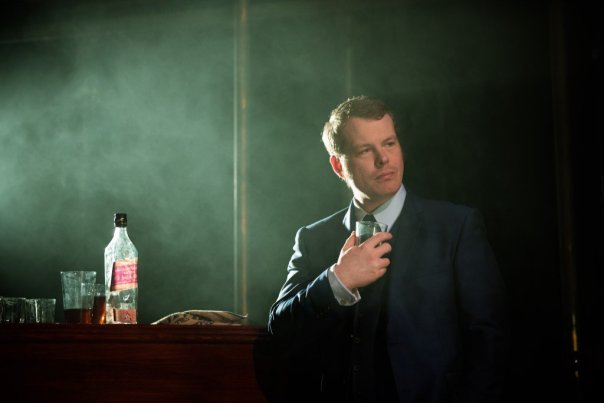
Jack encounters old gangster associate, Eric Paice (Benjamin Cawley- Shetland, Dr.Who, Doctors), who refuses to tell who is employing him as a chauffeur but Jack soon discovers he works for crime boss Cyril Kinnear. Confronting Kinnear who is playing poker seems like a dead end but he meets Glenda there. On a phone call to his boss Gerald Fletcher(Ed Gaughan) Jack is warned against damaging relations between Kinnear and the Fletchers. Back in town, Doreen gives Jack a train ticket to leave …
Enquiring who gave this to Doreen he is given the name “Brumby”. At 2.30 the following morning Jack discovers Brumby knows nothing about him and, believing he has been set up, leaves Brumby’s home. Later, with Glenda in the brick pit, Brumby identifies Kinnear as being behind Frank’s death and accuses Kinnear of trying to take over his business. He offers Jack £5,000 to kill the crime boss, which he flatly refuses and then pushes Brumby off the edge to his death. Next Jack is shown the porn movie of his niece Doreen with Albert and Glenda but Jack doesn’t knife Albert Swift in Betts version of Get Carter, he gets Margaret to suffocate him with a cushion before killing her in a shadow murder almost out of view at the very edge of the stage.The lighting designer Kristina Hjelm superbly sets the eerie atmosphere in the run up and eventual demise of Jack Carter. Eric survives his attempted murder, perhaps because he has a misses and a 6 month old baby? And so does Glenda.
A very different take to the classic movie. This adaptation portrays a less ruthless version of Jack who is shown to be a more caring villain with a murmur of a conscience whom, according to artistic director Lorne Campbell, ‘ is a sick man within a sick landscape.’
Reviewer : Clare Crines
Some Other stars
Oran Mor
Glasgow
7-11 March
Script: Stagecraft: Performance:
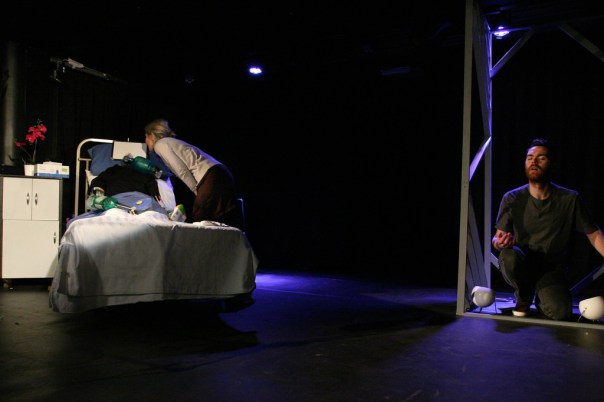
Recent IASH/Traverse Theatre Creative Fellow Clare Duffy is a playwright exploring dark themes. What if you have a stroke to discover you are in a vegetative state unable to communicate but fully aware of whats going on around you. Meet Ian (Martin McCormick) and his wife Cath (Kirsten Murray) who are having to learn how to live together apart. The set communicates expertly the prison of Ian’s body and he is confined to his vertical coffin like structure throughout most of the play. Innovative and surreal, especially the way Ian’s body is described through inanimate objects cluttering his bed and his wife’s mind.
Despite their desperate circumstances, Duffy still injects humour into her play .
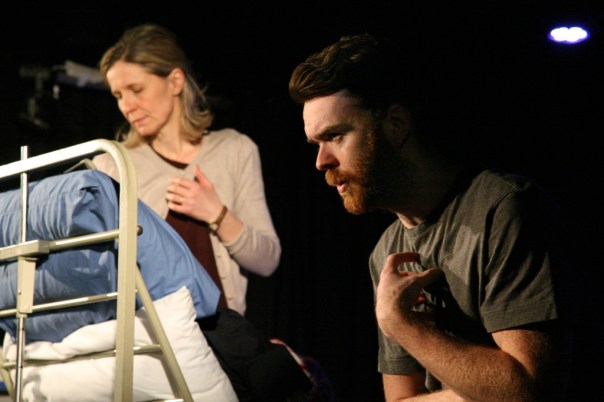
As Cath sets about washing Ian, he is concentrating hard to transport himself to China through his minds eye to see extinct volcanoes and a mirroring sea : he tries to smell the tea and not feel like the car being routinely washed. Cath was jealous of Ian’s relationship with his car believing he, ‘spent more time rubbing her down than you did me.’
Frustration to learn new ways of communication are explored in depth and with comic insight.
Ian’s locked in syndrome isn’t getting better and eventually their child grows up and has her own child. Cath has an affair and considers murder , ‘… death by chocolate ’ because after all, ‘how many ways can you kill your husband and not get caught? ’ The sensory experiences the audience are privy to are plentiful, from eerie screeching interference that best describes the torture going on in Ian’s head to the melancholic sounds of sea gulls in the distance and waves lapping the shore.
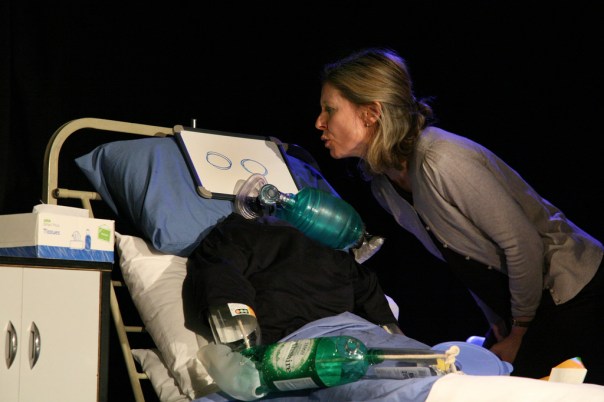
Ian’s launching off from his bed in the research centre in Houston where he’d like to, ‘ become a light particle ’ because he’s a ‘..post human space man…connecting to my space body.’ Will he keep going never to return? You will have to go to find out!
Reviewer : Clare Crines
King Lear
Pleasance Theatre
Edinburgh
March 1-5
Script:  Stagecraft: Performance:
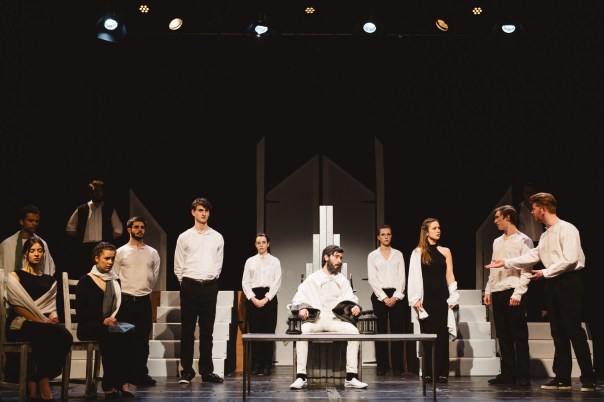
 Next month sees the 400th anniversary of the Bard’s ending-day. Perhaps he knew his fame would outlive him – but probably not how far the scope & expanse of his genius would penetrate. It is a staple of all the worlds’ studies; his language, human expositions & dramatic dialogue should stand forever as both a teacher & a delight to us all. In this commemorative year, then, the Edinburgh University Shakespeare Company has tackled King Lear, a murderous tragedy that wades in blood & guts only second behind the visceral early-crowd pleaser, Titus Andronicus. Touching on themes of family division & the onset of age with its wafting senilty, King Lear is a true classic, whose darkling & depressive mood plunges a sword-point into dankest depths of all our psyches.
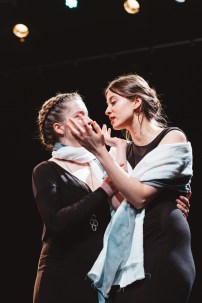 In the hands of the EUSC we are presented with a set straight out of Superman II (1980), with the ladies bedecked in evening wear; including rather pointy stilettos. At their heart is Will Fairhead’s grey-haired King Lear, who commands the stage with an increasing cantankerous acerbation. His touching descent into madness wins over one’s suspension of disbelief completely, especially when accompanied by a reddening face after a particularly loud outburst. Of Lear’s daughters, I found Agnes Kenig’s Regan very fluent, very believable, but the Mumble’s main praise must be bestowed upon Olivier Huband. He played Edmund to perfection, his stately soliloquies doing Shakespeare proud, while you actually could feel the electricity as he flirted with Goneril & Regan.

Olivier Huband’s Edmund

So did it work? I would say yes, it did. The cast comblended well together to deliver so complex a psychological montage, & did so bristling with energy. I wasn’t so sure about the accompanying sound-effects; a Dantean soundscape with a deep pulse that got louder as we descended into the mental hells of our protagonists. Perhaps it was meant to get us all nervous, but I just found it a bit annoying. Action-wise, while there was a seamless transition between scenes, the dialogue was at times a little rushed, especially in the mouth of Pedro Leandro’s fool. Saying that, the laddie was engaging all the same, a tantalisingly brilliant breath of fresh air in such gloomy play, composed as it was just after the demise of a more frivolous Elizabethan Age (1606). There really were some great moments of well-played theatre – the death scenes in particular were charged with high drama – while the soul-tortured monologues definitely demanded our attention. I did think at times the production was a little too shouty – Shakespeare’s words are essentially wooden, & it is up to the individual actors & actresses to bring them to life – but perhaps not quite so vividly… a cheeky subtlety here, an un-noticed nuancity there, plus a tension-pricked pause from time to time & this play could have been even better.
Reviewer : Damo Bullen
Mr And Mrs Laughton
A Play A Pie And A Pint
Oran Mor, Glasgow
Feb29th-March 5th
Script: Stagecraft: Performance:
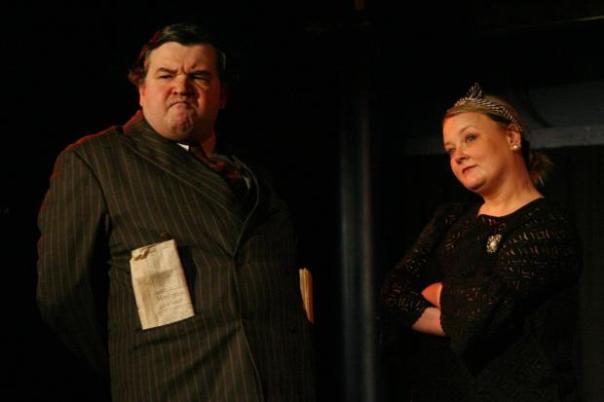
In this two-handed play written by Michael-Alan Read and directed by Gethin Edwards, we are introduced to the lives of Charles Laughton and Elsa Lanchester, one of the original odd couples of stage and screen from the 1920’s to the 1960’s. Elsa is played by Irish actress Abigail McGibbon and the talented but troubled Charles Laughton by Steven McNicoll, whose face may be familiar from the TV series Bob Servant Independent.
Mainly seen from Elsa’s point of view in a series of flashbacks the strange story unfolds of how two very contrasting characters came together and of their enduring marriage, which only ended with Laughton’s death from cancer in 1962. Elsa Lanchester, the attractive daughter of somewhat bohemian parents was making her way as a burlesque dancer and actress when she met Scarborough hotelier’s son Charles Laughton in a stage play. She lead a racy life as a society girl (she had an abortion at this time) and Laughton was in his own words “rubber faced and fat.” They married two years later in 1929.
 They both went on to have careers on stage and screen with Charles Laughton becoming a major Hollywood Star. Elsa Lanchester is probably best remembered for her part as the bride of Frankenstein in the film of the same name while Laughton had leading roles in Mutiny Of The Bounty, The Hunchback Of Notre Dame and many others. He also directed the original version of Night Of The Hunter, which has become regarded as one of the great Hollywood films of the 50’s. Even though Lanchester knew fairly early on in their marriage that Laughton was bisexual and that he admitted to bringing young men back to their home for sex she never left him and her obvious and undying love for him was at the heart of the play.
Although very well acted the piece did come across a bit as a potted history and it was left unclear as to whether Laughton had real feelings for his wife or the marriage was a cover for his homosexuality, which was illegal at the time. All in all though, a poignant play, which concluded with Lanchester quoting one of his sayings, “there is no time.”
Reviewer : David Ivens
The Angel & the Manse
PPP
Oran Mor, Glasgow
22 – 27 February

Script: Stagecraft: Performance:
George Docherty has added playwright to his repertoire of talents. Twenty years of acting has lead him to write what he would normally act. No bad thing. His cast comprising Sarah Carmichael ( Helen Logan), her husband Rev. Martin Carmichael ( Alan Steele) and the stranger in need of help Stephen ( Ewan Petrie) – who turns up at their door soaking in his tea shirt and jeans with head injury and no recollection of how it happened – are all excellent and very believable characters. Sarah is struggling, suffering from M.E. when she used to be the life and soul of the party and her preacher partner is struggling with hardened arteries to keep her amused; ‘What do you want…what would make you happy?’ The question of life eh? He thinks it might be fancy dresses, bigger house, but ultimately she wants to be noticed, touched and loved.
Docherty has illustrated through his plot and actors a very simple message – is the slog worth it when we want to realise our dreams? No-one knows what is waiting round the corner in this crazy messed up world but who you will find yourself identifying with? Will it be the self trapped wife, struck down with the debilitating condition of myalgic encephalomyelitisor, or are you more of the helper, carer kind willing to assist because you love the yuppie and know that she will probably marry you for your efforts?
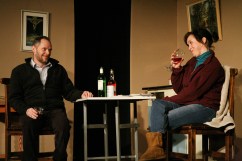
This disgruntled married couple face a storm in a storm. An angel in a teacup? Or a devil in disguise? After a dram the stranger Stephen gets poetic preaching to the converted Reverend and his mid life crises wife, ‘Your only significance is your insignificance.’ Is this, as Rev. Martin believe , his murder about to happen? Sarah, in sarcastic retort, enhances her husbands suspicions that Stephen’s a ‘hit man, it’s a great big game of cluedo. Killed in a manse with a walking stick? Too far fetched?’ Maybe, but there are some witty one liners that will strike a chord, even if its not the angelic kind.
Reviewer: Clare Crines
The Crucible
Lyceum
Edinburgh
18th Feb – 19th March

Script: Stagecraft:  Performance:
Without Arthur Miller, the American cultural landscape will be full of so many errant tumbleweeds, but he stands in the middle of it all like some strong, juicy cactus, prickly as hell, but completely ingenious. The guy lived for ninety years, but it was in his mid-thirties, the time of a man’s premium intensity of intellect, that he completed his eloquent masterwork, The Crucible. In it we are driven straight into the heart of the Salem ‘witch’ hysteria of the early 1690s, in which through only four scenes we are told the overall story & tickled by a series of sub-plots which together form the most immaculate, composite whole.

As we are ushered into a world of whispers, witches, warlocks, & the drinking of chicken blood, dramaturgically speaking, the play is perfect; each scene unveiling the development of each character’s personality, of which the hell-fire-raising then completely-bemused-by-everything-that’s happening Reverend John Hale is the most interesting. He is just one of a number of star turns from this brilliantly symbiotic cast, complemented by beautiful costumes & the most authentic New England accents I have heard outside of, well, New England (soft rrrrs included). Miller creates this world of words one would love to remain immersed in, with touches of ultra-modern humour tossed in with imperceptible nuancity.
Miller’s aim was to compare the persecution & labeling of women as witches with the Communist hunting of the McCarthy era, when people are condemned to ‘confess or hang.‘ In the same fashion, the play still resonates today – the suspicion present in 17th century Massachusetts has only been displaced onto other groups such as the Mexicans, or Islam. Paranoia has never left the American psyche in which lies a stagnating & deep-seated distrust of the different. But Miller also showed the other side of the story. Ron Donachie played Deputy Governor Danforth to perfection, a supercilious man with the remit of bringing order to that bewitching hurricane that blew through the streets & farmsteads of Salem. It was a time where people could enact petty personal vengeance on others by simply accusing them of witchcraft – Darnforth truly knew this, but was forced to uphold the law, for without it all would have descended into chaos – & thus 24 women were hung.

This play has a realistic fluidity, the sea-like cast ebb & flow into the nooks & crannies of the plot, & in the hands of director John Dove do so with optimum timing. Philip Cairns is a masterful, handsome lead – effortlessly growing into a more serious role after his ‘Kill Johnny Glendenning‘ & I look forward already to his next work. With the days getting longer this pretty little pre-spring, I urge on any theatre-goer to simply gasp with astonishment at the handling of Salems’ ‘black mischief’ by both Miller & the Lyceum players.
Reviewer : Damo Bullen

Face – Morag
HiPlay, Pie, Pint
Oran Mor, Glasgow
15-20 February
Script: Stagecraft: Performance:
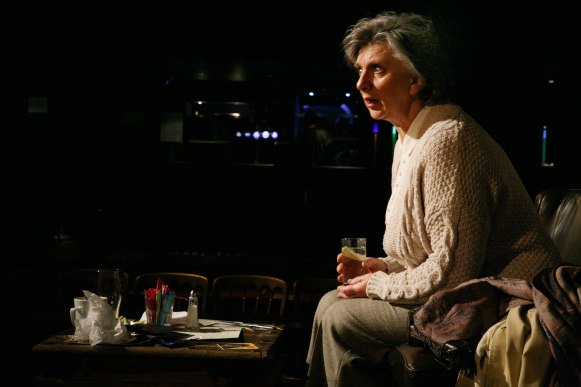
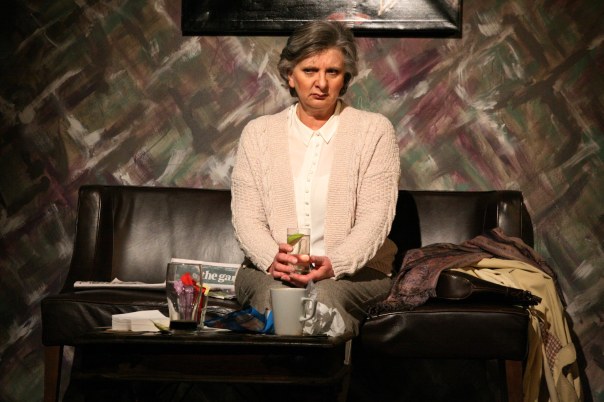
A week after we met the feisty Isobel, a five star performance, playwright Peter Arnott introduces the world to her twin sister, Morag. How different their lives are: where Isobel married & had kids, Morag remained single & focused on her career as a Science Teacher; where 10-year-old Isobel blamed her sister when she got caught nicking sherbet from John Menzies, 10-year-old Morag said nothing; where 60-year-old Isobel has left her family to live it up in Dubai on borrowed money, 60-year-old Morag stays in Britain to focus on her career, although admittedly – ‘at the of end her disappointing, unfulfilled tether.’
 This play sees the monologuing Morag give us all that information & more, a bitter sister caught in a dispute over the liquidation of their dead ‘mummy’s money.’ I didn’t see her first run out as these siblings incongruous, but I did feel keenly how well actress Janette Foggo brings to the optimum of reality Arnott’s characters. Their long-standing relationship had begun back in 1986 with the ‘Adventures of Thomas Muir’ at the Tron, & they seem a couple married to each others’ muses as their material & delivery remains invigoratingly accurate.
‘Is it alright if I sit here,’ asks Morag as she first enters the stage, ‘I wont disturb you.‘ But disturb us she did, running rough-shod over our deeply-buried ideas of death’s finality & life’s pointless carousel. Morag moans who way through the play with the high-brow eloquence enough to maintain our interest – one of the keystones of such theatre – holding us in her hands for a good fifty minutes, as if we were bartenders & she the only drinker in the bar, offloading her problems as she downed her JD & cokes. Though with Morag it was more like an Earl Grey & a wafer biscuit down the W.I.
There is something about the PPP plays that offers us windows into the lives of real people, which is a strength of its programming & support of local up & coming playwrights. With Morag, they have again hit the nail firm on the head, a piercing spike into the fibres of our existence that despite the odd uncomfortable moment, is a ravishing piece of reality. Arnott & Foggo should be really proud of this clever double-header.
Reviewer : Damo Bullen
The Canterbury Tales
Stanwix Arts Theatre,
Carlisle
13th February
Script: Stagecraft: Performance: 
The performance is billed as “The Canterbury Circus” and on entering the theatre the circus performance is already underway. It takes a bit of time to acclimatise though: the circus is more of a dark and grotesque carnival of exaggerated figures and sickly circus music; the pilgrims are already trying to catch our attention, gesturing–often lewdly– and commenting on the audience’s appearance: all very apt of course as in carnival everyone is an active participant, social class is at least temporarily destroyed and the grotesque is a part of the subversion in the sense that authority is humourless and sanitizes experience. I did like this dramatic focus on the carnival as The Canterbury Tales can be read as a moment when the full range of medieval society is introduced, but also the seriousness of the pilgrimage and hierarchy is gradually undermined and destroyed by the playful pilgrims; the production also catches Chaucer’s own self-deprecating irony: one pilgrim asks Chaucer, “Who are you?” Chaucer shrinks back and responds timidly, “No one.” And in a line to savour, Harry Baily, the host and ring master, tells Chaucer, “Thy drasty rymyng is nat worth a toord!”
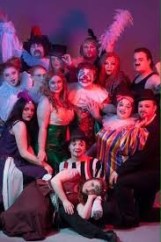
Chaucer’s pilgrims are amongst other things a mermaid, ring master, spiv, camp aristocrat, scullery maid, circus mannequin, bearded lady, gypsy fortune teller and Chaucer, the narrator, is a clown, or the clown’s precursor, the carnivalesque trickster figure, causing mayhem, cackling at disorder and subtly subverting the story telling process. Another interesting part of the production was the juxtaposition of Chaucer’s voices and the pilgrimage with the voices of the 21st century media perhaps representing a breakdown of social distinctions in creativity; to this end, the performance contained a dizzying array of cultural references to develop the idea that technology is a carnival of ideas, including Family Guy, Alice in Wonderland, An Officer and a Gentleman, and at one point—I think during the Reeve’s Tale– a pilgrim sang the narrative to the tune to of one of Adele’s hits and it worked beautifully.
So, what worked and what didn’t? The production cannot be faulted for vitality and creativity—it was bursting with ideas. It wasn’t a monument to an ancient text; it took the spirit of Chaucer’s text and threw it about with youthful abandon: surely the right thing to do. The best parts were the bickering of the pilgrims between the tales and the simpler tales; in particular I’ll mention The Cook’s Tale which was very vulgar and very funny, the lady doing her best Father Ted: “I’m feckin’ funny, feck off!” At times though the cacophony of voices was just too much and it was hard to follow the narrative, and in particular The Knight’s Tale was difficult: too much action, too much noise and without prior knowledge of the tale, all but impossible to follow, or enjoy. However, I could always follow Chaucer’s own advice when introducing the Miller’s Tale: if you don’t like it, “Turne over the leef and chese another tale”.
Reviewer: Paul Rivers

 Mumble Theatre