Category Archives: Uncategorized
Frankenstein
Bedlam Theatre
Edinburgh
Wed 10th – Thurs 11th Feb
*
“Do not pity me – you brought a child into this world & he is miserable!”
*
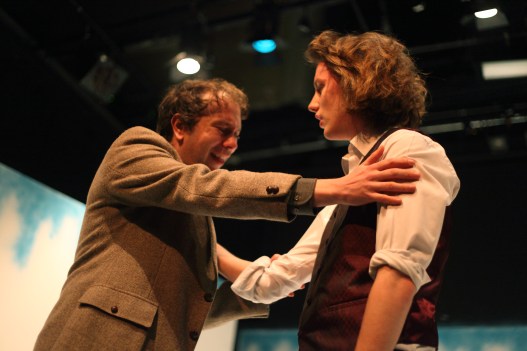
Jari Fowkes as Frankenstein’s father and William Byam-Shaw as Frankenstein
Script  Stagecraft:
  Performance
 A couple of hundred years ago, the English literati were discussing an anonymously written novel in the presence of the young Mary Shelley. ‘Perhaps it was written by a woman,‘ she suggested, only to be met with laughter & ridicule. Born from the gothic fermentation of the post-krakatoan apocolypse of 1815, when at the Villa Diodati the Shelleys & Byron swapped ghost stories throughout the dismal rainy summer of 1816, Frankenstein is an eternal classic. The idea of bringing corpses to life is a haunting one – & one still not realized outside films & TV series such as the Walking Dead. Mary’s own story has spawned thousands of spin-offs, including RN Sandberg’s play, which has just been capably performed by the Edinburgh University Theatre Company.
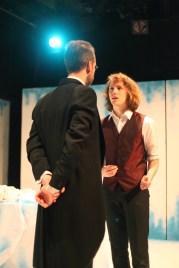 Set in the novel’s final scenes, but full of retrospective & psychodrama, this play is a moving piece which penetrates to the core of Mrs Shelley’s concepts of good & evil, of life & love, of birth & rejection – the raw primality of existence – with genuine tension-builds & a cataclysmic finish. The production was excellently-acted, perhaps a little too vigorously, with hardly a pause for breath. Outstanding performances came from the Monster itself, played by Jai Sharma, whose broad Yorkshire accent seemed rather apt for the role, & his ‘mate’ multi-playing Jennifer Jones, whose final hideous part was the best of her three. Also exceptional was Kelechi Hafstad’s Elizabeth – whose well-nuanced passage through the emotions was a joy to watch.
The only thing which let the play down was the set; which attempted to recreate the Arctic, but looked more like someone had splurged a huge tube of toothpaste all over the place. The final scene offered the stagecraft some redemption, however, when at the burning of the monster the set was illuminated in a bright & moody orange. This moment of purification, as if lifted from the Ramayana, was a thrilling way to end the play. Still, student theatre is more about the mood, I feel, & the company captured the feel of the story with a keen ability & I was very glad I bobbed along that night. That evening, by the way, was freezing, as was the Bedlam Theatre, which really did help transport one to the icy North.
Reviewer : Damo Bullen

Isobel
Play Pie and Pint
Oran Mor, Glasgow
8-13 Feb
Set:  Script:
 Performance:
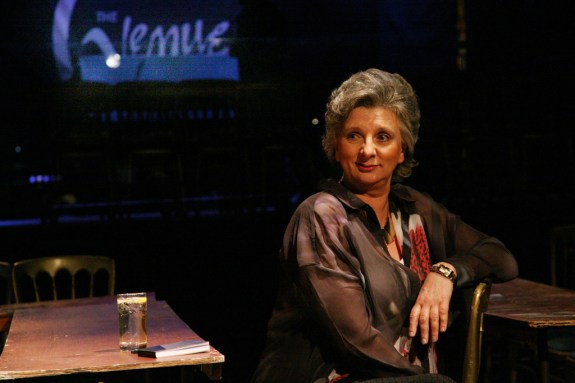
Isobel, played to mesmerising perfection by actress Janette Foggo is a typical west end theatre goer…a lady who lunches.. or is she? This play by Peter Arnott makes us think beyond the loud woman in the audience who is complaining about when the play is going to start. We are taken on a roller-coaster ride of life from sibling rivalry to toyboys and everything inbetween and beyond.
Meet Isobel , newly wealthy from her mothers demise : a lady with a fiery wit who takes no prisoners when it comes to life. This offering has more proverbial food to chew on than the mutton pie or quiche that comes with it. Of course Isobel is a quiche eater, she wouldn’t be seen dead with a greasy pie in front of her. It’s bad enough frequenting a former presbyterian church due to her very fixed views on, ‘presbyterian arse grabbers ’ but as she peruses the audience she’s not quite convinced, ‘looking at these pensioners maybe it is still church goers,’ in this place. As Isobel moved from her perch in the front row to take centre stage it becomes apparent that this woman doesn’t care for the theatre too much , they are always trying to convey, ‘some message to make you feel guilty.’ Now her twin sister, frumpy Morag is a different kettle of fish, a bit of a culture vulture, ‘this is her kinda place.’
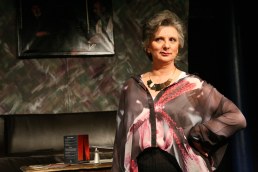 Isobel leads us on a merry verbal dance conjuring up potent visual images in our minds as she gives us her life story in under an hour with much mirthfulness along the way because as you find out Isobel is a half-full rather than half-empty kind of girl. At times you will love her, at times pity her though she would really hate that. Her demotic rhythms chime many a chord : humorously captivating us, not only with her charm but her scathingly wry comments like, ‘a protracted fart – plenty of time to walk away.’ The twins’ old school teacher, purple permanent maxi suited brutal Mrs Mackay’s ‘face softened…to a simper,’ prior to writing the word on the chalkboard before, ‘she held my hair and rubbed it out with my face.’
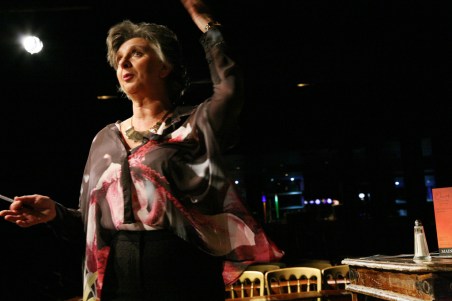 It really is all in the delivery, no amount of words can express this experience well enough. Peter Arnott is as accomplished a fellow Weegie as Chris Brookmyre, and is a talent to be treasured. If you can’t make this play, his new book Moon Country will give you many a laugh but you would miss Janette Foggo, (Rhoda Tait in movie Loch Ness and Mrs Meikle in Rab C. Nesbitt) bringing Arnott’s Isobel to life : from her smoking and shoplifting days when she suffered five hours of of Scottish opera on a Sunday afternoon to her plans for a face-lift in the imminent future, a beguiling presence with a thunderous thespian delivery and sense of timing difficult to match
Reviewer : Clare Crines

The Tailor of Inverness
Tolbooth
Stirling
5th February
Stagecraft:  Script : Performance
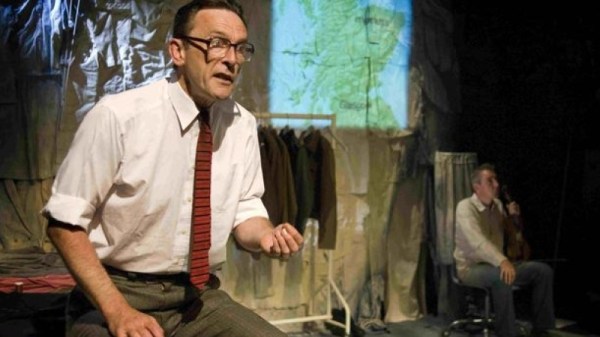
Last week I found myself watching on the BBC iplayer a story of Treblinka’s last two survivors, & was especially moved by their tales. If it wasn’t for the intrepid determination of the Jewish workers to escape the camp during those last desperate days, their story would never have been told. In the same fashion the Tailor of Inverness is also the story of a survivor of the great cataclysm that was the Second World War. This conflict is a gigantic stitched canvas in which millions of life-tales were interwoven – but in the case of Mateus Zajac, his thread weaves in & out & all over the canvas like some hyperactive child in a nursery.
 The play is in two parts – the first is an odyssey in the traditional sense: an orator with not a little PTSD traveloguing through a series of escapades & misadventures that saw the young Mateus land up in Scotland – a child of global war & scattered to the winds like so much confetti. The second half of the play concerns his truth-seeking sons unraveling of that tale & his astonishing discoveries of the real truths behind his father war-time activities. The play’s title comes from Mateus’s profession, who learning his trade in his home village astride the Poilus Ukranian border in Galicia, found himself in Scotland shortly after the war. Of his work, Dogstar Theatre’s director, Ben Harrison told the Mumble, ‘the metaphor of a tailor stitching fabric & at the same time fabricating stories to clothe or mask his true identity.’ On stage with him in a mannequin doll & table & a clothes rail , props used to perfection to flesh his tale. The stagecraft to this impeccable, perfect for the job from the fiddle-player accompanying the Ukranian folk songs, to the well-timed maps & photographs projected on screen – this is both a multi-lingual & a multi-media production.
 Mateus is played by his son, Matthew, who is also the writer & producer of Tailor. On its premier at the 2008 fringe it won many awards & went on to tour Scotland 5 times as well as performances in Poland, Ukraine, USA, Australia, Sweden, Denmark, Ireland, Wales, Germany & England; with its 250th performance coming up. Despite this heavy schedule, Matthew’s performance is still top-notch, capturing his subject with emotion & the most flawless delivery. His 33 years in the business has seen him assimilate ideas from across the board, masticate them in his teeming brain & then regurgitate what is clearly his masterpiece. It really is an astounding piece, which grabs you from the word go & doesn’t let go the teary finale.
The Tailor of Inverness invades your mind as the Polish, German, English & Russian tongues intermix, & at all times I felt like I was some wee nipper listening to my Great Grandfather’s yarns about the Boer War. Of its creation, Matthew told the Mumble, ‘The play represents the culmination of numerous journeys I have made, which started with childhood holidays to Poland…. my father’s story is one of millions, each worth telling, whether from Poland or Sudan, Syria or Congo. The need for these stories to be told is one of the strongest arguments I know for the necessity of art.’ As a spot of archiving, Tailor is supreme, & as a piece of theatre is as equally brilliant, an intricately-woven story full of fine speech & moving & momentous moments.
Reviewer : Damo Bullen
Frances And Ethel
A Play A Pie And A Pint
Oran Mor
Feb 1st– 6th
Script  Stagecraft
  Performance
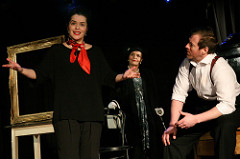
Frances Gumm was the somewhat inelegant given name for the star who was to become a leading player in the Hollywood of the Thirties and Forties and a singing legend of the Fifties and early sixties- Judy Garland. Unfortunately, Judy never escaped from the self image of herself as untalented, plump little Frances, (not helped by her mother and Louis B Mayer the head of MGM), and died from a barbiturates overdose, a tortured soul and totally burned out, at the young age of 47.
This excellent piece, written by David Cosgrove and Directed by Mary McCluskey gave us a touching insight in to some of the key moments in her career. Set in a dingy rehearsal room in New York at a confidence- boosting rehearsal prior to her major Carnegie Hall appearance in 1961, (she was a chronic no-show for films and gigs alike), the story is told from the point of view of Judy’s long-time friend and fellow musician, the hard-drinking Sal.
Piano playing Sal (John Kielty) reminisces about her fabulous career and Almost Being In Love, sung from offstage initially, announces the arrival of Judy (Frances Thorburn). Sitting upstage is her mother Ethel (Alison Peebles), dead by this time but still a grim and unlovable presence in her life.

We jump back in time and Frances’ father Frank has managed to secure a deal for her with MGM much to Ethel’s disbelief. How could fat little “monkey face”, her “little hunchback” possibly have managed this? It soon dawns on Ethel that there is money and fame to be had on the back of her daughter’s success.
One of the most poignant moments of the play is Judy’s rendition of her father’s favourite Danny Boy (a great vocal performance from Frances Thorburn throughout) as she reminisces about his early death which left her in the clutches of her domineering mother and the ruinous Hollywood star machine.
The finishing number,a show-stopping The Man That Got Away, had the audience spellbound and the players were given a well earned ovation by a near capacity crowd.
Definitely worth a trip to Oran Mor.
Reviewer : Dave Ivens

How You Gonna Live Your Dash?
Platform
Easterhouse, Glasgow
Touring 28 January – 13 February 2016
Script Stagecraft Performance
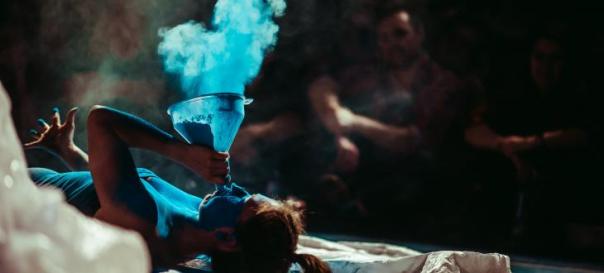
Jenna Watt presents her latest performance, a co-production with Platform and in association with Showroom – How You Gonna Live Your Dash? Exploring life-altering decisions people make in order to get the most out of their time on the planet: giving up a good career because you can’t bear the boss who used to be a friend, confronting an addiction, shooting a sucker rifle at a globe and moving there …
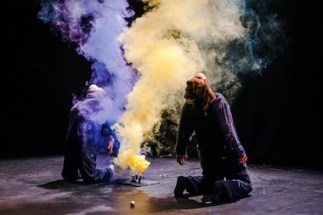 Based on reality, this punchy piece of theatre asks us to explore /detonate our own existence and look at ‘the dash’ which ultimately is the short period between birth and death, otherwise known as the rat race. Created and performed by Jenna Watt and co performed by Ashley Smith this is experimental theatre living on the edge. With fascinating sound effects in the form of amplified heavy breathing and the sound on a turntable as a record is about to start or end…interesting analogies in sound on ‘the dash’.
 The special effects are equally as impressive with bubbling cotton wool, smoke machines, clever use of fire in the pyrotechnics and even a slowed down music-less narration of Phil Collins Against All Odds .
Jenna was a recipient of Creative Scotland’s Artist Bursary where she spent a week at Cove Park writing Faslane. The fruit of this period is well worth a watch & I look forward to her future efforts with anticipation, for she really seems to have the gift.
Reviewer : Clare Crines
Causeway
A Play, a Pie & a Pint
Oran Mor, Glasgow
£12
Stagecraft: Script : Performance
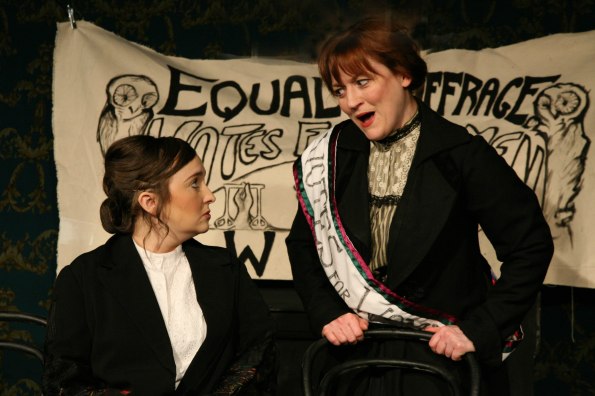
What a privilege it was to witness this play by Victoria Bianchi , directed by Debbie Hannan, set in patriarchal wartime Britain. The set is dark like the plot, the painted fire a nice touch and the period wallpaper strangely vintage turquoise and gold. With January being a time of reflection we are transported back to January 1913 where the two characters Frances Parker (Beth Marshall) and Ethel Moorhead (Stephanie McGregor) encounter one another prior to Ethel’s first Suffragette meeting. The banter between the two women throughout is comedy gold.
By 1914 the Suffragette movement was becoming increasingly violent, with many buildings around Britain being bombed and burned. In July of that year, Frances and Ethel attempted to set fire to the Burns Cottage in Alloway: not as a slur on the poet himself but for the fact that his words were being used to entice young men into the army. It also helped that Burns was dead and therefore there wouldn’t be any casualties while bombing his home and highlighting the Suffragette cause..
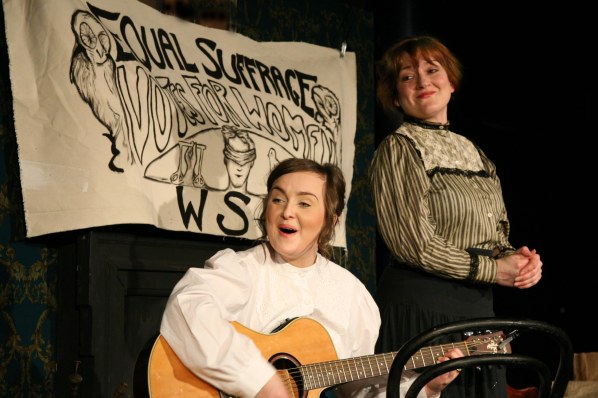
This play is about the planning stages of this bombing and the struggle the two endured on their long walk of almost forty miles from Glasgow to Burns cottage. It tackles the pitting of women against women in Mrs.Archibald Colquhoun’s speech and the role the media had in creating the myth that Suffragette women were hags and couldn’t get husbands. It is also about the loyalty between the two friends after Ethel is caught by a watchman on duty at the Burns abode. Although the plot is based on reality, Bianchi has chosen to send Ethel and not Frances to prison as was really the case.
While in prison Ethel went on hunger strike. Knowing that there was little chance of recapturing her if she was released, the prison authorities subjected her to brutal force-feeding in more than one orifice. Finally released to a nursing home, she managed to escape and return to Frances.
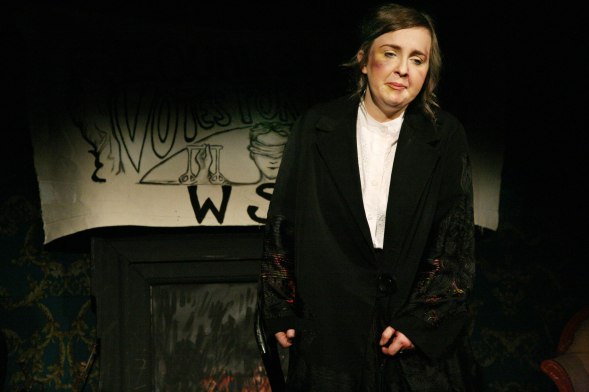
Ethel’s relaying of her court appearance to Frances is powerful, ‘I am at war with you. I can take your anger but not your pity…If we do not fight for it constantly with every fibre of our being then we will never achieve it.’ Ethel plays the guitar at times as she and Frances reinvent Burns songs such as A Man’s A Man For A’ That with lyrics that don’t mention men!
According to Oran Mor’s website, ‘CauseWay invites us to join with Frances and Ethel in their journey towards a fairer world and asks whether, over 100 years later, we’ve arrived at our destination.’ We clearly haven’t – books such as The Beauty Myth by Naomi Wolf give us all the statistics we need that prove women are still fighting for their right to equal pay in a world where men clearly have the monopoly on fair wages. What better a venue to shine a theatrical light on this issue than Oran Mor in the heart of Glasgow’s West end. This is a play with punch that kicks off the season as it intends to continue.
Reviewer : Clare Crines
East

Bedlam Theatre, Edinburgh
23rd Jan
Script Stagecraft
  Performance
In 1975, Steven Berkoff’s gritty slice of 70s cockney life found itself premiering at the Traverse Theatre, Edinburgh, to an international audience. Four decades later it returned to its spiritual home city in the hands of Edinburgh University’s finest up & comers, as part of the annual Bedlam Festival. And it was absolutely brilliant! The action began with a pretty live piano tinkle as our five protagonists sat in the dark on their chairs. Then up they stood, all booming voices and cool assurity as they ripped the shit out of Berkoff’s urban masterpiece.

East is a masticulated mix of Shakesperean dialogue & cockney street chit-chat, a wide open window into 70s Britain that contains timeless truths. Bovver-boots, manors, & visceral curses combine in a swirl of iambic pentameters such as ,’which we have well & truly robbed since then.‘ To these add phrases such as ‘piss off thou lump‘ & we witness the acute genius of Berkoff’s mind & discover how poetical the English language can be, in whatever dialect or situation it is spoken.
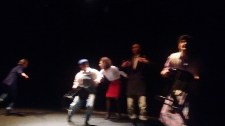 Junior thespians they may be, but Michael Hijiantonis (Mike), Celeste Macllwaine’s (Les), Esme Allman (Sylve), Brett McCarthy Harrop (Dad) & Rob Younger (Mum) were wonderful to watch, with a chemistry reinforced from the social integrations of their time together, carefree & footloose in the prime of their lives. The use of invisible props was excellent, especially a dodgem scene – proper funny – & combined with the nifty lighting really sucked you into Berkoff’s vision. They’ve got massive potential this lot, & gave a passionate performance all roun… it’ll be interesting to see how their careers pan out.
Reviewer : Damo Bullen
The Weir
The Lyceum
Edinburgh
15th Jan – 16th Feb
Script  Stagecraft Performance
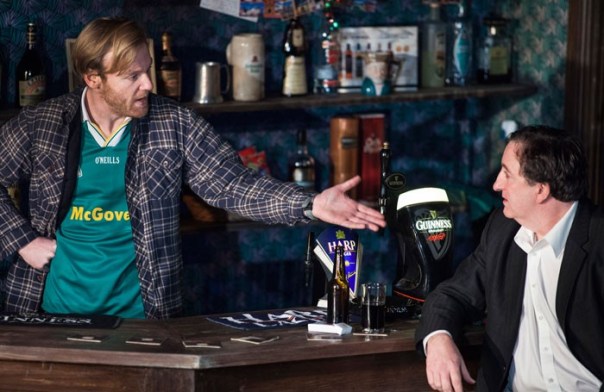
Taking my seat in the second row of the Lyceum, five minutes before showtime, I was suddenly squidged past by this giant of a fellow. Taking his seat beside me I’m like, ‘I recognise him… ah, Braveheart, Troy, its the Irish genius that is Brendan Gleeson.’ A few minutes later I watched him smile with pride as his son, Brian Gleeson, began playing the barman of ‘Brendan’s Bar,’ a true Irish watering hole in the furthest north-west reaches of the Emerald Isle. We had been transported there by the pen of one of Ireland’s most prestigious contemporary playwrights, Conor McPherson, & the marvellously accurate & atmospheric stagecraft of the Lyceum’s creative team, led by Amanda Gaughan. Among these purveyors of the noble craft, Francis O’Connor was responsible for the magical set, telling the Mumble, ‘I’ve designed a lot of Irish drama & many are set or part set in pubs so I’ve a huge amount of reference in my studio… and a very great deal of direct immersion!’
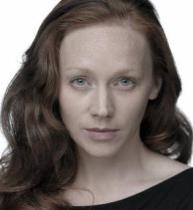 The Irish predilection for a good booze-up runs all the way through the play, a ‘Withnail & I’ style romp that almost drains the bar dry – a small one here, a harp there & a quick run inside the house by Brendan for the 1990 christmas bottle of white wine for the fancy city lady just moving into their rural haven, there. Her name is red-headed Valerie, AKA Lucianne McEvoy, & it is about her arrival in this obscure corner of Ireland that the play revolves. Accompanying her on stage are four fellows, the brilliant Gary Lydon as fifties singleton, Jack, the Compoesque Darragh Kelly as Jim, Frank McCusker as the married but flirtatious Finbar giving Valerie a tour of the area & of course Brian Gleeson, a right chip off the old block who oozed the most consummate confidence.
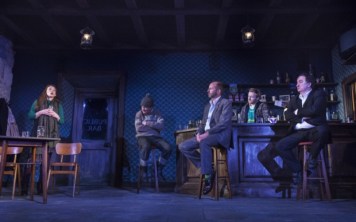
One by-one the cast trek through the stormy conditions of the Atlantic Irish coast & enter the welcoming bosom of Brendan’s bar. Everybody’s buying drinks for everybody else & bantering about the horses, work & all the usual stuff that surrounds life in the hicksville sticks. The play is dialogue heavy, & that is its main strength – the lovely lilt of the Irish dialect is always a pleasure to hear, especially through the rhapsodic tongues of professional actors. The banter flows as freely as the booze, & it is only when we reach a Decameron/Cantebury Tayles series of ghostly monologues that the play begins to stutter, somewhat. Saying that, perhaps McPherson introduced this as a an actual device, for by the time we reach the end of Valerie’s tale, I have never in all my days of witnessing theatre experienced a silence as sustained, impeccable & as harrowing as this one. We were almost begging somebody on stage to break the tension, a magnificent moment which everybody involved in this play should be proud.
This is a fine, fine play, in which Gary Lydon’s Jack is a particularly brilliant combination of actor & part blending in perfect harmony. We are not given answers to morality here, we are not taken on a thrilling journey of suspense, but what we are given are front table tickets to the world of real life & real people & real agonies & joys… & all in real time as well. With this play being performed in the winter months, I urge anyone to make a similar trek through wild conditions to find yourself basking in the warmth & comfort of Brendan’s Bar.
Reviewer : Damo Bullen

The Lion, the Witch and the Wardrobe
Edinburgh Lyceum
November 28th – 3rd January
19:00 (14:00 mat… wed/sat)
£15-£29
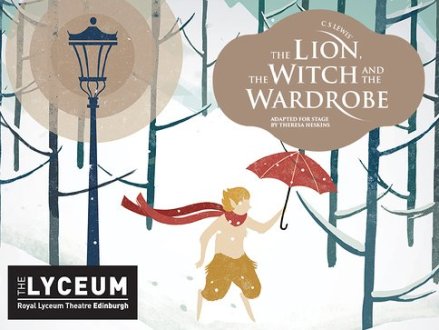
In Edinburgh this Festive season, it seems odds-on that the Lyceum has put on the best family show in the central belt, Theresa Heskin’s stage adaption of CS Lewis’ perennial favorite; the Lion, the Witch & the Wardrobe. The story commences with an introduction to our four heroes -Lucy, Peter, Susan and Edmund – as they are evacuated from town to country in Britain at the start of World War Two.Although initially the stage seemed crammed, director Andrew Paton uses clever props (in particular the revolving wooden doors),to create an intimate atmosphere that draws you into the the magical world of Narnia. The story is told through song and dialogue, with the latter delivered with infectious gusto. The songs, penned by Claire McKenzie and Scott Gilmour, were performed most passionately by the cast: in particular the White Witch, Pauline Knowles, gave a fantastic performance.

Lucy is the first to find the famous wardrobe and soon after the easily-led Edward is quickly put under a spell by the evil white witch – the promise of Turkish Delight all that is needed to turn siblings against one another. Of course no one believes Lucy and when Susan and Peter tell the professor the story of this magic land that Lucy claims to have visited, he does not seem surprised, which of course surprises them. Soon after in a game of hide and seek all the children enter the wardrobe which takes them to Lantern Waste and the scene of the iconic lamp-post. It is here they all meet Mr Tumnus and the humorous double act Mr and Mrs Beaver who are played brilliantly by John Kielty and Gail Watson.

The first half takes us up to the coming of spring and the “death of the age of winter”. The curtain goes down to a huge round of applause and leaves me excited about the second half and the arrival of Aslan. The story unfolds up to the moment Aslan is killed dramatically by the white witch and her followers. In time the evil spell is broken and good overcomes evil, while the cast superbly perform fight scenes to the backdrop of fantastically dramatic music. The finale sees calm restored to Narnia and magical theatre brought to the enchanting venue that is The Lyceum. I watched the show with my 10 year old daughter and we agreed it was a great night out for all ages.
Script 
Stagecraft
Performance
Review: Dolina Gorman
Life on Wheels
Eden Court, Inverness
26th of November
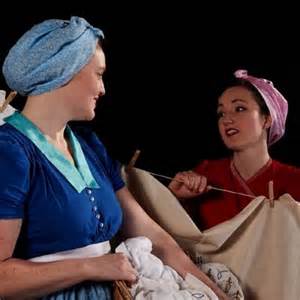
Life on wheels is the dream child of Jessie Rose and Lisa Truscott and is performed by the company Bella Kinetica which they have formed to explore the use of aerial and circus performances. It uses the medium of roller booting and circus skills to tell a story of two friends who are growing up in the 1940’s and their joys and traumas as they follow their life’s journey. The story starts in war time Britain showing the full drama of air raids and then the delight as victory was declared. The pair work in a wash house the audience are shown an amazing set that is made up of yards and yards of washing lines. The performance touches on the changes to the washing industry over the time period with the advent of washing machines.
The story is told through interviews of the women as elderly ladies and through snippets of news reals and adverts from the time as well as a very fitting sound track of songs from the period.
During the play there are some amazing displays of acrobats and dancing all on roller boots and with brilliant use of props. While creating the illusion of the pairs suitors and later on husbands being on stage men’s jackets hung on hangers are used, visually very impressive and believable the two ladies danced effortlessly with their husbands.
The play explored both life’s joys the war ending, young love, birth but also explored the darker emotions such as the loss and hopelessness felt by one of the ladies who was unable to have children. A very heartfelt and emotionally challenging dance was performed portraying depression and despair. The play also explored other dark aspects of life at the times such as physical and mental abuse within marriage. The play ends with the pair now as widows still lifetime friends and still supporting each other as they have always done even though at times they drifted apart due to the pressures of family and life.
I would urge anyone to go and view this play it is very thought provoking and the beauty of the set use of props and the talent of the girls is a pleasure to watch.
Script
Stagecraft
Performance
Reviewer : Lucy Tonkin


 Mumble Theatre