Category Archives: Uncategorized
A Winter’s Oresteia
Summerhall, Edinburgh
7.30pm – 9.30pm
Tuesday 3rd – Friday 6
Tickets: £8 (Concessions £6)
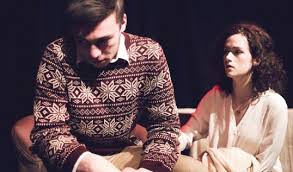
From awardwinning playwright, James Beagon (First Class, Best New Writing 2014, Buxton Fringe) comes a chilling new adaptation of an ancient Greek classic: a family tragedy of honour and revenge. A Winter’s Oresteia is the modern day adaption of the an ancient tale, set as the Trojan war comes to a close. Clytemnestra awaits the return of her sister, Helen of Troy, as tensions simmer below the surface and a family gathering is planned to show a united front to the world. There is a tangible hatred between Clytemnestra and her daughters Elcktra and Chrysothemis, and the arrival of her son Orestes only adds to the uncomfortable dynamics. Clytemnestra blames her estranged husband, Agamemnon, for the death of their daughter, Iphigenia, who she later discovers wassacrificed to the old Gods to guarantee the safe passage of a ship in a storm. The ghost of Iphigenia then manipulates the minds of those who can sense her and stirs up a concoction of hatred and revenge. And this is only scratching the surface of this dramatic plot. A complex family drama to say the least, that builds into a tornado of fractious emotions and psychological deceit. The character of the ghost of Iphigenia, played by Sally Pitts , is central to the story and is hauntingly executed. She holds an ethereal spitefulness, elucidated with an otherworldly singing voice, and embodies the vengeful corpse with a captivating performance.
The first act sets the scene firmly in the modern day with a family gathering around the dinner table. There is grating tensions between the mother and her children which reverberates with the trivialities of the modern world. Mobile phones and petty squabbling around the dinner table give this the feel of a soap opera, all the while referencing the tales of the Trojan war. This is convincingly portrayed and is carried along with sharp contemporary dialogue. As the story builds however the story moves from drama to massacre and then to almost farce. The ghost of Iphigenia is accompanied by six Furies, wraith like beings from the underworld who sing etherial harmonies that at times feel like Gregorian chants, and at other times echo the season in the form of eerie christmas carols. Their voices create powerful and sublime chorus, however after their arrival in the story, their almost constant presence on stage, with relentless writhing and hissing becomes overbearing and makes the tiny stage feel cluttered with the huge cast.
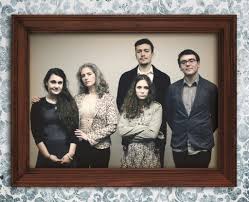
As we embark on the second half the vengeance of Iphigenia begins and the brutal scenes of revenge commence. Although convincing and shocking in the first instance this high octane frenzied energy then continues for almost the entire second half. There is what seems like constant panicked breathing, weeping, screaming and frenzied hysteria. A knife edge moment that seems to last for an eternity of murders, pleading and emotional wringing. Saying that the cast of what seemed to be students held this play together brilliantly, and with almost two hours of constant dialogue, there was not one slip or falter in their performance. The script eloquently transported this ancient tale into the modern day and raced forward at a good pace that held the audience in the tangled web it so masterfully weaved. A great effort from a young cast full of talent and enthusiasm. Definitely some faces to watch out for in the future there. The venue of Summerhall is also such a wonderful place to watch such a spectacle, with the old lecture hall adding to the enchanting feel of this powerful piece of theatre.
Reviewer : Glenda Rome
Lifesaving
Oran Mor, Glasgow
March 2-7
1PM
Play, Pie & a Pint
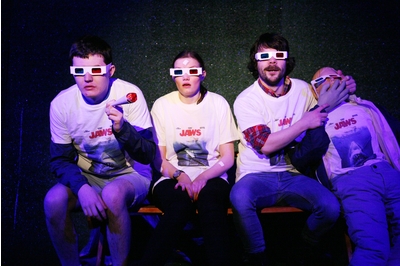
It’s a testament to the hardy Play, A Pie and A Pint audience that they turned out in such numbers on a vile, freezing and dreary wet Monday to watch the opening day of this week’s play, Lifesaving, by Rob Drummond (who has trained as a wrestler and magician to appear in his own works), is set in an imaginary green grassy space with picnic table centre stage. Two of the characters enter, a teenage girl and her older brother- the brother carrying a life-sized dummy used for CPR training- or Lifesaving. At this point the play is almost a monologue, with female character Sandra, played brilliantly by Lynn Kennedy, talking to, or at, her older brother Jamie played by Daniel Cameron.
As the play progresses it becomes apparent that he has learning difficulties and an obsession with lifesaving and CPR. There were some genuinely hilarious passages in the opening scene, which had the audience in stitches and the CPR obsessed Jamie’s serious responses made it all the more amusing. It eventually becomes plain that they have run away due to something terrible Jamie has done, that Sandra is protecting her childlike brother and that they are waiting for “Andy” who will miraculously solve everything for them.
Unfortunately for Sandra and Jamie it isn’t Andy who turns up, but Neil, his psychotic brother, played by Ross Mann, and Neil has a particular fancy for Sandra. The play touches on issues of adolescence and sex, disability, loss and how to deliver CPR properly. The unravelling scenes were linked by sound montages from the 70’s classic horror Jaws and Neil was definitely a circling Great White in Sandra and Jamie’s fragile world. This was enjoyable and engrossing stuff from beginning to end and, as such, is highly recommended. An hour passed in a flash.
Reviewer : Dave Ivens
Dirty Dancing

Reviewer : Mark ‘Divine’ Calvert
Twelve Angry Men
The Kings Theatre, Edinburgh
23-28 Feb
19.30 (mat wed & sat)
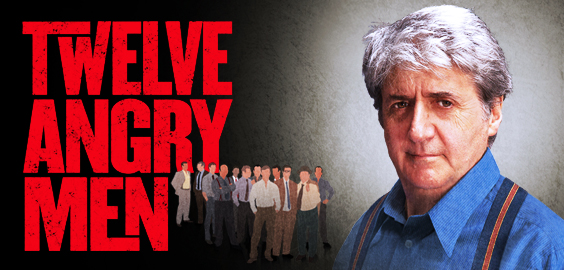
Twelve Angry Men is the story of a court case based quite uniquely around the Jury, who deliberate the case in a locked room. The set is sparse : a table in the middle, three large windows hung at the back & a toilet off to the left for those intimate, private conversations. These, & all the rest of the dialogue I found to be flowing flawless through out the whole production. The crime in question revolves about the murder of man, whose son is in the dock for the deed. To my mind, it seemed that unless it was a set up, the kid was bang to rights – but Tom Conti’s character does not see it this way at all. The whole jury is swayed in the end but it is a battle of wills. One fellow uses brute force & threats of violence, while Conti, more detective than juror, Conti questions all the facts, whose accent and stage presence made me think him a Columbo – all that was missing was his cigar.
Of the actors, Conti is the most well-known, but definitely not the best of the players on offer, drawn from a cross-section of society. New York testosterone, for instance, is depicted pitch-perfectly by Andrew Lancell, whose character just wants to see the lad in the chair so he can get home to see ‘the game.’ Ominously enough there are no women, in fact not even an effeminate man – a portrait of the times in which the script was written about and thankfully not indicative of the present. If it had been women, I imagine there would have been a lot more bitching in the toilets! FOUR STARS

Reviewer : Sarah Marshall
Long Live the Little Knife
Circle Studio, Citizens Theatre Glasgow
24th-28th Feb
£8.50-£12

When you are eventually allowed in [5 minutes before curtains up], to what seems the most Spartan of venues, the reason you have been kept waiting soon becomes apparent. The two actors, Wendy Seager and Neil McCormack, despite explanation to the contrary, are already in character. They meet and seat the audience whilst setting the backdrop for what’s about to unfold in this piece of ‘verbatim theatre’. A sense of intimacy with the small, but sell-out audience has already been established in preparation for a piece of in your face, black comedic storytelling.
The story is about a married couple [Jim and Liz], a pair of sharpies specialising in the trade of snide designer handbags, and their chance encounter, whilst on the lash, with the writer in a Glasgow pub. Having fallen foul of the East End Mafioso in a turf war, they find themselves being extorted to the tune of £250,000 and being forced to hatch a get-rich-quick scheme to avoid enforced removal of their mortal coils. They go to visit ‘The Wee Man’ for guidance and so their quest in becoming the world’s most notorious art forgers begins.
As the story unfolds, often at breakneck speed, the underbelly of a world of forgery, hard nosed art dealers, child prostitution, sex trafficking, armed robbery and arson is exposed. Although having seemingly more faces than Lon Chaney and clearly intent on breaking more than one felony in the pursuit of their mission, both characters, in true ‘Breaking Bad’ style, come across as the baddies with a moral compass. In comparison to the other villains in the narrative, which includes a Russian Oligarch with an unhealthy interest in farmyard gonadectomy, you could be forgiven in thinking of them as heroes.
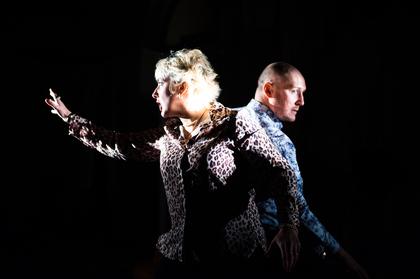
If you go to see this play, as is Leddy’s penchant, be prepared to be exposed to a bucket full of conflicting emotions. I found myself laughing out loud on more than one occasion and being simultaneously conscious of the smile sliding off my face. Huge praise must go to the actors in this thoroughly entertaining production for making the characters seem so real/fake with numerous, seamless, protean transformations which were delivered with an amazing energy. Little wonder that they looked completely drained when I saw them in the lift after the show.
In the ‘final chapter’ the machine-gun’ like manipulation of the most profound of feelings made me come came away from this boxing ring like arena, somewhat appropriately, punch drunk and feeling largely different from what I did before I went in. A must see, five star production. FIVE STARS
Reviewer : Fitzroy
The Caucasian Chalk Circle
Lyceum Theatre
Edinburgh
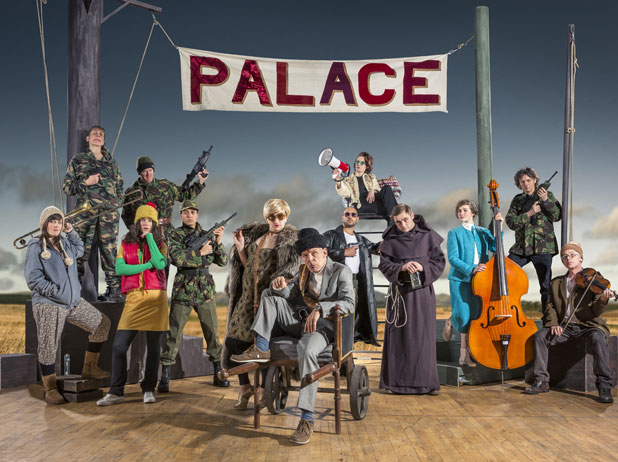
“Brechtian” is the sort of phrase lacklustre undergraduates pepper lacklustre essays with. To say a play is Brechtian is to say that it is the sort of theatre that tries to thwart the audience’s emotional attachment, so that we might focus on causes -not characters or their individual fates. A shame, cause if we were to judge the man himself by this standard, Brecht himself is typically far from Brechtian. He was just too good at writing engaging, sympathetic characters and placing them in compelling situations, and too damn funny. A lot of Brecht in the theatre, though, is pretty Brechtian alright. It can be bleak. It can feel like being lectured at, and the studious Dogma-style stripping away of elaborate sets and costumes, can be, well… dull. By contrast, the elegant Lyceum’s new production, the Caucasian Chalk Circle, is a shambolic, circus of a play. A joy.
It’s not that there aren’t lots of indications that the play tries to reach beyond the stage, members of the cast are playing in the bar before we are seated, the ladies loos (didn’t check the gents) are covered with printed out quotes about inequality. There’s no doubt that this is political, theatre breaking its own boundaries. There is no rise of the curtain, but rather the cast drift onto the stage as the audience arrive at their seats. The backstage area has been opened up, and made part of the set, props are wheeled about by cast members, So far so Brecht, and so effective.
There are some innovative departures too. Sarah Swire, our singing narrator is every inch the rock chick, full of fire. Her delivery is often “in your face”, which is how Brecht wanted the moralistic elements of his plays to be, right enough, he was the man who said : ‘Art is not a mirror with which to reflect reality but a hammer with which to shape it.’… He probably wasn’t imagining this Anni De Franco/ Amanda Palmer hybrid though, and the snarling grungy vocals sometimes get in the way of annunciation, and it’s hard to decipher what our story teller is telling us. . When the accordion comes in, or the play moves into a Country folk style, a soft ballad, an Irish jig, a tango, it’s such a relief to have the narrative communicated in a medium that is genuinely tuneful. Swire’s words become clearer too, and we can hear the language itself, which is, like her voice when it’s allowed to be, genuinely beautiful.
The cast also form the band, and the music, generally, is brilliant, an absorbing mish-mash of cultures and instruments. There’s a brilliant rag-tag quality to their continually dropping character to pick up this or that instrument– a trombone, a washboard, casually passing one another a double-bass. There are some stunning instrumentalists amongst them, certainly enough to pull off a great range of styles and create some genuinely moving and invigorating music, but some are undeniably greener in the gills, musically speaking. My companion, an aficionado of African drumming took umbrage at the djembe “player” who was, in her words “flailing about” with the thing. Then again, you don’t go to Brecht for the djembe. And fair play to them, not only does this cast play a lot of instruments, they each play a lot of parts, and generally do so excellently. A lot of gender-swapped parts here, too, which brings it’s own challenges, both for the actors, and the audience.
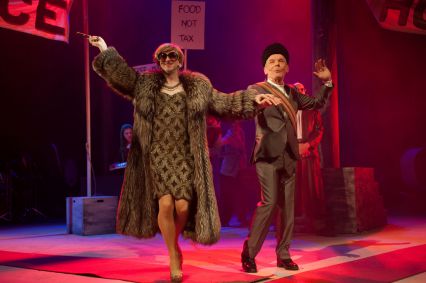
Deborah Arnott’s portrayal of the Sergeant a sexual predator and bully brutalised by war, was particularly brilliant a chilling portrayal an convincing, understated, performance of “masculinity.” Andrew Bridgemont’s scheming old mother wan another excellent example- he brought alive Brecht’s witty characterisation and deftly avoided being a “for laughs” granny drag-act. Others were less successful. Both the governor and his wife were played by opposite sex actors, who reduced them to cringingly reductive vaudeville which obscured almost any other aspect of the characters. Liam Gerrard’s Ludovika was straight up drag, and to be fair the audience adored him for it, but I wonder if I was he only one who cringed. One problem with modernising Brecht and that is that some parts are genuinely not modern. Ludovika, -a girl whose father in law has found her with a stable boy, and pressurises her to say she was raped, rather than unfaithful, might have been seen in a more sympathetic light. The famously wise Judge Aztec rules that, because of her downright sexiness, Ludovika has in fact raped the peasant… her beauty was so potent as to render her irresistible, more than asking for it, her appearanceforces the poor young man to have sex with her. Our drag-tastic Ludovika parades about in wobbling heels, simpering with gratitude as she’s belittled, and a moment that should be light is heavy with awkwardness.
How much more there is to like. Adam Bennett, the puppeteer, is genuinely brilliant- truly, he makes some white rags and a polyester mannequin’s head into something genuinely moving. Amy Mason, the actress playing Grusha, does so brilliantly. She looks and sounds like Katie Morag, so sweet, vulnerable and believably flawed. And falls in love with this child so convincingly that by the time of reckoning, in the chalk circle, the scene is tense indeed. A brilliant, challenging, play, brilliantly, and challengingly, played. One to see for sure. FOUR STARS
Reviewer : Katie Craig
Complete History of Comedy (abridged)
Eden Court
Inverness
10th Feb
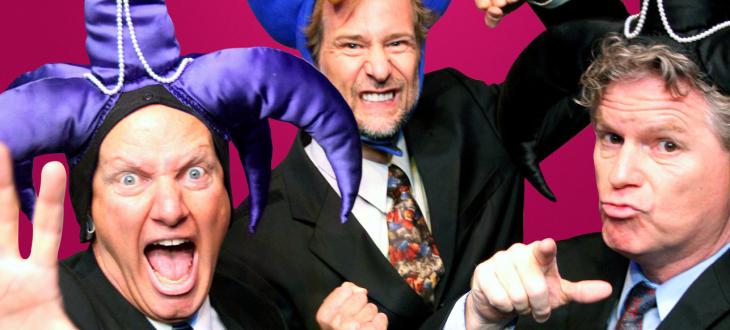
From the people who brought you the complete works of Shakespeare in less than 2 hours, comes a new comedy show that attempts to chronicle the whole history of comedy. Starting at the earliest joke (and jokers) all the way through to modern times. The Comedy Trio demonstrate amazing talent with all the different comedic arts on show from satire to slapstick.
The story begins with the guys finding an ancient text called the art of comedy, written by the art of wars author -Sun Tzu’s younger brother Ah Tzu (Achoo!). Each chapter tells of a different type of comedy which they go on to demonstrate to varying degrees.
As with their other shows this is performed at breakneck pace. The wide variety of different jokes mean that not everything is going to hit the mark but when a joke fell flat with the audience they would recover with brilliant one liners. There was a feeling throughout the show that it this was written for an American audience with several references that may not be picked up by the UK audience- including a Abe Lincoln stand up. That said they are still worth a watch if only for the over the top slapstick routine.
Reviewer : Lucy Tonkin
We Can All Agree To Pretend This Never Happened
Oran Mor
9th-14th February
13.00
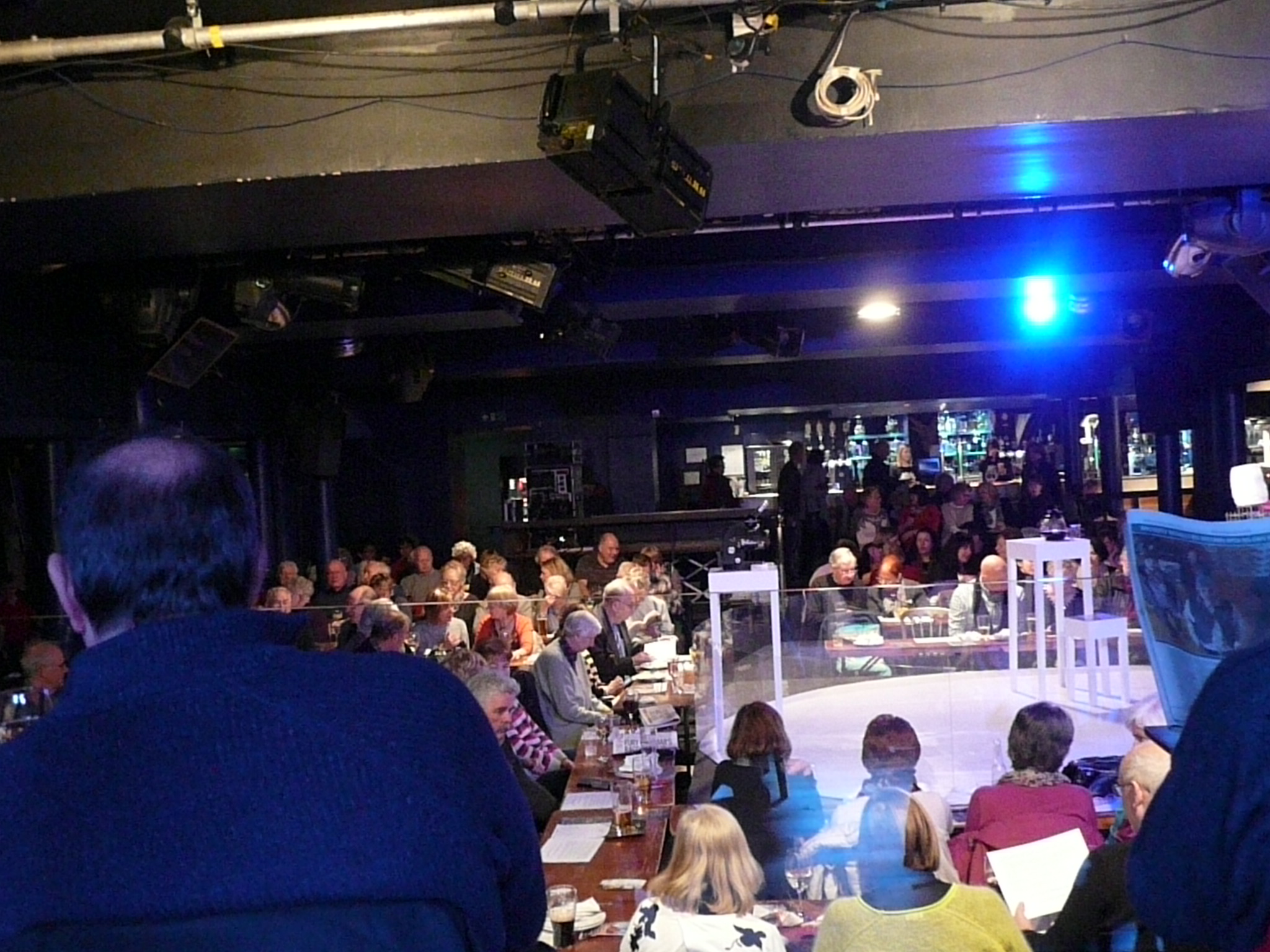
To mark A Play A Pie And A Pint’s 350th production, this week’s play was by American playwright Emma Goidel and was originally commissioned for American theatre group Tiny Dynamite. This international theme will continue through the current season of plays. The play, We Can All Agree To Pretend This Never Happened wraps up a serious topic (global warming) in what amounts to a classic comedy of errors. The action takes place in a scientific research lab deep in the furthest frozen wastes of Siberia and concerns four Americans (two male, two female) involved in climatic research. The characters are played by James Young (Lincoln), Robert Jack (Andrew), Sally Reid (Liz) and Helen McAlpine (Maya).
The well-designed and lit set placed the action firmly “in the round” both in it’s circular construction and position within the packed audience. The protagonists have obviously spent too long cooped up together in their isolated icy outpost (shades of The Thing?) , nerves are frayed and emotions and feelings, real and imagined, are running at fever pitch.
Thus, the scene is set for some farcical misunderstandings over romantic liasons and a plot to fake damning global warming data by the use of a manufactured deadly virus. To say more would spoil the plot, but the whole scenario was well acted by the ensemble, in particular James Young’s Lincoln was reminiscent of Richard Dreyfuss at his most exasperated and apoplectic.
The play was crisply directed by Gary McNair but never quite fulfilled it’s promise by being a little short at forty minutes and somewhat unfocussed in it’s ambition. Was it a comedy or a serious comment on global warming? We never really reached a conclusion in that respect. In any event, it was pretty entertaining and probably the only time I’ll be on the stage at Oran Mor. (Some seats had to be put there-it was so busy)
Reviewer : Dave Ivens
Mr. Carmen
Manipulate Festival
Traverse Theatre
7th February
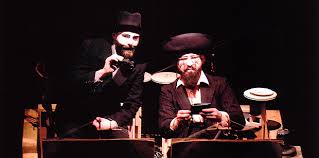
Two Creepy clown pirates with impeccable beards grace the stage as floating heads on a seaside style portrait-booth. These are cross-dressing alcoholics that smoke.. in front of a live audience. Actually, the smoking was fragrant, so clearly not the real thing but they made up for it by spraying a can of toxic spray paint to write Carmen. These demonic white-face-painted degenerates use the effects of smoking and severe alcoholism to animate their concerns in their small world created for themselves on stage. Their props, of which there seems to be an inexhaustible amount, include suitcases and doll. These dolls are tied to a reel that makes a square track around the two men. It appears like a boxing ring and they compete to see who can spell their words out the best. The words are Jose and Carmen, for the inspiration for this performance piece comes from Carmen by Prosper Merimee written in 1845 and of course is more commonly known because of the opera based on this story.
The words are spat out in wine through projected light, or written in silk atop a voodoo doll with the pins that are farrier’s nails. It is all very inventive, & its sheer brilliance to see such people really experimenting with how truly weird they can be : the world is way too full of people trying to be normal and these two men are clearly not that. The characters have a unique eccentric bond, and although they compete they are one and the same. In fact I had to ask myself how much these fellows are actually like this for real and if so I wondered where they they be heading for a drink next…..I’d like to join them! They stab at each other with knifes and steal each others cigarettes, as if they are siblings.
A performance of Carmen five years ago
The show is surrealistic in nature and quite like a horror in content, the score is dark and ominous at times or chaotic and unsettling at others. This creates an intensity that is a direct contrast to the more slapstick style comedy parts of the show, and it makes for an ingenious emotional roller coaster. The beards are pretty trashed by the end but that’s mostly because they are saturated in wine.
Reviewer : Sarah Marshall
[
Butterfly
Manipulate Festival,
Traverse Theatre
5th Feb
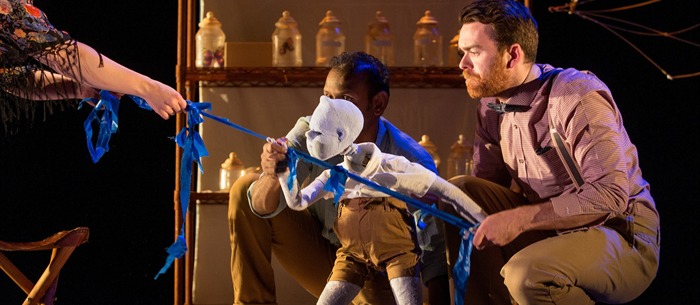
Some of us think we’ve had it bad in life , then all you need to watch butterfly to discover its not all that bad. The opening scene introduces our performers, Ramesh Meyyappan, Ashley Smith and Martin McCormick, in a synchronised dance. Ashley plays Butterfly a kite maker who’s affections are sought from a customer (McCormick) she is clearly not up for this but when Nabokov (Meyyappan) the butterfly collector comes along she changes her tune. The romantic scenes I found a bit cringe worthy….in fact in my notes it says BLERGH….and I found that the character Nabokov looked maniacal throughout this. Maybe this was deliberate as we realise his intention is not to nurture Butterflys individual creativity and freedom but to trap her in his world like the real butterflys in the jars he keeps. He is livid to find another man has affections towards her and tortures her as punishment. On finding the kite maker living with the other man her enraged customer takes her physically and rapes her. This scene is particularly traumatic. Slow motion movement is used and it directly contrasts with a scene next to it which is set in a blue lit ambience of the butterfly collector who is oblivious to violent red lit incident that is occurring in his absence. The customer is transformed from a gormless admirer to a predatory hillbilly.
As described by my friend Heidi, we then see the ‘butterfly effect’ of rape and domestic abuse. The scene is replayed over and over as the trauma causes Butterfly to be rejected by Nabokov and for fighting to become common place. As the show is without words various interpretations are triggered. In he following scenes we become less sure of what is dream, real or repeating memories. A shadow baby is projected onto one of the kites as a visually effective womb, Butterfly is pregnant. The baby is born and Butterfly is left alone looking after all the dead butterfly’s in jars. The baby grows to a toddler, a soft cuddly toy type puppet and although the movements created by the trio are very convincing the baby looks scary, like a mini Mr. Burns. Eventually the child breaks a precious butterfly and in a rage it killed by his own mother. The play ends here as the jarred butterfly’s flicker alive in the jars, perhaps symbolising the entrapment of this unfortunate woman in prison either a real one or metaphorically in her mind.
This play depicted real issues that effect many people. Domestic violence are tricky subjects to cover and it was an opening for myself and my friend to talk about it in a way that wasn’t too harrowing as thought we have about it could be referenced using the play. Cycles of abuse are common place in society, work like this gives people a chance to view such a taboo in a way that means you can be thoughtful without becoming overwhelmed by the horribleness of a situation that people too often have to go through. FOUR STARS
Reviewer : Sarah Marshall
 Mumble Theatre