Category Archives: Uncategorized
Treasure Trove of Shadows
C Venues
Aug 25-28 (13:50)
Script:  Stagecraft:
  Performance:
Now this is what its all about, the Fringe. We who live in the misty north of Britain have our fair share of culture through the year, but it is quite piecemeal & nothing too unconventional to our tastes. Then August comes along & a nuclear bomb of immense variety explodes into the city, & one must be rabbit-swift to catch even the minutest portion of the blast. But if one is lucky enough – & also daring enough to step outside the ‘couple of comedians & a play‘ mode of many – then we might just stumble across a show such as a Treasure Trove of Shadows, as I did yesterday.
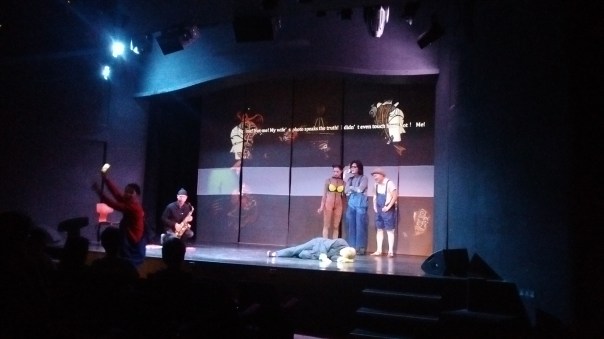
It all begins in Shaanxi, China, the home of the Terracotta Warriors & also the 2,000 year-old folk tradition of shadow puppetry. Alas, as tour manager Wayne Sam admitted to the Mumble, this tradition is ‘dying,’ with the modern generation preferring to be entertained by the vast panoply of electrical means available in 2017. Enter multi-media artist, Feng Jiangzhou, who has decided to create a futuristic version of shadowplay & elevate it to high theatre. Feng told the Mumble, ‘we deliberately avoided focusing on the history, intent & explanation of shadow puppetry. Our aim was to focus more on theatrical expression placing the play into the criticisms of reality.’
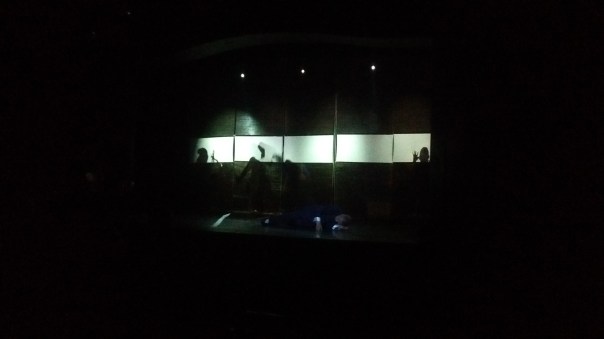
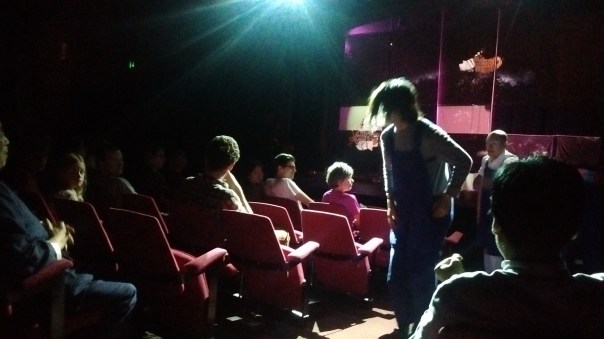
The end result is a bizarre & bold, mish-mash, neoclassical pastiche of Chinese folk stories, played out by a youthful, bright & bubbly cast, while a sophisticated saxophonist accompanies events with some smart sound-art. At all times, behind the proceedings, some simply amazing visual set-pieces are wheeled one-by-one before our eyes. This show is a visual delight, indeed shadowplay for the 21st century, but the story is unfortunately a little difficult to follow – despite the English translation being beamed onto the wall – a literary Wasteland, which even wanders into Macbeth at one point (!?).
However, watching Treasure Trove of Shadows is more of a transcendental experience which shines a time-warping telescope half-way across the world to the villages of China, where Shadow Puppetry once ruled supreme. Then, at the end of the show, the audience is invited onto the stage to witness the art of shadowplay in its purest form, & one hopes that someone in this crowd, or more likely in China, will fall in love with the artform & perpetuate it for posterity.
Reviewer : Damo

Catherine & Anita
Assembly Rooms
Until the 26th (21.05)
Script: Stagecraft: Performance:
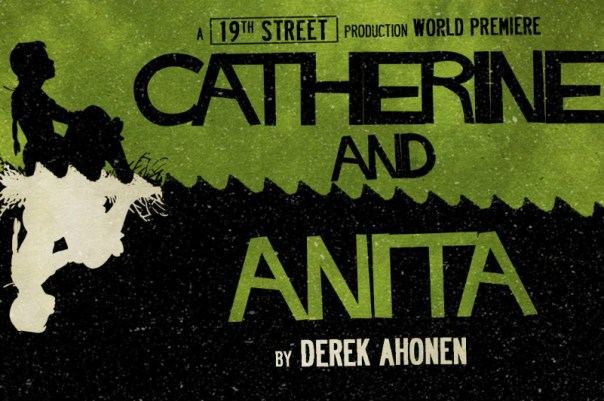
Catherine & Anita is a powerful & flippant piece of theatre. The brainchild of American writer/director Derek Ahonen, he has chosen as his mouth-piece the electric watch that is Sarah Roy, a graduate of the American Academy of Dramatic Arts in New York. Together, they tell the story of Catherine & her invisible friend, an idealised & actualised symptom of her madness, who supports her through both the childhood causes of her madness & the inevitable fall-out in her later, adult life. I don’t want to talk about the story too much, as a prior knowledge to events would deflect somewhat from the intensity of the dramatic interplay between the audience member & Roy’s ruminatingly, chin-strokingly decisive performance. All I can say is that the multi-layered plot peels off like an onion in an exquisitely smooth progress throughout Ahonen’s worldscape.
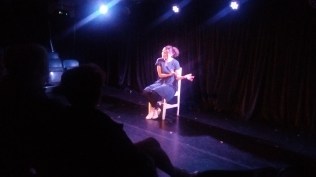
As Roy chitters away through all her angsty girliness, we become almost as one with Catherine, so powerful is the acting. I cannot praise highly enough how bold this play is, when a make-believe best friend becomes a massive, almost tangible presence on the stage – a rare feat which seemed easy putty in the hands of Roy. Indeed, her gothic, slightly deranged, but unquestionably courageous performance was at first unpleasant & a little corrosive to observe, then increasingly superb as the plot levels clothed her & we began to understand what was going on. Both an exploration of insanity & an expose on the darker corners of the world we undoubtedly share, C&A is a fascinating foray into the theatrical demense, & one which should be applauded for both its bravery AND its quality.
Reviewer : Damo
Kokdu

Assembly Hall
Aug 23-28 (12.00)
Script: Stagecraft: Performance:
It has been a decade since Jungnam Lee’s Kokdu swept the award-boards at the 2008 Korea Theatre Festival, & it is being given in 2017 a renaissance for a new generation. Rooted in traditional Korean storytelling, it explores that oriental land’s shamanistic rituals and beliefs, while incorporating traditional folk songs, dance, masks & costume-work. yes, you get everything crammed into one tour de force hour. Korean theatre is proud of its roots, rather like the Tanzanians laud their Ngonjera, & it is no surprise that MAC theatre want to give us their unadulterated, untranslated best, & thus Kokdu is given to us in Korean as if we were watching it in some rural village in that fabled peninsular.
Reminscent of O Yong-Jin at his most creative best, the folklorist elements of Kokdu take on a fairy-tale guise for the voyeur, & immerse us all in a dreamscape habituated by archetypes & punctuated by Dantean sounds visionary scenography. Kokdu is a fine spectacle, & tho the story may be unfamiliar & lost to us in translation, the overall effect is rather pleasing & worth an hour to reflect on Edinburgh festivals being international at heart, & not just about comedians from London.
Reviewer : Damo
Lula Del Ray

Underbelly Med Quad
Aug 22-28 (16:30)
Manual Cinema, based in Chicago, have created an entirely original show, using overhead projectors, shadow puppets, actors (non verbal) and live music. As well as the screen you can watch the team working the overhead projectors with clock work precision, the live band, a sound technician and the two actresses playing Lula (Sarah Fornace) and her mother (Julia Miller), with a look that adds to the surreal dystopian 50’s vibe that characterises the performance.
Lula lives in a caravan with her mother in a satellite array in the desert in 50’s America. There are scenes of rocky, desert landscapes where Lula and her mother share their love of space. However Lula is growing up and when she hears the Baden Brothers on the radio, she decides to head to the big city for an adventure of her own. The hand illustrated acetates add to the naivety and innocence of Lula but the dream and reality conflict and Lula faces difficulties in every direction. With nobody to look out for her, she is lost in a big city, eventually returning to her anguished mother.
Although at times I found it hard to follow, the story was peppered with social and political observations from this period of American history, and themes of fantasy sit with more uncomfortable themes of isolation and political unease. The music adds to the surreal but intense atmosphere of the play with guitar, percussion and cello, it’s quite modern and edgy in style but switches at times to a more quaint americana. I enjoyed the simplicity of the slides, and the attention to detail and timing was impeccable. I would highly recommend this show for its sheer originality and theatricality. Very cleverly put together, don’t miss this theatre group!
Reviewer : Sophie Younger
Golem
Sweet Grassmarket
Aug 21-27 (20:20)
Script: Stagecraft: Performance:
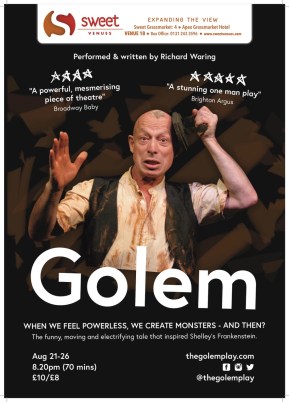
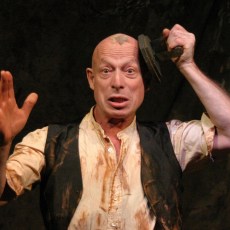
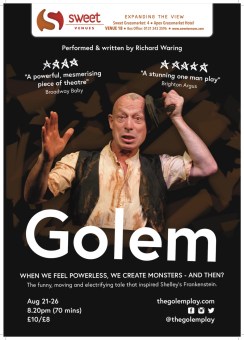
Golem is a stark, matter-of-fact recanting of a very ancient tale, that of the man-created monster, which once inspired Mary Shelley’s Frankenstein at the Villa Diodati in 1816. Returning us to its primal origins is Golem’s creator & sole actor, Richard Waring, who wakes up on stage as some middle-aged Jewish tinker with a drama-chiseled face perfect for the fancy, declaring, ‘I am still here!’ & proceeds to shimmer through the play as if he was in a permanent state of mild electrocution. In a recent interview with the Mumble, Waring, described the hoped-for effect his play would have on audience members as being;
that people will look at the things that they hold true in their lives and question them. I do believe that this version is really relevant to what is happening in the world today
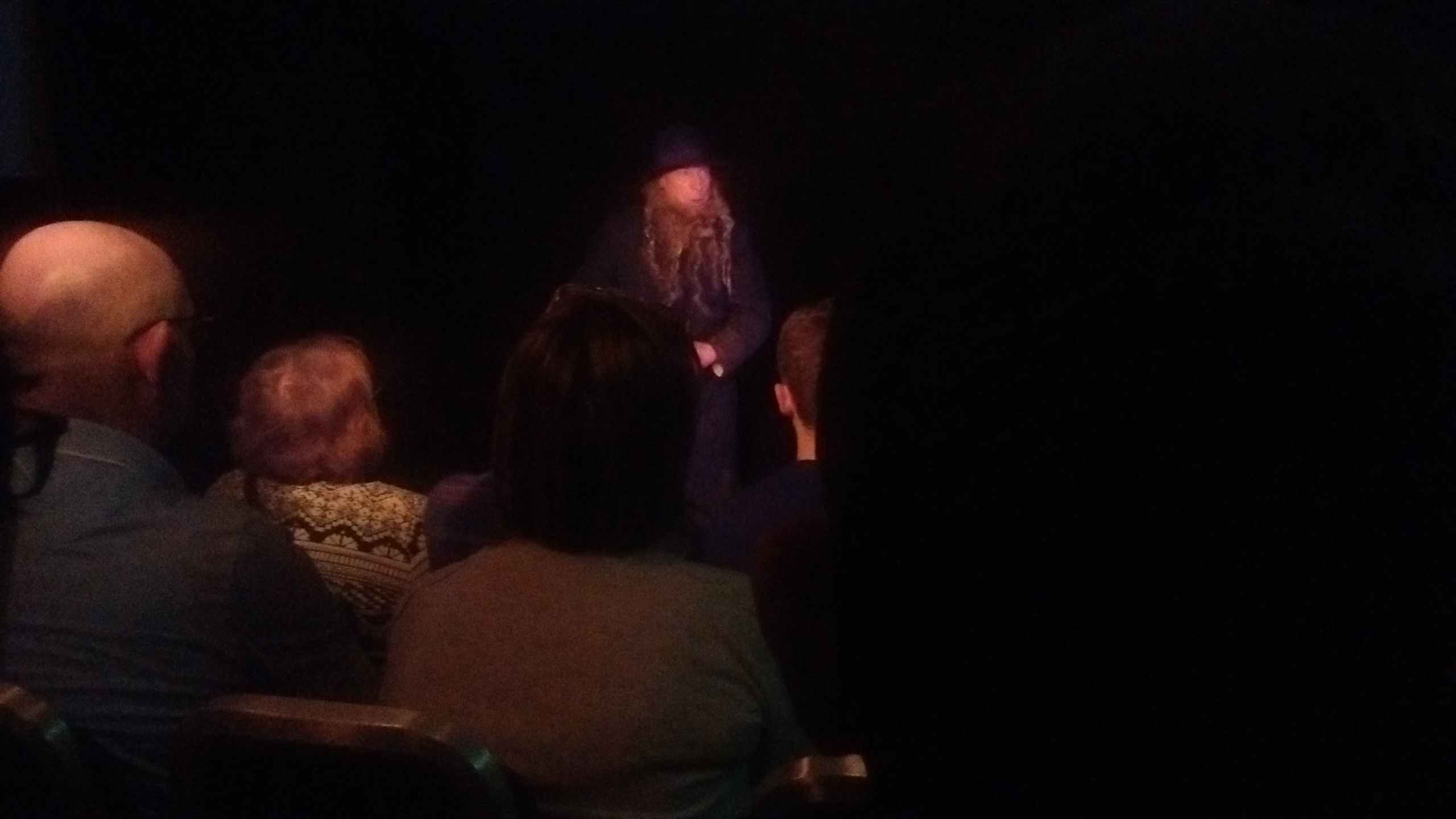
Through Golem, Waring asks for us all some of the fundamental questions of life, to which matter an eerie smattering of phantom sound effects have elevated the trance. His rich, slow, caterpillar dialogue reminds me of some religious procession through the streets of Jerusalem, while his dramatic body movements help Richard to achieve an absolutely riveting delivery of his play. ‘Under the wings of the Exalted One,‘ we follow the day-by-day progress of his creation, which is then superseded by the arrival of a classic, curly Jew, who proceeded to tell us a series of Jewish stories & jokes &…. well, it was all quite surreal & heady-headed, but fascinatingly morbid enough to hold one’s attentions, especially when caught in the grip of Waring’s fiercely lyrical performance.
Reviewer : Damo
An Interview with Helen Potter
 Hello Helen, so where are you from & where are you at, geographically speaking?
I grew up in Essex in an area so rural and unpopulated it doesn’t actually have a name, but I went to school in Chelmsford, so let’s say there. I live in London now having just graduated from East 15. It’s expensive.
When did you first find yourself getting into the dramatic arts?
They held auditions when 10 for the big play that year in Primary School and I landed the lead role, Susan the evacuee. It was probably the biggest ego-boost I’ve ever had.
What for you makes a good piece of theatre?
Taste is so individual it’s not worth pinning it down to style, but big selling points for me are always commitment, discipline and energy. If the actors are working hard and have gone for something ambitious it’s probably worth watching. At the fringe in particular I’d always rather see something that’s risky enough to divide opinion rather than plateau at ‘it’s good.’
When did you first realise you could write for the stage?
So much of writing seems to be just allowing yourself to try ideas out on paper and not judging yourself for them. The best writing I do is what comes out naturally, the worst is the material I write because I think it’s what people want to see, or what’s currently deemed as ‘in vogue.’ So probably at the point where I felt confident enough to write the really wacky stuff that I love as opposed to attempting something profound.
Which playwrights have inspired you?
I was mentored by East 15 CT alumni Charlotte Josephine when I was initially writing ‘Leaf’. Her emphasis was always on finding my own style and I’ll always respect her for that. Jesse Briton was also a mentor when ‘Leaf’ was part of East 15’s Debut Festival and he’s such a wickedly astute person his opinion is invaluable. I’m also always inspired by improv groups, it’s that kind of quick, sharp thinking that I like to try put in my writing – Racing Minds are a great example (although a little more family-friendly.)
What does Helen Potter like to do when she’s not being theatrical?
I play the violin, and I love making vocal arrangements of things and creating new music. I’m also a big fan of the outdoors (leaf..?), reading (currently working back through the Harry Potters), running, and cooking.
You are in the middle of bringing Leaf to Edinburgh this August, can you tell us about the play?
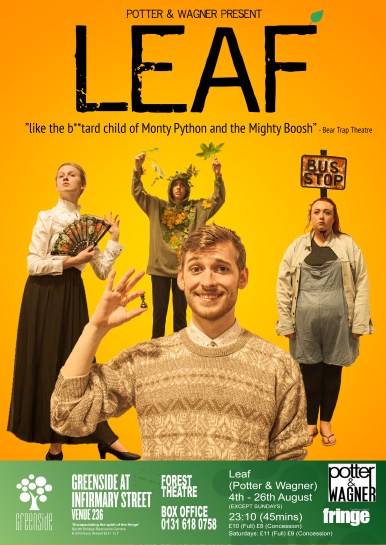
Leaf is a larger than life comedy that is both entirely based on the truth, and an absolute load of fictitious nonsense. As quintessentially British as the queen eating her roast dinner off a Boris bike seat (perish the thought!). Originally developed at East 15, Leaf is a show that combines the emotional rollercoaster of a socially awkward chemical engineer, with the wild chaos of a sketch-show.
What emotive responses have you been getting from your audiences?
Laughter (as we’d hoped.) Often mad guffaws when people are astounded by the sheer absurdity of what’s happening on stage. My favourite moments are when the true sadness of the characters is exposed – people often don’t know whether to laugh or let it sink in, the confusion is delicious. There’s a fantastic sense of guilt in what you’re laughing at sometimes, honestly we’re all just revelling in someone else’s troubles.
How do you find performing in your own play?
Difficult and fantastic. Honestly I wrote something that I would enjoy as an actor. I love mad, fast comedy, and I love the challenge of finding emotional truth in there as well. On the other hand, being a writer always makes you hyper-aware of the work, and you have to work hard to treat the two as separate identities in a rehearsal room. I’ve had the best team behind Leaf at the fringe, and their respect and encouragement has really helped me to develop the play without damaging its integrity – that in itself is indispensable.
Can you describe in a single sentence the experience of putting on a play at the Fringe?
Bloody hard work, incredible experience.
What does the rest of 2017 hold in store for Helen Potter?
A life for Leaf! We’re taking it back to London and on to other cities to spread the delirium. For me personally, I’d like to keep writing, and I’m working with my lovely agent Kate Borde as an actor, so I’m very fortunate in still being able to maintain two strides for now. Probably more violining in things, more puzzling in the living room, more Fleetwood Mac. Anything and everything that comes!
You can catch Helen in Leaf right now at the Fringe
Aug 21-26 : Greenside @ Infirmary Street (23:10)
From Ibiza to the Norfolk Broads
Script: Stagecraft: Performance:
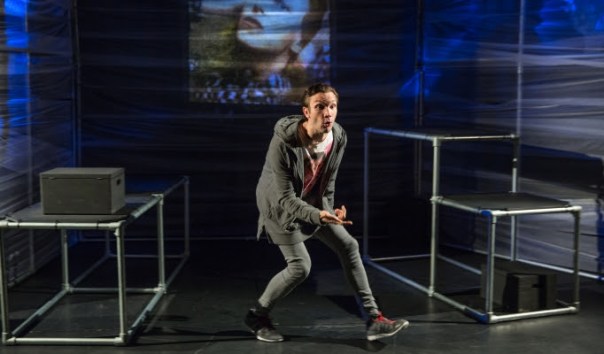
Martin has an illness nobody understands. This one man show written and directed by Adrian Berry is about far more than David Bowie. An 18 year old fan of Bowie who lost his father at the age of 2, peels back the layers of social isolation, eating disorders, anxiety and trying to come to terms with his father’s death, in addition to an alcoholic mother. It’s impossible not to feel sorry for Martin as he embarks on a journey to London, guided by a letter from his late father, who also loved Bowie. Travelling in the footsteps of his father he visits Bowie’s school, home, a Croyden pub where Bowie performed, and finally Soho where Martin at last begins to feel a sense of belonging, before moving to the last and tragic destination. In a recent interview with The Mumble, From Ibiza…. writer/director, Adrian Berry, described his creation as;
Three stories that converge – a tale of our capital city and things that are lost, about a boy with mental health problems who escapes through his fantasies, and the amazing birth, childhood and journey of David Bowie. It all comes together at the end, and people seem to love it, happily.
Alex Walton delivers a solid performance as the troubled teenager; whose only solace is through his love of Bowie; he knows he is different, but Bowie makes it cool to be different. Bowie is also his only real link to his father. There isn’t a great deal of silver lining to this show, and I was left wondering whether Martin would come through it all or not. However, Walton takes on the character convincingly and it is a very honest and raw depiction of adolescence, loss and mental illness. The voice over of Bowie (Rob Newman) was convincing and haunting, as well as the small parts also acted by Walton, in addition to the voice over of Glenda the counsellor, all made for a compelling performance.
Although I felt there could have been more music and content about Bowie from the obsessive Martin, it is an in-depth and honest portrayal of a troubled upbringing and the powerful influence of musicians.
Reviewer : Sophie Younger

An Interview with Richard Waring
 Hello Richard, so where are you from & where are you at, geographically
speaking?
Basically – North London – once lived in Sheffield and now in Lewes near Brighton.
When did you first find yourself getting into the dramatic arts?
During the summer holidays I joined the Junior Drama League but was too shy
to act so just did the tech stuff. However at University I joined the drama society and became one of their leading actors.
What for you makes a good piece of theatre?
A good story well told helps – but then I’ve seen great work that has little
story but was hair-raising and brilliant. So it has to touch the human condition somehow.
When did you first realise you could write for the stage?
I’ve never really thought about it – it’s just something I have occasionally done usually out of necessity – I’ve also written Kids books and worked as a Scriptwriter/script Doctor in the film industry for a bit.
Which playwrights have inspired you?
Shakespeare of course, Becket (love), Rattigan (great craftsman, really
underrated), Lopa De Vega, Durramat, Mamet, Miller.
When it comes to theatre, you are quite the polymath, but for you which are the most interesting & exciting aspects of the stage?
I just love the magic of theatre and the immediacy of it. I love working with scripts best of all I think.
You will be bringing Golem to Edinburgh this August, can you tell us about the play?
I’ve been mucking about with the Golem story for years. It’s one of the first monster stories – man screws around with nature to create something they hope will save them only for it to run amok – that sort of thing.
What compelled you to weave Judaism into the Frankenstein story?
Actually it’s much older than the Frankenstein story and an academic friend told me that it was the source material for Frankenstein. I also wanted to explore religious fanaticism and thought the Golem story was a good way in. Also I am Jewish so I understand it’s some of its rituals and beliefs from the inside (I think).
What emotive responses do you expect from your audience?
On a basic level, I want them to feel they have got their money’s worth. I
also hope that people will look at the things that they hold true in their lives and question them. I do believe that this version is really relevant to what is happening in the world today.
What does the rest of 2017 hold in store for Richard Waring?
Fun – got a couple of theatre sets to design and build, some teaching and I’ve got a few Golem bookings – including one in Spain!
You can catch Richard in Golem throughout the last week of the Fringe
Sweet Grassmarket : Aug 21-27(20:20)
Goody
Pleasance Courtyard
Aug 20-28 (14:15 )
Script: Stagecraft: Performance:
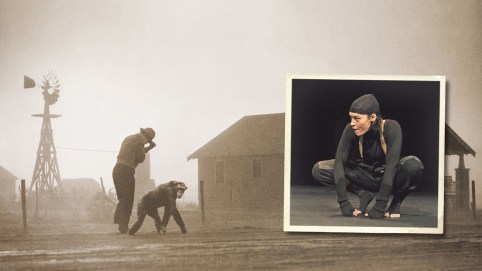
There is something quaintly charming about the experience of watching Goody. This play is brought to us by Boondog Theatre, & is essentially a monologueing travelling-entertainer monkey-handler & his bubbly nose-picking, booze-swilling chimpanzee, played with wonderful agility by Lucy Roslyn. watching her in action shows that altho’ we humans have lost the tail, we can still pull off the moves.
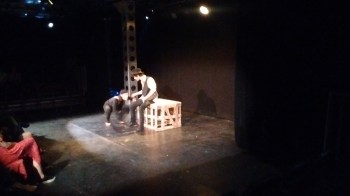
The time is 1930’s Dustbowl America, & what follows is rag-tag ride through reminiscence & inter-species friendship, combined with a lot of silent monkeying about by Roslyn, which was all, like I said, quaintly charming. Then something unexpected happens, the chimp begins to speak. ‘Ouch’ I thought, that wasn’t needed, why set up one type of theatre, then rip the rug from under out psychic feet. Then I remembered something Lucy had said in a recent interview with The Mumble:
It is a darkly funny look into the relationship between one man and his ape – two characters unable to communicate on an equal level. Backstage at the circus we meet Goody, a performing chimpanzee, and her one companion: her trainer Frances. How does this relationship work? An ape is dangerous and volatile. Even with an animal you have known for years, things can flip in a moment
Was she actually talking about the flip between a chimpanzee & a speaking monkey! Either way, Goody is ultimately a ghostly piece of theater where nothing much of interest really happens, but when it does it actually detracts from the theatrical illusion.
Reviewer : Damo


 Mumble Theatre