Category Archives: Uncategorized
Wind In The Willows
Script:  Stagecraft: Performance:
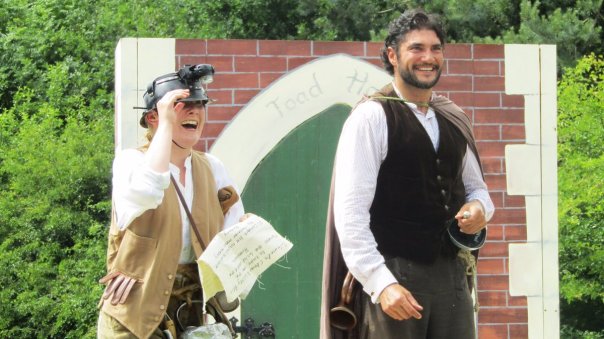
Thirlestane Castle – with its rolling, green, and sheep-flecked grounds – makes for quite the Arcadian backdrop against which a touring troupe of players might perform. While Chapterhouse Theatre Company’s “The Wind in the Willows” does have a very serviceable and aesthetically-pleasing set of its own, there is no doubt that the production is imbued with no small amount of romance by its wider setting, lit only by the evening sun, and punctuated by picnics, pleasantries, and children rolling about in the grass.
 With food digesting, and thermoses at the ready, we turned to the stage as the first performer strode forward and announced that we were all going to have a lovely time, and that if it rained, we would get wet, but at least we were all in it together. This prologue delivered, the actor was joined by the rest of the cast and their instruments, and the show opened with a song. Thus began a pleasant two or so hours, during which the multi-talented – and mostly multi-roled – performers entertained us with the well-loved tale of Mr Toad, his companions, and his conscience.
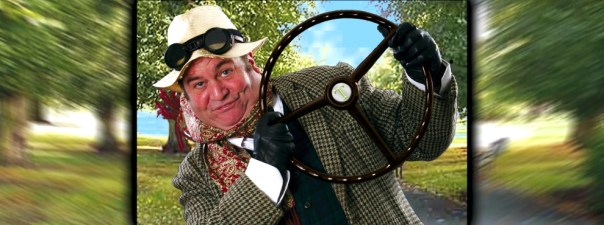
The difficulty with children’s shows is generally in the pitching, for they need to please both the kids and their parents, and thus too often fall between two stools. In the case of “Willows”, while there are moments when the jokes land a little over the heads of the kids, and the length of the play is perhaps fifteen minutes too long for the attention spans of the youngest in the audience, Chapterhouse largely succeeds in avoiding this pitfall, with the children clearly engrossed in the story, and happily discussing the characters on first-name terms come the interval. The grown-ups, too, were engaged, and although the script and the staging tended to err on the safe side in terms of experimentation, this is perhaps not unwise in a production already so vulnerable to the elements.
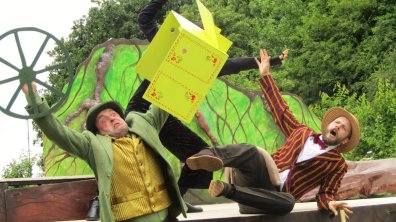
Particularly impressive were the clarity of delivery in the al fresco setting, and the upbeat nature of the performance, without the cast resorting to shouting or over-loud sound effects, which I have seen frighten young children time and again at the theatre. Even the “baddies” (Weasel and Stoat), were amiable in their way, and both could be found after the performance with swarms of children around – and, in one case, climbing *on* – them.
This is a talented cast within a solidly professional company, delivering a dependable and quality production. If it is the gorgeous setting that elevates it still further in the audience’s experience, that doesn’t detract one bit from the delight those present took in the evening as a whole. We had a lovely time, it didn’t rain, and – as promised – we were all in it together.
Reviewer : Laura Ingham

An Interview with Rachel Briscoe
 Hello Rachel, so where ya from & where ya at, geographically speaking?
I’m from St Albans, which is a fairly dull commuter town just north of London, and I live in Newcastle-upon-Tyne, which is brilliant.
When did you first find yourself getting into the dramatic arts?
Quite late really… I thought it would be a good way to meet people at uni, so I produced a freshers’ play. It was terrible (the play, not the organisation – it was organised very well, if I do say so myself). I thought, how hard can this directing thing be? So I decided to have a go. I think the first stuff I directed was probably quite bad, but luckily not too many people saw it!
What for you makes a good piece of theatre?
Something where I don’t notice time passing, where I’m totally engrossed and the lights go up and I can’t believe it was two hours long. Something where I laugh out loud, have a moment of profound sadness – and then think about it for days afterwards. I don’t ask for much.
What does Rachel Briscoe like to do when she’s not being theatrical?
Cook! I love food and sharing it with other people. At the moment I’m refining my recipe for the perfect burrito. I can talk about food for hours. Once I’ve finished one meal, I’m already planning the next one. I also like running but I think that’s just so I have an excuse for eating more food.

Can you tell us about fanSHEN Theatre?
We make theatre, live events and interactive experiences. We’re really interested in taking massive, important ideas and synthesising them into playful, dynamic formats. We’re also fascinated by the different ways in which we can co-create with the people who experience our work – whether that’s them playing within a structure we’ve made, creating content or committing radical acts of imagination with us!
 What was the initial inspiration behind forming fanSHEN?
Honestly? Dan Barnard –who I run fanSHEN with- and I graduated and realised we had a choice: we could either sit there and wait for someone to give us a job, or we could get on with making something happen ourselves. I’m really pleased we made that decision. Over the last ten years, having the company has allowed us to build a family of amazing associate artists, make some great projects and meet fantastic audiences.
Have you been to Edinburgh before, either visiting or performing?
I brought shows as a student but not since then. I visit most years – it’s a great chance to see shows by companies you’d never normally encounter.
You will be bringing Lists For The End Of The World to the Fringe this August, can you tell us about the play?
Lists… is a show composed entirely of crowd-sourced lists, from all kinds of people in all kinds of places – including from the audience as they queue up to take their seats. In Lists…, the ordinary and the extraordinary, the profound and the ridiculous sit playfully side by side: Things I pretend to be interested in; Times my 8 year old self would be proud of me; Places I would hide a body. It includes laughs, music, sadness, romance, some dancing, a look at the world through other people’s eyes, fish sticks. Each performance is different then, what are the ingredients for the best shows?
That’s right, we source content online and from each audience. Some stuff will stay the same and some will be different. I guess I’m always trying to make sure that there’s a real range of perspectives in there – there are moments in the show where I want people to hear something and think “Oh yeah, me too!” but also moments where I want them to be like, “Wow, I never thought of it like that.”
What does the rest of 2017 hold in store for Rachel Briscoe?
We’re opening a new interactive show called Disaster Party, which is like a murder mystery crossed with one of those melodramatic Latin American telenovellas. We’re also piloting a new playable theatre jury game. And I’m starting to make new piece about AI. And R&Ding a new show about a woman who jumped off the top of Empire State Building and got blown back in again on the floor below (true story!). And I might try to have a couple of days off – I hear December 25th is a popular choice.
Lists For The End Of The World will be playing throughout the Fringe
@ The Summerhall
2-27 August (Not 14, not 21) 13:45
An Interview with Joyce Nga Yu Lee
Hello Joyce, so where ya from & where ya at, Geographically speaking?
I’m originally from Hong Kong but I have been living in Leeds for 8 years. People tell me I now speak with a Hong Kong/Yorkshire accent. I am pretty proud of that.
When did you first realise you could write for the stage?
When I realised that writing for the stage is not about pen and paper (or screen and keyboard). I write with choreography, rhythm and pacing, light and sound including words and voices. I try to treat the script to my theatre like notation to music.
Which playwrights have inspired your own writing?
Antonin Artaud, Jerome Bel, Isabel Allende, Susan Sontag, Roland Barthes. They are not playwrights but they inspired me. They gave me imageries, intensions and provocations.
What is the difference between Chinese Theatre & that of the West?
Haha can someone please first sum up what ‘Theatre of the West’ is? As you can imagine it is both impossible and wrong to try and summarise. From my observation, There are a lot of theatre venues where I came from in Hong Kong that look like the venues I see in Europe. Performance happened within them and tended to be similar to each other, no matter where they come from. It is when you venture outside the boundaries of theatre venues then you will discover the joy of diversity. Go to a tiny factory or flat, converted into a studio theatre and see what independent theatre makers are passionate about and how they make theatre with minimum resource; go to a teahouse or community centre to see Xiqu (generally known as Chinese opera), which has got a totally different aesthetic on stage and etiquette off stage; or even a pedestrian only street to see what tricks street performers are up to. Theatre is everywhere.
What does Joyce Nga Yu Lee like to do when she’s not being theatrical?
I like gaming on my phone or computer. I enjoy a good story without stressing about my HP all the time, so I am more into RPG, adventures and puzzle games. I particularly like classic Chinese martial arts RPGs which I play on DOS simulator. I also like reading: sci-fi, history, science, economics, politics, manga… just not romance.
Can you tell us about your company, Mind the Gap?
Mind the Gap has been creating work since 1988 and I’m pleased to say that we’re one of Europe’s leading learning disability theatre companies. We’re all about creating an arts sector where there is equal opportunity for performers with learning disabilities, creating work for local, national and international audiences. The type of work we produce includes touring theatre, site sensitive productions, forum theatre and more recently street theatre. We make work alongside people with learning disabilities that excites, surprises and challenges audiences.

You are also the artistic director of the multi-art form Daughters of Fortune. Can you tell us more about this project.?
Daughters of Fortune looks at humanity through the eyes of parents with learning disabilities. It involves three live performance outputs, the three daughters: Anna, a interactive forum theatre piece; Mia, a contemporary studio theatre piece and Zara, a large scale outdoor spectacle. Anna and Mia are perfectly formed “sisters” and now on the road. The little sister Zara, who is due early 2019, however involves the biggest ambition. Zara will feature a three storey tall puppet baby, with epic choric movement of people and vehicles. Just imagine a cross between Godzilla, District 9 and the opening ceremony of the Paralympic Games.
 Through Daughters of Fortune you are bringing Mia to the Fringe, can you tell us about the play?
Mia is a fast moving contemporary performance that appeals to audiences who like the new and authentic. In partnership with Royal Holloway and with the support of the Wellcome Trust, the team collected real stories from parents with a learning disability. Everything in Mia is grounded in real life stories. The subject matter is impossibly complex, the performance is composed to reflect this complexity. The performance is structured with a series of non-linear episodes strung together with a progressive narrative arc. The episodes vary in form and pace, from high energy pop dance to intimate acting, low tech object manipulation to live feed camera and loop pedal. Mia is highly demanding for the performers, and catered for audiences with a critical and inquisitive mind.
What emotive response do you expect from the audience?
Some feedback I heard frequently was that it was like an “emotional roller coaster”, and “laugh one minute and cry the next”. Mia is full of jump cuts between light and shade, sometimes the absurdity of reality even renders us not knowing whether to laugh or cry. When you leave the theatre, I hope you feel entertained, but also feeling a bit more human and energised for action.
What does the rest of 2017 hold in store for Joyce Nga Yu Lee?
When you see me in Edinburgh this year you will see me sporting a baby bump 🙂 Isn’t it interesting? While I am heading a project about having babies, I am making one in my belly. This is an incredible experience. If you have read our marketing material, you’ll see the doubts and questions one may ask when considering having kids: can I cope? Will I be able to afford it? Will I screw it up? These are real questions I am asking myself. I still can’t answer yes to all these questions, but I’m trying my best and ain’t letting fear stop me.
You can catch MIA : DAUGHTERS OF FORTUNE at the Fringe
Aug 8-27 : Summerhall (14.45)
An Interview with Hippolyte Poirier
 Hello Hippolyte, so where ya from & where ya at, geographically speaking?
I was born and raised in a little village called Gidy near Orléans in France and moved to Hull at the age of 10 – quite a culture shock! After 8 wonderful years in the North East, I moved down to Surrey to study at GSA and have lived in London for two years since graduating. Despite having lived in the UK more than half of my life, I am still very much a proud Frenchman at heart.
What for you makes a good piece of theatre?
I think that there are many factors that contribute to making a quality piece of theatre but ultimately it boils down to the story and the characters. At least one of those things has to have some quality (preferably both!) otherwise there is no hope of getting your audience engaged. It might sound a bit obvious and simple but then again, I’m easily pleased! As an audience member all I’m asking for is to be taken on a journey with the plot and to connect with the characters on an emotional level. It’s also always a bonus when a piece not only provokes emotional reaction but intellectual reflection as well.
As an actor, what are the secrets to a good performance?
One of the most important things for me is to be relaxed on stage so that I allow everything to come naturally. As soon as the nerves kick in and you start thinking about yourself as an actor or what the audience might be thinking, it becomes near impossible to get any truth out of your character as you’re not fully concentrating on them. It’s also crucial to listen to and focus on your fellow actors as they are the people that you are (re)acting to. Acting is a massive team effort and listening is the key.
What does Hippolyte like to do when he’s not being theatrical?
Plenty of things! I love sports, football in particular so I spend most of my time watching or playing it (on FIFA). I’m a Gunner through and through and football is probably the closest thing I have to a religion. I also play various instruments and love a singalong.

You are a member of Junkbox Theatre, can you tell us about the company?
JunkBox was created just under a year ago but they have already achieved an incredible amount. They sold out their first show and have only gone upwards since them. Georgia, Ali and Jack having trained as actors had to learn how to direct and produce on the job and I really admire the fantastic job they’ve done. I’ve been lucky enough to act in all of JunkBox’s shows so far and have enjoyed every single one. I can’t wait to see what they come up with next and as their friend, I am very proud of their deserved success.
Have you ever been to Edinburgh before whether visiting or performing?
I performed two shows at the Fringe in the summer of 2014 and had an amazing experience. I loved the hub of creativity and enthusiasm that is the Mile, saw so much great theatre and met some brilliant people. As there was a lot of flyering involved last time, I am looking forward to exploring the city in between seeing as many shows as possible.
 You will be performing in two plays in Edinburgh this August, can you tell us about them?
“Mine” follows the stories of three young couples and their experiences with planned/unplanned pregnancies. It’s got a great balance of humour, touching moments as well as a couple of scenes to tug at the heart scenes. It touches on subjects that are rarely showcased in theatre and does so in a very honest and accurate way.
“Stiff Dicky” is a very different show and as the title would suggest, is not quite as serious. Two best friends go on a birthday night out with the rest of their group, pick up a friendly Frenchman and wake up the following morning to find a corpse sporting a rather impressive erection in their bed. Hilarity ensues as the group try to work out what to do next. Both shows are a joy to perform in as the characters are contrasting and well written.
What does the rest of 2017 hold in store for Hippolyte Poirier?
When I get back from the Fringe, the first task will be to move in to a new flat as no matter how important acting may seem, housing has to come top of the list. Otherwise, I don’t really have many plans for the rest of the year but I’m looking forward to whatever comes my way.
You can see Hippolyte the August at the Fringe in two different plays
MINE : Aug 5, 8, 10, 12, 14, 16, 18 : Space Triplex (21.15)
STIFF DICKY : Aug 4, 7, 9, 11, 15, 17, 19 : Space Triplex (21.15)
An Interview with Glenn Chandler
 Hello Glenn, so where ya from & where ya at, geographically speaking?
I was born virtually on the slopes of Arthur’s Seat in Edinburgh, so doing the Fringe is very much coming home, with a brisk climb to the top every morning to keep myself sane for the day ahead. I now live in Hertfordshire. Contrary to popular belief, I never lived in Glasgow, and when writing Taggart had to immerse myself in a very different culture. For an Edinburgh public school boy, that was quite terrifying at first!
When did you first find yourself getting into the dramatic arts?
Long before creating Taggart, in a universe far far away, I wrote a number of short plays for two London fringe theatres, but when TV came a-knocking I let it in and a Glasgow detective series was born. While immensely grateful for everything TV did for me, about nine years ago I made the decision to go back into theatre, and not only write but produce – and ultimately direct – my own work. It’s about taking control, taking risks, and doing the things you can’t do on television.
What for you makes a good piece of theatre?
Entertainment value. Showmanship. Imaginative staging. Something that sends me out smiling rather than shaking my head. And if it changes my perception of life and gives me something to think about all the better. I saw a show last year on the Fringe which was an interplanetary adventure through space and time and it was performed with cardboard boxes and an ironing board as a rocket. It was brilliant. I love that sort of stuff.
When did you first realise you could write for the stage?
It was an extremely hot summer in London (1976) and I had a dull office job on Piccadilly. One day I got chatting to the boy who operated the photocopier (they were huge machines in those days). It turned out he worked as a rent boy on his lunch hour and he told me a few stories about his experiences. I wrote a play about him and his mates and it was put on at the Little Theatre in St Martin’s Lane, which is now Stringfellows. He came along and loved it, and I realised I loved writing for the stage. I often wonder what happened to him.
You are a prolific writer for stage & screen, but what does Glenn Chandler like to do when he’s not being theatrical?
I love walking and hill-climbing. My partner and I used to spend two weeks every year in the Highlands with a tent, camping rough, but the midges sadly had a policy of non-cooperation. I enjoy astronomy – I have a ten inch reflector at home. Family history is another great passion, I have traced my Chandlers back to 1575 in the New Forest where they were yeoman farmers. My favourite discovery was that my grandfather was a bigamist, a fact I’m very grateful for. If he hadn’t abandoned his first wife in London and come to Edinburgh where he met my grandmother, I would never have been born and would not be writing this.
Can you tell us about the transition from being a writer to being a producer?
It was a baptism of fire. In 2008 I produced my first two shows in Edinburgh, one of which was my own Boys of the Empire. It was a sell-out. However, somebody forgot to tell me that as a producer you have to put up/find/steal/borrow the money. You also have to look after actors, soothe their egos, deal with hundreds of little problems that come up daily, like the young actor who was constipated for two weeks, went to the doctor and got an emergency quick-acting laxative. He was performing two shows each day. I went out and bought the nappies. Luckily, his relief came between shows, but it was nerve-racking for a while. You think being a producer is glamorous?
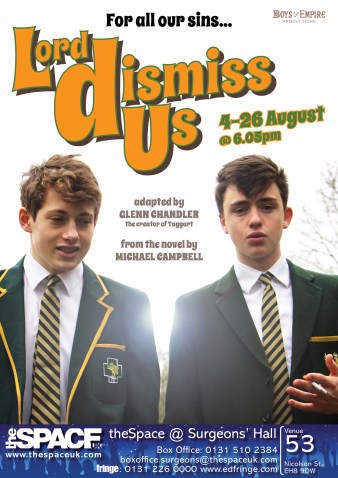
You will be bringing Michael Campbell’s novel, Lord Dismiss Us, to life this August, can you tell us about the novel & the play?
I read the novel as a teenager (under the bedclothes) and it made a great impression on me. Although I wasn’t aware of it at the time, it was a coming-out novel, all the more remarkable for the fact it was written in 1967. As a gay teenager, who had gone through school and experienced some of the same emotions, I lapped up every page. The play is the very first adaptation. I have had to cut some characters and combine others for reasons of time and economy, but the main protagonists are there and though I have had to tweak the story a bit I hope and believe I’ve stayed faithful to the spirit of the novel.
Do you feel a connection with Michael Campbell in any way?
Quite definitely. He went to St Columba’s School in Dublin, which was his model for the sexually repressive Weatherhill School in the novel. It is said that the suicide of a master there was the inspiration for one of the characters. He lived for many years with his male lover, a publicity director for the firm of Heinemann who were his publishers. When he died, he left the rights to Trinity College, Dublin, from where I bought the rights to adapt the novel for the Edinburgh Fringe. I’d love to have met him and known more about his boyhood and schooldays, but even if half of Lord Dismiss Us is autobiographical, he was having rather an interesting time. For the period.
What emotive responses do you expect from your audience?
Oh gosh. I want them to laugh. The novel is very, very funny and I hope the play is too. The boys put on a school musical within the play which involves dressing up as girls, and there’s a passionate snog which raises the ire of the headmaster who tries to stop the show. The result is mayhem. But it’s a tragedy as well, and in the year that it’s set – 1967 – Parliament partially decriminalised the law on homosexuality. Nevertheless, Terry, the hero of the novel, leaves school and will be a criminal until he is 21. I want people to realise what life was like fifty years ago, to see how far we have come in half a century. There are some powerful emotional storylines involving two boys in love, a master wrestling with his sexuality, treachery and betrayal. Yup, I suppose I’m going for every emotion I can get.
What does the rest of 2017 hold in store for Glenn Chandler?
I want to climb a Scottish mountain. Desperately! A stiff breeze and no midges and a bottle of Islay malt. Then think about what happens to Lord Dismiss Us. I have plans, but nothing cast in concrete yet.
An Interview with Matthew Zajac
 What for you makes a good piece of theatre?
Brilliant acting, a strong script which is unafraid to tackle the most challenging subjects, great theatrical ambition and synthesis of theatre disciplines and an absence of anything superfluous. Everything which is on stage must be there for a reason.
What does Matthew Zajac like to do when he’s not being theatrical?
Climb hills, meet my friends and family, read and watch Inverness Caledonian Thistle.
You are a member of Dogstar Theatre can you tell us about the company?
Dogstar has commissioned, produced and toured new plays for 18 years from its base in the Highlands. It has built an international reputation, in spite of surviving for all that time on individual project grants. The company is a dogstar with a bone.
Can you tell us about the transition from being an actor to being an artistic director?
I’ve been running companies for most of my 35 years in this business, so there wasn’t much of a transition. Generating work myself and with colleagues is one of the main reasons I’ve managed to keep going as an actor.
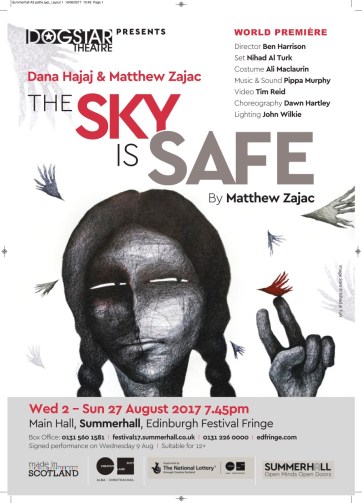
You will be bringing The Sky is Safe to Edinburgh this August, can you tell us about the play?
In 2012 I was stranded in Istanbul for nine days while I waited for an Iranian visa which eventually was refused due to my UK nationality. This was during a period when diplomatic relations had broken down between iran and the UK. I’d been due to go to Iran to play a role in a feature film. I had a couple of interesting encounters on Istanbul’s streets and wrote about them. Last year I was pondering a new project for Dogstar and remembered the Istanbul experience. I learned that there were now around 350,000 Syrian refugees in the city and I decided to try to marry my earlier experience with that of Syrian women trying to make a life in the city. In March this year, I returned to istanbul and, with the help of a local NGO, I had the great privilege of meeting and interviewing a number of Syrian women in their homes. A lot of what Amal, the female character in The Sky Is Safe comes from these interviews. She is essentially an everywoman, a composite character who embodies aspects of the female experience of the Syrian war. The play is a two-hander, and I’ll be playing Gordon, a Scottish executive on a work assignment in Istanbul. His business has some bearing on the war, so he represents aspects of the West’s relationship to Syria and the greater Middle East. We are lucky to have a wonderful creative team on this show – Director Ben Harrison, who worked with me on The Tailor of Inverness and Factor 9, Composer Pippa Murphy, Video Designer Tim Reid, Costume Designer Ali Maclaurin, Choreographer Dawn Hartley and Lighting Designer John Wilkie. The Set Designer is Nihad Al Turk, a highly respected Syrian visual artist who came with his family to Scotland from a refugee camp in Lebanon 16 months ago. Our main publicity image is one of Nihad’s paintings.
In one sentence can you describe the experience of performing in Edinburgh in August?An exhausting and exhilirating whirlwind full of highs and sometimes lows.
What does the rest of 2017 hold in store for Matthew Zajac?
Resting, hoping for a successful outcome to Dogstar’s fourth attempt to get Regular (core) funding and for some interesting acting work where someone else is doing the producing etc., getting out into the hills, supporting ICT’s efforts to bounce straight back into the Premier League and writing.
Matthew will be bringing The Sky is Safe to the Edinburgh Fringe
Aug 2-27 : Summerhall (19.45)
An Interview with Reese Thompson
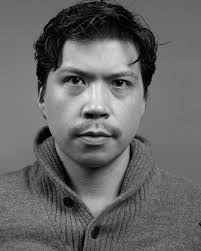 Hi Reese, so where ya from & where ya at, Geographically speaking?
I grew up in Queens, New York. Currently I’m living in downtown Brooklyn. Lots of hipsters with strollers and prams. There’s always a new artisan cafe or gym about to open.
When did you first realise you could write for the stage?
When I saw people in the audience laugh instead of fall asleep. It took a long time to get there though. Also, when people walk out because they’re offended. Obviously, I’d rather people stick around and like the play. What I tell myself is that it’s preferable to total indifference. I hope I’m not being delusional.
Which playwrights have inspired you?
Chekhov, August Wilson, Caryl Churchill, George Bernard Shaw, Joe Orton, Ibsen. Not the most original list, but each is like their own planet. I can keep returning and never stop finding reasons to love and be fascinated. I also love Simon Stephens, Brian Friel, Paula Vogel, Chris Shinn, Young Jean Lee, Tarell Alvin McCraney, Suzan Lori-Parks. All for different reasons. I’m also inspired by people like Pina Bausch, Ariane Mnouchkine, David Lynch. I could go on. A strong cup of coffee can be very inspiring also. Also, I’m someone who’s in a constant state of excitement over some writer I’m either discovering or re-discovering. Right now I’m obsessing over the Brontë sisters. If I had to choose, I think Emily would be my favorite.
What does Reese Thompson like to do when he’s not being theatrical?
Watch cat videos on youtube, hang out in bars with friends, try not to feel depressed about the world, obsess. I’m kind of boring.
You have poetry in your blood, does this transfer into your writing for the stage?
The short answer is yes. I’m still discovering how, so maybe I’ll have a better answer in a year. Also, I was never a good poet. Poetry is so hard. It seems easy because anyone can do, but it’s also hard to be really good at it. What I can say is that years of trying to be good at it has had an influence on how I write. I think poets craft their writing in a very particular way. I also think it trains your ear. So my obsession with rhythm and syllables and word choice are things that have been hammered into me. Even writing a joke requires attention to craft that I don’t think I would have without poetry.
Have you ever been to Edinburgh before whether visiting or performing?
I haven’t. This is my first time! I’m very excited!
 You have written the rather interestingly titled ‘Whore, A Kid’s Play’ which is coming to Edinburgh this August. Can you tell us about the play?
It’s definitely a title I have to earn. The play is about friendship and all the ways we become the person we end up being. With the play (and the title), I was trying to capture a time during adolescence when we’re never more innocent and vulgar at the same time. As an adult, someone can call me a fag, a whore, or a chink, and (if there’s no threat of violence) it doesn’t bother me because I know who I am and whether what they’re saying is true or not. But when you’re a kid, you don’t know yourself as much, so being called names can be a bit more scarring. Also, when you’re a kid, everything is so high-stakes. At some point it all amounts to wanting to be a juvenile delinquent of some sort. Why is that?
What does the rest of 2017 hold in store for Reese Thompson?
I wish I knew what I was doing this afternoon. Probably more writing.
Reese will be bring his creation to the Edinburgh Fringe this August
Aug 4-26 : Greenside @ Infirmary (16.05)
An Interview with Joy Donze

Hi Joy, so where ya from & where ya at, Geographically speaking?
I grew up in middle America in a small town called Perryville, located an hour and a half outside St. Louis. In other words, I’m from the heartland of America. The corn and the cows and the caves. 🙂 I’ve lived in New York City for the last 8 years.
When did you first find yourself getting into the dramatic arts?
I came out of the womb “hamming” it up. I started taking piano and dance when I was 6. Took my first acting class in middle school. I did drama and choir all through high school. I got my BFA from Avila University in Kansas City, and MFA from The New School for Drama in New York City.
What does Joy Donze like to do when she’s not being theatrical?
Wait, there is life outside of theatre? I like to produce. Something I’ve learned about myself is I love to watch things come together. I like introducing artists to one another and fostering community. I am, also, a professional karaoke host. I host parties in then Brooklyn NY nite life scene. I am, also, a teaching artist. I love working with kids. I mostly facilitate drama club, social awareness, mindfulness, and leadership.
Have you ever been to Edinburgh before whether visiting or performing?
Nope! I’ve always dreamed of going to this festival! I traveled around Europe a ton, but I have never been to Scotland!
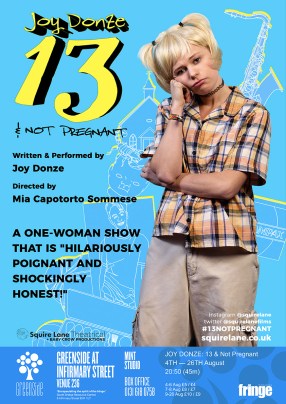
You are bringing your ’13 & not Pregnant’ to Edinburgh this August. Can you tell us about the play?
“13 & Not Pregnant” is a one woman show that features verbatim journal entries from my 6th grade diary. I always knew I wanted to turn my diary into a theatrical piece, and began working on it in a solo performance class in 2015. I’ve performed it in New York and Chicago and both times it was well received. Not only by my friends who love to laugh at my ridiculousness, but also folks who have never met me. It’s enjoyable for anyone over the age of 13… Anyone whose been through puberty. Thankfully, I, also, wrote down popular song lyrics from my youth, and did some self deprecating poetry… So no fear – there will be dance breaks.
How have you found working with Director, Mia Capotorto Sommese?
Mia and I met in graduate school and worked together on an Ionesco piece called “The Lesson.” When I first read the play I thought…. What?! But Mia is so brilliant, and it ended up being one of my favorite theatrical experiences. It was a challenge, but she is a great storyteller and dramaturge. I knew she would let me approach my show the way I envisioned and give me freedom, while still helping me shape, stage, and specify the piece.
What for you makes a good piece of theatre?
Stories worth telling and a strong need to tell them. If the story isn’t important to you – why would it be important to anyone else. I am drawn to new narratives that need telling. I’ve been focusing my artistic endeavors towards social and political theatre that pushes the boundaries and steps outside tradition.
What does the rest of 2017 hold in store for Joy Donze?
Hmmm, well…. I’m not sure at the moment. Let me get through August and I’ll get back to ya! 🙂
Joy will be bringing her play to Edinburgh this Fringe
Aug 4-26 : Greenside @ Infirmary (20.50)
Pride & Prejudice
Thirlestane Castle
Lauder
18th June 2017
Script: Stagecraft: Performance:
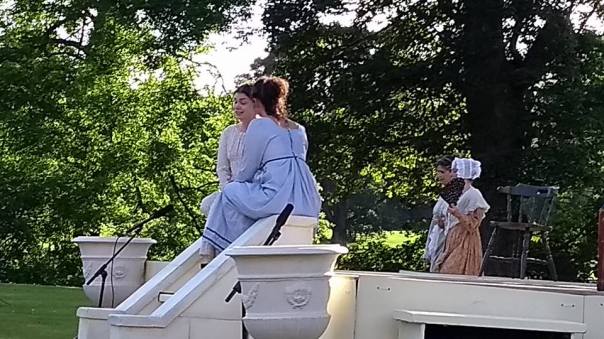
It was with great excitement & also slight trepidation that I drove to Lauder with my two daughters – aged 8 & 10 – to see Chapterhouse’s al fresco version of the seminal classic of Regency literature, Jane Austen’s Pride & Prejudice. Adapted for the stage by Chapterhouse’ in-house penswoman, Laura Turner, in a recent interview with The Mumble she elucidated on working with such a sacred text; ‘there’s definitely a lot of pressure working with stories that everyone knows and people feel so passionately about. I feel a responsibility to the author themselves, to reflect their work as they might have intended, and also to the audience who will be looking forward to seeing their favourite bits come to life! As with any adaptation, you inevitably have to leave things out but I hope that in doing so I still capture the overall feel and heart of the story. It’s never easy to make these decisions but the external factors of time constraints and the amount of actors I have to play with forces my hand, but I never make these cuts or changes without real consideration of whether it feels right. Hopefully it enhances the storytelling by making the production streamlined. I’d hate for an audience to get bored!’
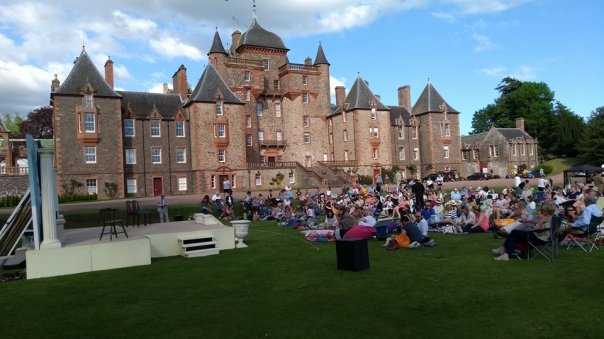
Amidst a beautiful blast of greenery overlooking sheepfields, perched in front of the glorious Thirlestane Castle with picnic baskets & pimms, P&P is played out before us across a simple, static Georgian set. Twyx silly sisters & dashing gents, the formalities of Regency romance are bounced to & fro between Lizzie & her Darcy, all egged on to a merry nuptial conclusion by Lizzie’s gold-grabbing mother. The music is beautiful, the dancing is sweet & the overall time-travelling effect is quite authentic. I was part of a happy audience, a mix of all ages, enjoying the ideal setting – golden sun bouncing off green fields – as much as the story, whose complexities almost actively encourage one’s mind to meander up into the cyan skies.
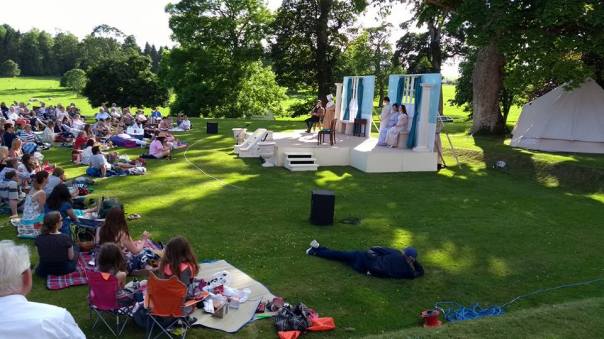
As sounds of bleeting sheep competed with the pop of champagne corks, the High English of the actors was delivered throughout a charming & at times extremely compelling performance. The whole thing pointed to what it would have been like to have witnessed the Elizabethan court being entertained as it made its way round the stately lords of England, such as at Kenilworth in 1577. Both my daughters loved being there for separate reasons. My younger enjoyed the adventure park more, but at the half-time interval – as the raffle was rumbling away – I enquired as to my daughters’ joint enthusiasm for staying. ‘Damn right we are,’ said the eldest & raced back to her seat to continue laughing aloud at lines such as, ‘I find you endlessly appealing even against my will.’ Meanwhile, the young mothers to our our left were chirping, ‘isn’t this just the picture of civilization – sangria & strawberries at the castle,’ & I could not have been more cordial in agreement.
Reviewer : Emily Beeson Bullen

The Lyceum welcomes 70,000 Rooftop-Residing Bees

The Royal Lyceum Theatre Edinburgh is delighted to welcome 70,000 new permanent residents to the theatre; two hives of bees, now housed on the theatre’s rooftop. Having arrived in June, the bees are part of the theatre’s comprehensive green initiative, and public are invited to adopt a bee or sponsor a whole hive, with all funds raised going towards making The Lyceum more environmentally sustainable.
Within the next five years, The Lyceum aims to replace the diesel-ran company vehicle with an electric one, install LED lights throughout the Front of House areas, and replace the theatre’s ageing boiler system in favour of a more efficient system that will significantly reduce carbon impact, with all bee donations going exclusively towards these goals. Green initiatives such as these will help lessen the theatre’s impact on the environment, allowing existing limited financial resources to be directed towards artistic programming and vital outreach work in the community and with young people.
Ben Twist, Director of Creative Carbon Scotland, said: “We are thrilled that The Lyceum, a leading member of the Green Arts Initiative, is taking this wonderful step. This is exactly the kind of inventive and engaging project that we have learned to expect from Scotland’s cultural organisations. Environmental sustainability projects often seem difficult to pay for, and The Lyceum’s creative thinking shows how it can be done. I believe that The Lyceum will soon be just the first of many arts organisations in the country to fundraise specifically to improve their environmental sustainability.”

Brian Pool
Looking after the theatre’s beloved bees is Scottish-Honey’s Brian Pool, a third-generation professional beekeeper with 40 years of experience.
Speaking of The Lyceum’s new residents, Brian said: “The Lyceum’s roof is now home to 70,000 bees who have settled in very nicely – you wouldn’t even know they were there. With access to Princes Street Gardens and the Meadows to collect nectar and pollen, we’re looking forward to collecting some delicious Lyceum Honey.
The Lyceum is the first theatre I’ve worked with and joins other Edinburgh institutions like The Balmoral, St Andrew’s House, and Royal Botanic Gardens to host my beehives.”
Individual bees can be adopted for £1, and Dine, Edinburgh’s contemporary brasserie located near the theatre, are the first to sponsor a hive for £500. As thanks, The Lyceum hopes to provide honey harvested from the roof, for use in the restaurant.

 Mumble Theatre