Professional Cultural Surveyors
The Mumble are in the vanguard
Of the 21st Century reviewer
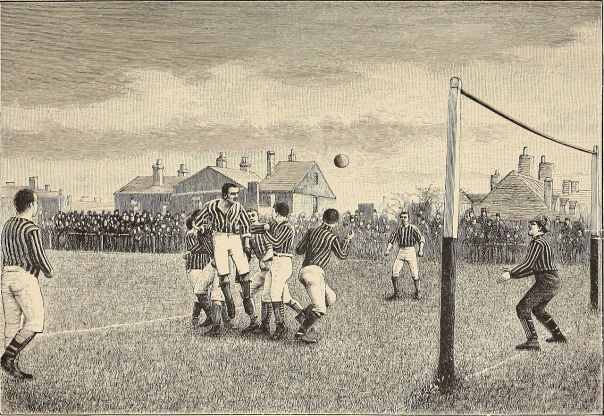
The 1880s saw the dawn of a new breed of footballer – the professional one, the one that got paid to play. The old boys of the public schools, who founded the game in the first place, were in total uproar. Despite such protestations, growing public demand declared an appetite for the better players, & began to happily pay to observe sustained quality throughout their beloved game. By 1888, twelve clubs from the Midlands & Lancashire – including that of my home town, Burnley – had conjoined themselves into the first professional football league. Roll on a century & a third & a Women’s World Cup is just kicking off where the best female players are being paid healthy sums of money to perform, & most of all inspire, on a global stage.
Reviewers need paying and – as this week’s developments at the Evening Standard show – the publications that employ them need to see a sustainable future in theatre criticism or it will continue to dwindle
Alistair Smith
A similar state of affairs has just been illuminated through an article & editorial from the Londoncentric The Stage, who were absolutely choking on their biscuits to hear that the Mumble asked artists for £25-£30 to cover our reviewers’ expenses. Maybe decades-old publications like The Stage can still afford to operate on a model that pays its reviewers via advertising and subscriptions, but newer publications need to find fresh ways to break even in an increasingly demanding market.
As is generally the case with these things, a spiteful attack from a member of a common body proves the innovation. The actual story is weak journalism. A rake through twitter found an ‘expert witness’ in a gentleman who has ‘been doing the fringe for six or seven years and have not encountered this before.’ He cannot be talking about the Edinburgh Fringe, for it is common knowledge among performers that most publications exchange coverage for cash during the Edinburgh August in various guises. The Mumble openly charges £25 or £30 to mobilize our reviewers, a figure kept low in order to preserve the integrity of our journalism. You cannot just magic a review out of thin air, they must be laboriously crafted. Reviewers need to get to & from town, to eat & drink while they are there.
You’ve got to ruffle a few feathers to break a few eggs
To make an omelette
Damian Bullen

Professional Cultural Surveyors are currently in the cute puppy stage of their existence
During the Fringe the Mumble publish both paid & unpaid reviews. Of the latter sort, we cherry-pick the better offerings from the publicists paid thousands to get reviews for free. Of the former, the paid review, we offer a clear & professional service. This is not London rules anymore, we are in the heat of an Edinburgh August, when our mostly local reviewers take on the role of cultural surveyors. If you’re trying to sell your house in a crowded market, you get the surveyors in. The same applies to the Edinburgh Fringe and its thousands of shows.
£30 might not seem a large sum for theatremakers keen to sell tickets at the fringe
Luke Emery
The Mumble is based in Edinburgh all year round, & delights in the fact that the cream of the world’s performance art permeates our gorgeous city’s nooks & crannies every August. The reviews we bounce back off these thousands of fabulous artistes are read, appreciated & disseminated in every country across the planet. To some, thousands of miles away, they are an eyeglass into the beautiful operations which encompass the Edinburgh Fringe. To others, these reviews are validations of months, years even, of hard work & rehearsal to produce a show they always hoped the random public would enjoy.
The falling away of the number of critics who can afford to come up to the festival has a cumulative effect. It is hard for us to get the word out about shows during the festival without the help of the star ratings given out. These sell the shows to the crowds when there are so many to choose from when we put them on the posters and leaflets. The word of proper, quality reviewers really matters.
Mel Brown
For each of our seven years at the Fringe, the Mumble team has gone from strength-to-strength, being enabled & enriched with an ever-widening pool of experience reviewing each of the performing arts. Our perfectly impartial reviews are sent pinging across the world to family, fans & friends of the performers. Despite this, the journalists at The Stage would rather people saw a Mumble review & quibble, ‘that’s been paid for, its not right.’ Instead let them say, ‘that’s been paid for, that is valuable;’ & see a positive Mumble review as a mark of quality from a diligently honest company of Professional Cultural Surveyors.
Damian Bullen
What the Animals Say

Oran Mor, Glasgow
June 3 – 8, 2019
Script:  Stagecraft: Performance:
As we settled in our seats, the simple set (6 chairs and a screen) effectively took us to the waiting room of the Stranraer to Belfast ferry. This two-hander by David Ireland (first performed at the Oran Mor in 2009) concerns two young men, Eddie (Jordan Young) and Jimmy (Kevin Lennon) who encounter each other in the ferry terminal. The two soon discover that they are actually old school buddies from Belfast although they then took completely different paths in life. We get an inkling of this from their attire, with Eddie looking very smart in his expensive track suit and state of the art headphones, while Jimmy is scruffier in rather down at heel casual gear.
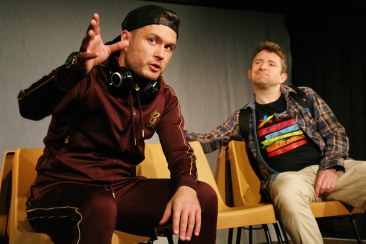
It turned out that Eddie had made it big as a football star and now captains Glasgow Celtic and hobnobs with celebrities. Jimmy, as he continually impresses upon Eddie, is an accomplished actor, but is still seeking his big break; the role that will really put him on the map. At the moment he was on his way to an audition which he hoped could change his life, to be in a new Mel Gibson film. As the two converse, we see Eddie’s larger than life personality as he becomes more and more personal with Jimmy, and exposes his own sectarian and racist attitudes. The military-sounding flute and drum music that introduced the piece had already given us a clue as to the underlying themes what would be explored.
The contrast between the two characters couldn’t be greater, with Jimmy quoting Shakespearean passages in the face of an increasingly threatening and volatile Eddie. The content came fast and hard with the whole thing seeming to be an emotional outburst about the sectarian sector we know of in our society. The writing had a straight attitude towards that by simply having them state, the hard facts that are on the road in the Glaswegian lifestyle. It also got to the heart of its subject by posing abrupt emotions; as they really seem to lie in us that they both did with the same sincerity but also lightening the mood as needed be.

In the second part of the play, there was a complete turnaround. The scene changed to a dressing room where Eddie was practicing his lines. It drove Jimmy mad that Eddie now wanted to try his hand at acting and has persuaded Jimmy to help him with his lines in return for an introduction to Mel Gibson. But after some more personal jostling they both wind up with balaclavas on their faces, a no holds barred and rather shocking effect that was done with a little humour. Eddie held a small bat in his arms with much too great a relish. In the end Jimmy was beaten with the bat as Eddie just loses it and can find no more use of words. With its straight down the line dialogue, this play challenges many levels of perception, perspective and reality. You cannot look away, it was strong theatre.
Daniel Donnolly

An Interview with Jared Harford

Imagination Workshop offer an Edinburgh Fringe experience all unto itself. The Mumble caught up with its director-curator…
Hello Jared, first things first, where are you from & where are you at, geographically speaking?
This is always a question and a half! So, originally I’m from New Zealand, then moved to Australia, then moved to the UK, then back to Australia with a stop in Thailand, and nomadic living in Australia for three months. I’m currently in Melbourne and setting up a home base. However, I’m currently in Canada before returning to the UK for the run-up to Fringe.
When did you first develop a passion for performance art?
I would say from birth! I was very lucky growing up to have free instrumental music education through school in Australia – something that isn’t offered all around the country and is under threat from a lack of cultural policies by conservative governments in Aus. My mum is an actress, and my dad used to work behind the scenes in the local theatre in NZ as well as work in a props hire shop. I was also lucky to go to a high school whose main focus was on performing arts, so I got to experience a lot of drama and music that most people don’t get to at that age.

Love/Hate Actually
Can you tell us about your training?
I studied at the Queensland Conservatorium and received a Bachelor of Music in Performance with a Major on Classical Clarinet. I was lucky in my final year of study to change to an amazing musician and beautiful human being who really pushed me hard and brought back my passion for performing after wanting to quit my degree. I owe so much to her for really strengthening my focus on what I wanted to do and making me learn the flute! (I play clarinet, sax, and flute.) I also owe a lot to a close friend of mine for pushing me to be a better jazz and musical theatre musician – though that’s all training on the job!
You’ve got three famous performers from history coming round for dinner. Who would they be & what would you cook; starters, mains & dessert?
Amy Winehouse, Charlie Parker, Gian Marco Schiaretti. But if I was allowed anyone, it would be The Queen, Louis XVI, and Catherine The Great. As for cooking – I am not the best but I think something like: smoked duck with a sweet sauce; a pasta dish; and coconut panna cotta. Though I imagine at least two of my performers wouldn’t do much eating at all!
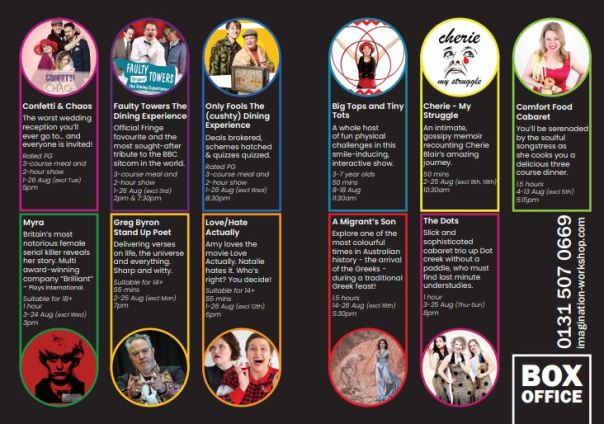
Can you tell us about Interactive Theatre International?
It’s a relatively small company that competes on the same level as large theatre companies. We started in 1997 with Faulty Towers The Dining Experience and now tour that show to 40 countries. It’s a true smash hit, and it’s about to sell its millionth ticket – might have done so by the time this is published! We have four other shows also touring currently, and they’re all immersive and interactive comedies too. And we have actors and admin staff based in Australia and the UK – there are 90 of us now!

A Migrant’s Son
It’s like one big happy family – can you tell us about the personal ties?
The company was founded by Alison Pollard-Mansergh, who is my mum, and her husband Peter Mansergh. I started working for the company two years ago in the UK, my sister currently works part-time doing design, and my brother works part-time doing tech. Because my little brother and sister were so young when Faulty made its success in the UK and Europe, they have travelled around the world and the majority of the staff in the company and actors know them! So for them, it’s just family and extended family!
The company goes from strength to strength, what is its secret?
Drive, determination, and Ali. Honestly, the company’s key to success is Ali – she has a way of creating and developing shows that entices people from all around the world to come to see us. And people even try (unsuccessfully) to copy us! But you know what they say, Imitation is the sincerest form of flattery…
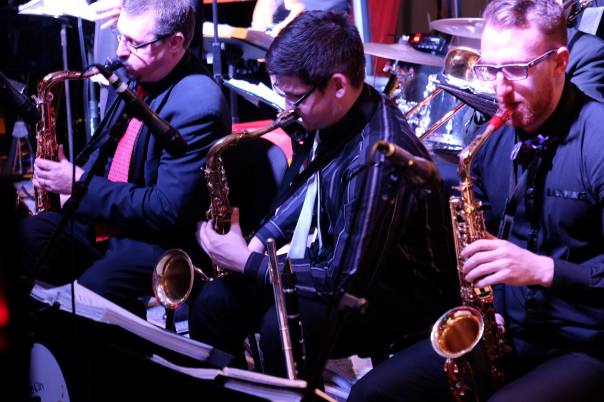
Jared having a jam (right)
Can you tell us about Imagination Workshop?
Imagination Workshop is the home of immersive and interactive theatre. For us, it’s about showcasing non-traditional theatre and non-traditional theatre spaces. And it just so happens that at Edinburgh Fringe we’ve got a 4-star hotel to transform. It’s way more classy than other venues!

You’re bringing quite a few shows to this year’s Edinburgh Fringe, what do you think of the festival?
Edinburgh Fringe is The Thing that made us A Thing. We love it, and I personally love it – as exhausting and full on as it is!
How is your working relationship with the venue?
Amazing. We love the level of support and enthusiasm the team at the hotel have for us and what we do – especially the General Manager, Andreas. The thing about us is we don’t fluff around with each other. We cut to the chase and are open and honest. In business it’s a rare thing, so it builds a strong relationship and support from the get go. Being a decent human being is important, I say!
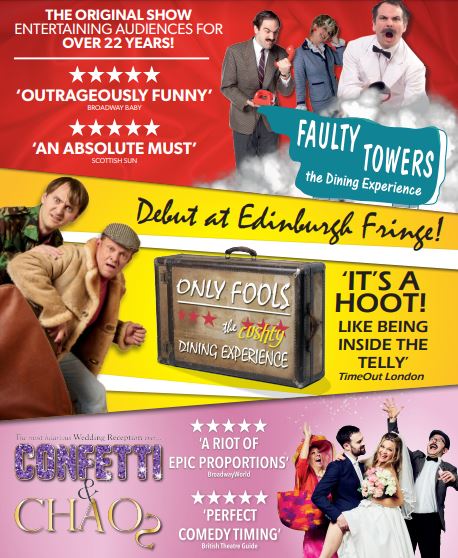
You’re bringing your classic shows like Faulty Towers and Confetti & Chaos (formerly The Wedding Reception) – the Fringe would not be the same without them, by the way – but what new stuff have you got for this year?
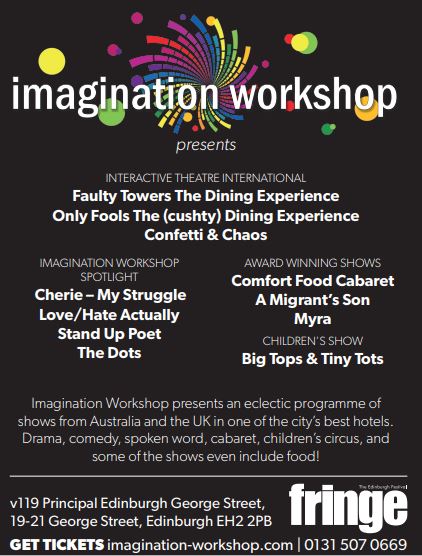
Yes, I think Faulty Towers The Dining Experience is the Official Fringe Favourite – people look out for us year on year, and keep coming back to us! This year ITI is bringing up three other shows too: Only Fools The (cushty) Dining Experience makes its Fringe debut, Pamela’s Palace is over at The Assembly, and The Wedding Reception returns as Confetti & Chaos – a name that really does fit the show! We also have eight other shows coming to our venue this year! Four Aussie acts and four from the UK. Two of those are dining shows, so we have five shows with food in the venue (the others are A Migrant’s Son and Comfort Food Cabaret). And everything is interactive or immersive!
Which are the kid-friendly shows?
All our shows are kid friendly, whether PG or G. And we have fun interactive kids circus called Big Tops and Tiny Tots, which is from Australia: Luth is an amazing performer and really has a way to get kids and parents having a great time
What will you be doing personally after the Fringe?
Sleeping. Lots of sleeping. But hopefully I’ll get a holiday somewhere on the way back to Aus!
Imagination Workshop
THE GEORGE
Principal Edinburgh George Street Hotel
An Interview with Birdlife Productions

New Zealand puppet-theatre company, Birdlife Productions, are touring Europe this summer. The Mumble had a chat with man & wife maestros, Roger & Bridget Sanders
When did you first develop a passion for theatre?
Bridget: I lived in London when I was a teenager and it was the 70’s – a fantastically vibrant and creative environment to be immersed in. In those days you could cycle into the West End and queue for theatre tickets to all the best shows for only a £1. After that I went to Leeds University and studied Theatre and Dance and Art at Bretton Hall.
Hello Roger. So what for you makes a good piece of theatre?
Roger: Hello! I go to the theatre to have my mind and imagination opened. I want to be totally transported to the world that is presented to me and fully absorbed by it. I want to make theatre for the same reason.
What is it about performing in front of other people that makes you tick?
Roger: Actually I don’t really know the answer to that. I think it might be something to do with the opportunity to be totally present in the moment with a group of people, sharing something of value through creative expression.
In a world where entertainment is on demand – what makes theatre so special?
Bridget: The difference between theatre and video is like the difference between seeing a picture of the ocean and actually swimming in it – what’s to compare? Theatre is something that envelops us and we immerse our whole selves in it. We hope that Theatre is always entertaining – but I think we go there looking for more than that – we want to be changed by it – if only momentarily.
How did you you two meet?
Bridget: Roger and I met in the wilds of West Wales – we were both looking for something outside of the mainstream or something more to life. We had babies and lived in a Tipi but from early on we promised ourselves that one day we would make our living from being creative together.
How does being in a romantic relationship influence your professional partnership?
Roger: It actually really helps! Our Theatre company is our livelihood so we have to get through things – there is no walking away. We understand each other very well and are able to have a lot of fun, which helps us deal with the challenges.
What does your perfect Sunday afternoon with Bridget look like?
Roger: Being out in Nature laughing about life!

Can you tell us about Birdlife Productions?
Bridget: Up to a few years ago we were both involved in The New Zealand based BodyInSpace Theatre Company. I had started out as a props and costume maker and my involvement gradually morphed into performance. When that company folded, Roger and I decided to form our own company – we really wanted to try and make a living from the thing we loved. ‘Birdlife’ was the name of our first production and the name stuck!
What are the key tenets to telling stories without words?
Roger: Understanding and communicating the emotional journey, effective use of visual symbolism, recognising the way body language reads and visual timing. Simplicity helps!
Can you tell us about the design process behind creating your puppets from inception to performance?
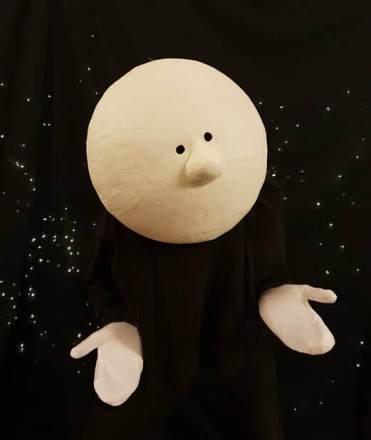
Bridget: Puppetry is a very fluid Artform – anything can become a puppet. I have learned over the years that having too fixed ideas about a particular puppet can be restrictive to the process. I usually start the rehearsal or devising process with a mock-up of a sort of puppet that fulfils the character and then the actual mechanics of the puppet come much later, when we know how sophisticated it needs to be or how much it needs to communicate. Our creative ethos is very much about the ‘hand-made’ – we want children to be inspired to think they could do it themselves so we like to keep the puppets as simple as possible, often making them out of recognisable stuff like junk and household objects.
You are bringing a show to Europe in 2019 called ‘Kotuku and the Moon Child’ – can you tell us about it?
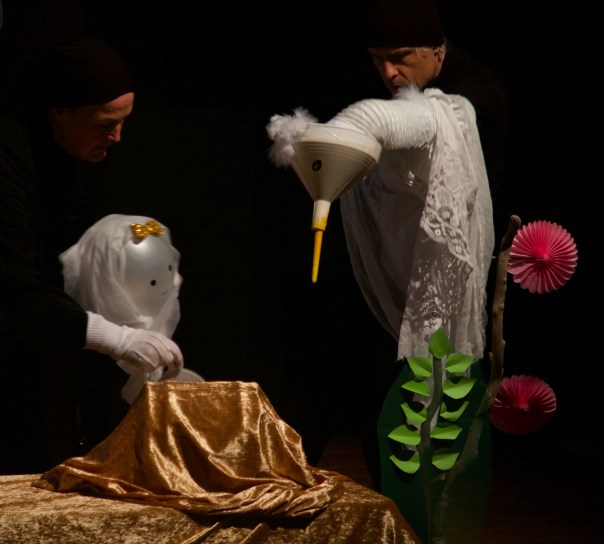
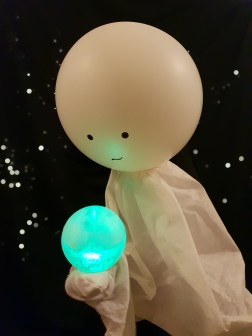
Roger: A Moon Child gets trapped on Earth – how will she find her way home? This is a 50-minute family puppet and mask show that uses modern puppetry techniques mixed with the spirit of traditional fairy tales which have been shaped and inspired by the New Zealand landscape – it’s light, colours and bird life. The story unfolds using only the languages of mask, puppetry and music. It is accompanied by a beautiful original piano score by New Zealand Composer David Sanders, who also
happens to be my brother.
Where did the idea of ‘Kotuku and the Moon Child’ come from?
Bridget: I was on holiday near an estuary and a lone Kotuku (white Heron) came to visit every day. In New Zealand, the Kotuku is a very rare and auspicious bird that brings good luck. The story, somehow, came to me fully formed over a weekend – although we have made quite a few tweaks to the story over the past year!
The play has already been winning awards in your New Zealand home, can you tell us about this?
Roger: We debuted this show at the New Zealand Fringe Festival in March this year. The judges gave us the ‘GREEN LIGHT LIST AWARD’ which was a new award to honour and encourage a show that did not fit into any particular category. We then went on to the Dunedin Fringe Festival in April and won ‘OUTSTANDING DESIGN’ which was a terrific honour, and unexpected for a children’s show.
The themes seem universal, are there any age restrictions, and if not how do you think each end of the age-range will be entertained, and those in the middle too, of course?
Bridget: Yes, the themes are universal, but also very relevant. Our New Zealand debut came the day after the terrible recent shootings of Muslims in Christchurch. In our story, the Moon Child is a little immigrant who finds herself in a foreign place. She learns to communicate, make friends and empower herself. It’s a story for children about empathy, relationship and healing. We use no spoken language in our show so all of this is conveyed through gesture and music. In these days of constant digital media there is very little opportunity for children (and their parents) to be fully immersed in gentle vibrant theatre. There is no age barrier to following our story and all ages seem to have been delighted by it – there is even enough adventure for teenagers. Having said that, children under 5 find it harder to sit still for the full 50 minutes and often need to verbalise what they are seeing, so it is better for 5 years and up – all the way to 95 years!
You’ve got 20 secs to sell the play to somebody in the streets, what would you say?
Roger: Step out of your world and give yourselves and your children a treat. Spend an hour with us immersed in a world of visual and musical wonder! It will make you happy!
Kotuku and the Moon Child
24th to 28th May, Prague Fringe CZ
12th to 16th June, Festival Valise, Poland
23rd June, Ludlow Fringe UK
28th to 30th June, Barnstaple Fringe UK
6th July, Small World Cardigan Wales
13th July, Guildford Fringe UK
19th – 20th July, Great Yorkshire Fringe UK
www.birdlifeproductions.co.nz
Leeds Playhouse: Autumn-Winter Season
James Brining
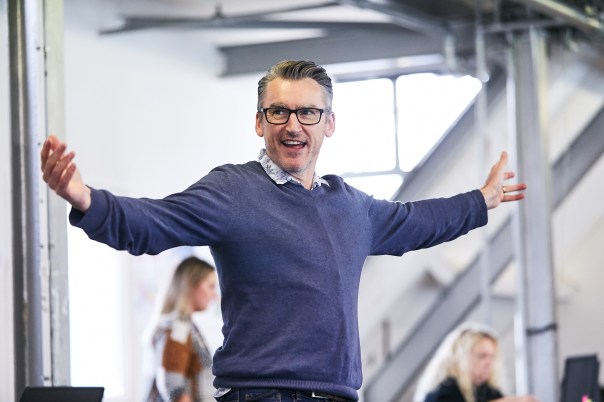
On Thursday evening last week, James Brining, artistic director, Robin Hawke, Executive Director, Amy Leach, Associate Director and whole array of writers, directors and performers presented the autumn and winter season announcement for Leeds Playhouse, running through their upcoming attractions. This year, however, the announcement was coupled with something even more exciting.
Last year, James Brining, announced an extensive £15.8 million redevelopment programme to what was formerly West Yorkshire Playhouse. Alongside this, he announced a name change to Leeds Playhouse alongside. This is a dishearteningly separationist world that we currently find ourselves in, a world of Donald Tump’s oft-threatened country dividing wall, a world of that business around leaving the EU. Against this backdrop, this name change could be interpreted as something of an isolating move, of a theatre extricating itself from the rest of West Yorkshire and becoming solely a theatre for Leeds. However, from the content of Thursday’s showcase, it is quite clear that is not the case. Not only is the theatre firmly rooting itself in all things Yorkshire, providing a voice to established and upcoming voices, as well as reaching out to the rest of the UK and the world beyond. The Leeds in its name is more of a doubling down on its identity, a reaffirming of itself as an important part of the city of Leeds, imbuing its new walls with the character of the city around itself.
West Yorkshire Playhouse closed its doors on June 23rd 2018, and since that date has held performances in a converted set workshop, dubbed the Pop Up Theatre. This performance space has seen many superb performances. Over the past 9 months there have been performances of 14 shows and over 50, 000 audience members have attended these performances. There was an air of regret at having to leave this temporary performance space behind – its longer stage and more intimate feel has offered new ways perform and the team have clearly felt at home within its walls. However, this sadness is now tempered with the anticipation of what is to come. What was originally intended to be a quiet year for Leeds Playhouse whilst development works took place, has become one of great creativity and activity.

Trojan Horse
The revamped Leeds Playhouse will offer two rejuvenated performance spaces in the Quarry and Courtyard theatres as well as one exciting new performance space – the Bramall Rock Void: a performance space that has been created below the theatre’s old box office, developed in the ground of Leeds’ Quarry Hill itself. The old theatre, while of great significance to Leeds’ cultural backdrop, did not command much awe as a building. However this new building will be much grander in both height and scale, offering a greater connection to the city itself with new entrances opposite Leeds Bus Station and a short distance from the heart of Leeds city centre. The expanded building will offer new routes through its spaces and new ways for the public to engage within – with bars and cafes sitting alongside the Quarry, Courtyard and Rock Void. The team’s excitement was palpable, and they were very much looking forward to waiting in the theatre’s entrances and witnessing the public’s reactions on their opening weekend.
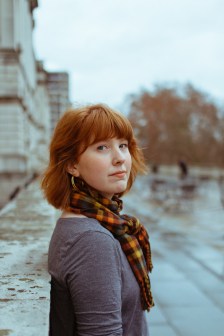
Charley Miles
A challenge that the team faced as work continued deep down into Quarry Hill, was the surprise discovery of bodies buried beneath the theatre. Historically, there have been three churches situated on Quarry Hill – from the Old Boggart House Methodist Chapel, to St Mary’s Church. It is likely that these churches had burial grounds on site, hence the discovery. With a wry smile, it was noted that many established theatres have their own ghosts that lend them a mystery and charm, so with any luck their very modern building may inherit its own ghost. What better a symbol of a strong link to the area and to local history than a ghost, with echoes of the past overlaid on the present?
Another fantastic symbol of the link to place and past is the new performance space, the Bramall Rock Void. This is named after the Liz and Terry Bramall Foundation, who have supported the Playhouse over the years and have donated significant amounts of money to facilitate this new development. This underground theatre features exposed red brick walls that echo the sarchitecture of Leeds, filling it with local spirit and character. It also has exposed rock in the floor to connect it with the very foundations of the city. From 11th – October to 2nd of November, the Bramall Rock Void will feature its inaugural performance – There are No Beginnings by local writer Charley Miles, who has found her home at the Playhouse. Set at the time of the Yorkshire Ripper murders from the discovery of the first body to the eventual arrest of Peter Sutcliffe, the play follows the lives of four individual women as they deal with curfews and a time that gave birth to the Reclaim the Night movement. Charley Miles firmly insists that this is most certainly not a story about the Yorkshire Ripper, but one about female resilience; it is a positive affirmation of a dark time. The Rock Void is a flexible space that allows for many different seating arrangements and this play will be performed in traverse, with the audience seated at either side of the performers, in an intimate and atmospheric production. Miles is thrilled about having her work performed here and describes the Bramall Rock Void as “an unearthed heartbeat that was hidden under our theatre all along”.
As building work continues on Leeds Playhouse, so does work on Leeds City College’s new Quarry Hill Campus next door. This new neighbour has provided fresh opportunities and a new production signals the burgeoning connections between the playhouse and Leeds City College. Leeds Playhouse’s Youth Theatre will be performing Influence, a new play by Andy McGregor at Leeds City College’s new campus from 31stOctober to 2nd November. Directed by Gemma Woffinden and taking inspiration from modern TV shows such as Stranger Things, Influence presents a lively comedic adventure full of explosive action as a group of teenagers embark on a search for a missing local boy. This new partnership is one of many that extends and deepens the Playhouse’s connections to the wider communities across Leeds and Yorkshire as a whole. The team remain dedicated to supporting developing talent in the area, and then showing this off across the county.
One such production is Trojan Horse (3rd – 5th October) by Helen Monks and Matt Woodhead, a multi award winning play award winning play that will begin a national tour at Leeds Playhouse’s Courtyard theatre in advance of the full opening festivities. Originally developed through the playhouse’s Furnace programme, the play won the Scotsman Fringe First award in 2018. It deals with the allegations of Muslim teachers plotting extremism in Birmingham schools and is built around real life testimonies of people from Bradford, Birmingham and London. Many theatres and institutions were reluctant to get involved with this project and the company themselves were very concerned that the sensitive nature of their work could ruin the reputations of those involved. However, the Playhouse was supportive in this venture and are proud to place this performance at the very beginning of their opening celebrations.

Other planned performances are: Northern Ballet’s Dracula at the Courtyard Theatre (29th October – 2nd November), a performance that is due to be broadcast live to cinemas across the world; A new production of Hanif Kureishi’s My Beautiful Launderette, running for two weeks (15th – 26th October) after the theatre’s opening weekend; Mushy: Lyrically Speaking (8th – 12th October), a true story about Musharaf Asghar from TV’s Educating Yorkshire;Barber Shop Chronicles, returning to Leeds after a sell out world tour. Additionally, there is a whole raft of performances aimed at a younger audience, designed to introduce them to theatre. In the run up to Christmas, they will be staging The Night Before Christmas, a play about language barriers that incorporating sign language into D/deaf friendly performances. This certainly highlights the theatre’s dedication to inclusive performance and its drive to create a fully accessible theatre experience.
Finally, we were treated to a snippet of the play Dinner 18:55, a play that was originally performed in February 2019, in advance of its UK tour. This is an intergenerational production born out the theatre’s Creative Engagement programme and features a cast of young people aged 18 to 21 and adults over 55. The play itself presents a moment in which two generations take time over a meal to converse and tell their stories. We got to hear two of the characters tell their stories: a young man mused on the nature of “success” in the age of social media and how he struggled to measure his own success against high profile success stories. Next, a retired social worker told his own life story and measured his experiences against this young man’s definitions of success, highlighting its truths and lies. Two cast members, Pat & Wisdom, spoke of their involvement in show, of bridging the generational divide and the opportunities presented that slowed them to tell their own personal stories as they improvised and collaborated on the writing of this production. This show, along with all of the others listed above, show exactly how much the Playhouse desires to reach out to the communities that surround it, to showcase local talent and develop their involvement in theatre.
Following a series of stress tests to ensure that the building is ready, along with the one coordinated toilet flush to ensure that the building can cope with its new influx of visitors, Leeds Playhouse will be ready to open its doors to the public.
Opening weekend will take place from 11th – 13th October, deliberately timed to coincide with Leeds’ hugely popular Light Night on 11th October. It presents a wonderful chance to explore the theatre’s new performance spaces, restaurants and bars, along with pop up performances in the atrium, tours and theatre workshops. The team have opted for a gradual opening, with each space having its own opening performance rather than one big bang event, and are very much looking forward to meeting their future audiences.
Steve Bromley
www.leedsplayhouse.org.uk
Cool Dads
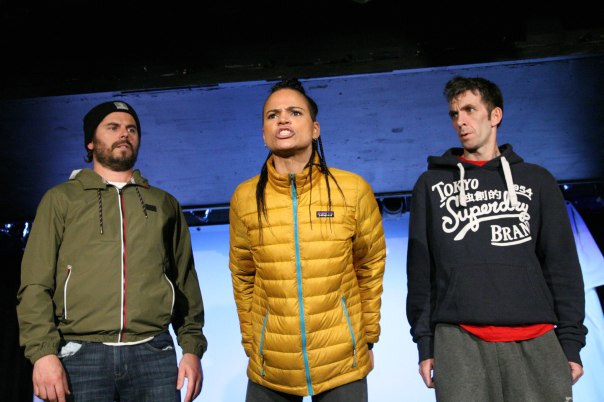
Oran Mor, Glasgow
May 20 – 25, 2019
Script: Stagecraft: Performance:
No sooner had the house announcer proclaimed “…with no further ado…” than the room fell silent and dark and we were catapulted straight into the action. The spotlight fell on an ever so green set, with two supporters standing on the touchline for the first round of the under 14’s Scottish Cup where their boys’ team, Mosspark, faces the mighty Kings of Rosshill. The banter between the sardonic Danny (Adam Robertson) and his pal Graham (Kris McDowall) was fierce and authentic, with Graham clearly terrified of the opposing team. Along comes the team coach, Paul (David McGowan), making a big impact in his tracksuit, along with larger than life Angie (Natali McCleary) who soon makes her presence felt.
The four of them, long term – and long suffering – fans, talk football and offer contrasting opinions and guidance from the side lines, yelling their gratuitous advice and instructions in the familiar manner of fans the world over. We see Danny unable to shift out of his negative mindset – even when their team scores, and then wins the match, he can’t find praise for the youngsters. His ranting becomes more and more aggressive as if he can’t stop himself while friend Graham keeps his back from any fray and tries to guide Danny towards a more peaceful mood.

It turned out there was history between Danny and coach Paul – they had a falling out when Paul’s football career was cut short due to an injury caused by Danny, something Paul had never been able to forgive. The two nearly come to blows, but Angie intervened and in an angry outburst she puts them in their place by shouting that life could ultimately be a lot harder and that in fact no-one had the right to think of themselves as the ‘cool dads’ that they think they were because there’s always something new to learn. In the course of these exchanges we came to realise that Danny had never known his own father, something he found hard to accept and which perhaps was at the root of all his troubles.
So there you have it – a great play not just about football (though that too) but about life and learning and living with our past. An enthralling hour full of gusto, passion and an ultimately moving story. What’s not to love?
Daniel Donnolly
An Interview with StoneCrabs
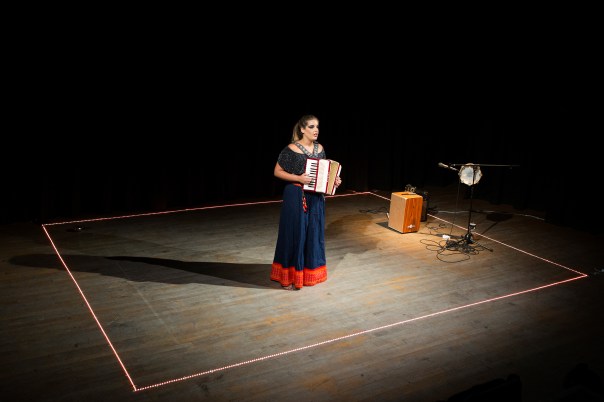
StoneCrabs herald from Brazil & are bringing a cutting piece of interactive LGBT theatre to Britain this summer. The Mumble had a chat with the company’s Franko Figueiredo & Inês Sampaio…
Hello Franko, so first thing’s first, where are you both from & where are you at, geographically speaking?
Franko: I’m from Brazilian mixed heritage and Inês is from Portugal of Angolan Heritage. I now live on the Isle of Wight and Inês lives in Nottingham.

Inês
Hello Inês, so can you tell us about your theatrical training?
Inês: I started engaging with theatre back in Portugal in 2009 when I joined theatre O Bando for weekly workshops. It was a sort of Young people’s company led by extremely knowledgeable theatre practitioners who had been developing their own school and approach to theatre that was extremely stimulating and challenging. This got me excited to learn more, and so I attended East15 (2012-2015) and completed my degree with a 1:1 in BA(hons)World Performance. The best way to describe such content rich course is to tell you that I had the pleasure to join an around the world trip in 3 years, with the privilege to experience a taste of the culture, art, approach to theatre, rituals and essence of all four corners. This course not only trained me in acting and multi-media but also in various styles of dance and music forms/instruments from all over the world including; Butoh, storytelling, African dance, Bharatanatyam, storytelling and masked performance and mask making. As well as traditional theatre performance, I have also received training in directing, scriptwriting, research, devising and production skills. The range of disciplines acquired enables me to create and apply myself confidently to new visceral work.
When did you first develop a passion for theatre?
Franko: Since my childhood, I’d say. Though the passion was more about storytelling, being with other children gathering around a bench in the town’s square, at dusk, hearing locals tell stories, and re-telling those stories at home.
What for you makes a good piece of theatre?
Inês: Passion, wit, engagement and a lot of hard work. Good theatre ultimately entertains. I am a big supporter of theatre as a platform to educate, inspire and provoke, but nonetheless is has to entertain. There is a formula that makes theatre good, and I am learning more about it, just as I read “Strategies for play building” by Will Weigler, which gives you five main ingredients for a successful theatre show. I love theatre that celebrates multi art forms and embraces world theatre techniques, when appropriate.
In a world where you can get entertainment ‘on demand’, what makes theatre special?
Franko: There is a special connection in theatre, the collective energy that we exchange, the reminder that we are not alone. The shared risk and the immediacy of it is unlike anything else, it can make it for a very special, charged experience.
What’s the last thing you do before you step out on stage / the curtain goes up?
Inês: I love the romantic idea of curtains going up! I breathe in through my nose and push my right hand forward, as I exhale on various sounds like “s” or “sh” or humming I bring my left arm forward and the right arm back. This helps me keeping my vocal cords active without being too loud, helps me calm my nerves with the breathing and keeps me distracted as I focus on the arms (right arm represents my belly as it expands forward and my left arm the sound coming out). I also jump and say “You got this, this is gonna be good, this is gonna be great, it will be what it wants to be and I trust.”
You’ve got three famous writers from history coming round for dinner. Who would they be & what would you cook; starters, mains & dessert?
Franko: Probably Octavia E. Butler, James Baldwin and Yukio Mishima. I’d serve smoked salmon pancakes for starters, Brazilian moqueca with manioc flour, rice & beans, and dessert would be apple pie and ice cream. I’d go straight into my overdraft and serve plenty of wine


Can you tell us about StoneCrabs & your role?
Franko: StoneCrabs is a small BAME, LGBTQ Theatre Company which I co-founded back in 2002 with Tereza Araujo and John Heyd, when we were ‘post-dramatic’ political theatre. Later in 2006 Kwong Loke joined us and we share the role of Artistic Directors. As we welcome new members to the company, the work changes and we start developing our theatrical language further; we are particularly interested in intercultural political theatre and right now experimenting using ‘gaming’ techniques and interactive play strategies when creating new theatre work. We also deliver lots of community and educational projects. Like most small companies, I have a chameleon role of producer, writer, director, facilitator, fundraiser, you name it. We are a small registered charity and I am helped by a wonderful board of trustees, my colleagues and company associates, who are all freelancers like myself, meaning we oscillate from getting paid on a project basis to being volunteers.
What is the theatre scene like in Brazil?
Inês: For the new government art has become less of a priority and artists are being fed with passion (literally, no money) and the Arts and Culture Ministry is now extinct. I have just finished a tour of an opera show for families which was part of SESC festival, an absolutely incredible programme and an honour to have been part of, and off course, I have experienced some of the most exquisite classical music shows, but very little theatre. All theatre I watched was kind of underground, off the radar, done with very little resources. And I met far too many talented people who explained that the funds for theatre were so scarce that they were no long fighting for the cause, which has really sadden me. Poverty in Brazil is not like the poverty here, thus I am afraid their priorities lay elsewhere and theatre is left, sadly, for the few, who can afford it.
What does your perfect Sunday afternoon look like?
Inês: My perfect Sunday afternoon will have direct sunlight onto my skin, a fresh diet coke with plenty of ice and lemon, the cold Atlantic sea on my feet and family and friends around. But if we are talking about an english Sunday I would have to say that a nice trip to the park, a good (on budget) meal with friends, a trip to the theatre with some boardgames afterwards seems like a pretty good day! (and there I am, over booking myself!).
You are currently touring a new play around Britain, can you tell us about it?
Franko: The Trial is a interactive play about identity, equality and justice. The audience is transported to rural Brazil and is invited to play Jury to a case brought to trial by Tieta. Tieta is a young man who was shunned from their small town for being queer, years later Tieta returns as a trans-woman and set the challenge to the townsfolk (the audience) to find her justice. As the Trial progresses and the Jury learn the facts, circumstances and evidence and must reach a final verdict to the case brought to court. I wrote The Trial as an attempt to bring to light some of the issues the LGBTQ+ community is going through in Brazil, Inês and Almiro also brought in authorship to the text, and what we ended up with is a post-dramatic interactive show that uses rakugo (Japanese storytelling form), dance, live music and audience interaction.
How have you found working with your Brazilian colleagues, Franko & Almiro?
Inês: Franko is an absolute inspiration for me. Ever since we worked together at East15 when StoneCrabs came to direct my showcase I was in awe with their craft. Franko is an incredibly supportive director who encourages my creative input and this for me is very important. I trust them as a director and feel very grateful to have the honour of working with them. The true source of my nerves when performing The Trail is not that I may make a fool of myself, but that I may not make justice to Franko’s work. Almiro is a very kind artist with an excellence in dramaturgy that is beyond compare. Always very attentive and caring, bring a light and inspiration to our working space.

Franko
How much of this play is fed by your own experience?
Franko: The rural setting is definitely from my growing up and there are moments of the Trial that borrows from a personal universe, for instance being an immigrant, having left Brazil at the end of a military regime that created a very oppressive society. Like the character of Tieta, I was very conscious, from a young age, that I was different, that I didn’t conform. When I came out as gay (the word queer was not in use yet), there was no tolerance. When I was given the opportunity to leave Brazil I didn’t hesitate. Arriving in London to the tune of Bronski Beat’s song ‘smalltown boy’ playing in some of the LGBTQ bars was both welcoming and challenging, in different ways. I went back to Brazil last year, soon after the new president took power and I probably experienced more hatred now than I did all those years ago, this has also influenced the play.
Does Tieta encapsulate the main themes of the play?
Inês: Tieta is a complex character; although she goes through a lot of changes, her journey is full of ups and downs. She represents a fight for equality and human rights, and in that sense I believe she is the most suitable person to do so, and The Trial is a call for arms from Tieta.

How did the start of your tour go in Nottingham?
Inês: We had an amazing response, the audiences were with me, and with the show, all the way through. They were fully responsive and incredibly provoked. Their final verdict was mind blowing, I can’t tell you more without spoilers. I feel very grateful. We couldn’t have had a better start to the tour.
Do you think the Brazilian mesh of poverty vs wealth & greed, social exclusion vs fight for equality will resonate with the British in 2019?
Franko: Perhaps, Britain feels so divided right now, there is the element of populism and far right thinking that seems to be dominating the stages. I was recently in Liverpool, and we just played The Trial in Nottingham. I couldn’t help observe the amount of homeless people on the streets, years of austerity has left us morally bankrupt and it is really scary. There’s seems to be a huge lack of education and respect, people just seem to think that it is okay to shout abuse at one another, it’s ugly. I’m very interested in the verdict the audiences will deliver with in the performances The Trial? Will we still base our choices/votes in ingrained patriarchal ethics and ideas?
You’ve got 20 seconds to sell the play to somebody in the streets of Brighton, what would you say?
Inês: This is an incredibly fun interactive show that will make you experience the whole spectrum of emotions. If you love music, you need to watch it. If you like stand up comedy, you need to see it! If you enjoy story telling, this show is for you! If you are interested in the concepts of equality, identity and justice, than come and watch this show! Witty, SO ENTERTAINING, unexpected.
The Trial
The Warren: The Blockhouse
May 28-30 (20:00)

www.stonecrabs.co.uk
Be My Baby
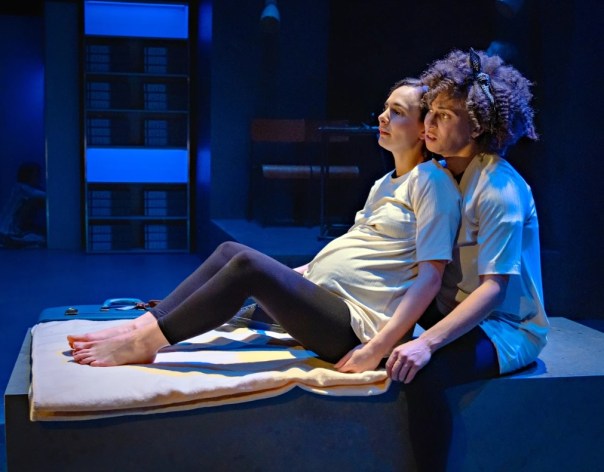
Leeds Playhouse
May 18 – June 1, 2019
Script: Stagecraft: Performance: 
Be My Baby is a subtly gripping history lesson about an underexposed and somewhat shameful aspect of our collective past. Set in a home for unwed mothers it centers on the lives of a small group of young women from very different backgrounds who never the less find themselves in the same predicament: being single and pregnant at a time ( the early 1960’s) when to be so was tantamount to social suicide.
At the very heart of the play is Mary (Simona Bitmate), a young woman from a comfortable middle class background whose disapproving mother (played brilliantly by Jo Mousley – all brittle anxiety and superiority) is conflicted about leaving her in such a place.However under the firm hand of Matron, the head of austere St Saviours Mary begins to find her feet. She befriends the other girls, sassy, hardbitten Queenie ( Crystal Condie ), giddy, naive Dolores ( Tessa Parr )and serious, self-contained Norma ( Anna Gray) as they bond over their mutual incarceration and their shared love of soulful pop.
All have their individual fantasies of boyfriends, jobs and escape which they begin to reveal to each other, all in different levels of denial about their situation. The play started slowly creating a sense of time and place before gradually drawing the characters out (none of whom are entirely what they seem). I found the dialogue with its flashes of humour and underplayed emotion very naturalistic. The script relied as much on what was not said as what was. There was a sense that things were hinted at and suggested which made the gradual revelations both believable and all the more affecting. The potential heaviness of the subject matter too was handled in such a way that it seemed to gradually seep into the play almost imperceptibly until the quietly devastating final act.
At first we are encouraged to view matron as being a negative figure, the girls jailer a prudish and stern disciplinarian but such is the depth of the play that Matron is shown to have great empathy for the girls. There is a tenderness and care beneath her stiff exterior. Even during a deeply uncomfortable scene in which she forces Mary to understand how the world outside might view her we don’t doubt that this is done for the best intentions. Susan Twist’s performance as Matron is a masterclass in restraint, with tenderness and deep feeling glimpsed beneath her character’s stiff exterior.
In fact the script encourages the audience to empathise with all the differing perspectives of the characters to the extent that we can see how everyone is equally struggling with social rules they had no say in making. For though this is a play about women men still act as a shadowy presence off stage, their actions pushing the events of the story as much as the women on it. In this way the play shows how all the women are contained and restrained by the expectations and desires of the men around them. Even the sassy Queenie appears to ultimately accept that to imagine another way is nothing but a pipe dream.
The play has something to say about class too as it looks at the different expectations the girls and others have of them. The interplay between Queenie and Mary, showing how the former’s inverted snobbery stops her from seeing they are both equally trapped. The actors all have good material to work with and all manage to create fully realised nuanced performances. No-one here is a cliché or cypher yet through them the show explores issues as varied as back-street abortions, rape and forced adoption. I found the relationship between Queenie, the tough cynic with dreams of pop stardom and Mary, the naive girl from the genteel background with the steely resolve particularly finely drawn. It felt like we were watching the growth, blossoming and wilting of a friendship before our very eyes.Although both the script and performances are uniformly excellent some of the credit for making the play a success must go to the overall design, sound and lighting.
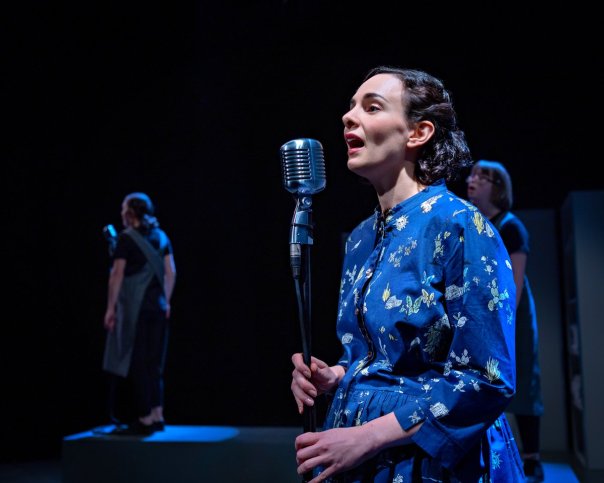
The costumes of the characters were cleverly used in a symbolic way. . The pastel pinks,purples and blues of the parental figures denoting a faded authority, the grey pinafores of the girls seeming to suggest a desire to turn back them back into little girls, whilst also implying the dull uniformity of the prison yard. The overall use of a limited palette in terms of costume and set allowed the performances themselves the space to breathe which they needed. The set which could – given the time period of the play – have been used in a more hackneyed way was used to convey a sense of sterility, it’s minimalist grey cabinets, shelves and boxes evoking more the furnishing department of a high street department store than the swinging 60’sof lore.
The only element which did place us in a particular time-frame was the play’s imaginative use of music. Between each scene change we hear and see the girls sing along to 60’s pop which wittily expressed their situation. Towards the beginning when a moment of romantic pop segued and merged with a hymn and later as the music overlapped a wistful monologue this was handled in such a masterful way as to really hit me in the gut. The lighting, subdued throughout was particularly effective during the spotlit birthing scene. This created a real sense of wonder as the actress performed in a kind of flowing, slow-moving mime the act of her baby bulge becoming a living, breathing child.
I found the play to be unexpectedly moving as I found myself drawn into the lives of these young women journeying with them through their excitements, fears, frustrations and disappointments. It was all the more emotionally rich for being performed by all with such obvious care and empathy. Ultimately it was a fitting tribute to the lives of all those young women whose unknown story it now told so well.
Ian Pepper
Jocky Wilson Said
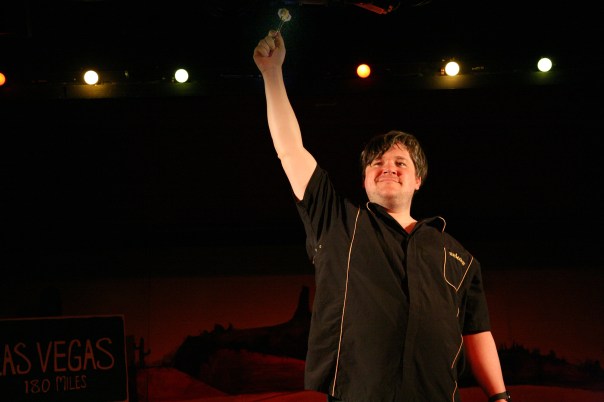
Tron Theatre, Glasgow
May 13 – 18, 2019
Script: Stagecraft: Performance: 
A desert scene stretched out from the back of the stage, with colourful backdrops and green fresh cacti. A solitary scene for the one-hander to come. It’s 1979 and Jocky Wilson was 184 miles from his destination, Las Vegas, but missed his connection and was forced to hitch hike his way there. But would the wait prove too much for him? Darts player Jocky Wilson (convincingly played by Grant O’Rourke) turned professional in the late 70’s and went on to win World Pro Darts Championship in 1982 and again in ’89. He always was the gallous character from Fife that was captured in this play written by Jane Livingstone and Jonathon Cairney. Jocky Wilson Said was first performed at Oran Mor in 2017.

Clothed in his professional darts garb – he was on his way to play an exhibition match – Jocky’s emotions fluctuated from elation to despair as he waited for a ride that at times didn’t look like it would even come. At one point he screamed angrily as a possible hitch passed him by. He started talking to a cactus and in the conversation reflected on his life and the journey which had taken him thus far. It was as if the stage was peopled with characters from his imagination as he recalled the huge, all- encompassing part that darts had played in his life, becoming a way out for him, but more than that giving him something at which he excelled. He told the cactus of his great triumph and how winning the championship was both a victory for himself and a victory over people he encountered who perhaps didn’t believe in him as much as he would have liked.
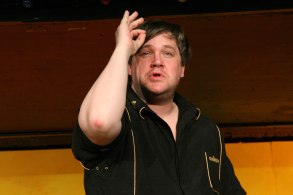
Jocky Wilson Said was very much a tale of the underdog made good, going through the elements of his life one by one like the pile of rocks he was sitting on. We saw the real man behind the image, got a feel for what made him tick. Not least because of a wonderful performance by Grant O’Rourke, who seemed to completely inhabit Jocky’s persona, from his accent and mannerisms to the very spirit of the man himself. And at the moment when a vehicle finally stopped for him, he gathered his things and as a goodbye from him to us he lifted an imaginary championship cup and he proudly and defiantly raised his hands to the sky. With that, the lights went out and he was gone.
Jockey Wilson’s character shone through this play, his courage, his determination; and in no small part, his humour. It set the stage alight as though it was big production with a big cast. But these were things it didn’t need. Altogether a skilful and accomplished piece of drama.
Daniel Donnolly
Toy Plastic Chicken
Oran Mor Glasgow
May 6 – 11, 2019
Script: Stagecraft: Performance:
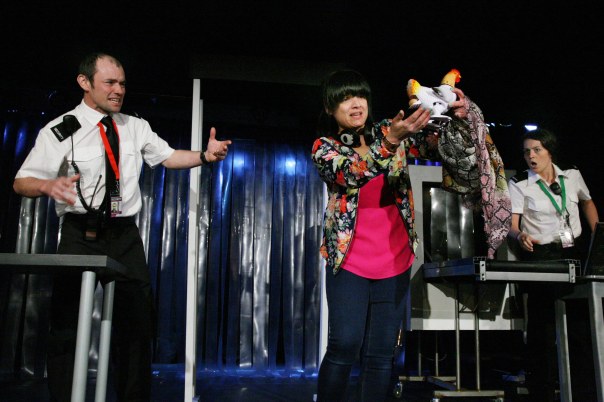
At the Oran Mor, this week’s set had an air of readiness about it, somehow clinical. Sure enough, when the lights were on it, a passport control point immerged. Ross (David James Kirkwood) and Emma (Anne Russell Martin) appeared as passport officers in full uniform. Ross seems happy in his work, while Emma is full of inner rage about her profession. The play, written by Uma Nada-Rajah, is set at Edinburgh airport and is a black comedy based on a true story.
Enter Rachel (Neshla Caplan), who seems like a victim from the moment she comes on stage and is put through her paces by the two officers. The set changes cunningly to depict the various sections of the airport kiosk, as the examination progresses. In one powerful scene, the hapless Rachel has been told to strip behind a screen, while the silent and furious Emma stands by. It is an extremely uncomfortable moment. Ross, the jokey male officer, provides an element of comedy. But his jokes have somehow an undercurrent of violence about them, highlighting another uncomfortable aspect of the action.
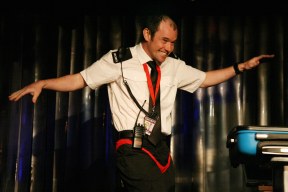
The eponymous plastic chicken is set on the table from the beginning as it is the only item left after Rachel has divested herself all metal and electronics. When the alarms go off, the toy chicken is deemed to be a bomb and uproar ensues. Protocol must be followed and Emma becomes more and more robotic in the discharge of her duties, though Ross can be relied upon for complaining to. Indeed Ross even professes his love for Emma, but she simply replies ‘…not today…’ The situation deteriorates drastically, and Rachel reacts badly, becoming distressed. As she has to turn her attention to the woman’s care, an increasingly conflicted Emma curses repeatedly “..f**k..” as she expressed her hatred of her life as a passport control officer.
The play ended as it began with a deliberately standoffish Emma and the ever-joking Ross directing a distraught traveler through Edinburgh passport control – a down to earth delving into the paranoia of modern life and the art of sticky situations, I found the dialogue dynamic and emotionally true. Yet another example of the high art of drama to be expected at the Oran Mor venue, well worth a watch.
Daniel Donnolly
 Mumble Theatre