Outside In
A Play, a Pie and a Pint
Oran Mor, Glasgow
3rd-8th May
Script:  Stagecraft: Performance:
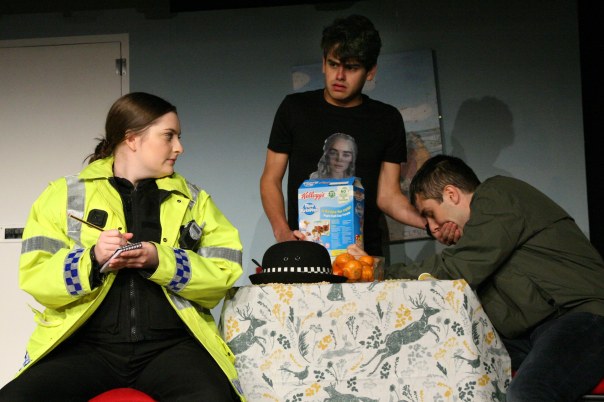
Jay, a distressed young man in tartan pyjama bottoms and floppy slippers, paces anxiously while awaiting the return of his mother with the milk he desperately needs for his late supper of Rice Krispies. The agoraphobia that won’t let him leave the house is reinforced by a succession of bleak reports on the TV news. What the nervous Jay doesn’t need, is a hand wiggling through the letter box like a horizontal Lady of the Lake, holding not Excalibur, but an automatic pistol that drops with a clunk to the floor. Soon Coco, an apparently aggressive youth is pounding at the door, demanding and gaining entry to the flat – and there’s still no sign of mammy and the milk. Could things get any worse? Well on the plus side, local police officer Kayleigh, who is on a shots-fired case and hungry, can take her Rice Krispies without milk. She does have a few questions though, that both of the guys might struggle to answer.
Christian Ortega’s Jay and Martin Quinn’s Coco are a delightful pair of seemingly mismatched characters that find they have more in common than they think. As they bounce hilarious, perfectly timed, verbal misunderstandings off each other an unlikely bond is built that softens the would-be gangster Coco, and toughens the stay-at-home Jay. Their musings about the possible ways of eating soup without a bowl, straight off the table, is a discussion Beckett’s Vladimir and Estragon would have lapped-up.
Katie Barnett’s officer Kayleigh is a good natured, well grounded cop who knows Coco has ‘previous’ and works slowly but surely to unravel the case. Not short on dry humour, she opines that “Nobody should be in a gang that doesn’t have a tree house.”
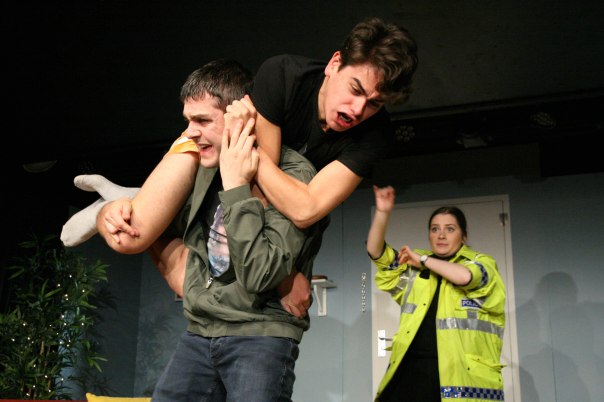
Chris Grady has written a comedy drama as bright as officer Kayleigh’s high vis jacket. With plenty of laugh-out-loud moments to keep the audience entertained, the dialogue is sharp and fresh, the characters funny and rounded. A highly entertaining play well worth getting out of the house to see.
David G Moffat

The Yellow On The Broom
DUNDEE REP
Tue 28 August – Sat 22 September
Script: Stagecraft:  Performance:
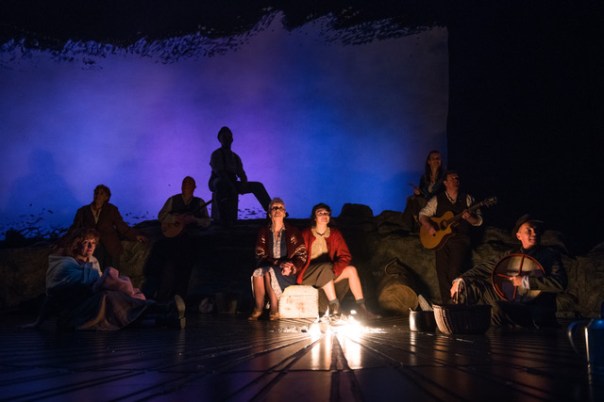
Throughout this year, Dundee Rep have presented different versions of Scotland and Scottish folk. The urban-rural culture clash of Passing Places and the derring-do of The 39 Steps have given us some entertaining fictional portrayals of Scotland and Scots; from misanthropic Highlanders to dislocated young urban men. The most recent offering from the Rep continues this trend with a lyrical and sympathetic presentation of Scottish travelling people, often reviled by ‘decent folk’ and by definition on the margins of society. The Yellow on the Broom is a dramatisation of the first book of autobiography by Betsy White, a traditional Scottish Traveler, covering her childhood years in and around Perthshire and Angus. This is a revival of Anne Downie’s faithful adaptation, directed by Andrew Panton, and brings a focus on nostalgia for a time and place and ways of living now long gone from Scotland.
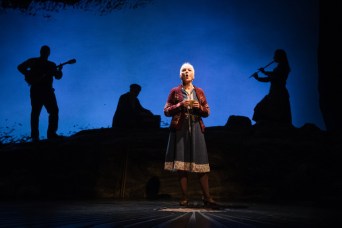
Sentimental without being saccharine can be a difficult road to steer, but the Rep’s fine ensemble players manage to get it right most of the time. In particular, Ann Louise Ross is superb as the older Betsy, who narrates the story, and thus holds together the entire piece, through her memories of her younger self, Bessie. There’s a lovely point in the action where young Bessie’s father reaches out for the young Bessie’s hand, and the older Betsy’s hand reaches out for his, only to fall back again as the older Betsy realises that it’s a memory, and instead it’s the young Bessie who grasps her father’s hand.

The young Bessie is played with real energy by new member of the Rep Chiara Sparkes. Sparkes captures the tomboy of the book exactly as one would imagine her. By turns wild and carefree, by turns courageous and forthright, the young Bessie navigates the prejudice and mean-spiritedness of the ‘Scaldies’ (the non-travelling, settled people), learning how to live in the wider world and still be true to her heritage. Bessie survives bullying and taunting from schoolmates as she and her family move from town to town, and she endures her hundred days minimum schooling per year. Luckily, it seems that for every unfair teacher who unfairly punishes Bessie for standing her ground against the bullies, or bigoted policeman who moves Betsy and her family on, there is a kindly stranger who offers the travellers some food or clothes or small charity of some sort. Sometimes, there is even better luck for the family. Comic relief comes in the guise of characters from Bessie’s childhood memories – a gaggle of Glaswegian women raspberry pickers that you wouldn’t want to meet on a dark night and a wonderfully eccentric Laird played by Barrie Hunter.
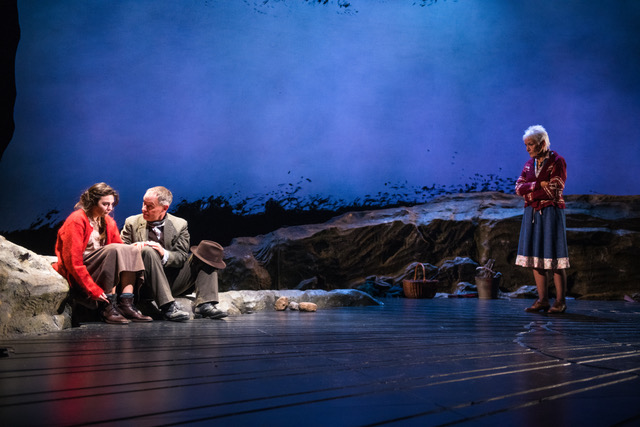
Family is important to travelling people and in Betsy’s case her relationship with her father, Sandy Townsley, seems to have been central to her early years. Sandy is lovingly portrayed by Gary Mackay as a wise, quiet man, ennobled but physically broken by adversity and hard work. Sinéad McKenna’s lighting effects give Kenneth MacLeod’s stark set designs the quality of illustration, especially at the beginning of each act where the stage is one great silhouette. This is an entertaining tale played with real sentiment that avoids sentimentalism and gives an enthralling glimpse of a Scotland and a group of Scots that we have forgotten, in our race to be modern.
Review: Mark MacKenzie
Photography – Tommy Ga-Ken Wan
BOOK TICKETS HERE
TOURING TO MACROBERT ARTS CENTRE WED 26 – SAT 29 SEP
The Song of Lunch
The Pleasance Courtyard
August 27th
Script:  Stagecraft: Performance:
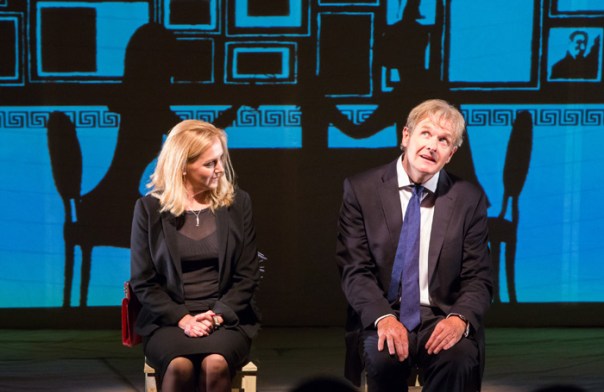
The Forth venue at Pleasance Courtyard is a wonderful space and was filled to capacity in anticipation of this 50 minute show. The words “The Song of Lunch” were projected onto the back wall, looking like the sign of a café. The action begins with Robert Bathurst’s silhouette on the screen as he launches into dialogue with the audience that was somehow calm but manic at the same time. With his “…imagination peeled…” he refers to TS Elliot and describes with gusto his taste for the written word.
His lunch date, with an old flame, came in the shape of Rebecca Johnson who looked fabulous, an observation he shared with the audience as he thought out loud poetically and ravenously. He set a high bar of comedy “…under new mismanagement…” and had us agreeing to it with laughter. Yet he wonders if his pursuit is in vain, “…was the shadow world to welcome him”? He danced lightly around while pouring the dialogue from his mouth in torrents and swash-buckling precision. They meet for lunch.
The silhouette mocked him laughingly as he sang an interlude melody. We watch as he compares his memories of her with the current reality and finds his heart gladdened and his sensibilities heightened. Drinking more wine than her in his nervousness, his head tells him that he has a speech to deliver now that he is in her company. At the same time, he finds he wants to amuse her too, so he tries both.
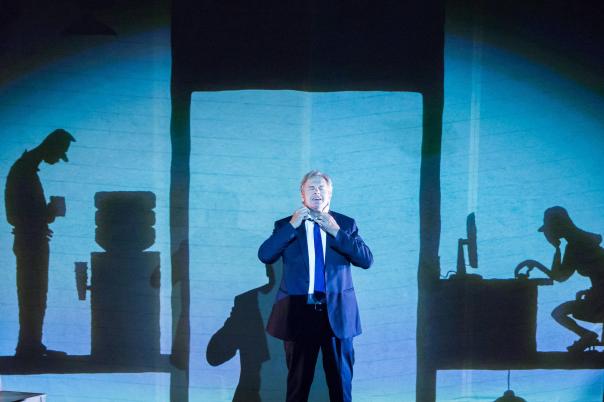
They physically circle each other, in a birdlike dance, winding up by standing side by side in an easy movement, slipping back into conversation. The physical interplay has them at one moment close to caressing and the next moving a great distance apart, all the while with him lyrically describing to us everything that was happening. The silhouette scoured the room and showed us a shadow dance on the screen. He tells us that this gives him an almost youthful delight.
Rebecca stands in front of him and they move the two chairs to sit down for lunch. We see everything in great detail, mirroring his heightened feelings. His nerves are pushed to the point of destruction as he excitedly drains the bottle of wine while she is still on her first glass. “Could this all go horribly wrong?” he asks himself. There’s a change in the dynamic as the chairs are moved and he takes her hand in an intimate way and sensually describes it. We watch with rapt attention as the action builds to a crescendo. It’s all done very lightly with clean, tight direction and simple tricks like Robert laying himself on her lap, showing the depth of his feelings.
Robert strides up into the audience, moving from one side of the stage to the other and taking centre stage by lying on the floor as an antidote for all of life’s ills. We laugh as he hilariously takes a trip to the loo to take a pee – was it “…will power or wine…?” As the silhouette spans the screen he doesn’t know whether to weep or sleep – nudge him, he says, and he’ll crumble. He expresses the underlying joy he feels at this reunion in an adorable deprecating manner, funny and touching. This is a thoroughly delightful 50 minutes of entertainment – it would be great to see these characters in further dramas.
Daniel Donnelly
The Journey
Pleasance Dome
August 27th
Script:  Stagecraft:
  Performance:
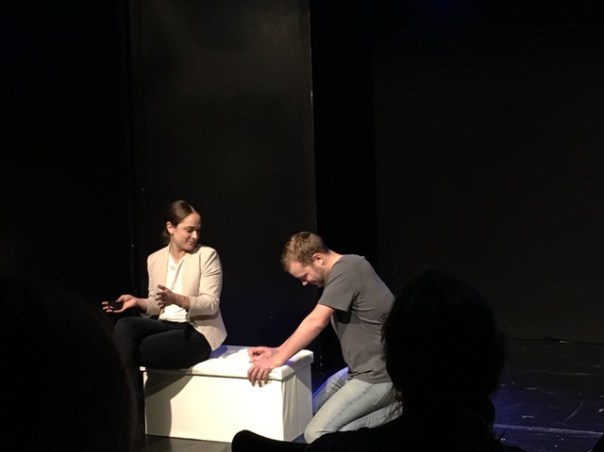
Whew! Men seem to be getting a bad rep at this year’s Fringe! I left this show with the chills and feeling just a bit shaken at what I’d just watched. Was this a spot of the “Me Too” movement taking place in the Pleasance Dome? How Stuart Law’s rom-com set in deep space, managed to take it’s audience from the plot-thin standard fare of fringe comedy to a stunned silence at it’s denouement was very clever indeed.
Will Brown and Phoebe Sparrow play Adam and Kate, who find themselves in the hothouse of a new relationship, made even hotter by the fact that they are together twenty-four-seven on a spaceship headed into the depths of space. Comedic charm soon turns toxic and we watch the couple lose their lustre for each other. In orbit around this story arc there’s a lot of back history about Adam’s previous partner, also Kate’s sister, who seems to have gone a bit off the rails. Poor Adam makes a lot of appeals to the audience for understanding as this new relationship rapidly seems to be spiralling into a similar chaos. The pressure builds to an explosive and pretty unexpected climax. Without giving too much away, expect to have your allegiances shattered.
There are some laughs along the journey. Zero-gravity and men’s untidiness don’t seem to mix well in a cramped shared cabin. The comedy, well-populated at first, does become more remote as the characters begin to drop their pretences. There’s much more to this play, however, than Red-Dwarf meets Love Island, it just all seems to come on one all of a sudden. The whole gravity of the situation comes down on the two characters and like Scotty in Star Trek would say “She just cannae take any more captain! If I give her any more she’s gonna blow!” Fireworks ensue….
Mark Mackenzie
Losing the Rag
A Play, a Pie and a Pint
Oran Mor, Glasgow
Aug 27 – Sept 1st
Script:  Stagecraft: Performance:
Newspapers, especially the local variety, have been under the cosh for some time now as circulation falls and advertising moves from printed paper to pixelated screen. It would seem, with publications big or small, the medium is the message or as a succinct blogger might put it, Gutenberg … 0 Berners-Lee … 1. This is certainly the case with the Avondale Advertiser where Derek (Gerry Mulgrew) a stressed-out, old-school editor, is under pressure to boost digital ratings and avoid staff cuts. The 34 year veteran of journalism prowls his office despairing at the inaccuracies that litter his publication. With the newspaper’s owners, Mental Mickey the local junior football team manager and possibly Kim Jong-un on his case, he is a man with a strong-tea habit, feeling the strain.
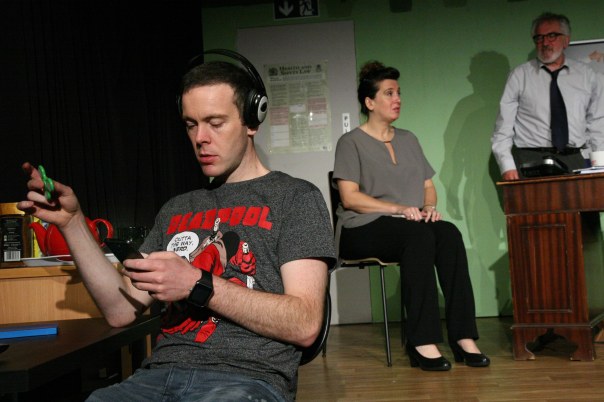
Perhaps salvation lies with his second in command Susan (Louise Ludgate) who started journalism in the days of clattering typewriters and fag-fug newsrooms. She’s been working for some time on an exclusive involving a politician’s dodgy expenses. Could a financial scandal be the big story that saves the wee paper and secures jobs? There’s more than a hint of arrested development in the third member of the team, young Barry (Martin Donaghy) who hurtles to work on a BMX bike, headphone-cans clamped to his ears. He’s a broad-strokes, funny-photo sort of journo, with little idea of the consequences of getting the facts wrong. Yet might his youthful insouciance and social media savvy, trigger the online hits his paper needs or is his ‘Deadpool’ T-shirt an ominous prediction of the fate awaiting the press in all community newspapers?
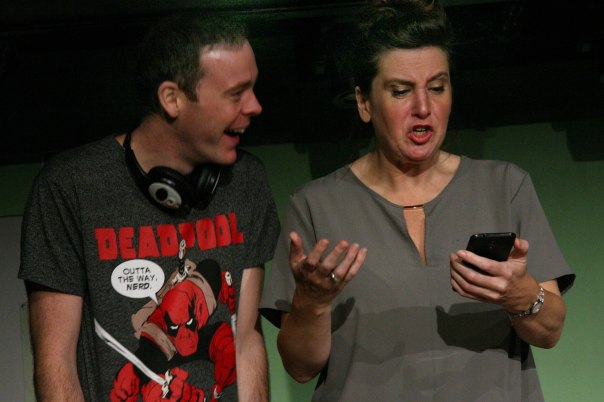
Alan Muir’s play takes an amusing look at the troubles facing traditional journalism when it has to compete with wacky web content for site hits. Although free online material is an issue, the main problem this fictional newspaper seems to have, is the incompetence of staff who fail to notice the numerous errors and mix-ups that pepper the publication. Injudicious quotes, misplaced adverts, wrongly captioned photographs; these faults are not caused by internet rivals. Maybe that’s the message – lower the standards of traditional journalism far enough and you get the equivalent of what dubious cyberspace has to offer.
Not a headliner but a fair start to Oran Mor’s new season of lunchtime plays.
David G Moffat

Freeman
Pleasance Courtyard
Aug 25027 (17.00)
Script: Stagecraft: Performance:
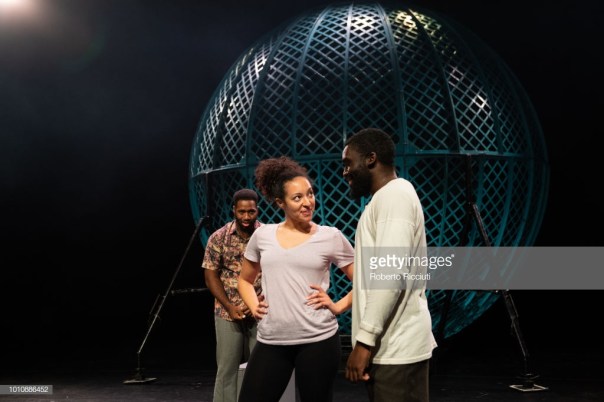
It’s always a pleasure to be back at the Pleasance Above venue, with its high seats and sloping design. The stage took up half of the room, promising powerful performances. Strictly Arts have worked with award winning writer Camilla Whitehall to create the Freeman extravaganza. The subject is crying out for our attention, perhaps impartial attention; the wilful shooting of black Americans, the aftermath, the police acquittals. It begins with silent story-telling, a silent yet deafening explosion of physical posturing involving all six actors, a scene where they were all tossed high and low, almost throwing each other around. It was very impressive, introducing the plot loudly and proudly.
They were all dead, killed by the police. In the after world they compare their horrifying deaths and the identity and life so brutally taken from them. We had William Freeman who died just before his retrial In Auburn, August 1847. He was beaten and tortured so savagely by the Police that he couldn’t recognise himself or his mother. And Sandra Blaund; after she was beaten by the police she was found having apparently hung herself in her cell. The stories go on well into the night (so to speak) and much was made of every case, told by the victims of each atrocity.
The play flowed in music, song, dancing, using tricks like shadow dancing for effect and acrobatically balancing on top of each other to depict cars and other artefacts. Each one of the 6 deaths, tragedies that gave us a sickening feeling in our guts, were thoroughly explored from every angle. At the same time examining the human condition, showing us something that was complex and cruel. The subject turns to mental illness, where people were considered mentally unstable and consigned to bed for 21 years as some inane idea that it would be good for them. “Rage against the dying of the light” (to quote Dylan Thomas) they boomed with the full force of six voices. In 1949 someone stowed away on a boat and found himself in the rock n’ roll era. When the stage turned into a magnificent dance hall of the American 50’s, they all danced and swung. It was around that time that use of electro therapy was used to solve these problems with blatant disregard as to the effects thereof. The horror continued.
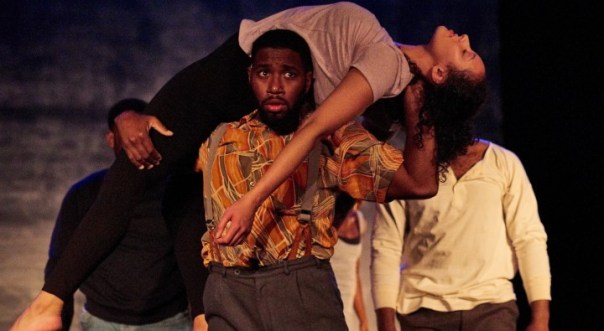
The Male Caucasian was put on trial to convey the privileges he had compared to Africans. Negros, fellow human beings, were kept in a submissive state, “a condition of the mind…” Needless to say this was achieved by means of whipping. The accused stood there and sang about the favours of whipping and how pleasant a good whipping would always be. An image of blood ran down the screen at the back of the set, that was roof to floor, they all died again and a pitch fork stabs a rice bag for effect. When Sandra Blaud was stopped by police, irritating her, she argued with him and things escalate into a heavy handed scene where she was brutalised and degraded. The officer, explaining that she resisted arrest, pins her to the floor and declares that she deserved it. She was devastated and sits there weeping loudly in grief. She takes out her phone demanding the right to film. The films we sometimes see on Facebook are but a glimpse into the worrying unease at the heart of American law enforcement. Being brutalised for a failure to indicate seems absurd.
Anger caused William Freeman to kill four people, the system called him insane and lobotomised his memory, he couldn’t recognise friend from foe. He struck out in rage and anger. Good old fashioned racism means that names get forgotten. Remember our names they whisper as the stage darkens. The power and emotion of this performance will stay with you for a long time. It will send you home rightly raging against injustice, determined not to forget.
Daniel Donnelly

The Extinction Event

Pleasance Courtyard
Until August 27th (15:40)
Script: Stagecraft: Performance:
The Pleasance Courtroom is among the larger venues at the Fringe, high and echo-ey, a perfect setting for The Extinction Event. This brand new show from David Evans and Simon Aula follows on from The Vanishing Man, which I had just attended. It’s good to see both shows, with the theme of magic running through them, but they each stand alone and both take us to the heights of good theatre. In The Extinction Event, we were told that every hour a species becomes extinct, an alarming figure that also shows that this world is a big place to be able to afford to lose so much. For the opening line we were asked to clasp our hands together with our pointing fingers up and parallel to each other. The fingers moved together and we couldn’t help but laugh.
“Magic”, they said, “is a hard thing to do in front of an audience – it’s a place where you need to learn, try things out and make mistakes, all in the interest of improving the show”. They asked how can you repair that which is broken – even using magic it can’t be done, or can it? We were shown an elastic band trick where it appeared to pass through itself and were told that the eyes see everything. We were being led into a place where the two played with our imaginations and turned it into improvisation – a fantastic leap. The double act was an integral part of the show with the continual interaction paving the way for our understanding and appreciation of magic and science
Following the original theme, the possibility of control over evolution itself was characterised as a dangerous magic, akin to the trick of catching a bullet in your mouth. We were told that the famous magician Chung Ling Soo died while attempting this superhuman feat. Very often Magicians blame their mistakes on their assistant. In hypnotism they claimed that they can help with programming a human brain. There was one instance apparently where a person was hypnotised for 8 months which I found impossible to believe. We watched as, with a touch of the shoulder and a head hung down, hypnosis was performed, but only as a joke. This was all leading up to an exercise in Improvement to show that we were all under some kind of sway, under the influence of the most complex thing in the universe – the human brain. The trick to do with mind reading was the one where you pick a number to take you to the page, another number for the paragraph and another for the word. The magician would say the phrase from the other side of the stage, displaying “true magic”, which seemed utterly believable.
We were asked to think about the process of retrieving our memories and mastering them, even going so far as to raise the dead. And again we are brought round to the trick of catching a bullet in your mouth which is intended to be about death, to achieve the ultimate of cheating it in front of a packed audience. It seemed as if the whole show was leading up to the moment when at last they did the trick. Bang, the gun goes off, David falls to the floor, there’s blood, he screams. What had happened? Had they really gone and done it…? Magic is enjoyed across the globe. Countless finely tuned tricks have audiences in awe and believing the impossible. The idea is to know what to believe – and if you get yourself down to the Pleasance you may find out, and be thoroughly bamboozled, intrigued and entertained in the process.
Daniel Donnelly
Just William’s Luck
Until August 26th (12:10)
Underbelly, Cowgate
Script:  Stagecraft: Performance:
 The Fringe festival is so varied, with so much on offer, that every single niche is surely covered somewhere. Thus, if you are a grandfather of a certain age, & you wanted to see a show with your grandchildren of school-age – in particular your grandson(s) – then Just William’s Luck is the more-than-perfect choice. I’m not saying no other groups would enjoy the play – I did immensely – its just I can really see that particular grandfather & grandson combo becoming rather passionate about this strangely deranged performance.
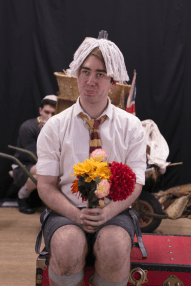
Richmal Crompton’s Just William stories are irreproachable classics, & are brought to life by Shedload Theatre’s convenial genius, with the help of Richmal’s great-great nephew Jonathan Massey. They’re like a pantisocracy of art are this lot, whose quite daring retro theatre is a joy to watch. The story is this; William Brown & his pals – the self-acclaim’d Gang of Outlaws – want to put on a play, using sets & props cobbled from kitchens & cupboards. Tomfoolery is the watchword, as the tale of Arthurian adventure is played out via a torrential sympathy towards the antics of the Goon Show.
With an acute sensitivity to the original, born clearly from Massey’s familial respect, Just William’s Luck is a mimicking masterpiece, full of slick touches, which as art perhaps transcends the books themselves. William Brown is now flesh & blood & his world is full of living colours & breathtaking vigour. There is also the arrival of precocious six-year-old Violet Elizabeth into the mix, played by the superb Lousie Waller, whose annoying mischief-making is the star-turn. Witness on your haunches spectatorship – you never get a chance to relax & philosophize about events unfolding before you. The best way to describe the experience of seeing the play is seeing five balloons blown up to bursting, then released into whizzing bat-like inspirals at the same time…
Damo
Paradiso
Zoo Charteris
August 20-27th (11.30)
Script:  Stagecraft:
  Performance:
Still buzzing from last night’s “Pussy Riot” gig, I strolled down to Zoo on Nicolson Street to collect my tickets for Monday’s review… Paradiso. Then on to Charteris Church for the performance of a puppet show about old people dying, convalescence and palliative care. It was a full house, but it must be noted that considering most of the congregation were in their winter years, this venue was quite hazardous to circumnavigate. It was so, so, so dark, & when one had climbed the steps to take your seat, it was impossible to see the steep steps. A lot of the old people were talking about this being an accident waiting to happen. The lighting deffo needs improving there. Luckily, everyone was seated safety.
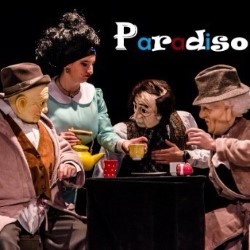
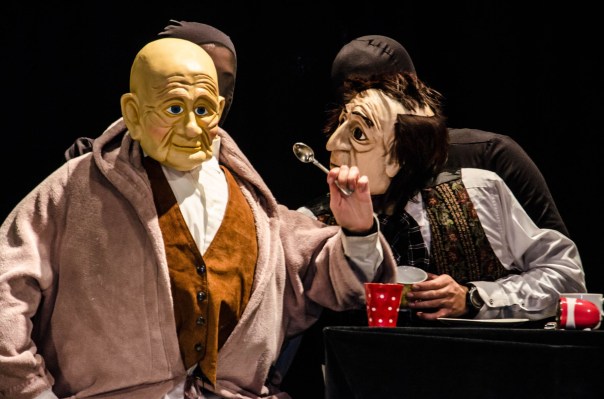
The puppets were not of the puppets-on-a-string variety, but were worn by each of the puppeteers. Three old men and one buxom charge nurse that bared an uncanny resemblance to an old flame of Divine’s.This was a performance that took its time to draw you in. The little dialect there was, was spoken in Italian. It was a performance that worked the audience. Three men that were forty minutes away from ascension, the story-line mimed by puppets. One man possessed a copy of Playboy; the soft porn – glossy, permanently attached. As the Pearly Gates moved closer, our heroes began reminiscing about past loves. The memories were enacted by shadow puppets, which didnae leave much for the imagination. If one wasnae paying attention it would have been so easy to have given up on even beginning to understand what was going on. I think this is one of the reasons that it did draw me in.
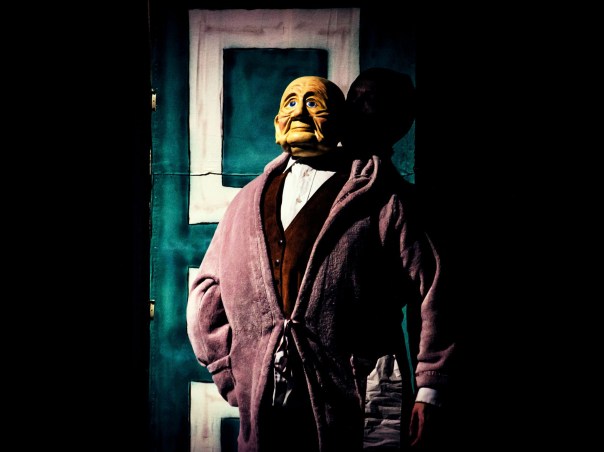
The charge nurse using a metal detector before boarding the last plane to ascension was as surreal as the entire concept. Then she began helping the last of our trio back through the Pearly Gates because he kept returning. Hmm, I thought, was this the dark twist, had the nurse murdered the last old man puppet, perhaps? It certainly took a while to process this show. As I wandered over to the Meadows, the sun was watery warm, I lay down on the grass and processed. My conclusion is that Paradiso is fine within its field, but not for everyone, & definitely not the kids expecting a fun show with puppets.
Mark ‘Divine’ Calvert
Drenched

Pleasance Bunker
August 20-27 (15.00)
Script:  Stagecraft: Performance:
The show began with the audience being addressed in an ancient tongue – Cornish- for we were now about to enter into the deep past, to a time of myths and legends, one legend in particular “The mermaid of Zennor”. Our guide was Daniel Drench, a professional storyteller and sometime actor played by Dan Frost. With his booming voice and evident pride for his Cornish homeland Drench was a large presence on the stage both literally and figuratively. A demonstrative performer he gesticulated wildly with his hands and stomped about the stage with intent before the story had even begun.
When he did begin Drench narrated the story to the audience whilst intercutting it with scenes where he acted the part of the main character, sullen Anti hero Matthew. These sections were played out as rather beguiling silent tableau illuminated by spotlight. Out of the shrouded darkness came the voices of bar-room bores, friends or his parents trying to communicate with him. As well as being beautifully atmospheric this also helped heighten the sense of the central character, Matthew as being a troubled yet passive individual lacking any real sense of a will of his own. The contrast between Frost’s energetic and charismatic role as storyteller Drench and Matthew ‘s lumpen silence worked rather well particularly in the way it was staged with the effective use of lighting. It seemed that his role of storyteller in its way was just as much a performance as that of Matthew and there was fun to be had in his grumbling about failing to land a role in “Poldark” or in his chastising of the audience for not joining in with his singing.
The language of the writing did feel at times a little stale and I became aware of the use of over-familar turns of phrase but there were also moments of rather lovely poetic description particularly of the local landscape. One part particularly stands out where Matthew’s mother describes in juicy detail a bird attacking and making off with a rat whilst he sits impassive and glum his knife and fork raised in his hands.
The moodiness of the piece was leavened by Drench’s interactions with the audience and the flecks of humour with which he coloured the piece and I would have liked to have seen more of this. When circumstances changed for Matthew and he was given a new lease of life it seemed like the story might likewise pick up the pace and head somewhere interesting but sadly this was not the case. It merely dawdled along to an insubstantial and unsatisfying conclusion. Though the use of sound and lighting made great use of the space and created a real sense of atmosphere and times even genuine beauty a show such as this needs more than technical trickery to get by.
It was true that Frost’s performance as Drench was full of flair and drew me in despite the weakness of the material he had to play with however overall I felt the show dragged and was let down by the weakness of the central story. As a story it was simply not interesting or powerful enough to warrant the amount of effort everyone had clearly gone to. I feel the piece would have worked far better if Drench and his issues with the material and conflicts with his own situation as a storyteller and performer had been more of the focus and the folk tale had been used more as a framework to build it around. An intriguing, if not entirely successful piece of theatre.
Ian Pepper

 Mumble Theatre