A Christmas Carol

Dundee Rep
30 Nov – 31 Dec
Script:  Stagecraft:
  Performance:
“Imagine a time…” begins the narrator, setting the scene of a bustling city on Christmas Eve. On stage, Christmas Eve shoppers rush around, buying that last-minute trimming for the next day’s festivities, wishing each other a Merry Christmas and young children skip excitedly, bursting with anticipation of presents under trees. It could be the present day. But we know its not — we’ve come to see the well-beloved Dickens’ “A Christmas Carol” and hear again the story of one Ebenezer Scrooge and how his miserly ways are turned around by the three spectral visitations from the past, present and future. It’s as familiar a recipe as Christmas pudding, right?
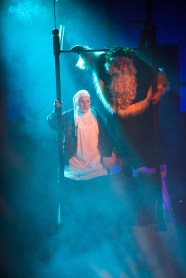 Dundee Rep’s production, skilfully adapted for stage by Neil Duffield, takes a fresh pull at this Christmas cracker. And what a treat there is inside! It’s Ebenezer, the zero-hours boss, the protean anti-society capitalist, the nemesis of workers everywhere, as a woman! Not a gender-bending pantomime dame, but a real hard-nosed, iron-hearted woman. And Scrooge as a woman, so utterly black heartedly played by Anne Louise Ross, has slipped a nip of something enlivening into the familiar, and the result is a truly magical mix of fun and song – even some literal shocks – for young and old alike.

The opening night of Dundee Rep’s Christmas offering was a joyous event. The ensemble cast recreated the familiar tale with a loving respect for the original story, interweaving the action with superb medleys of Christmas carols throughout, and the audience, young and old alike, joyfully joined in with the singing.
The cast play well together, turning up both the humour and sentimentality of Dickens’ original story to just the right temperature. All the old favourite characters are lovingly recreated; Bob Cratchit, Jacob Marley, Mr and Mrs Fezziwig and Tiny Tim, played by Oliver Mulholland and Harrison Hughes, pulled on the heart strings perfectly. Look out for the mischief made by the ghosts with Scrooge’s bedtime routine!
Settings and costumes were evocative and expressive and detailed, making the whole event a delight for the eyes as much as the heart. Scene changes happened with brandy-butter smoothness. The audience were magically transported with Scrooge and her ghostly guides to scenes from the past, to discover just how she came to be so mean, then whisked away to see happy Christmas revellers mix in the present and on to a dark foreboding future that, like a Christmas pudding, had a real flaming topping!
Take a young person to see this wonderful, faithful production, or just go see it yourself and believe in the power of Christmas – for a while at least!
Reviewer : Mark MacKenzie

The Weir Sisters
A Play, a Pie and a Pint
Oran Mor, Glasgow
20-25 November, 2017
Script: Stagecraft:  Performance:
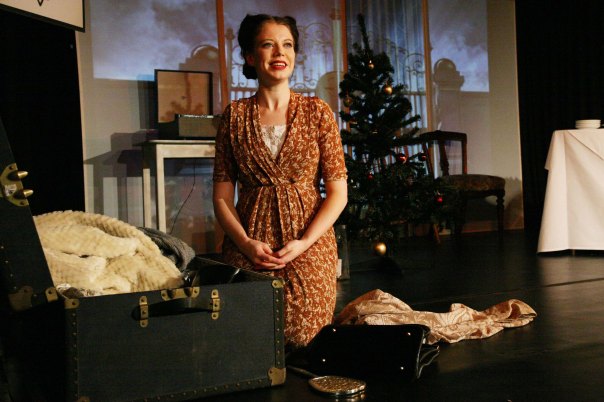
It’s Christmas day in Paradise and young Grace who passed away in the 1940s, is all a flutter, laying out the sausage rolls and Bristol Cream in anticipation of a very special visitor. She is assisted by her older, down-to-earth sister Margaret, who refuses to use the ‘Chalice of Vision’ to keep up with terrestrial events. She’ll only stick her face in water if it’s to dook for apples. A celestial bell announces the arrival of a third sister, the recently expired, doddery Dorothy. Difficult truths can at last be divulged and sibling forgiveness sought.
 Meghan Tyler is wonderfully endearing as the aptly named Grace, bringing a wide-eyed earnest innocence to the role. Sandra McNeely’s feisty Margaret delivers the best of the jokes while Deborah Arnott as Dorothy, has the saddest tale to tell. As her ancient form uncoils from her zimmer to rediscover her youthful stature (you get to choose your preferred age in heaven) her accent, for no apparent reason, mysteriously transforms from that of the Western Isles to Glaswegian???
Lynn Ferguson’s admirable play has humour, pathos and a large dollop of yuletide sentimentality that would please Frank Capra and bring a tear to old man Potter’s eye. The production is a worthy finale to Oran Mor’s Autumn Season.
Reviewer : David G Moffat
Kind Stranger
A Play, a Pie and a Pint
Oran Mor,Glasgow
13-18 November 2017
Script: Stagecraft: Performance:
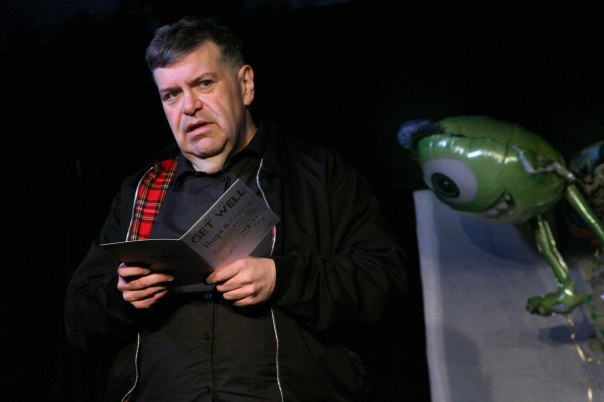
Why would someone choose to be a regular hospital visitor? Do they have a philanthropic wish to do good work, or maybe just enjoy the sound of their own voice? The eponymous kind stranger (Tom Urie) pops into a room with one bed, to find he has a captive audience as the patient is in a coma. This presents no obstacle to the jolly, wisecracking visitor, (“Hands up who disnae want a story?”) he has a bag-full of books from which he can read aloud. Tellingly his favourite is A Christmas Carol, with its supernatural tale of a life turned around and redemption attained.

This one-man play by Matthew McVarish appears to be a straight forward account of the visitor’s life, his fear and rejection before finding love and acceptance but as he reveals more about his life, we start to question if this linear narrative is all that it seems to be. The dialogue when varying from bouncy knockabout to gloomy introspection works well but the preponderance of enlightening quotes from Hippocrates, Sophocles, Buddha, Shakespeare, Winston Churchill, Helen Keller, Anne Frank, Dolly Parton and many others, does seem a bit much, even for a well-read man. Urie puts in a fine performance as the irrepressible visitor, whose layers of brash confidence are slowly shed to reveal an unexpected sensitivity. The denouement may have you scratching your head a bit- but in a good way.
Reviewer : David G Moffat

Lampedusa

Citizens Theatre, Glasgow
08 Nov 2017 – 18 Nov 2017
Script: Stagecraft: Performance:
I will be honest, Lampedusa by Wonder Fools makes for an uncomfortable watch. In the intimate black box that is Glasgow’s Citizens Theatre Circle Studio we find ourselves extremely close to the two actors whose interleaved monologues we listen to, but that is not where the discomfort lies. It is in Anders Lustgarten’s play, which takes the global problem of mass migration and forces us to face that it is everyone’s responsibility. He also shines an unflinching spotlight on some home grown issues: institutionalised attitudes to the poor and, he argues, endemic racism.
Stefano, an Italian ex-fisherman salvaging the bodies of drowned trafficked migrants from North Africa from the sea off the island of Lampedusa, describes what happens to bodies after days and weeks in the water. He says he gets used to the shock of finding them, but the dread as to what condition they will be in never goes away. His distress is accompanied by rage: “Where is everybody else?” he cries and when he reads of a disaster or a crisis he can predict who will be turning up on Europe’s shores next. Of those who survive he says “I resent them for their hope,” because he has none: the fish have gone, his country is a basket case.
The other protagonist, Denise, a mixed-race student in Leeds is funding her studies by acting as a pay day loan collector from people who spit on her, and racially abuse her. She is also in a vehement battle with work capability assessors over her sick mother’s clearly proven case for benefits. Like Stefano, her view of her own country and by extension, Europe, is that it is utterly broken; she will not be staying when she gets her degree. Describing herself as “mixed, mouthy and poor”, at times her impassioned speeches almost tip over into a diatribe, but a more nuanced performance (and writing) comes when her character meets with kindness. Indeed, this is the third theme of the play: kindness and friendship from the most unexpected quarters undoes both Stefano and Denise and liberates them from their bitterness and despair.
Both actors give committed performances of an exceptionally intelligent and humane play. Andy Clark as Stefano is particularly subtle and intense, while Louise Mai’s Denise is realistically brittle and angry. With music provided by guitarist/composer Stuart Ramage that is like a third voice in the play rather than an accompaniment to it, Lampedusa is that odd thing; an evening of very good theatre that will leave you feeling very uncomfortable.
Reviewer : Mary Thomson
Meat Market
A Play, A Pie and A Pint
Oran Mor, Glasgow
6-11 Nov
Script: Stagecraft: Performance:
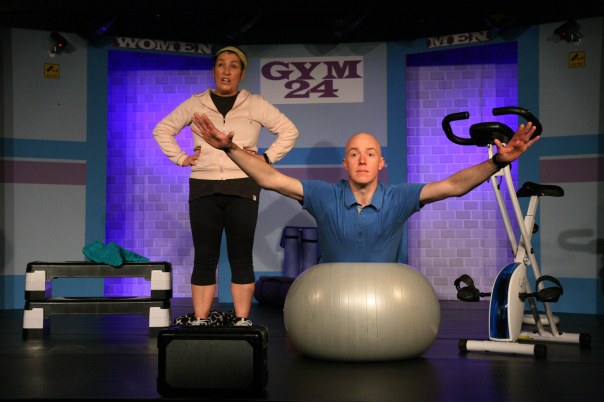
We live in a world where everything has a price and is usually available at the click of a cursor. So if it’s 3am and a trio of disparate characters have a rendezvous in a 24 hour gym to discuss a purchase, surely something nefarious must be afoot? Well yes but to reveal the clever conceit at the centre of Chris Grady’s thoughtful dark comedy, would be criminal indeed.
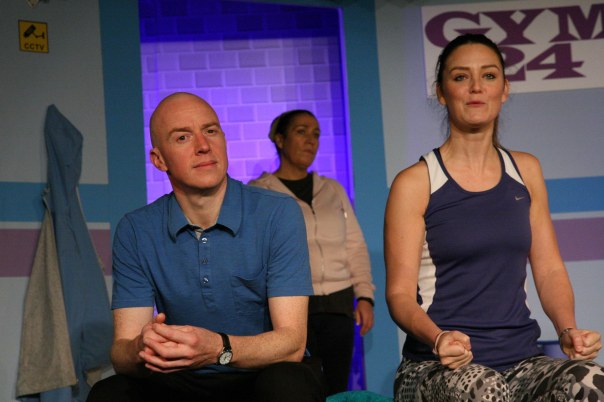
What does mercenary Alex (Megan Shandley), tall, confident and a robust picture of health, have that could interest wee Fran (Julie Duncanson), a chanty-mouthed bundle of perspiration in a sweatshirt and joggy bottoms? Could it be the same thing that cultured, epicurean Bruce (Robin Laing) hungers for? Will his silver tongue and well argued logic win the day?
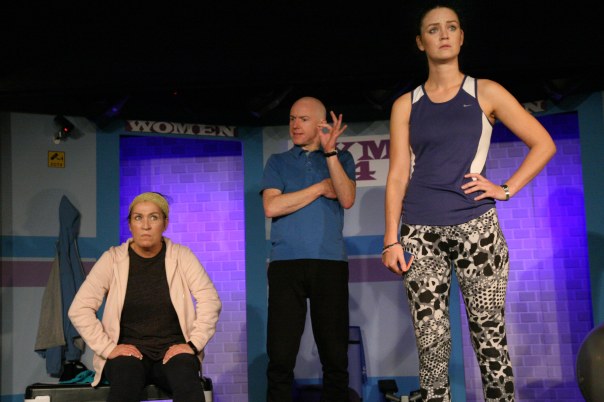
Though earthy Fran gets the best of the stinging banter, asking follicly challenged Bruce if he’s Bruce, as in Willis, as in ‘King of the Bald Guys’, all three actors are in fine contrasting form revealing their true motivations as the action progresses and personal ethics get a workout. This is a seriously funny, original piece of drama that’s well worth stretching your legs to get along and see.
Reviewer : David G Moffat
Zoetrope

Venue: West Yorkshire Playhouse
Run: 2 – 4 November 2017
Script: Stagecraft: Performance:
An extraordinary, deeply important piece of theatre, performed by the Youth Theatre, following the stories of seven young people’s struggles and experiences of mental health issues and illnesses. The performance was just over an hour long with no interval and it was thoroughly captivating from start to finish. The set, staging and the use of colours of the characters’ clothing were brilliant. Each of the seven participants of the group counselling sessions wore different coloured clothes and accessories. This was symbolic, especially as the play developed, each colour representing a different psychiatric illness, which, as well as being visually stimulating, helped the audience to understand and engage with the specific topics addressed (food, self-harm, drug abuse, teenage parenting).
The performance from the actors, despite their young age, was faultless; the utmost professionalism was observed, they worked well together and each took on their character splendidly. Characters ranged from doctors, teenagers, nurses to parents, and these were treated appropriately in regards to every aspect: the script, language and performance. Movement, music and light were used to create the atmosphere and emotion. Seamless and subtle changes meant there was no need for actual set changes and the audience was never left behind. The whole stage was used to its advantage and to create the desired emotion, for example the fast turning of the roundabout and the loud and overlapping voices to create the character’s feeling of desperation, anxiety and panic.
The research and tremendous amount of thought that went into making this piece of theatre genuine was evident. Each mental health problem was dealt with sensitively and compassionately, and the different perspectives of such illnesses were portrayed. This included the value of Mindfulness, views on meditation, and the contrasting views of self-harm between parents and health professionals. Through this play, the audience was able to glimpse the struggles and processes which people with mental ill health deal with in order to get help and support: the waiting lists, the various assessment questionnaires and scales (which were explained through a comedic skit, reminiscent of Philip Glass’s Einstein on the Beach), the misinterpretation (“chill out.. don’t take life so seriously”), the disjointedness of children’s and adult’s services (“not a transition but a bloody great full stop”).
The end of the play (involving a culmination of character Lily’s story, and the following being said: “freaks are those who can cope and can get back up” was poignant and upsetting, not least because it was unsurprising. It was thought-provoking, at times uncomfortable to watch, and sadly all too familiar, which, as Director Gemma Woffinden herself said when speaking generally, is exactly what “makes for a good piece of theatre”. Though, arguably, I would change her word “good” for “outstanding”.
Reviewers : Georgie Blanshard and Lucy Clark
The Burton Taylor Affair

A Play, A Pie and A Pint
Oran Mor, Glasgow
30th October – 4th November
Script:  Stagecraft: Performance:
 A huge photographic portrait of a movie star with arched eyebrows, hooded eyes and sultry lips dominates the stage. Either side of the framed picture, luxurious swathes of golden drapes glitter but little else does, in this disappointing drama by Steven Elliot featuring a reminiscing, Richard Burton (Dewi Rhys Williams) and Elizabeth Taylor (Vivien Reid). Comparisons of the couples earnings, Oscar nominations, and capacity for alcohol are ping-ponged back and forward with little conflagration, while lengthy quotes from Shakespeare and Marlow, used to illustrate their tempestuous on screen/off screen relationship, offer the best of what little chemistry the actors have.
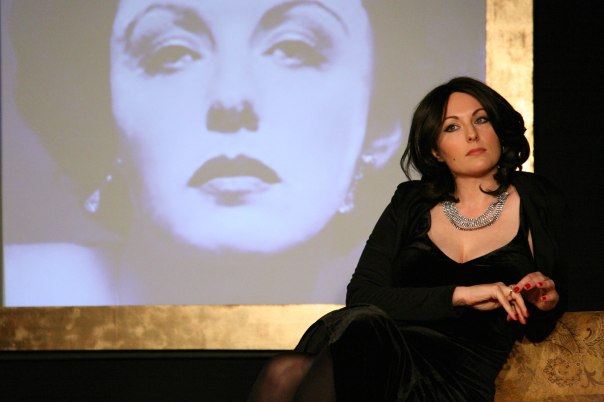
The female movie star seems far too young to hold her own, in a verbal joust with the mature stage actor and one wonders if Williams is reluctant to let loose the throaty Welsh grit of the full-Burton voice, for fear of extinguishing Reid’s lacklustre Taylor completely. This is a story that requires something a bit special to intrigue an audience familiar with the antics of a real-life married twosome they have seen on screen and in all probability, as characters portrayed by other actors. The play and cast deliver a muted, far from legendary, piece of theatre.
Reviewer : David G Moffat
In Short Order

October 26th – November 11th
Slate Theatre, Seattle
Script: Stagecraft: Performance:
After a tasty wonton soup I headed across Seattle Blvd to the imposing Inscape Arts Building. I wasn’t sure it was the right place, but then I saw a small chalkboard that said “Slate Theater.” Bingo! On entering I was greeted by some friendly folks who directed me to the small performance space inside the large building. They were serving ‘by donation’ beer and then I found my seat for In Short Order, presented by MonoMyth Theatre.
The show is a vignette play with a three-woman cast. Patty Bonnell, Laura Engels and Ashley Salazar each put on stellar performances, fluidly transforming into a new character for each scene, while ably managing & maintaining a continuity which made the sections fit together neatly as a whole. The set was effectively minimalist, which added a lot of energy to the action without being overly noticeable. The lighting and recorded sounds were tight, & overall I experienced an expert staging of a theatrical piece.
The first scene, ‘Recruit,’ is set in a dystopian doctor’s office, where a woman has no right to choose how or with whom she will make a baby. This scene made me realize a different side of the woman’s right to choose debate. Like in China where they had the one child, and now a two child, policy. Of course it seems good to control overpopulation, but it is a slippery slope when the government wants to regulate a woman’s body. I am more grateful for our country’s right to choose, and will be steadfast in defending that right.
‘Witness’ begins with a person reading a poem on the street. A passer by compliments the poet and tells them about social media. A police officer approaches and interferes with the interaction and everything goes bad. The term “gut wrenching” is used a lot, but I didn’t know what it was like to have my gut wrenched until the climax of this scene. I had a powerful and tangible jolt in my stomach which has never been invoked by drama before.
In ‘Talkback,’ a mixed nationality married couple is at the US immigration office applying for permanent residence so they can stay together. When the official comes for their interview it becomes clear this is a Kafkaesque nightmare, and the worst part is that it is completely believable. Again I wish that our country were more welcoming to new people. Diversity is a great part of our country and it is wrong to treat new people with anything but kindness
In the last scene Patty and Ashley read from cards which the audience was asked to submit. Laura enters and tells us that the doors are locked, and we can’t leave. This ties the whole show together, because each scene is about lack of freedom, and, finally, the audience gets to experience not having the freedom to leave. Brilliant.
This show does a superb job of expressing meaningful ideas and having fun with it; funny, intimate and engaging, I hope you will go see this wonderful piece.
Reviewer : Michael Beeson

#71

A Play, A Pie and A Pint
Oran Mor, Glasgow
23-28 October 2017
Script: Stagecraft: Performance:
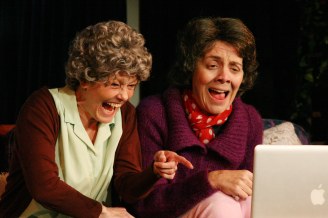
Septuagenarian Chrissy (Karen Dunbar) is rarely without pain and having tried every pill on the planet, has come to a decision. She’s invited her two closest friends round to the house as there is big news to impart. While she waits she slowly dances, in the old fashioned way, with a framed photo of her departed husband. The two chums couldn’t be more different with Jean (Maureen Carr) a short, permed, devout, worrier, prone to repeated malapropisms and Coco (Clare Waugh) a tall, confident, woman of the world, littering her speech with dubious Parisian pretensions – N’est-ce pas?

On a stage, impressively transformed into a conservatory, the women swap memories and insults while searching for the essential truth about love and death…as one does in Whiteinch. When Jean reveals she has a passion for Grime then hip-hops a song about her loss of faith, we know sooner or later, this will end in gin. The affection for Dunbar (who wrote the play) from the packed audience is palpable and each familiar Glasgow expression included in the dialogue is rewarded with the laughter of recognition. There is however, a paucity of genuinely funny lines, for the broadly caricatured characters, to deliver.
Reviewer : David G Moffat
Coriolanus: Fight Like a Bitch

October 17th – November 18th
12th Ave Arts
Seattle
Script: Stagecraft: Performance:
The play begins in fog, with warehouse techno music playing, & feelings of intense anticipation grip us tighter & tighter. Despite an age of more than 400 years, Rebel Kat Production’s Coriolanus: Fight Like a Bitch is an action filled feast, and incredibly relevant to today’s political and social issues. 12th Ave Arts Mainstage is a perfect place to see a play. There is a catwalk-like stage which bisects two seating areas, allowing all in the audience to see all of the action on the stage – as well as fellow voyeurs across the way. It gives the performance an entirely immersive feeling.

Coriolanus: Fight Like a Bitch has an all female cast. When Martius starts to interact with her wife and child, I realized: wait, shouldn’t Martius be he, but they call her she, and she is she? My brain got confused at this total break from the norm. Martius and her wife are both female. The all female cast helped me to identify this bias I have in my self. In a recent interview producer & actress Colleen Carey (Aufidus) told The Mumble;
All-female Shakespeare is being done quite a lot these days. There are all-female Shakespeare companies in major cities all over the world… Gender is only one factor among many. It would be easy to assume that seeing or making a single-sex production would be a binary experience. The truth is, it is far more complex than that. Actually, the reason that I wanted to produce this particular play, with an all-female cast, is that the character of Coriolanus is neither a hero nor an anti-hero. It’s a fascinating social experience to see a woman playing a role that is not ‘likable’ per se; and when that beautifully complex female character is surrounded by other female senators, warriors and politicians (many of whom are also wives and mothers) a reflection of the modern world in which we live can be seen with a great deal of honesty.
The story reminded me of modern politics. The main character Martius is a political elitist rather is out of touch with the needs of the common people. Just as Hillary Clinton felt that she should ascend to the presidency as if by right, Martius believes that her accomplishments make it obvious that it is she who should be elected senator. Alas for her, to the people she represents the politicians, who live fat lives, while normal folks struggle to put corn on the table.

Nike Imoru brings Martius to life brilliantly. She is skilled on the battlefield, but the Martius who interacts with the public was cold and reminded me of a border patrol officer who acts like a dick, because it is their job to act like a dick. Then there is another side whenever Martius she interacts with her family, you see her as a child to her mother, a wife to her wife and a mother to her child. Seeing these two sides of the character made me conflicted about who to root for, the misunderstood tyrant, or the struggle of the people. The latter are fed up with the government establishment and reject it with the banishment of Martius. In Coriolanus, the people have to deal with the terrible consequences of the vote to banish Martius, like the British people now are dealing with their decision to leave Europe. Back in Shakespeareana, when the people realize the ramifications of rejecting Martius, they feel regret. It was a big theme of the show for me. Making a decision and regretting it, then trying to change it and regretting the change.

The play’s language is of course difficult to understand for an early 21st centuryite. I can tell the players are speaking English, but what they are saying is not always clear. With pure Shakespeare it is then up to the director and cast to show the audience what the characters are feeling and doing. The great thing about this is the audience has to exercise their brains to give the story meaning. Coriolanus is participatory, unlike popular television which tells you a story to be observed passively, we as the audience need to create our story along with the performers facial expressions and actions. Director/choreographer Emily Penick has given her players a beautiful space to bring Coriolanus to life and the show is a rewarding experience.
Coriolanus: Fight Like a Bitch is a truly wonderful play and I hope you will see it and make your own interpretation of it. Coriolanus is also great exercise for your brain, to work on empathy and imagination.
Reviewer : Michael Beeson


 Mumble Theatre