(The fall of ) The Master Builder

West Yorkshire Playhouse, Leeds
30th Sept–21st October
Script:  Stagecraft: Performance:
(The Fall of) The Master Builder, a new modernised take on the play by Ibsen is a brave if flawed attempt to bring into the light a subject more often left in the darkness. Ibsen was famed for his tackling of taboo subjects and the psychological intensity of his plays was controversial (and even sometimes banned) in his day but how would a modern adaptation of his work fare? Would it seem a hackneyed vision from a more conservative age? Or would the coruscating insight of his story still feel strikingly relevant even now?
The play opens on the dregs of a party celebrating architect, Halvard Solnes upcoming acceptance of the ‘Master Builder’ award. The set brilliantly creates a doll’s house style box for the actors to perform in albeit one which looks more like a 1970’s office than a Victorian drawing room. There is also great use of music from the beginning which is used sparingly and with deft subtly creating a sense of foggy memories and burgeoning violence.
As the play begins the audience is thrown straight into the action halfway through a conversation – a technique which though intended to create a sense of immediacy merely feels confusing. We see assistant, Knut Brovik and his trainee architect son, Ragnar bickering about their boss before the master builder himself appears. Halvard enters swaying and staggering, a jaunty and charismatic drunk trying to instil some much needed sense of camaraderie amongst his colleagues. But his mood of triumphalism is soured by an undercurrent of tension. For at the very moment of his greatest triumph Halvard is beginning to feel his sense of privilege slipping away; the women don’t want him any more, he’s making more mistakes and he’s running out of new ideas. Thrown into this heady cocktail of middle aged doubt is cocky student, Hilde with her unhealthy obsession with him, scheming and ambitious trainee, Ragnar and his neglected wife, Aline. Is it possible that Halvard will clasp defeat from the jaws of victory or will he find some way beyond these entanglements?

The play is something of a character study in which the central character, Halvard is gradually revealed to us as his mask of gregarious charm and cheek slips into something far more desperate and troubled. It’s a play about power, control and the personal cost of desire. It’s a tall order for any actor to create such a character and resist the compulsion to showboat but Reece Dinsdale as Halvard gives an excellent charismatic performance creating a compelling portrayal of a ruthless charmer which subtly flashes with hints of the inner anguish and despair of a man who recognises the wickedness of his behaviour (“I’m a terrible human being in some ways but I try…”) but though fleetingly filled with remorse lacks the will to actually stop doing it.
Though Halvard is very much the centre of the play the other actors bring nuanced performances from what at times could end up as bit part characterisations. Susan Cookson as Aline gives her character a winning mix of strength and vulnerability. Katherine Rose Morley manages to create some depth from a character which could have been a mere archetype. David Hounslow as Dr Herval captures the righteous hypocrisy of his incorrigible reprobate of a character very well just as Emma Naomi manages to create empathy for her spirited portrayal of the feisty, loving Kaja. But sadly the other actors fair less well as Michael Peavoy gives a charmless one note performance of belligerent ambition as Ragnar and Robert Pickavance wrings no pathos from his flat performance as Knut.
One aspect which is handled well by all the actors is their investment in the physicality of their performances as they lend all the characters a slightly different physical presence from the stiffness of Knut, and the sprightly Halvard to the elegant Kaja. The way the perspective is changed from that of Halvard to the other minor characters towards the end of the play has a powerful immediacy to it through the use of first person monologues which feels like a brave yet successful risk. This chorus of conflicting voices and perspectives forces the audience to see things afresh and challenges our attitudes to all the characters.
The creeping claustrophobia of the final act is conveyed wonderfully through the stagecraft as the very environment seems to crowd in upon Halvard and we see emanations of what is to come with flashes of harsh and angry white light. However the build up towards Halverd’s retribution at times feels slightly overwrought and ends in monster movie theatrics which do much to jeopardise the subtlety of some of the actors previous work. The actual ending if stopped a scene earlier would have felt marvellously brutal – like a slap in the face but instead we unfortunately have a final scene which though visually striking in its starkness patronises the audience somewhat by spelling out the ‘message’ of what we have just witnessed.
This queasy mix between the understated and the lurid is a real fault of the script as although the dialogue is at times witty and there is often a naturalism to it which flows very well some of the plot twists and turns lack finesse and give the play at times an uneven tone as it shifts from farce to melodrama to tragedy. Sometimes this is handled well and the shift is subtle yet at others it feels jarring. There are also unfortunately some aspects to the adaptation of Ibsen’s original work which feel misjudged. There are countless references to “churches” and “trolls” which have real symbolic force but which are clearly derived from Ibsen’s original play and are very much of the 19th century Norway of its origins. Combined with references to modern shopping centers and Prince Charles this leave the play’s sense of time and place muddled. I feel it would have been better to have either given up any attempt to set the play in modern times or lose these references entirely for the play to be more effective. Overall I enjoyed the play and although at times its message felt a little heavy-handed the talents of the cast brought a sense of reality to what in other hands could have been a rather contrived piece.
Reviewer : Ian Pepper

Love and Death in Govan and Hyndland

A Play, a Pie and a Pint
Oran Mor
Glasgow
Oct 2nd-7th
Script:  Stagecraft: Performance:
Trips to the toilet, cups of tea, banging your head on the desk, these are standard diversions for any scribbler with writer’s block. Time to get your mother out the cupboard and have a chat with her urn; after all it is the tenth anniversary of her passing.
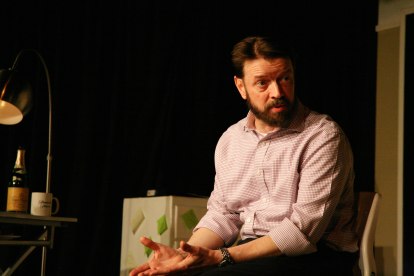
Ivan (Stephen Clyde) looks back a decade, reflecting on the relationship between his mother and himself at the time she discovers she is dying. Fifty years of smoking has lead to terminal lung cancer, ashes to ashes indeed but this is a woman who knows her own mind. No daft bucket list of extreme sports thank you, she is happy in her own home. Besides, every time she’s out and coughs, the neighbours phone their weans to get their name down for the hoose. Clyde handles this demanding one-man performance with confidence, zinging Glasgow barbs in the voice of Ivan and his mother, as both use humour to cope with impending loss.
Events in Ian Pattison’s excellent play, the shift of control, the need for the younger person to communicate in the world of the older, the physical indignities, all will be familiar to those who have experienced loss of an elderly parent. An engaging piece of theatre that is poignant, funny and true.
Reviewer : David G Moffat

CASTING FOR CITIZENS THEATRE PRODUCTION OF CINDERELLA ANNOUNCED
The Citizens Theatre, Glasgow, has unveiled the cast for its production of Cinderella – an alternative festive experience to round off 2017. Cinderella is recommended for ages 6+ and runs from 28 Nov – 31 Dec
 Glaswegians young and old can expect a fun and lively re-telling of this classic fairytale, with plenty of the hallmark ingredients that have earned the Citizens Theatre a reputation for unique Christmas shows. Citizens Theatre Artistic Director Dominic Hill – alongside his frequent collaborator, composer Nikola Kodjabashia – will bring his inimitable style to this production, deploying a handpicked ensemble cast to present this familiar story of magic and true love, with a twist. Peter Collins, whose comic performances have been at the heart of the theatre’s past two Christmas shows, returns to the company for his third festive season in a row. Peter’s most recent appearance at the Citizens was in Dominic Hill’s highly acclaimed production of The Oresteia: This Restless House (2017). Also returning to the Citizens stage for Cinderella is Irene Allan, whose performance as the Witch in Hansel & Gretel (2016) was described by the Daily Record as “utterly fabulous.” This year, she takes on the role of Cinderella’s stepmother.
Caroline Deyga, in her Citizens debut, is expected to wow audiences with the voice and spirit that saw her jointly nominated for ‘Best Actress in a Supporting Role’ at the Olivier Awards 2017, as part of the eight-strong cast of the award winning Our Ladies of Perpetual Succour (NTS). She will be joined by fellow Citz debutant Hannah Howie who, alongside Deyga, will bring her ‘strong comic timing’ (The Stage) to the production as one of Cinderella’s ugly sisters. As part of the theatre’s commitment to nurturing new talent, the Citizens is putting its two Actor Interns Nicholas Ralph and Sinéad Sharkey centre stage for this production. Nicholas’s internship is funded by the Robertson Trust.
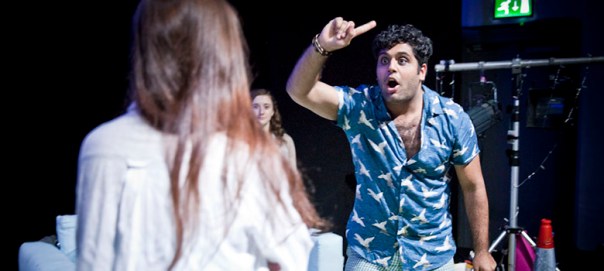
Jatinder Singh Randhawa in SNOWFLAKE & the Pleasance, 2017
The company is also delighted to welcome to the stage Jatinder Singh Randhawa, who will be taking a break from the Citizens Theatre’s front of house team. Jatinder recently graduated from North Lanarkshire College with a BA in Acting. The cast is completed by actor and physical theatre practioner Malcolm Shields, who brings over two decades of experience on stage and screen to this production. Last year Malcolm made a memorable cameo in Ken Loach’s I, Daniel Blake and first appeared at the Citz as Franco Begbie in the theatre’s landmark 1994 adaptation of Trainspotting.
Family tickets for Cinderella start from £33.50 for a family of three to £77.50 for a family of five. You can purchase tickets here.
Pleading
A Play, a Pie and a Pint
Oran Mor, Glasgow
25-30 September
Script: Stagecraft: Performance:

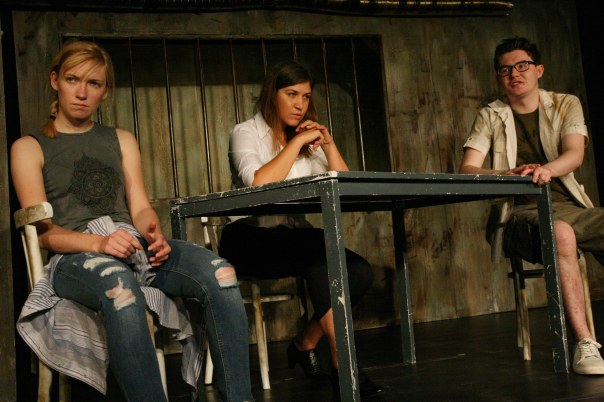
Inside a Far East prison a young couple sit at a table awaiting the arrival of a lawyer. Incarcerated for the last 22 days, their prospects seem as dim as the flickering bulb that lights the dubious stains on the walls of the interview room. If Freya (Kim Allan) and Michael (Daniel Cameron) are to be saved from the most severe of punishments they must tell Amelia (Nicole Cooper), their legal representative, everything that happened before they caught the plane in Brisbane. Both have reasons to be economical with the truth but the fact is, somehow, someway, something illegal got into their luggage.

Allan’s Freya is convincing as a feisty, defiant teenager, impatiently demanding the legal system realises they are not foreign but British. Cameron’s Michael is timid, prone to despair, more likely than his travelling companion to turn to tears when the going gets tough. He wears shorts, she wears the trousers. Cooper’s Amelia is a calm presence carefully teasing out the truth, laying out the options, curtailing the more outlandish hopes of the accused – the UK is unlikely to revoke trade deals to ensure their release (well not with Brexit looming).
Writer Rob Drummond’s satisfying play moves to the Traverse in Edinburgh next week, where its serpentine plot will keep the audience guessing right till the end.
Reviewer : David G Moffat
An Interview with Euan Wilson
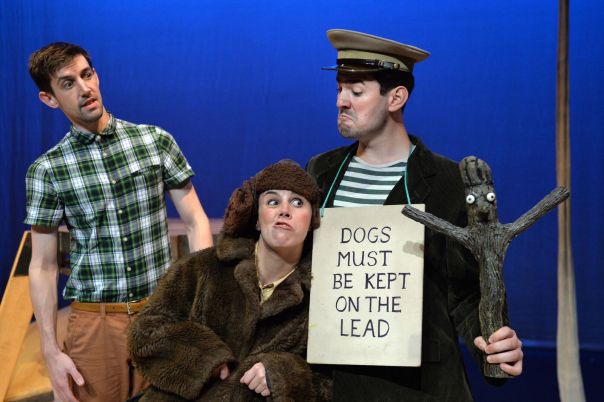
Hello Euan, you are currently touring with ‘Stick Man,’ can you tell us about the play?
Stick Man is a fantastic story about Stick Man trying to find his way home and everyone he meets on the way. It’s a brilliant adventure that sees him meet numerous exciting characters and travel to equally exciting places.
What do you hope the audience will take away from the production?
I think the audience will take away the wonderful story of adventure – as well as having the songs stuck in your head!
What was your initial response to the Stick Man script?
I absolutely loved how bursting with fun and energy the script is – it’s never slow and has bundles of excitement around every corner. The script works brilliantly for only three performers onstage and I can’t wait to start performing it around the country.
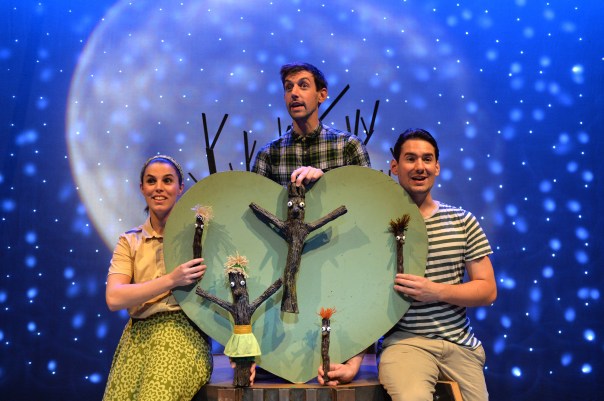
Have you found it hard bringing a character to life from the book?
So far, I’m actually finding it really easy! The multiple characters I play are really different but all full of life and energy and a joy to play. As well as that my character plays a lot of music on stage and the music is brilliant and really fun to play.
Did you always want to be an actor? How did you get to where you are today?
After deciding that being an astronaut wasn’t for me, I always wanted to do something creative. I loved music from a very early age and then got involved with drama at my school and the local amateur theatre company which I absolutely loved. From there I joined the National Youth Theatre of Great Britain and after leaving sixth form studied Actor Musicianship at Rose Bruford.
What was your favourite book growing up?
I loved reading when I was growing up. I absolutely adored the adventure and excitement in Harry Potter and the Young Bond series, which is one of the main reasons I love Stick Man.
What would you say to encourage people to buy a ticket?
You absolutely don’t want to miss this show. There’s more fun, music and puppetry than you can shake a stick at.
Any advice for budding actors?
Go and see as much theatre as you can! Find out where you can get the cheapest tickets from and go see whatever you can. It really is a learn by watching kind of art and the more you see the more you’ll realise what kinds of theatre you love. I would also strongly suggest auditioning for the National Youth Theatre, it’s a great introduction into the world of acting and you’ll have the time of your life!
You can catch Euan & Stick Man as they tour the UK,
from September 2017 to January 2018.
SEPTEMBER 2017
22 – 23 SEP GLASGOW King’s Theatre 0844 871 7648 BOOK NOW
24 – 25 SEP DUNFERMLINE Alhambra Theatre 01383 740384 BOOK NOW
26 – 27 SEP FALKIRK FTH Theatre 01324 506850 BOOK NOW
30 SEP – 1 OCT SALFORD QUAYS The Lowry 0843 208 6010 BOOK NOW
OCTOBER 2017
2 – 3 OCT NEWCASTLE Tyne Theatre & Opera House 0844 249 1000 BOOK NOW
6 – 7 OCT BLACKBURN King George’s Hall 0844 847 1664 BOOK NOW
8 – 9 OCT MIDDLESBROUGH Theatre 01642 81 51 81 BOOK NOW
10 – 11 OCT NOTTINGHAM Theatre Royal 0115 989 5555 BOOK NOW
13 – 15 OCT WINCHESTER Theatre Royal 01962 840 4405 BOOK NOW
16 OCT LEAMINGTON SPA Royal Spa Centre 01926 334418 BOOK NOW
18 – 19 OCT LOWESTOFT Marina Theatre 01502 533200 BOOK NOW
21 – 22 OCT LONDON artsdepot 020 8369 5454 BOOK NOW
23 – 24 OCT PORTSMOUTH New Theatre Royal 023 9264 9000 BOOK NOW
26 – 27 OCT BURY ST EDMUNDS Theatre Royal 01284 769505 BOOK NOW
28 – 29 OCT SOUTHEND Palace Theatre 01702 351135 BOOK NOW
NOVEMBER 2017
1 – 2 NOV BOURNEMOUTH Pavilion Theatre 0844 576 3000 BOOK NOW
4 – 5 NOV BRISTOL Old Vic 0117 987 7877 BOOK NOW
6 – 7 NOV MALVERN Forum Theatre 01684 892277 BOOK NOW
8 NOV TEWKESBURY Roses Theatre 01684 295074 BOOK NOW
12 – 14 NOV NORTHAMPTON Royal & Derngate 01604 624811 BOOK NOW
17 – 18 NOV SOUTHPORT The Atkinson 01704 533 333 BOOK NOW
19 NOV NORTHALLERTON The Forum 01609 776230 BOOK NOW
DECEMBER 2017-JANUARY 2018
18 – 24 DEC MILTON KEYNES The Stables 01908 280800 BOOK NOW
26 DEC – 12 JAN BIRMINGHAM Town Hall
An Interview with Katie Bonna

Hello Katie, so where ya from & where ya at, geographically speaking?
I live in London, but I am Midlands through and through and I am currently travelling around the UK with my show All The Things I lied About. We hit Glasgow this week, we’ll be at the Iron on 22nd and 23rd September. I’m bloomin’ thrilled.
When did you first find yourself getting into the dramatic arts?
I was pretty certain I’d be going into it when I played Supergirl with my sister aged four. I took it so seriously I ended up with a nosebleed from face-planting into our bedroom wall. I was so convinced I could fly.
As an actress, what are the secrets to a good performance?
Before every show I have to do two things. The first is to remind myself that I have never said anything I’m about to say before and the second is to mainline Beyonce. Freedom and Formation are my two favourite songs right now.
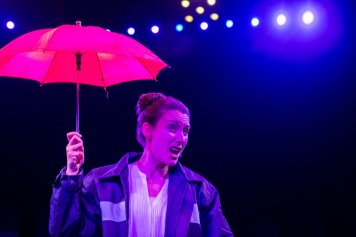
You’ve been washed up on a desert island with a solar-powered DVD player & three films. Which would they be?
Harold & Maude for sure, I love that film. I’m not really a film person, though. I try to be because it feels more cultured but I generally prefer TV. I’d take all of Girls and the complete Alan Partridge as well as Harold & Maude.
What does Katie Bonna like to do when she’s not being theatrical?
I love London. Walking round it, visiting obscure little places, eating all the delicious food! I read a lot, I generally have three books on the go at any one time. I’m reading a glorious book set in NYC in the 70s right now, a sort of sprawling, Dickenson, multi-story wonderland by Garth Risk Hallberg. And I’m a massive yoga-addict. I practice every day and have to find a local yoga studio if I travel with my work.
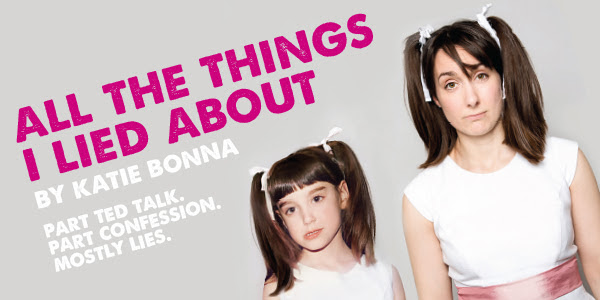
You are just commencing a national tour of ALL THE THINGS I LIED ABOUT. Can you tell us about the play?
It’s part TED talk, part brutal, personal confession. It’s a comic exploration of how the little lies we tell every day have led us to a world of Trump and Brexit.
You have both written & are starring in the play. What does it feel like to be so immersed in a piece of theatre?
It’s a lot more intense than acting in someone else’s project. I used to get stressed about doing acting jobs, but they feel like a walk in park after performing my own work! I do enjoy it, though, and the sense of satisfaction when you really connect to an audience is incomparable.
You performed the play at Paines Plough Roundabout & Edinburgh’s Summerhall last year. What have you tweaked in the interim, either stagecraftwise or writingwise?
I’ve changed a lot actually. The heart of the show is exactly the same but I think it’s more well-rounded and crafted now in terms of the script. In terms of staging, we’ve had to move it from in-the-round to end-on. That’s been a big shift, but I think we’ve made it work well.
What emotive responses do you expect from your audience?
I don’t expect anything. Some people have a strong emotional response, especially if they have had similar experiences in their life or can relate to the subject matter in other ways, but I don’t expect anything from the audience per se. Everyone reacts differently, don’t they? That’s the beauty of it for me.
What does the rest of 2017 hold in store for Katie Bonna?
I have just received funding to develop my new show, which is as yet untitled! I’m working with Live Theatre Newcastle to make it. It’s a three-hander about gender-conditioning, self-censorship in women and the complexities of 21st century feminism. It’s inspired by the classical Greek chorus and my love of Marilyn Monroe. It will be a lot of fun. The rest of the year will be spent on that and drafting a novel that I’m writing for young adults. I’m super excited about both of those things!
All The Things I Lied About is now on tour:
September:
16/09/17 HighTide Festival, Aldeburgh
20/09/17 Norwich Arts Centre
22/09/17 & 23/09/17 Tron Theatre, Glasgow
25/09/17 Theatre Royal Bury St Edmunds
27/09/17 The Stahl Theatre, Oundle
28/09/17 North Wall, Oxford
29/09/17 Dixon Studio, Southend
30/09/17 Sherman Theatre, Cardiff
October:
02/10/17 – 07/10/17 Bike Shed, Exeter
12/10/17 The Riverfront, Newport
13/10/17 & 14/10/17 The Edge, Manchester
16/10/17 The Shelley Theatre, Bournemouth
17/10/17 & 18/10/17 Everyman Theatre, Cheltenham
Disturbed
A Play, A Pie and A Pint
Oran Mor, Glasgow
Sept 18-24
Script: Stagecraft: Performance:
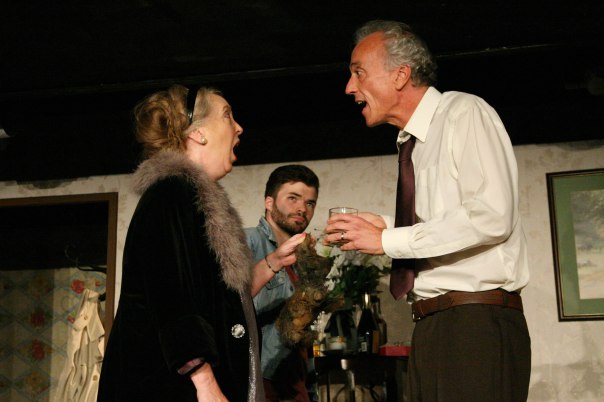
With sexual ambiguity and sharp dialogue, there are shades of Orton in this black comedy by Ian Cowell. Suburban couple Peter (George Drennan) and Grace (Anne Lacey) have been together for over 40 years and are at that intuitive plateau where words are not needed. If he taps his empty glass rapidly, the little lady knows it’s time to put down her knitting, fetch the malt and serve him another whisky. What could be more normal? Perhaps the longevity of their relationship is cemented by a hobby they share, even though it does tend to leave a bit of a mess in the darkness of the wine cellar and some digging to be done in the garden.
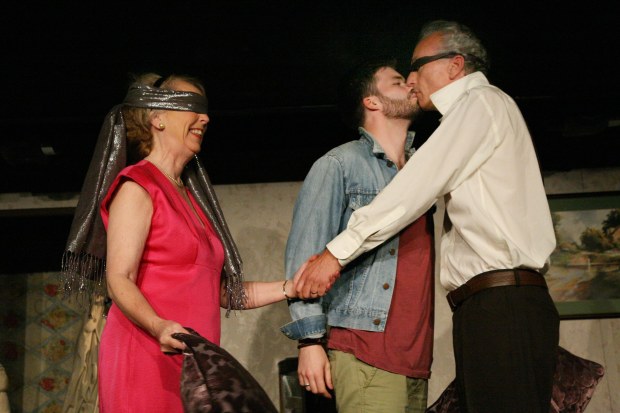 Once again they’re looking for a new tenant for the spare room and when a mysterious, handsome young man appears, keen to rent the space, the new lodger (Matthew Tomlinson) arouses the interest of Grace… and Peter. Drennan and Lacey are subtly convincing as the staid domestic couple about to have an additional layer of weirdness added to their already strange life by Tomlinson’s lively, double-dealing interloper. A mention should be given to Andy McGregor’s direction, which contrasts the early sedate sufficiency of the couple with the parlour game chaos of the trio at the end, a treat to watch throughout.
Reviewer : David G Moffat
The Sky Is Safe

Brunton Theatre
14th September 2017
Script: Stagecraft: Performance:
During the madness that is the Edinburgh Fringe I saw that Matthew Zajac was performing in a new self-penned play, The Sky is Safe. After seeing Matthew in his extremely excellent ‘Tailor of Inverness’ of 2016 I didn’t want to dilute the experience, & so gladly opted to wait until it toured itself into the Brunton Theatre the other night. I was glad to wait, for I found the play to be a highly intellectual, explicitly detailed & ultimately satisfying slice of theatre. Of the play’s substance, in an earlier interview with the Mumble, Matthew told us;
In 2012 I was stranded in Istanbul for nine days while I waited for an Iranian visa which eventually was refused due to my UK nationality… I had a couple of interesting encounters on Istanbul’s streets and wrote about them. Last year I was pondering a new project for Dogstar and remembered the Istanbul experience. I learned that there were now around 350,000 Syrian refugees in the city and I decided to try to marry my earlier experience with that of Syrian women trying to make a life in the city. In March this year, I returned to Istanbul and, with the help of a local NGO, I had the great privilege of meeting and interviewing a number of Syrian women in their homes. A lot of what Amal, the female character in The Sky Is Safe comes from these interviews.
The central theme of the play is the relationship between Matthew’s Scottish gentleman, Gordon, & the female refugee, Amal, played with consummate confidence by Dana Hajaj. The story leaps from place to place through time locale, & at all times the chemistry between Gordon & Amal is quite pleasant to watch as they trip through the ordealistic travails of the Syrian refugee. Stagecraftwise, the music is excellen, all Turkish strings & twangs, while the set is smart enough – a soft-watching medley of warm squares of quasis-granite. I also found the explosive & light-flashing portrayal of a bombing scene stupendously atmospheric. The Sky is Safe is an hour long, Fringe-length of course, & the brevity is welcome in a play with just two actors. That doesn’t mean we only have two characters, however, while the brooding presence of the interviewees is never afar away. ‘My name is Marwa,’ we hear, ‘It means a smooth white rock. You need love to heal. My name is Jadwa. It means gift. We have men in power & the country is destroyed. My name is Raina… My name is Farida…’ etc, etc.

There are many strands to The Sky is Safe, whose well-researched material moulded into genuine entertainment by the slick Dogstar team. Theatre is about transporting the witness to another world, even when that world grates against our station in a fertile, wealthy island. There are real tragedies happening out there, real suffering, real & epic tragedies born of bureaucratic bullshit, all of which are conjoined by the spirit of hope; & although documentaries & news channels may be switched off or over, to get the same information from a trip to the theatre means one’s mind must become transplanted with the truth. In such a fashion The Sky is Safe is a welcome success, for the characters we are presented or more-than-real, the amplified essence of these desperate – for some – times.
Reviewer : Damo
Photos: Laurence Winram
It is still possible to catch The Sky is Safe on its tour of Scotland;
Sept 18-20 : Eden Court, Inverness
Sept 21 : Reay Village Hall
Sept 21 : PPP, Wick
Sept 23 : Durness Village Hall
Queen of Chapeltown
West Yorkshire Playhouse, Leeds
13 – 15 September 2017
Script: Stagecraft: Performance:
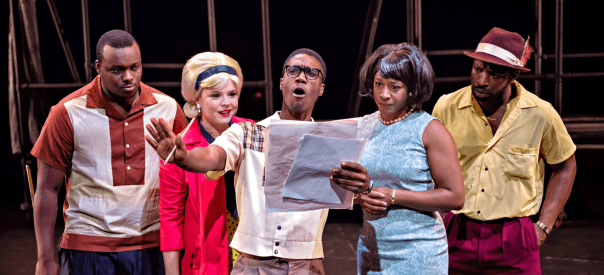
A wonderful play, telling the story of how the Chapeltown Carnival came about, and of the first Carnival Queen. At an hour long with no interval, it was the perfect way to portray this informative, important, local piece of history. Throughout, there was lots of comedy; some aimed at the locals (derogatory, yet fond, comments about Chapeltown and comparing it with Roundhay) and some bittersweet quips (“I didn’t know I was Black until I came here”), all performed with faultless comedic timing.
The ‘less is more’ approach of this piece of theatre was arguably its best asset (as Walt Whitman says: “simplicity is the glory of expression”). A sparse set, the use of the whole stage, the radio snippets, the dance and the perfect balance of simple dialogue and periods of silence, made for a thoroughly engaging performance. The actors worked well together and dance was used to evoke the situation and time. This was done beautifully by all the actors, especially the hairdressers’ Mexican wave in one of the scenes, and in the club where actress Elexi Walker used body language to show her character being initially cold and uncertain to the new dancing but thawing and enjoying herself – no speech was used.
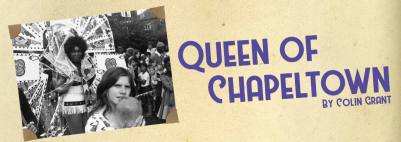
One of the main themes was the racism of the time period and this was portrayed very effectively through radio announcements (a ploy which gave immediacy and credibility to the racist words) and the use of music (such as Nina Simone), as well as the titular character Beverly’s thwarted attempt at scoring a job as a hairdresser. Contrasted to this deep-rooted racism, was the unison of the mothers of black character Beverly and white character Hilary’s quotes that “if you aren’t allowed to cut the hair you should wash it.”
Scenes flowed seamlessly and subtle techniques were used, for example varying the numbers of actors on stage, dialogue and silence, music. One of the most poignant scenes was where character Beverly is shown crying to a Nina Simone record; a counterpoint to the raucous dancing of the previous club scene.
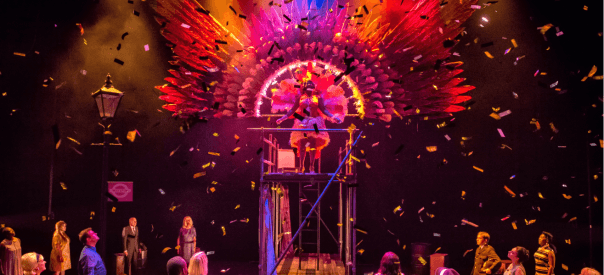
First-night nerves showed at times; a certain lack of finesse in the actors’ performance and some of the dialogue was hard to hear, drowned at times by the audience’s laughter when the actors hadn’t paused to wait. The end scene depicts character Beverly as the Queen of Chapeltown. The bright colours of her clothes were in stark contrast to the muted colours of Beverly’s previous outfit (such as the white coat and even her pastel blue party dress), and it was remarked upon by character Hilary realising that previously she lived in black and white and the Carnival was the first time that she saw colour. The audience was left with one thought: “Being a Carnival Queen is about honouring your ancestors”.
Reviewer : Georgie Blanshard
What Shadows
Royal Lyceum
Edinburgh
September 7-23
Script: Stagecraft: Performance:
 The topical transatlantic hot potato that is racial integration has just exploded like a White Supremacist nail-bomb onto the Lyceum stage. I’m always a little wary about picking open old social wounds in the name of entertainment, let sleeping rabid dogs lie kinda thing, but seeing as ignorance is in fact the bedrock of racism, encapsulating & regurgitating the essence of the tamer, slave-emancipating British variety through the educatory medium that is theatre is a prudent exercise. ‘We need to talk about England,’ the Lyceum’s artistic director, David Greig, told the Mumble, surfing the socialistic waves instigated by Brexit, for the England of 2017 is one in which the post-imperial diaspora has finally taken root. What Shadows explores what it means to be English, & in the play, the daughter of Caribbean immigrants, sable-skinned Rose Cruikshank, states quite proudly & progressively, ‘we all have multiple identities, but English is what we share.’ ‘But there are some of us more English than others,’ retorts a near-death Enoch Powell, who insisted on funneling his deep-set & quite inane old-school attitudes of race & Empire into the fermenting cauldron of modern Britain. It was 1968, & his ‘Rivers of Blood Speech’ – or the ‘Birmingham Speech’ as Powell called it himself rather whimsically – would plant ideas into the British psyche which would take decades to shake off. Not quite as incendiary as the 1861 Cornerstone Address by Confederate Vice President Alexander Stephens which ignited the American Civil War, but still a rather combustible collection of words which escalated into abhorrent social conflict that cup-of-tea-&-a-biscuit racism of English housewives. No longer would we hear, ‘that Sheila Donnelly’s shacked up with one of them coons, y’know!’ ‘Bloody nora, I wonder what colour the kid will be?’ Instead, ‘fuck off Pakis back to your own country,’ would become the bestial norm.
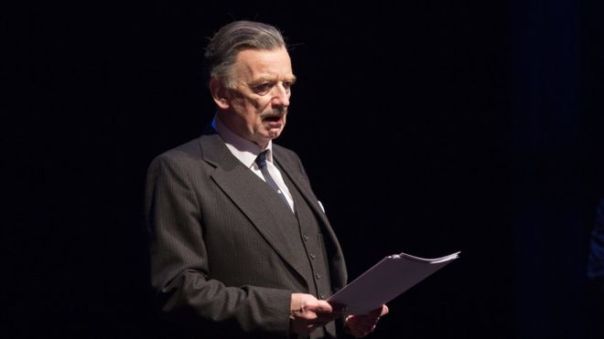
The stage before us is sparse but vivid; a wee copse of permanent Silver Birches transmorphing in eclectic variations of projected video-light. The script we hear is intelligent, witty & informative; a fascinating triumph of integrity by Chris Hannon. I enjoyed his previous work for the Lyceum – in which he manage to shorten the Iliad & still make it resonate with Bronze Age beauty. With What Shadows we may observe Hannon’s growing sense of maturity, & also historicity, of which David Greig told The Mumble, ‘Chris Hannan uses his skill to shatter & examine some of the most urgent questions of the moment: Who are we? Where are we going? And who gets to decide?‘ The story is presented by a stellar cast, a cornucopian banquet of talent consisting of British-Asian stalwarts Waleed Akthar (Salmon Fishing in the Yemen) & Amneet Chana (what has he not been on?), Amelia Donkor, Nicholas Le Provost, Paula Wilcox & Joanne Pearce. The richest picking on this silver platter is Ian McDiarmid, whose mountain-peaked experience was distilled into a rendition of Powell’s speech itself, with his genius steaming through every nuance of accent, emotion & snidey attack on the fledgling immigrant infrastructure of England. As an audience member born a decade after the speech, hearing McDiarmid in full flow offered a crystal clear memorial to that landmark occasion, allowing me to experience at quasi-first-hand that venomous piece of history which resonated bigotry & ignorance thoughout the land. No longer was England a place of churches, picnics & sunken lanes, but ghettos were developing in the inner cities out of which, according to Powell, legions of darkies would swarm to take over the island.
The speech came at the heart of the play – just before the interval. Before, & after, the action oscillated between the late 60s & 1992, telling Enoch’s personal story & the lingering after-effects of the speech – from Oxbridge to Wolverhampton via the barren shores of remote Scotland – while also sketching out a brief history of immigrant integration from its awkward early steps to the times when illiterate Pakistani villagers had given themselves a British education & got a decent job in a modern, accommodating & progressive society. The second half was a little drifty, lacking the dramatic tension that entailed the build-up to the speech… but the finale was excellent, a caustic conversazione between Rose Cruickshank & an elderly Enoch Powell, physically shaking with Parkinson’s Disease & spiritually shaking at the gall this young black woman had to question his inherent racist attitudes. As smart & witty as Virginia Wolfe at a literary soiree, she cut Powell to pieces during an existential debate which left me wondering what the next step of social integration is going to be. I guess, when someone asks us where we are from & who we are, we shall eventually reply only with a curt, ‘I am global.’
Reviewer : Damo
 Mumble Theatre