The Witches of West Fife

Play, Pie, Pint
Oran Mor (Glasgow)
Sept 11-16
Script:  Stagecraft: Performance:
Set in the present day and the early 17th century, Jane Livingstone’s play features an all female cast, an appropriate reversal of what was the Elizabethan norm, as we are about to learn (in gruesome but necessary detail) the fate of women thought to be witches.

Three Fifers, Isobel, Janet and Mags are recruited to do a bit of double, double, toil and trouble round the caldron in a film of Shakespeare’s Macbeth. Not professional actors, they’ve been hired for their faces and to add a bit of colloquial authenticity. The director shouts action and we are transported back in time to the Bard’s London house where Will sits with Lilyan a Scottish seamstress who not only makes costumes for the company’s theatrical players but can read – a skill that arouses suspicion in Sir Grigor, a misogynistic royal emissary, visiting the playwright with a supernatural commission from King James.
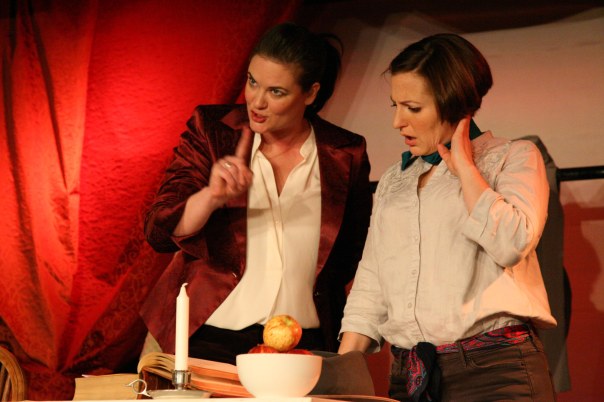
The actors, Kirsten McLean (Isobel /Will), Sally Reid (Janet/Lilyan) and Clare Waugh (Mags/Sir Grigor) are comfortable in their dual roles, contrasting the dark drama of the past with the joking, cowl wearing, amateur performers in the film. (In a third guise they appear at a witch-trial in bunnets and football scarves. Weird but it works!)
Livingstone packs her intriguing play with facts and ideas which argue, with convincing authority, that the historical demonization of women through accusations of witchcraft had more to do with political repression than any fear of sorcery. A production that’s both entertaining and edifying.
Reviewer : David G Moffat

An Interview with Fiona Miller
 Hello Fiona, so where ya from & where ya at, geographically speaking?
Based in Glasgow, but we work all over Scotland and beyond when possible!
When did you first find yourself getting into the dramatic arts?
From as long as I can remember. I used to watch Ethel Merman films and imagine myself in a flowery swing cap beaming at the camera
What for you makes a good piece of theatre?
It has to make you feel something. I’d rather feel angry watching something than bored. Short is good too!
What is it about being an artistic director that makes you tick?
I mostly get to make bits of theatre that interest me. I like developing a way of working with other artists, sometimes over a long period of time. I also like the freedom to see a performance or someone work that I like and can find ways to collaborate with them.
What does Fiona Miller like to do when she’s not being theatrical?
My favourite pass time is going to different countries when I can. It freshens my senses. This year I have been to Japan, Spain, Romania and Italy. I have to say this is not a typical year for me.
You have been part of the Scottish Theatre scene for three decades now. How has the scene evolved in that time, including the development of trends you may have noticed?
When I started out there was hardly any youth theatre in Scotland. So, I was involved in that first big movement to develop Youth Theatre as a new theatre form and make it accessible to all the young people who wanted to take part. I feel that I am now part of a new trend, an Older People’s Theatre movement across the country! There has been a big shift in attitudes to theatre created by professional and non- professional performers over the last 30 years. There is more recognition that the quality of performance can be the same, the content and styles may be different. But I don’t think we are quite there yet. A lot of people still feel theatre is not for them.
You are a member of Tricky Hat, can you tell us about the company?
I’m Artistic Director of Tricky Hat. I co -founded the company 12 years ago. We create new theatre. We currently have a schools tour going to every 16 year old in Dundee at the moment. Our other main focus is making theatre with and about older people. All our work is collaborative, we work with big organisations like See Me Scotland to create dramas that challenge perceptions to community based organisations who support older, more frail and isolated people. Plus artistic partners like CCA, Cumbernauld Theatre, The Catstrand. We create live performance, digital installations, on line films and Forum Theatre based interventions.
What are the secrets to a good workshop with your fledgling actors/actresses?
Enabling people to discover that they are creative, that they do have a voice and that they feel safe enough to try new things. But most importantly a good laugh.
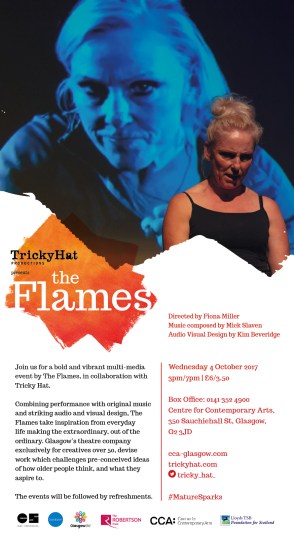
You will be bringing The Flames to the CCA in Glasgow next month, can you tell us about the play?
We have started devising it now. We have 24 Flames in this performance, more than double the last time. We prefer to call them performance events! We work together for 5 days then rehearse for one day, then perform to an audience. All the content of the show comes from the Flames lives, ideas or imaginations. Together with a director, a digital artist, a musician and a choreographer we decide the best medium to tell each of the stories. We don’t really know what the show will look like until the dress rehearsal. We are exploring choices, decisions, reasons to stay, and reasons to go.
What emotive responses do you expect from your audience?
Not to be bored! Being moved in anyway at all will do for me.
What does the rest of 2017 hold in store for Fiona Miller & Tricky Hat?
After this next Flames Performance on 4th October, the rest of the year will be focused on planning the next round of Flames events in association with the CCA. We also want to offer different experiences to the Flames community (once a Flame, always a Flame). We are working toward a collaborate with a Japanese artist and some older people in Japan ( Japan is leading the way in the world with its aging population) and the Flames. I think the cultural exchange would be fascinating. I also want to do a project called £10 Ticket based on the migration of people from Scotland in the 50’s 60’s to New Zealand & Canada. What are the parallels between then and migration now? I’d love to create a multi media performance of this on a railway platform.
You can See THE FLAMES @ Glasgow’s CCA, October 4th, 2017
Late Sleeper
A Play, a Pie and a Pint
Oran Mor
Glasgow
Sept 4th-9th
Script:  Stagecraft: Performance:
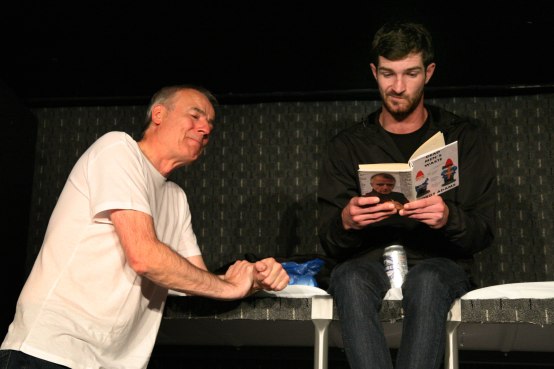
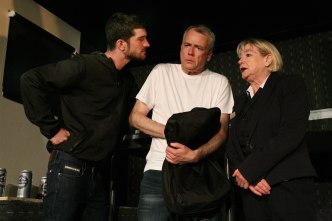 George (Vincent Friell), a novelist of the gritty Tartan Noir variety, now living in fashionable Crouch End, is forced to share a sleeper berth on the London to Inverness train, in this comedy drama by Simon Macallum. He and his sunglasses are not best pleased. Bren (Barbara Rafferty) the dismissive, overnight attendant is hardly selling the experience suggesting the food’s awful and the good night’s sleep that George is after, can be achieved – but only with the use of earplugs and chloroform. Into the compartment swaggers a young Glaswegian out of Catford called Goags (Neil Leiper) replete with attitude, agenda and poly bag of cans he’s determined to share as he ‘likes a good bevy on the train’.
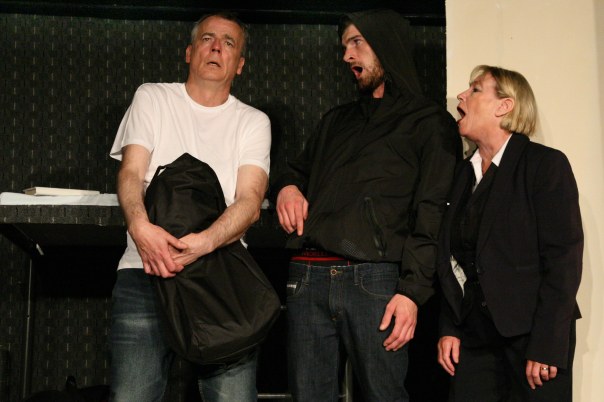
As they head north, an intimidated George goes through emotional changes, worrying about his family, his bargain-book-bin sales and his fellow traveller’s mysterious black luggage. Meanwhile a probing Goags questions the author’s street credentials, delivering earthy aphorisms with hoodie chutzpah in a claustrophobic, bunk bed set, reminiscent of a prison cell. As wheels turn and plots develop, is someone being set-up and looking at porridge for breakfast? Given the action unfolds in real time, George, a novelist after all, seems a little too easily manipulated by his devious bunk mate. Has he never watched Hitchcock’s Strangers on a Train? Where’s Farley Granger when you really need him?
Reviewer : David G Moffat

An Interview with Wonder Fools
At the end of September (27th-30th), Wonder Fools will be bringing THE COOLIDGE EFFECT to the Tron in Glasgow. The Mumble managed to catch a wee blether with the dynamic duo behind Wonder Fools; Jack Nurse & Robbie Gordon.
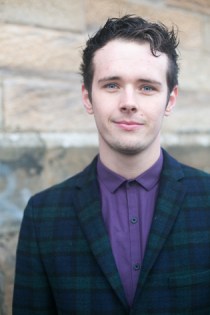
Robbie Gordon
Hello guys, so where ya both from & where ya both at, geographically speaking?
ROBBIE : Geographically speaking I hail from Prestonpans, East Lothian and funnily enough, it’s where a lot of our work is born as well. The story of “549: Scots of the Spanish Civil War” starts in that town, which neighbours with Tranent, the setting for our other play, “McNeill of Tranent: Fastest Man in the World”. As a theatre-maker, I’ve always been motivated to bring to life rural and untold stories to life. Jack comes from Kirkcudbright and I’m sure there’s a treasure trove of stories that come from that town too and that’s what keeps us making work. New tales are the reason we keep going and we’re lucky Scotland has such a great culture for telling them.
What for you makes a good piece of theatre?
JACK : For me, a good piece of theatre is one that is both entertaining and thought-provoking. Theatre should never be boring, it should be visceral and exciting and it should also have an intellectual element that makes you think.
When did you first find yourself getting into the dramatic arts?
ROBBIE : I actually started off as all most all young people in the arts do… by winning the P7 talent show singing Robbie William’s hit single Rock DJ. In all honesty, I came second but I think it was because I took off my vest like Robbie did in the video and it was deemed inappropriate. I had a passion for performing from a young age and pursued the standard youth theatre route until I went to see shows like Ontrorend Goed’s “Teenaged Riot”, Greyscale’s “Tonight… Sandy Grierson Will Lecture Dance And Box” and Grid Iron’s “Decky Does A Bronco”. These performances amongst others really shook things up for me. I started to really challenge and push my tastes and that’s what lead me to study Contemporary Performance Practice at the Royal Conservatoire of Scotland
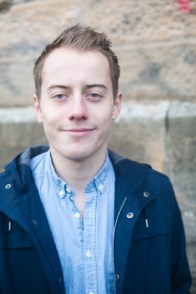
Jack Nurse
You’ve been washed up on a desert island with a solar-powered DVD player & three films. Which would they be?
JACK : I’ve always loved Walk the Line, the Johnny Cash biopic. I think the lead performances in that are stunning and the music obviously very evocative. I love Inception. And I rewatched Casablanca recently and it’s the definition of a classic.
As an actor, what are the secrets to a good performance?
ROBBIE : I’m not sure I have any secrets but what I do believe in greatly is authenticity. Just standing up, being yourself and telling the story. Jack often says to me before a show “have fun and tell the story”, this has become somewhat of a mantra for me. It carried forward into performing as the narrator in Douglas Maxwell’s “Charlie Sonata”, Jack was with me, even then… I can’t get rid of him! I think I’d be gutted if I was on stage doing a show and I wasn’t having a good time.
What does Robbie Gordon like to do when he’s not being theatrical?
ROBBIE : I like a quiet pint (mainly Tennents), podcasts and music. I’m a human being of simple tastes. Currently, I’m a bit obsessed with podcasts. I’m a big fan of Radiolab and I’d like to thank Gary McNair for the introduction. It has made me laugh out loud, late for work and cry on public transport and it has often stopped me dead in my tracks, On the music front, right now, it has to be Four Tet, Bonobo and of course… Robbie Williams.
You are a member of Wonder Fools, can you tell us about the company?
JACK : Wonder Fools is made up of me and Robbie Gordon. We started making work together whilst we were still students at RCS. We create contemporary new work based on a diverse range of current and historical real-life stories. During our short history, we have sought unknown and forgotten stories lost in the evolving social landscape of modern Britain that we are able to reshape and make theatre from. From these stories we have taken theatre productions, performance installations and drama workshops to over 2000 people across Scotland. To date we have staged three full productions: McNeill of Tranent: Fastest Man in the World, a one man show performed by retired athlete George McNeill, who in 1972 was the fastest man in the world despite never being allowed to compete in the Olympic or Commonwealth Games; 549: Scots of the Spanish Civil War, a verbatim account of the journeys of four miners from East Lothian who travelled among 549 Scots to fight against fascism in Spain; and The Coolidge Effect. Wonder Fools are one of six Graduate Emerging Companies on attachment at the New Diorama Theatre, London.

So Robbie, you have both written & are starring in The Coolidge Effect. What does it feel like to be so immersed in a piece of theatre?
ROBBIE : Jack and I have both been immersed in this piece of theatre for over two years now. It was devised from interviews with porn advocates, addicts, mental health experts and scientists. We spoke to so many incredible people and these conversations still float around in my brain. A part of the process that has always stuck with me was when we interviewed a Californian Digital Love Doctor, Robert Weiss. We found him through a VICE documentary and you can see why he’s such a spokes person for these issues The time he gave us over skype was enlightening in the extreme. He talked to us in depth about the correlation between addiction and trauma in one of the most engaging and simplistic ways possible. He called for a radical re-definition of trauma and asked us to consider how traumatic adolescence is for a young male who is expressly told to “man up” and “not cry”. This lead us to interrogate the toxic expectations young males are faced and how these might be interconnected with addiction in ways that we would never have considered otherwise.
So Jack, you are a rising star in the world of Theatre Direction, but what is it about being a Theatrical Director that makes you tick?
JACK : I’ve always loved telling stories and that’s the thing I like most about directing. Also, in 2017 I think theatre as an art form has become even more special because it’s one of the few places you can go and experience something live with a group of total strangers without a screen or social media distracting you. I think the opportunity for connection between audience and performer in 2017 is vital.
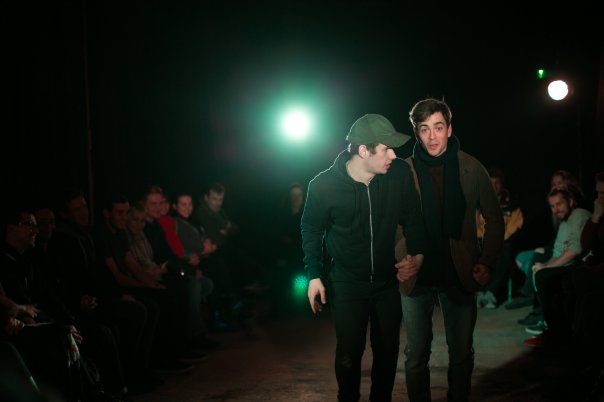
You will be bringing The Coolidge Effect to Edinburgh & Glasgow later this month, can you tell us about the play?
JACK : The Coolidge Effect explores society’s relationship with pornography. Specifically, we look at porn addiction and how porn affects our mental health, sexual experiences and relationships. It’s a complex subject matter but we have tried to tackle it in a fun and engaging way through intertwining narratives, poetry and a little bit of science.
What emotive responses do you expect from your audience?
ROBBIE : It’s really hard to gauge how an audience will think and feel. Above all, I want people to be present in the space with me and I want to tell them the story. A story I heard over the course of two years from all the people who talked with Jack and I. I would like for people to feel how I did when I first heard these words. It’s not a simple issue and it will be met with mixed responses but what I would love is for people to hang around at the end and talk. I think a big step to tackling a stigmatised issue is to start a conversation and I hope this performance begins an active dialogue.
What does the rest of 2017 hold in store for Jack Nurse & Wonder Fools?
JACK : Next up for me and Wonder Fools is a production of Lampedusa by Anders Lustgarten. It’s being staged by the Citizens Theatre in association with the company and I’ll be directing. It looks at the refugee crisis through two intertwining monologues and is the first time we will be working as a company with an existing text. We can’t wait.
Leaf

Greenside @ Infirmary Street
Aug 25-26 (23:10)
Script: Stagecraft: Performance:
Leaf is essentially a patchwork quilt of capers, japes & nonsense under which we audience members may snuggle & giggle warmly for an hour. As we are swept from the ‘infamous moors of Berlin’ to the period drama of Georgian England, we are given the loosest pretensions of a story revolving about the lovequest of chess-loving chemical engineer Mark. The most remarkable thing about watching Leaf, in fact, is how its actors – led by commander-in-chief Helen Potter – can keep a straight face during the show. In a recent interview with The Mumble, Helen described her creation as;
larger than life comedy that is both entirely based on the truth, and an absolute load of fictitious nonsense. As quintessentially British as the queen eating her roast dinner off a Boris bike seat (perish the thought!)… Leaf is a show that combines the emotional rollercoaster of a socially awkward chemical engineer, with the wild chaos of a sketch-show.
A sketchy play in both senses of the word, Leaf is still a fascinating – & funny – watch. A lot of thought has gone into the stagecraft of Leaf; its visually exciting, while the voice-overs work superbly. This play is comedy bombast at its most fluent & foppish best. Some moments are freshly hilarious, while others are just dodgy pun-making, but with the latter being delivered with such overenthusiastic confidence that these turn out to be kinda funny n’all. Leaf also gets a bit taps-aff towards the end, & with a lung-bursting rendition of ‘Total Eclipse of the Heart’ to finish, this wonderful late-night watch was a perfect way to finish my Fringe for 2017.
Reviewer : Damo
The Empty Charcoal Box
A Play, a Pie and a Pint
Oran Mor, Glasgow
Aug 28-Sept 2
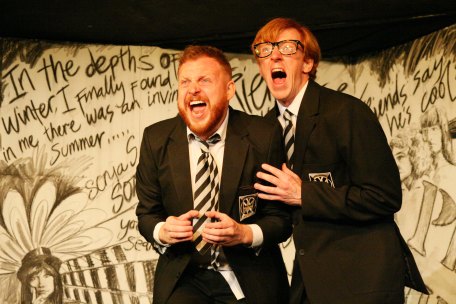

Before a backdrop of a huge page from an adolescent notebook, scribbled with drawings and philosophical ponderings, a man trudges back and forward in a tired dressing gown making a cup of tea. A throbbing soundtrack tells us he’s only human after all. The phone rings and a conversation with an old friend, takes him back to a place he’d rather not be. It’s the 1980’s and Billy, a 5th year boy with journalistic ambitions, has access to the school’s Gestetner printer. What could possibly go wrong? Well given his publication is called the Cumnock Finger, plenty.
 The play by Stuart Hepburn explores the relationship between three school friends over three decades. Billy (Ryan Fletcher) is a wannabe intellectual who knows a good book is for being seen with, not reading. Eddie (James Mackenzie) is cool and knows life is for living, not writing about. Deansy (Gavin Wright) is their sensitive specky pal, not terribly sure about anything. The characters are well rounded and their youthful disregard, for actions having consequences, will be all too familiar with many in the audience. With a capella singing and a strong, what-happened-next narrative, this is a sound start to Oran Mor’s autumn season.
Reviewer : David G Moffat
Squeeze my Cans
August 27th
Assembly Rooms
Script: Stagecraft: Performance:
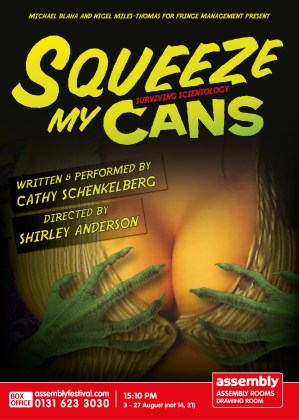
For a long time I have been interested in Scientology. I’ve seen the South Park episodes, Phillip Seymour Hoffman in the Master and the documentaries, visited their Museum of Death and Visitors Center in LA and even wrote a song about them. I have yet to be audited, but I’ve always been a bit paranoid about going that far. Maybe they’re smarter than they appear…? Anyway, one thing I have learned is that it’s a very brave thing going up against them and certainly revealing their secrets. Although I think that after the South Park episode half the world knows their big revelation you used to have to pay a hundred odd grand to reveal. All praise Xenu! Anyway, for that fact alone Cathy Schenkelberg, the protagonist of the show, deserves a lot of credit. And while she doesn’t have any major new insights, she does give us a fairly indepth account of how the cult took a great deal out of her, both personally and financially.
The problems with the show however were the often hammy acting and the fact that it assumed a lot of the audience. In particular of the dense brain washing language used by the Scientologists. As it manically flipped between life and auditing I was often lost in the dense vocabulary of the cult. I respect shows that don’t dumb down for an audience but the vocabulary of Scientology is niche knowledge at best. Even for someone as fascinated by it as I am. Never the less the gist was got and the ever increasing sums of money projected behind her were an effective graphic illustration of how Scientology may in reality be nothing but a marketing scam. Another interesting point made was that the aim of Scientology is to make the Able more Able, which may explain why they do so little for actual charities. Truly a cult of the elite. Anyway, if you have an interest in cults and haven’t seen the Master, the South Park episodes and the documentaries there is much to learn here. Although if you haven’t I’ve only got one question – where have you been the past twenty years?
Review by Steven Vickers
Treasure Trove of Shadows
C Venues
Aug 25-28 (13:50)
Script: Stagecraft:  Performance:
Now this is what its all about, the Fringe. We who live in the misty north of Britain have our fair share of culture through the year, but it is quite piecemeal & nothing too unconventional to our tastes. Then August comes along & a nuclear bomb of immense variety explodes into the city, & one must be rabbit-swift to catch even the minutest portion of the blast. But if one is lucky enough – & also daring enough to step outside the ‘couple of comedians & a play‘ mode of many – then we might just stumble across a show such as a Treasure Trove of Shadows, as I did yesterday.
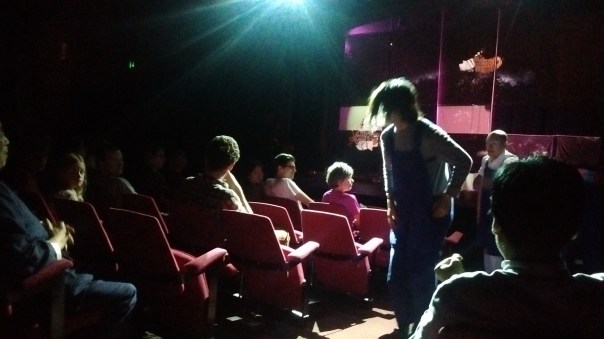
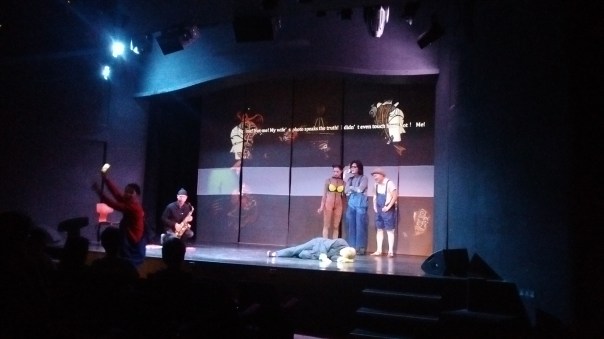
It all begins in Shaanxi, China, the home of the Terracotta Warriors & also the 2,000 year-old folk tradition of shadow puppetry. Alas, as tour manager Wayne Sam admitted to the Mumble, this tradition is ‘dying,’ with the modern generation preferring to be entertained by the vast panoply of electrical means available in 2017. Enter multi-media artist, Feng Jiangzhou, who has decided to create a futuristic version of shadowplay & elevate it to high theatre. Feng told the Mumble, ‘we deliberately avoided focusing on the history, intent & explanation of shadow puppetry. Our aim was to focus more on theatrical expression placing the play into the criticisms of reality.’
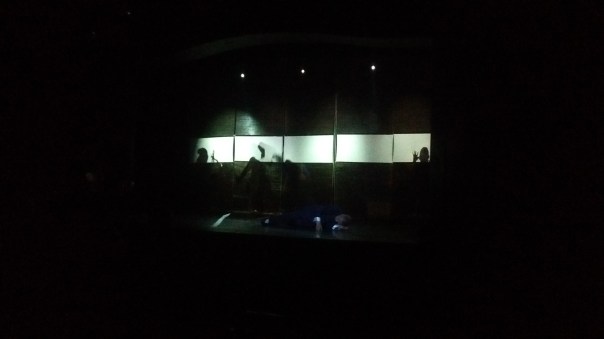
The end result is a bizarre & bold, mish-mash, neoclassical pastiche of Chinese folk stories, played out by a youthful, bright & bubbly cast, while a sophisticated saxophonist accompanies events with some smart sound-art. At all times, behind the proceedings, some simply amazing visual set-pieces are wheeled one-by-one before our eyes. This show is a visual delight, indeed shadowplay for the 21st century, but the story is unfortunately a little difficult to follow – despite the English translation being beamed onto the wall – a literary Wasteland, which even wanders into Macbeth at one point (!?).
However, watching Treasure Trove of Shadows is more of a transcendental experience which shines a time-warping telescope half-way across the world to the villages of China, where Shadow Puppetry once ruled supreme. Then, at the end of the show, the audience is invited onto the stage to witness the art of shadowplay in its purest form, & one hopes that someone in this crowd, or more likely in China, will fall in love with the artform & perpetuate it for posterity.
Reviewer : Damo
Catherine & Anita
Assembly Rooms
Until the 26th (21.05)
Script: Stagecraft: Performance:
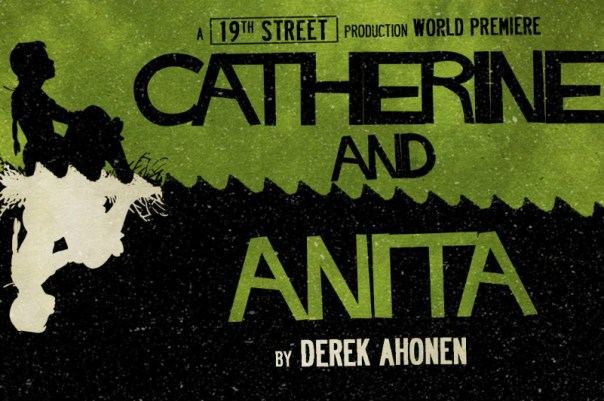
Catherine & Anita is a powerful & flippant piece of theatre. The brainchild of American writer/director Derek Ahonen, he has chosen as his mouth-piece the electric watch that is Sarah Roy, a graduate of the American Academy of Dramatic Arts in New York. Together, they tell the story of Catherine & her invisible friend, an idealised & actualised symptom of her madness, who supports her through both the childhood causes of her madness & the inevitable fall-out in her later, adult life. I don’t want to talk about the story too much, as a prior knowledge to events would deflect somewhat from the intensity of the dramatic interplay between the audience member & Roy’s ruminatingly, chin-strokingly decisive performance. All I can say is that the multi-layered plot peels off like an onion in an exquisitely smooth progress throughout Ahonen’s worldscape.
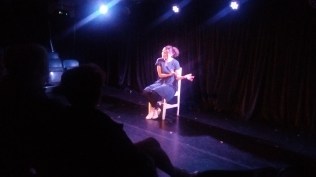
As Roy chitters away through all her angsty girliness, we become almost as one with Catherine, so powerful is the acting. I cannot praise highly enough how bold this play is, when a make-believe best friend becomes a massive, almost tangible presence on the stage – a rare feat which seemed easy putty in the hands of Roy. Indeed, her gothic, slightly deranged, but unquestionably courageous performance was at first unpleasant & a little corrosive to observe, then increasingly superb as the plot levels clothed her & we began to understand what was going on. Both an exploration of insanity & an expose on the darker corners of the world we undoubtedly share, C&A is a fascinating foray into the theatrical demense, & one which should be applauded for both its bravery AND its quality.
Reviewer : Damo
 Mumble Theatre