An Interview with Hippolyte Poirier
 Hello Hippolyte, so where ya from & where ya at, geographically speaking?
I was born and raised in a little village called Gidy near Orléans in France and moved to Hull at the age of 10 – quite a culture shock! After 8 wonderful years in the North East, I moved down to Surrey to study at GSA and have lived in London for two years since graduating. Despite having lived in the UK more than half of my life, I am still very much a proud Frenchman at heart.
What for you makes a good piece of theatre?
I think that there are many factors that contribute to making a quality piece of theatre but ultimately it boils down to the story and the characters. At least one of those things has to have some quality (preferably both!) otherwise there is no hope of getting your audience engaged. It might sound a bit obvious and simple but then again, I’m easily pleased! As an audience member all I’m asking for is to be taken on a journey with the plot and to connect with the characters on an emotional level. It’s also always a bonus when a piece not only provokes emotional reaction but intellectual reflection as well.
As an actor, what are the secrets to a good performance?
One of the most important things for me is to be relaxed on stage so that I allow everything to come naturally. As soon as the nerves kick in and you start thinking about yourself as an actor or what the audience might be thinking, it becomes near impossible to get any truth out of your character as you’re not fully concentrating on them. It’s also crucial to listen to and focus on your fellow actors as they are the people that you are (re)acting to. Acting is a massive team effort and listening is the key.
What does Hippolyte like to do when he’s not being theatrical?
Plenty of things! I love sports, football in particular so I spend most of my time watching or playing it (on FIFA). I’m a Gunner through and through and football is probably the closest thing I have to a religion. I also play various instruments and love a singalong.

You are a member of Junkbox Theatre, can you tell us about the company?
JunkBox was created just under a year ago but they have already achieved an incredible amount. They sold out their first show and have only gone upwards since them. Georgia, Ali and Jack having trained as actors had to learn how to direct and produce on the job and I really admire the fantastic job they’ve done. I’ve been lucky enough to act in all of JunkBox’s shows so far and have enjoyed every single one. I can’t wait to see what they come up with next and as their friend, I am very proud of their deserved success.
Have you ever been to Edinburgh before whether visiting or performing?
I performed two shows at the Fringe in the summer of 2014 and had an amazing experience. I loved the hub of creativity and enthusiasm that is the Mile, saw so much great theatre and met some brilliant people. As there was a lot of flyering involved last time, I am looking forward to exploring the city in between seeing as many shows as possible.
 You will be performing in two plays in Edinburgh this August, can you tell us about them?
“Mine” follows the stories of three young couples and their experiences with planned/unplanned pregnancies. It’s got a great balance of humour, touching moments as well as a couple of scenes to tug at the heart scenes. It touches on subjects that are rarely showcased in theatre and does so in a very honest and accurate way.
“Stiff Dicky” is a very different show and as the title would suggest, is not quite as serious. Two best friends go on a birthday night out with the rest of their group, pick up a friendly Frenchman and wake up the following morning to find a corpse sporting a rather impressive erection in their bed. Hilarity ensues as the group try to work out what to do next. Both shows are a joy to perform in as the characters are contrasting and well written.
What does the rest of 2017 hold in store for Hippolyte Poirier?
When I get back from the Fringe, the first task will be to move in to a new flat as no matter how important acting may seem, housing has to come top of the list. Otherwise, I don’t really have many plans for the rest of the year but I’m looking forward to whatever comes my way.
You can see Hippolyte the August at the Fringe in two different plays
MINE : Aug 5, 8, 10, 12, 14, 16, 18 : Space Triplex (21.15)
STIFF DICKY : Aug 4, 7, 9, 11, 15, 17, 19 : Space Triplex (21.15)
An Interview with Glenn Chandler
 Hello Glenn, so where ya from & where ya at, geographically speaking?
I was born virtually on the slopes of Arthur’s Seat in Edinburgh, so doing the Fringe is very much coming home, with a brisk climb to the top every morning to keep myself sane for the day ahead. I now live in Hertfordshire. Contrary to popular belief, I never lived in Glasgow, and when writing Taggart had to immerse myself in a very different culture. For an Edinburgh public school boy, that was quite terrifying at first!
When did you first find yourself getting into the dramatic arts?
Long before creating Taggart, in a universe far far away, I wrote a number of short plays for two London fringe theatres, but when TV came a-knocking I let it in and a Glasgow detective series was born. While immensely grateful for everything TV did for me, about nine years ago I made the decision to go back into theatre, and not only write but produce – and ultimately direct – my own work. It’s about taking control, taking risks, and doing the things you can’t do on television.
What for you makes a good piece of theatre?
Entertainment value. Showmanship. Imaginative staging. Something that sends me out smiling rather than shaking my head. And if it changes my perception of life and gives me something to think about all the better. I saw a show last year on the Fringe which was an interplanetary adventure through space and time and it was performed with cardboard boxes and an ironing board as a rocket. It was brilliant. I love that sort of stuff.
When did you first realise you could write for the stage?
It was an extremely hot summer in London (1976) and I had a dull office job on Piccadilly. One day I got chatting to the boy who operated the photocopier (they were huge machines in those days). It turned out he worked as a rent boy on his lunch hour and he told me a few stories about his experiences. I wrote a play about him and his mates and it was put on at the Little Theatre in St Martin’s Lane, which is now Stringfellows. He came along and loved it, and I realised I loved writing for the stage. I often wonder what happened to him.
You are a prolific writer for stage & screen, but what does Glenn Chandler like to do when he’s not being theatrical?
I love walking and hill-climbing. My partner and I used to spend two weeks every year in the Highlands with a tent, camping rough, but the midges sadly had a policy of non-cooperation. I enjoy astronomy – I have a ten inch reflector at home. Family history is another great passion, I have traced my Chandlers back to 1575 in the New Forest where they were yeoman farmers. My favourite discovery was that my grandfather was a bigamist, a fact I’m very grateful for. If he hadn’t abandoned his first wife in London and come to Edinburgh where he met my grandmother, I would never have been born and would not be writing this.
Can you tell us about the transition from being a writer to being a producer?
It was a baptism of fire. In 2008 I produced my first two shows in Edinburgh, one of which was my own Boys of the Empire. It was a sell-out. However, somebody forgot to tell me that as a producer you have to put up/find/steal/borrow the money. You also have to look after actors, soothe their egos, deal with hundreds of little problems that come up daily, like the young actor who was constipated for two weeks, went to the doctor and got an emergency quick-acting laxative. He was performing two shows each day. I went out and bought the nappies. Luckily, his relief came between shows, but it was nerve-racking for a while. You think being a producer is glamorous?
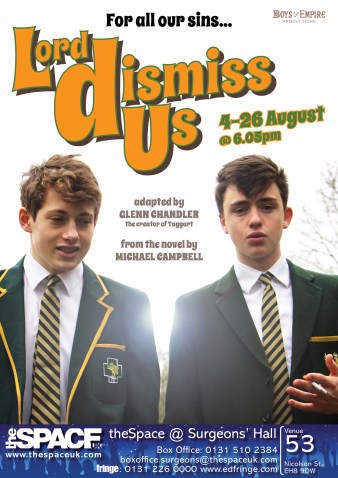
You will be bringing Michael Campbell’s novel, Lord Dismiss Us, to life this August, can you tell us about the novel & the play?
I read the novel as a teenager (under the bedclothes) and it made a great impression on me. Although I wasn’t aware of it at the time, it was a coming-out novel, all the more remarkable for the fact it was written in 1967. As a gay teenager, who had gone through school and experienced some of the same emotions, I lapped up every page. The play is the very first adaptation. I have had to cut some characters and combine others for reasons of time and economy, but the main protagonists are there and though I have had to tweak the story a bit I hope and believe I’ve stayed faithful to the spirit of the novel.
Do you feel a connection with Michael Campbell in any way?
Quite definitely. He went to St Columba’s School in Dublin, which was his model for the sexually repressive Weatherhill School in the novel. It is said that the suicide of a master there was the inspiration for one of the characters. He lived for many years with his male lover, a publicity director for the firm of Heinemann who were his publishers. When he died, he left the rights to Trinity College, Dublin, from where I bought the rights to adapt the novel for the Edinburgh Fringe. I’d love to have met him and known more about his boyhood and schooldays, but even if half of Lord Dismiss Us is autobiographical, he was having rather an interesting time. For the period.
What emotive responses do you expect from your audience?
Oh gosh. I want them to laugh. The novel is very, very funny and I hope the play is too. The boys put on a school musical within the play which involves dressing up as girls, and there’s a passionate snog which raises the ire of the headmaster who tries to stop the show. The result is mayhem. But it’s a tragedy as well, and in the year that it’s set – 1967 – Parliament partially decriminalised the law on homosexuality. Nevertheless, Terry, the hero of the novel, leaves school and will be a criminal until he is 21. I want people to realise what life was like fifty years ago, to see how far we have come in half a century. There are some powerful emotional storylines involving two boys in love, a master wrestling with his sexuality, treachery and betrayal. Yup, I suppose I’m going for every emotion I can get.
What does the rest of 2017 hold in store for Glenn Chandler?
I want to climb a Scottish mountain. Desperately! A stiff breeze and no midges and a bottle of Islay malt. Then think about what happens to Lord Dismiss Us. I have plans, but nothing cast in concrete yet.
An Interview with Matthew Zajac
 What for you makes a good piece of theatre?
Brilliant acting, a strong script which is unafraid to tackle the most challenging subjects, great theatrical ambition and synthesis of theatre disciplines and an absence of anything superfluous. Everything which is on stage must be there for a reason.
What does Matthew Zajac like to do when he’s not being theatrical?
Climb hills, meet my friends and family, read and watch Inverness Caledonian Thistle.
You are a member of Dogstar Theatre can you tell us about the company?
Dogstar has commissioned, produced and toured new plays for 18 years from its base in the Highlands. It has built an international reputation, in spite of surviving for all that time on individual project grants. The company is a dogstar with a bone.
Can you tell us about the transition from being an actor to being an artistic director?
I’ve been running companies for most of my 35 years in this business, so there wasn’t much of a transition. Generating work myself and with colleagues is one of the main reasons I’ve managed to keep going as an actor.

You will be bringing The Sky is Safe to Edinburgh this August, can you tell us about the play?
In 2012 I was stranded in Istanbul for nine days while I waited for an Iranian visa which eventually was refused due to my UK nationality. This was during a period when diplomatic relations had broken down between iran and the UK. I’d been due to go to Iran to play a role in a feature film. I had a couple of interesting encounters on Istanbul’s streets and wrote about them. Last year I was pondering a new project for Dogstar and remembered the Istanbul experience. I learned that there were now around 350,000 Syrian refugees in the city and I decided to try to marry my earlier experience with that of Syrian women trying to make a life in the city. In March this year, I returned to istanbul and, with the help of a local NGO, I had the great privilege of meeting and interviewing a number of Syrian women in their homes. A lot of what Amal, the female character in The Sky Is Safe comes from these interviews. She is essentially an everywoman, a composite character who embodies aspects of the female experience of the Syrian war. The play is a two-hander, and I’ll be playing Gordon, a Scottish executive on a work assignment in Istanbul. His business has some bearing on the war, so he represents aspects of the West’s relationship to Syria and the greater Middle East. We are lucky to have a wonderful creative team on this show – Director Ben Harrison, who worked with me on The Tailor of Inverness and Factor 9, Composer Pippa Murphy, Video Designer Tim Reid, Costume Designer Ali Maclaurin, Choreographer Dawn Hartley and Lighting Designer John Wilkie. The Set Designer is Nihad Al Turk, a highly respected Syrian visual artist who came with his family to Scotland from a refugee camp in Lebanon 16 months ago. Our main publicity image is one of Nihad’s paintings.
In one sentence can you describe the experience of performing in Edinburgh in August?An exhausting and exhilirating whirlwind full of highs and sometimes lows.
What does the rest of 2017 hold in store for Matthew Zajac?
Resting, hoping for a successful outcome to Dogstar’s fourth attempt to get Regular (core) funding and for some interesting acting work where someone else is doing the producing etc., getting out into the hills, supporting ICT’s efforts to bounce straight back into the Premier League and writing.
Matthew will be bringing The Sky is Safe to the Edinburgh Fringe
Aug 2-27 : Summerhall (19.45)
An Interview with Reese Thompson
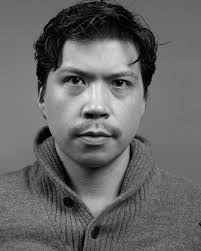 Hi Reese, so where ya from & where ya at, Geographically speaking?
I grew up in Queens, New York. Currently I’m living in downtown Brooklyn. Lots of hipsters with strollers and prams. There’s always a new artisan cafe or gym about to open.
When did you first realise you could write for the stage?
When I saw people in the audience laugh instead of fall asleep. It took a long time to get there though. Also, when people walk out because they’re offended. Obviously, I’d rather people stick around and like the play. What I tell myself is that it’s preferable to total indifference. I hope I’m not being delusional.
Which playwrights have inspired you?
Chekhov, August Wilson, Caryl Churchill, George Bernard Shaw, Joe Orton, Ibsen. Not the most original list, but each is like their own planet. I can keep returning and never stop finding reasons to love and be fascinated. I also love Simon Stephens, Brian Friel, Paula Vogel, Chris Shinn, Young Jean Lee, Tarell Alvin McCraney, Suzan Lori-Parks. All for different reasons. I’m also inspired by people like Pina Bausch, Ariane Mnouchkine, David Lynch. I could go on. A strong cup of coffee can be very inspiring also. Also, I’m someone who’s in a constant state of excitement over some writer I’m either discovering or re-discovering. Right now I’m obsessing over the Brontë sisters. If I had to choose, I think Emily would be my favorite.
What does Reese Thompson like to do when he’s not being theatrical?
Watch cat videos on youtube, hang out in bars with friends, try not to feel depressed about the world, obsess. I’m kind of boring.
You have poetry in your blood, does this transfer into your writing for the stage?
The short answer is yes. I’m still discovering how, so maybe I’ll have a better answer in a year. Also, I was never a good poet. Poetry is so hard. It seems easy because anyone can do, but it’s also hard to be really good at it. What I can say is that years of trying to be good at it has had an influence on how I write. I think poets craft their writing in a very particular way. I also think it trains your ear. So my obsession with rhythm and syllables and word choice are things that have been hammered into me. Even writing a joke requires attention to craft that I don’t think I would have without poetry.
Have you ever been to Edinburgh before whether visiting or performing?
I haven’t. This is my first time! I’m very excited!
 You have written the rather interestingly titled ‘Whore, A Kid’s Play’ which is coming to Edinburgh this August. Can you tell us about the play?
It’s definitely a title I have to earn. The play is about friendship and all the ways we become the person we end up being. With the play (and the title), I was trying to capture a time during adolescence when we’re never more innocent and vulgar at the same time. As an adult, someone can call me a fag, a whore, or a chink, and (if there’s no threat of violence) it doesn’t bother me because I know who I am and whether what they’re saying is true or not. But when you’re a kid, you don’t know yourself as much, so being called names can be a bit more scarring. Also, when you’re a kid, everything is so high-stakes. At some point it all amounts to wanting to be a juvenile delinquent of some sort. Why is that?
What does the rest of 2017 hold in store for Reese Thompson?
I wish I knew what I was doing this afternoon. Probably more writing.
Reese will be bring his creation to the Edinburgh Fringe this August
Aug 4-26 : Greenside @ Infirmary (16.05)
An Interview with Joy Donze

Hi Joy, so where ya from & where ya at, Geographically speaking?
I grew up in middle America in a small town called Perryville, located an hour and a half outside St. Louis. In other words, I’m from the heartland of America. The corn and the cows and the caves. 🙂 I’ve lived in New York City for the last 8 years.
When did you first find yourself getting into the dramatic arts?
I came out of the womb “hamming” it up. I started taking piano and dance when I was 6. Took my first acting class in middle school. I did drama and choir all through high school. I got my BFA from Avila University in Kansas City, and MFA from The New School for Drama in New York City.
What does Joy Donze like to do when she’s not being theatrical?
Wait, there is life outside of theatre? I like to produce. Something I’ve learned about myself is I love to watch things come together. I like introducing artists to one another and fostering community. I am, also, a professional karaoke host. I host parties in then Brooklyn NY nite life scene. I am, also, a teaching artist. I love working with kids. I mostly facilitate drama club, social awareness, mindfulness, and leadership.
Have you ever been to Edinburgh before whether visiting or performing?
Nope! I’ve always dreamed of going to this festival! I traveled around Europe a ton, but I have never been to Scotland!
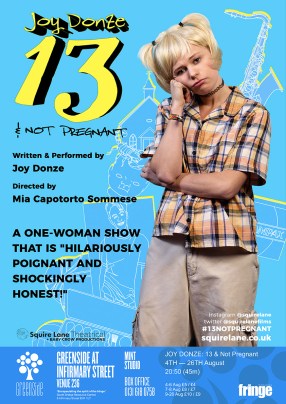
You are bringing your ’13 & not Pregnant’ to Edinburgh this August. Can you tell us about the play?
“13 & Not Pregnant” is a one woman show that features verbatim journal entries from my 6th grade diary. I always knew I wanted to turn my diary into a theatrical piece, and began working on it in a solo performance class in 2015. I’ve performed it in New York and Chicago and both times it was well received. Not only by my friends who love to laugh at my ridiculousness, but also folks who have never met me. It’s enjoyable for anyone over the age of 13… Anyone whose been through puberty. Thankfully, I, also, wrote down popular song lyrics from my youth, and did some self deprecating poetry… So no fear – there will be dance breaks.
How have you found working with Director, Mia Capotorto Sommese?
Mia and I met in graduate school and worked together on an Ionesco piece called “The Lesson.” When I first read the play I thought…. What?! But Mia is so brilliant, and it ended up being one of my favorite theatrical experiences. It was a challenge, but she is a great storyteller and dramaturge. I knew she would let me approach my show the way I envisioned and give me freedom, while still helping me shape, stage, and specify the piece.
What for you makes a good piece of theatre?
Stories worth telling and a strong need to tell them. If the story isn’t important to you – why would it be important to anyone else. I am drawn to new narratives that need telling. I’ve been focusing my artistic endeavors towards social and political theatre that pushes the boundaries and steps outside tradition.
What does the rest of 2017 hold in store for Joy Donze?
Hmmm, well…. I’m not sure at the moment. Let me get through August and I’ll get back to ya! 🙂
Joy will be bringing her play to Edinburgh this Fringe
Aug 4-26 : Greenside @ Infirmary (20.50)
Pride & Prejudice
Thirlestane Castle
Lauder
18th June 2017
Script:  Stagecraft:
  Performance:
It was with great excitement & also slight trepidation that I drove to Lauder with my two daughters – aged 8 & 10 – to see Chapterhouse’s al fresco version of the seminal classic of Regency literature, Jane Austen’s Pride & Prejudice. Adapted for the stage by Chapterhouse’ in-house penswoman, Laura Turner, in a recent interview with The Mumble she elucidated on working with such a sacred text; ‘there’s definitely a lot of pressure working with stories that everyone knows and people feel so passionately about. I feel a responsibility to the author themselves, to reflect their work as they might have intended, and also to the audience who will be looking forward to seeing their favourite bits come to life! As with any adaptation, you inevitably have to leave things out but I hope that in doing so I still capture the overall feel and heart of the story. It’s never easy to make these decisions but the external factors of time constraints and the amount of actors I have to play with forces my hand, but I never make these cuts or changes without real consideration of whether it feels right. Hopefully it enhances the storytelling by making the production streamlined. I’d hate for an audience to get bored!’
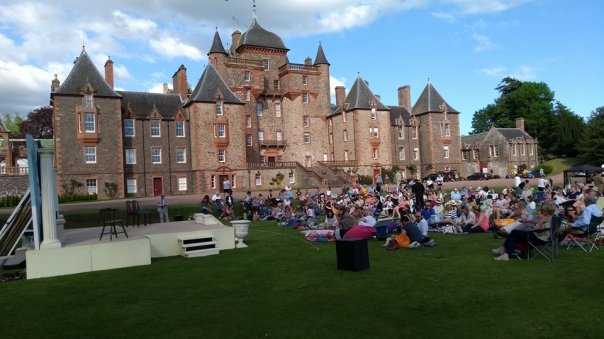
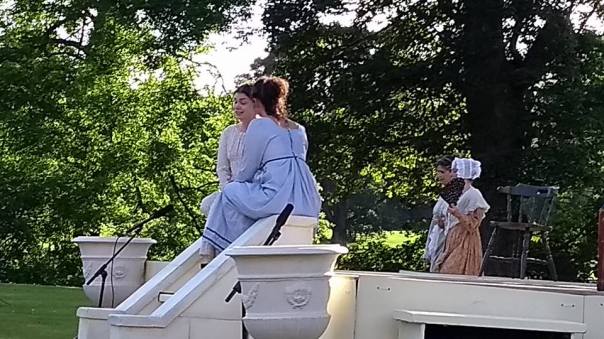
Amidst a beautiful blast of greenery overlooking sheepfields, perched in front of the glorious Thirlestane Castle with picnic baskets & pimms, P&P is played out before us across a simple, static Georgian set. Twyx silly sisters & dashing gents, the formalities of Regency romance are bounced to & fro between Lizzie & her Darcy, all egged on to a merry nuptial conclusion by Lizzie’s gold-grabbing mother. The music is beautiful, the dancing is sweet & the overall time-travelling effect is quite authentic. I was part of a happy audience, a mix of all ages, enjoying the ideal setting – golden sun bouncing off green fields – as much as the story, whose complexities almost actively encourage one’s mind to meander up into the cyan skies.
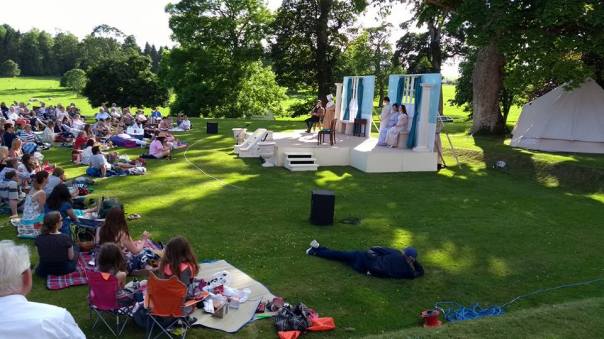
As sounds of bleeting sheep competed with the pop of champagne corks, the High English of the actors was delivered throughout a charming & at times extremely compelling performance. The whole thing pointed to what it would have been like to have witnessed the Elizabethan court being entertained as it made its way round the stately lords of England, such as at Kenilworth in 1577. Both my daughters loved being there for separate reasons. My younger enjoyed the adventure park more, but at the half-time interval – as the raffle was rumbling away – I enquired as to my daughters’ joint enthusiasm for staying. ‘Damn right we are,’ said the eldest & raced back to her seat to continue laughing aloud at lines such as, ‘I find you endlessly appealing even against my will.’ Meanwhile, the young mothers to our our left were chirping, ‘isn’t this just the picture of civilization – sangria & strawberries at the castle,’ & I could not have been more cordial in agreement.
Reviewer : Emily Beeson Bullen

The Lyceum welcomes 70,000 Rooftop-Residing Bees

The Royal Lyceum Theatre Edinburgh is delighted to welcome 70,000 new permanent residents to the theatre; two hives of bees, now housed on the theatre’s rooftop. Having arrived in June, the bees are part of the theatre’s comprehensive green initiative, and public are invited to adopt a bee or sponsor a whole hive, with all funds raised going towards making The Lyceum more environmentally sustainable.
Within the next five years, The Lyceum aims to replace the diesel-ran company vehicle with an electric one, install LED lights throughout the Front of House areas, and replace the theatre’s ageing boiler system in favour of a more efficient system that will significantly reduce carbon impact, with all bee donations going exclusively towards these goals. Green initiatives such as these will help lessen the theatre’s impact on the environment, allowing existing limited financial resources to be directed towards artistic programming and vital outreach work in the community and with young people.
Ben Twist, Director of Creative Carbon Scotland, said: “We are thrilled that The Lyceum, a leading member of the Green Arts Initiative, is taking this wonderful step. This is exactly the kind of inventive and engaging project that we have learned to expect from Scotland’s cultural organisations. Environmental sustainability projects often seem difficult to pay for, and The Lyceum’s creative thinking shows how it can be done. I believe that The Lyceum will soon be just the first of many arts organisations in the country to fundraise specifically to improve their environmental sustainability.”
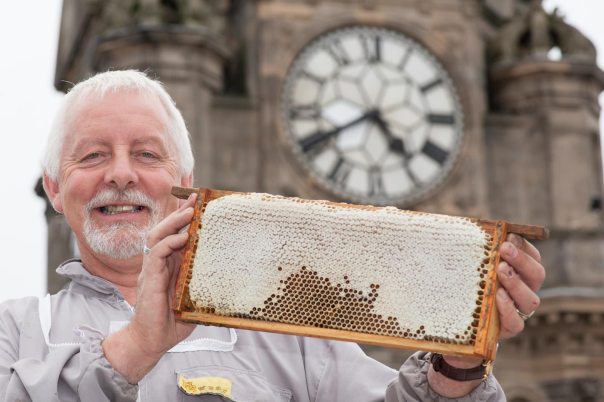
Brian Pool
Looking after the theatre’s beloved bees is Scottish-Honey’s Brian Pool, a third-generation professional beekeeper with 40 years of experience.
Speaking of The Lyceum’s new residents, Brian said: “The Lyceum’s roof is now home to 70,000 bees who have settled in very nicely – you wouldn’t even know they were there. With access to Princes Street Gardens and the Meadows to collect nectar and pollen, we’re looking forward to collecting some delicious Lyceum Honey.
The Lyceum is the first theatre I’ve worked with and joins other Edinburgh institutions like The Balmoral, St Andrew’s House, and Royal Botanic Gardens to host my beehives.”
Individual bees can be adopted for £1, and Dine, Edinburgh’s contemporary brasserie located near the theatre, are the first to sponsor a hive for £500. As thanks, The Lyceum hopes to provide honey harvested from the roof, for use in the restaurant.
An Interview with Christel Bartelse
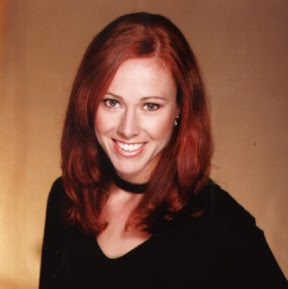 Hello Christel, so where ya from & where ya at, Geographically speaking?
I’m from Toronto, Canada. I was born and raised in a smaller city, Kitchener, but no one really knows where that is, and I’ve lived in Toronto for 19 years, it’s home. My entire family, apart from my parents who moved here 40 years ago, is from Holland and they all live overseas. I’m married to a Welshman so all of his family will be travelling to see me in Edinburgh.
When did you first find yourself getting into the dramatic arts?
I was always a silly, creative kid growing up. I was always putting on voices, costumes, and playing characters for my older brother and for the neighbours. I loved putting on little skits in the basement. As I was growing up, I was in competitive dance (jazz, tap, ballet) and loved the stage. I wanted to act, but dancing was my life. In high school I started taking drama and loved it. And then at 19, realized I wasn’t going to be a professional dancer. My body ached and I was never super flexible so I pursued acting. In theatre school, I loved Shakespeare and the dramatics, but one Improv class in, I discovered my love of comedy and improvisation. A friend of mine and I formed a successful female sketch duo (The Burnt Marshmallows) and pursued that for 6 years, and then she moved away to Vancouver and I decided it was time to go solo, creating one woman shows.
What for you makes a good piece of theatre?
A good piece of theatre is a great story. It has to keep me interested and captivated, I want to think about it when I leave. I want it to challenge me and provoke me. I love theatre that is beautifully staged and entertaining. An extra bonus is when it’s visually stunning. But I have also seen exceptional storytelling done on a bare stage. A captivating performer makes great theatre.
What does Christel Bartelse like to do when she’s not being theatrical?
It’s rare I turn it off;) When I’m not being theatrical I love hanging out with friends in good restaurants and pubs. Yoga, a lot of yoga, keeps me sane, I enjoy hanging with my husband, cycling, just being in the outdoors. In the Winter, when we don’t leave the house, I love catching up on films and Netflix.
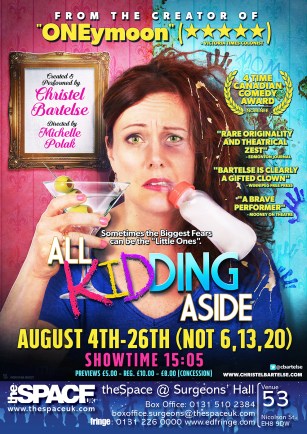
You will be bringing All KIDding Aside to Edinburgh this August, can you tell us about the play?
All KIDding Aside is a comically honest exploration of my fears and hesitations around being a 30-something year-old woman wanting to hit the snooze button on my biological clock as it starts to tick…… It’s now decision time. This quintessential double bind faced by womankind sets the stage for an epic, hilarious “what if” battle of Parenthood v Career. My show takes place in a doctor’s office as I await my test results. My period is late. Am I pregnant? Or not pregnant? Riddled with indecision and anxiety, my show explores the pros and cons of having a baby and all of my fears surrounding it. This show is quite physical and I use a giant baby head mask to help tell the story.
How does it connect to your successful Oneymoon, are there emerging & continuous themes?
ONEymoon was about a woman who marries herself. After touring that show for years, I actually got married (to someone else, not myself!) All KIDding Aside is about the fear of having babies, but so far no babies… But I always create my shows based on strong themes going on in my life, so there are parallels in the way I created both shows. But in ONEymoon I play a heightened version of myself, playing my alter ego Caroline Bierman. Whereas in All KIDding Aside, it truly is my story. I’m being very honest and vulnerable and not hiding behind a character. But both of them have my quirky sense of humour. And they are both about “the self” and life choices.
What is the difference between a Canadian audience & a Fringe audience?
The difference between a Canadian and Edinburgh Fringe audiences is that some Canadian audiences actually know who I am. Ha. Where as in Edinburgh, I’m a total nobody. But overall, the big difference between the Canadian Fringes and Edinburgh is that there isn’t much opportunity on the Canadian Circuit. Its rare big producers are coming out to see shows. You can’t really climb the ladder. It’s more about the quality of the art you produce and there is an ability to make a lot of money. But the biggest gain is really just wowing an audience, city to city. But that’s all you get, because there is no “next step”. Edinburgh at least provides more opportunity. There are people seeking out the “next show”. It’s no guarantee anything will happened, but it could. Also, for me I have to change some references in my show for UK audiences. Shoppers Drug Mart in one of our top pharmacy chains in Canada, but when I discuss this in my show, I now have to change it to Boots or another Chemist. Otherwise no one will know what I’m talking about.
What emotive responses do you expect from your audience?
I hope audiences feel joy after seeing my show, but also I’m okay if they feel confused, in perhaps their own life choices. They’re may also be some mild anger, or disbelief in one little sequence where I do try and surprise the audience. You basically get a wide range of emotions. It’s a trip.
In one sentence can you describe the experience of performing in Edinburgh in August?
The most intense month of my life, one filled with over one hundred emotions, and that’s just what I feel in one day.
What will Christel Bartelse be doing after the Fringe?
I’m sure after the Fringe I’ll be sleeping. There won’t be much of that in August. But after some rest, I return to teaching in the Fall at Humber College and jumping into a new show that I’ll be creating. Essentially getting ready for and prepping the next tour
BARTELSE WILL BE PERFORMING HER SHOW
JUST KIDDING ASIDE
Aug 4-26 : theSpace @ Surgeons Hall (15.05)
An Interview with Samson Hawkins
 Hello Samson, so where ya from & where ya at, Geographically speaking?
I’m from a hamlet called Crowfield in South Northamptonshire, it’s near Silverstone race track, proper farmer country. But now I live on a canal boat in Southall aka Little India in West London.
When did you first find yourself getting into the dramatic arts?
I’m dyslexic and couldn’t read a word while the rest of my age group were smashing through Harry Potter. My mum sent me to Youth Theatre because my sister had so many hobbies that she was great at and I didn’t really have anything apart from being rubbish at football. But once I got to Youth theatre I loved it, I could be gangsters with guns that fire custard pies, victorian pick pockets or a prince of an ice kingdom, It was nuts. My mum’s plan worked though, I had to learn to read otherwise I had no idea what I had to say. It was all a ruse on her part, but I guess I’m not illiterate anymore, so well done to mum.
What for you makes a good piece of theatre
Something I haven’t seen before. When a production stays in your mind for days or weeks, or in a few cases, (Earthquakes in London) years. A production that could fail, but doesn’t. I like theatre that remembers it is story telling, and then tries to tell the story in the most interesting way possible.
When did you first realise you could write for the stage
I wasn’t a very good student at school. I was a solid C student. But the teachers always said they wish they could give my essays better marks because they where fun to read. Mr Hughs knew I was never going to get very good marks, so when my Essay on Gladstone and Disraeli took the form of a rap battle, he didn’t have a go at me, he just said it was the best F he has ever given. I started writing sketches for youtube, and once I got to East 15 they started becoming more like scenes. I was a part of Greyscales Play Development Project, where I was completely out of my depth, but Selma Dimitrijvic was inspirational and really focussed me on what theatre can be. I wrote my first play ‘Death is Wasted on the Old’ which was performed as part of Scribble at The Avondale Theatre, someone complained about its blasphemous content, it’s all right, Jesus is quite forgiving apparently.
What does Samson Hawkins like to do when he’s not being theatrical?
Making money and fucking bitches. No I’m poor and have a long term girlfriend so none of those things happen. I’m really boring these days, I’m either watching theatre, or making it, or doing admin work for plays. I do play football manager to a really high level, and I’m a connoisseur of new varieties of Kit Kats and Snickers bars.
Can you tell us about your baby, Second Sons?
My third-year housemates formed the company in out 3rd year of Italia Conti to make ‘Theatre for people who don’t like theatre’. We have had a bit of success since we started, to the surprise of everyone involved really. We run a new writing night ‘Playtime’ which has sold out Theatre N16 and The Bunker, Swan Bake got nominated for a Brighton Fringe award and our production of Dark Vanilla Jungle, by Philip Ridley got great reviews and is now being co-produced by 53two in Manchester as part of the Manchester Fringe. We take a jump off the cliff and learn to fly on your way down, and it’s working.
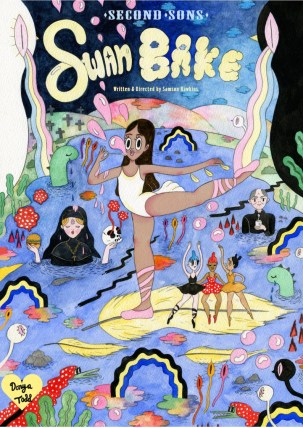
You will be bringing Swan Bake to Edinburgh this August, can you tell us about the play?
It’s a comedy play which uses puppetry and dance to tell the story of a drug-addicted ballerina and her relationship with a nun. It started as my dissertation project and I’ve been working on it since. I’ve always wanted to take it to Edinburgh as it just feels so much an ‘Edinburgh Show’. It doesn’t fit very well into conventional genres and it’s all the better for it. It’s a really fun show that looks at the experience of drug addiction in a new way.
How much of you is on the play?
I used to take quite a lot drugs. And I wrote the play as I wanted to stop, but didn’t really know how. There is a point when you are trying to give up when you just realise how hard being high is sometimes. I saw one of my teachers in Tesco but I was hallucinating at the time and it was really hard not to just slap him in the face and run away. He runs a venue now though, so I’m really glad I didn’t. It’s kind of about my experience at drama school, Bell, the main character, has spent her entire life wanting to be a ballet dancer, but is now told she isn’t good enough, that was kind of me with acting at Conti. The characters are all archetypes, big bold exaggerations of what they are in real life.
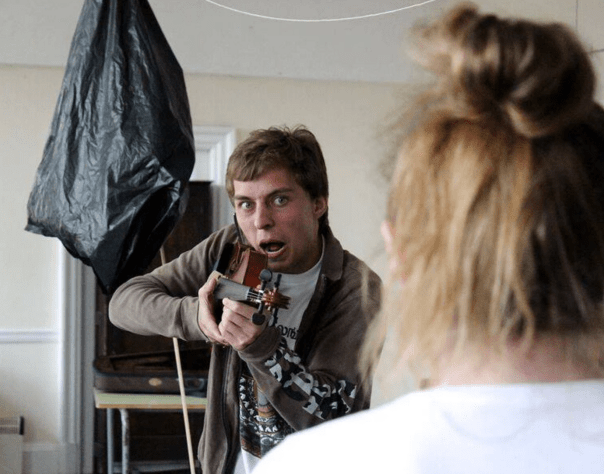
How did audiences respond when it was performed in Brighton?
Before Brighton, we had only done the show in front of people we knew, and obviously people you know laugh at anything. So I was worried, but when we took it to Brighton, in front of new audiences, it excelled. People actually took the script in and we got a lot more laughs for the punch lines and not just at bits like the guy in a gimp suit tap dancing. People still laughed at that as well, because everyone loves a tap dance. The new audiences also appreciated the moments of pathos a bit more. Doing a play about lost hope in front of people full of hope isn’t always great, when Swan Bake finds it’s real target market, the outsiders, the loners, the people just about clinging on, it’s wonderful. We also got some proper blokes in who loved it. Don’t really know why, but now I kind of want to make ‘theatre for proper blokes’, I’d give out John Smiths and in the interval have a meat raffle.
In one sentence can you describe the experience of performing in Edinburgh in August?
Stress, stress and more stress, after that it’s magic.
What will you be doing after the Fringe?
I would like Swan Bake to have a London run, hopefully, something will come from Edinburgh. I may be doing a MA in Theatre Directing because as much as I like to pretend otherwise I actually take this quite seriously. I’m looking for a home for a play I’ve written called Olympic Fencing, after Swan Bake that’s my next focus. I’m also trying to set up a comedy wrestling federation but that’s a story for another time.
Samson will be bringing his Swan Bake to Edinburgh
Aug 2-28 : C Venues (14.40)
An Interview with Steve Attridge
 Hello Steve, so where ya from & where ya at, Geographically speaking?
I’m a Londoner. My Dad was a blacksmith in the East End and my Mum worked in an eel and pie shop. I’ve lived in Warwickshire for over 20 years now but I also have a place in Spain where I go to work – no Internet, no TV, no landline. A study and laptop. Mountains. Sea. Wine. Brilliant.
You are an internationally renowned writer, but when did you first realise you could do it?
I always wanted to be a writer. It was an imperative. I would have done it even if I’d had no success. Getting my first things published and broadcast made me realise I could entertain an audience, whether one reader or a bunch of people watching a play or film or TV. In the late 1980’s and early 1990s I suddenly hit a rich vein in terms of getting work.
When did you first find yourself getting into the dramatic arts?
I think when I started lying to get out of trouble. The power of imaginatively reawakening the world. Also as a kid when I realised that if I could entertain people by making them laugh or gain their interest and curiosity, then they would be less likely to beat me up. I think life is theatre anyway, it’s just when you try to do something for the stage you must heighten and distort and cut out the boring bits. I think most people do that in their heads anyway – we’re all the central character in our little dramas.
Theatre is not the only string to your bow, you are quite the polymath: what else interests you in the artistic spheres?
Everything connects really. For example, if you write reasonable poetry it makes you a better writer of dialogue. I worked as a performance poet and still write the odd poem. I’ve written a lot of film scripts and been lucky in that some of them have been made. I’ve had about 100 TV scripts broadcast. I play guitar and have written a couple of musical plays. And I love the solitude of writing books – had 20 published so far. Good writing can be an eclectic animal and go on diverse journeys.
What does Steve Attridge like to do away from writing & performing?
Passionate about playing tennis. I used to love football too but got my nose, my leg and my arm broken and realised it was time to stop as I was running out of bits of me to break. I like gardening, music, walking. Watching animals and birds.
What for you makes a good piece of theatre?
Not boring the audience. Keep it moving. Keep it lively. Throw in a few surprises. Make it jump. So many plays are too long and pleased with themselves.
You will be bringing Dick in Space to Edinburgh this August, can you tell us about the play?
It’s a seriously bonkers piece of comic theatre about an intergalactic film noir detective hunting a murderer through space. Dick Spacey, the main character, has multiple selves and cannot always distinguish between himself and others and has bizarre and powerful relationships with inanimate objects and invisible presences. It’s psychologically a bit surreal and bizarrely physical in terms of language and action. Someone said the character is like Tom Waits on amphetamines. A lot of jokes and one liners but also connecting plot lines. It’s an unusual piece.

There seems to be quite a mish-mash of contents & styles – what holds it all together?
A strong central character, running jokes, a sense of a personality and world falling apart in surprising and entertaining ways. The play creates a little world of its own. There are lots of elements in the pot but it’s all one stew.
In one sentence can you describe the experience of performing in Edinburgh in August
O brave new world, that has such people in ‘t!
What will you be doing after the Fringe?
Sleep. And then I go to Spain to work on a new novel.
What does the rest of 2017 hold in store for Steve Attridge
Just getting up and working. My new novel calls and I have a backlog of work to get out there. I may also learn to become invisible.
Steve Attridge will be performing his ‘Dick in Space’
@ the Cuckoos Nest (venue 106)
3rd-27th August (20.00)
& also 14th and 21st Aug at 3.30 pm in the Counting House Lounge

 Mumble Theatre